


What causes brain fog?
Brain fog is not a diagnosis. It is a description of a cluster: slow thinking, a word that will not come, reading the same paragraph three times, losing the thread mid-sentence. Healthdirect, the Australian Government's health information service, lists its usual causes as not enough sleep, not enough exercise, a diet that does not include all the nutrients you need, stress, menopause and certain medicines, and notes that more than 1 in 4 people will experience brain fog at some stage.
If you are reading this mid-experience, the worry is usually not the fog itself but what it might mean, and the timing: it arrived while you were doing something right. Sleeping less because life is full, eating less because your appetite has changed, or moving through your late forties. Brain fog tends to show up at exactly the moments intake drops, and almost nobody connects the two.
This piece takes each recognised cause in turn, names the primary evidence for it, and ends on the group of causes you can measure with a blood test and a food diary rather than guess at.
Is it sleep?
Start here, because it is the most common cause and the least mysterious. The Victorian Department of Health's Better Health Channel lists difficulty concentrating, trouble remembering things and processing information at a slower pace as direct symptoms of sleep deprivation, and estimates that about one-third of Australians are sleep deprived. The guideline it cites is seven to nine hours a night for adults aged 18 to 64.
Sleep plays a role in memory formation and consolidation, which is why a fortnight of six-hour nights shows up as forgetting rather than as feeling tired. The honest test is a week of logged bedtimes, not a feeling. If the log says under seven hours most nights, the fog has its first suspect, and that suspect does not need a supplement.
Readers who reach this point often ask about magnesium next. What it is and is not shown to do, and the narrow wording the regulator allows, is set out in best magnesium supplement.
Is it stress?
Sustained stress produces a recognisable thinking pattern. The same Better Health Channel names poor concentration, forgetfulness, indecisiveness and apathy among the ways stress changes how we think, alongside the physical response of a raised heart rate, breathing rate and blood pressure.
Stress and sleep also feed each other, which is why they are hard to separate in the moment. A stressed week shortens sleep, and short sleep lowers the threshold at which the next demand feels like too much. If both are true at once, treat them as one cause with two handles, and start with the bedtime.
There is a nutritional edge to stress as well, and it is behavioural rather than biochemical. Stressed weeks are the weeks food becomes an afterthought: skipped breakfasts, a late lunch eaten standing up, dinner replaced by whatever is quickest. The intake side of the fog often starts here, months before anyone thinks of it as a nutrition problem.
Is it perimenopause?
For women in their forties this is the cause most often missed, because the label they reach for is age or stress. Jean Hailes for Women's Health describes what many women report during perimenopause as difficulty concentrating, poor memory, not having the right words, losing your train of thought and slow thought processes.
The measurement behind that description comes from the Study of Women's Health Across the Nation, which followed 2,362 women through the transition. In late perimenopause, processing-speed scores did not improve with repeated testing the way they did at other stages, and verbal memory scores did not rise in early or late perimenopause either (Greendale et al, Neurology, 2009). The same study found improvement rebounded to premenopausal levels after menopause, which is the part worth holding onto: the transition-related difficulty appears to be time-limited.
It rarely arrives alone. Perimenopause also changes sleep, and it moves iron in whichever direction your cycle is sending it, so a woman in her late forties can be carrying three of the causes on this page at once. The full picture is in perimenopause symptoms.
Are you eating enough to think with?
This is the cause people underrate, and the arithmetic is unforgiving. The brain accounts for around 2% of body weight but consumes about 20% of the body's glucose-derived energy, and glucose is its main fuel (Mergenthaler et al, Trends in Neurosciences, 2013). An organ that expensive notices when the supply line thins.
Supply lines thin for ordinary reasons: a deliberate deficit, a run of stressed days, a breakfast habit that quietly lapsed. They also thin because of rapid weight loss, reduced eating and medically induced weight loss. In a controlled trial of free-choice eating, people on a GLP-1 medicine ate roughly a quarter less across a day than on placebo (Blundell et al, 2017). Nothing about that quarter is selective: the iron, the vitamin B12, the protein and the vitamins leave with the calories.
And it lands on a poor baseline. Over 90% of Australian adults do not meet dietary guidelines (AIHW), so for most people a smaller diet is a smaller version of one that was already short. The nutrients that fall first when intake drops are mapped in what happens to your nutrition when you eat less.
The practical test is a food diary, kept honestly for seven days. Not to count anything, but to see whether the meals that carry iron, vitamin B12 and protein are still there, or whether they were the first casualties of a smaller appetite.
More on what changes when calories drop: vitality support when you are eating less.
Iron, vitamin B12 and vitamin D: the three worth testing
These are the nutritional causes with a blood test attached, and the Australian numbers on them are recent.
Iron first, because concentration is written into its symptom list. Healthdirect names struggling to concentrate and remember things alongside fatigue as signs of iron deficiency, and lists menstruating women, pregnancy, breastfeeding and vegetarian or vegan diets as the groups whose needs run highest. The Australian Bureau of Statistics' National Health Measures Survey 2022-24 found 5.6% of women had a serum ferritin level under the WHO cut-off, against 0.9% of men, and 10.5% of women had an abnormally low haemoglobin level.
Vitamin B12 is the nerve and memory nutrient. It helps produce and maintain the myelin around nerve cells and is tied to mental ability, in the Better Health Channel's summary, and it is found almost only in foods of animal origin. The NHS lists problems with memory, understanding and judgement among the symptoms of deficiency, and its causes page names vegan diets without fortified foods, stomach and gut conditions, and some medicines as reasons levels fall. Who runs low and why is covered in vitamin B12 deficiency.
Vitamin D is the quiet one. Healthdirect notes it usually produces no symptoms at all, with tiredness, muscle weakness and mild bone pain the possible exceptions, which is exactly why it goes unnoticed. In the same 2022-24 ABS survey, 20.6% of Australian adults were vitamin D deficient, and the rate was highest, at 29.2%, in people aged 18 to 29.
| Nutrient | What running low can look like | Who tends to run low |
|---|---|---|
| Iron | Fatigue; struggling to concentrate and remember things (Healthdirect) | Menstruating women, pregnancy, breastfeeding, vegetarian and vegan diets (Healthdirect) |
| Vitamin B12 | Problems with memory, understanding and judgement; feeling weak or tired (NHS) | Vegan diets without fortified foods, older adults, some stomach and gut conditions, some medicines (NHS, Better Health Channel) |
| Vitamin D | Often no symptoms; possible tiredness, muscle weakness, mild bone pain (Healthdirect) | People mostly indoors, darker skin, covered for work or cultural reasons, pregnancy and breastfeeding (Healthdirect) |
None of these is a self-diagnosis. All three are a single GP visit, and the value of the visit is that it turns a vague fog into a number that either explains it or rules it out.
Are you drinking enough?
Mild dehydration is a cognitive cause with unusually precise evidence. In healthy young women, a body mass loss of just 1.36% produced lower concentration, headache and a greater perceived difficulty of tasks (Armstrong et al, The Journal of Nutrition, 2012). A review the same year put the threshold at about 2%: being dehydrated by that much impairs performance on tasks needing attention, psychomotor skill and immediate memory (Adan, Journal of the American College of Nutrition, 2012).
Those percentages are small. For a 65 kg woman, 1.36% is under a kilogram of water, which is an ordinary afternoon of forgetting to drink. Healthdirect's guide is around 2.1 to 2.6 litres of fluid a day for adults, and a smaller appetite tends to take fluid with it, because some of each day's water arrives inside food and a reduced appetite eats less of it.
Could it be a medicine?
Some medicines act directly on alertness and some act through nutrition, and both belong on the list. Healthdirect's brain fog page names medicines used around surgery and in cancer treatment as recognised causes. Sedating antihistamines, the older hay fever and sleep-aid type, list drowsiness and problems with coordination as side effects, and Healthdirect notes that even non-sedating ones can make some people sleepy.
The nutritional route is less obvious. Proton pump inhibitors, the common reflux medicines, and metformin can both reduce the amount of vitamin B12 in the body (NHS), which puts a long-term prescription on the same page as the vitamin B12 section above. If you take either and your fog has crept in over months, that is a specific question for your GP, and a vitamin B12 level is a cheap answer.
This section is general information, not medical advice. Decisions about starting, changing or ending any medication belong with your doctor.
Where HLTH+ fits, and where it does not
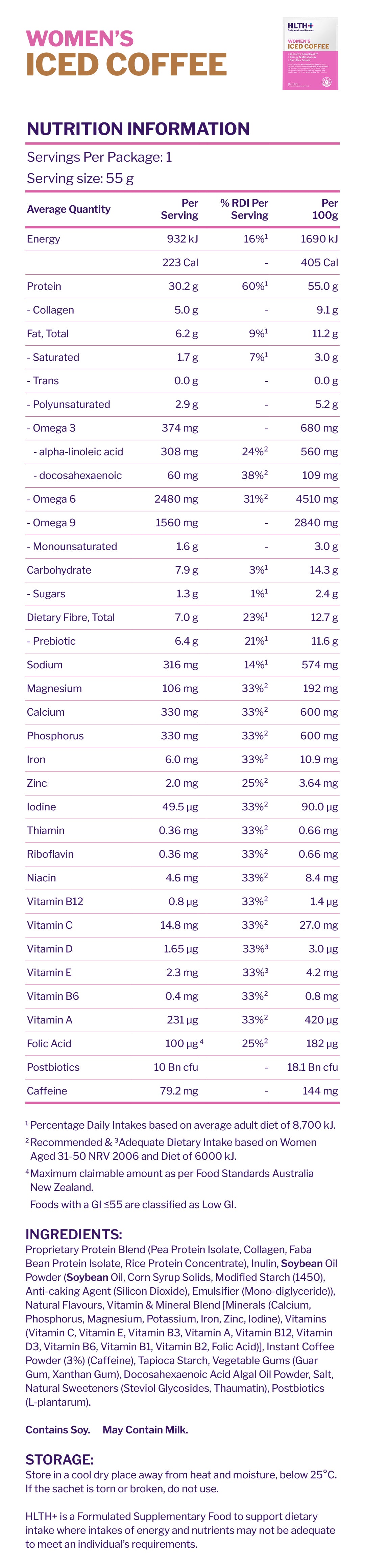
HLTH+ does not act on brain fog, and nothing above should be read as saying it does. It is a daily nutritional formula, a Formulated Supplementary Food under the FSANZ Food Standards Code, made in Australia in facilities complying with Good Manufacturing Practice. Its job is the intake side of the arithmetic in the eating-enough section: when a day's food is carrying less than it used to, a Formulated Supplementary Food supplements the diet.
Each serve, a 55g sachet in the Women's formulas, carries 30g protein per serve, 7g dietary fibre, 60mg DHA and 30 essential daily nutrients, with 5g collagen and 10 billion CFU of Lactobacillus Plantarum Postbiotic in the same sachet. The vitamin and mineral side of the formula is a balanced multivitamin profile. Protein contributes to the maintenance of muscle mass and to tissue building and repair; dietary fibre contributes to regular laxation.
The range is dietitian-formulated by gender and life stage, as Women's, Women's 50+, Men's and Men's 50+, with each formula dosed against the Nutrient Reference Values published by the National Health and Medical Research Council, the Australian Government Department of Health and Ageing and the New Zealand Ministry of Health. Requirements move at 30, at 50 and again at 70, so a formula dosed to one average sits precisely right for nobody.
We believe in a food-first approach, and the AIHW figure above says food alone is not getting most people there. That makes this nutritional insurance underneath a food-first plan, never a substitute for eating well, and never an answer to a symptom. Which micronutrients thin out first when intake drops is set out in the vitamins that fall away when you eat less.
RRP $6.00. On subscription, 28 serves at $142.80 comes to $5.10 a day and 14 serves at $75.60 comes to $5.40 a day, and you can pause, skip or cancel at any time. It is sold at hlthplus.com, through the HLTH+ Amazon AU store and at Chemist Warehouse online.
The quiz is diagnostic, not a sales pitch: it shows what your current supplement routine is leaving out. If that is the question underneath your search, the ✦ Find My Formula quiz takes 30 seconds.
Frequently Asked Questions
What are the most common causes of brain fog?
Short sleep, sustained stress, perimenopause, eating too little, low iron, vitamin B12 or vitamin D, mild dehydration and certain medicines. Healthdirect lists sleep, exercise, an incomplete diet, stress, menopause and medicines as the usual causes, and notes that more than 1 in 4 people experience brain fog at some point. Several usually overlap.
Can not eating enough cause brain fog?
Yes, and it is underrated. The brain is about 2% of body weight but uses around 20% of the body's glucose-derived energy, so it notices a thinner supply early. A diet that shrinks by a quarter, whatever the reason, carries a quarter less iron, vitamin B12, protein and vitamins along with the calories.
Which blood tests are worth asking for if you have brain fog?
Iron studies including ferritin, vitamin B12 and vitamin D are the three with concentration or tiredness on their symptom lists and recent Australian prevalence data behind them. Ask your GP. The 2022-24 ABS National Health Measures Survey found 5.6% of women low in ferritin and 20.6% of adults low in vitamin D.
Does magnesium help brain fog?
No approved claim says so. Under the Australia New Zealand Food Standards Code, magnesium contributes to a reduction of tiredness and fatigue and is necessary for normal nerve and muscle function, and nothing in that wording covers concentration or memory. If broken sleep is driving your fog, sleep is the thing to test first.
Is brain fog in perimenopause permanent?
The evidence says no. In the Study of Women's Health Across the Nation, 2,362 women were followed through the transition; processing speed and verbal memory stalled in late perimenopause, then improvement rebounded to premenopausal levels after menopause. The researchers described the difficulty as likely time-limited. Sleep and iron status often shift at the same time.
This article is general information, not medical advice. Decisions about any medication belong with your doctor.


Leave a comment
This site is protected by hCaptcha and the hCaptcha Privacy Policy and Terms of Service apply.