

The right Sustagen alternative depends on which Sustagen you mean, because the tin on a hospital tray and the tin in the supermarket are different products with different jobs. Sustagen Hospital Formula is clinical nutrition, and if a dietitian or doctor recommended it, any change is their call. Sustagen Everyday is a 15g milk additive that publishes 3g of protein and 8.3g of sugars per serve before the milk goes in (retrieved 8 September 2026), and for that job a daily nutritional formula does more.
Most people asking have a specific reason. The sugar figure surprised them, the protein turned out to come mostly from the milk, or they want the daily habit without a product built for a hospital ward.
This page separates the two Sustagens, sets out what a replacement needs to deliver, and compares the three routes people take instead, using each brand's own published panel.
Which Sustagen are you replacing?
Sustagen publishes six products, and the two that matter here sit at opposite ends of the range. Hospital Formula is a 60g serve mixed with 200mL of water or milk: 225 calories, 13.8g protein and 27g of sugars, with 14 serves to a tin and "27 essential vitamins and minerals" on its own page (retrieved 8 September 2026). Sustagen's own wording is that it "cannot be used as a total diet replacement".
Sustagen Everyday is the supermarket tin, and it is a different kind of product: 15g of powder stirred into 175mL of reduced fat milk, 36 serves to a pack. From the powder alone a serve is 55 calories, 3g protein and 8.3g sugars; with the directed milk it reaches 138 calories, 9.5g protein and 17.6g sugars (retrieved 8 September 2026). The brand describes it as "an everyday nutrition top-up" carrying "14 Vitamins & Minerals".
Neither panel prints a dietary fibre row. Sustagen answers that itself with a separate Hospital Formula Plus Fibre at 4.1g per serve, which clears the 4g "good source" threshold in Schedule 4 of the Australia New Zealand Food Standards Code. The full read of the flagship product is in is Sustagen good for you.
So the honest comparator for a well adult is Everyday, and every figure below says which Sustagen it means.
If Sustagen was recommended by a doctor or dietitian
Keep taking it. Around half of older Australians are malnourished or at risk of it (Dietitians Australia), and clinical nutrition products exist because food alone is not covering that gap for someone who is unwell, recovering, or losing their appetite with age. Hospital Formula's 27g of sugars per serve is calorie density by design for that person, not a formulation mistake.
The alternatives in that category are other medical nutrition products, and the choice between them belongs with the clinician who knows your case. Abbott Ensure Powder is the usual comparison: its Australian page publishes 3.72g protein, 4.68g sugars and 1.01g dietary fibre per 100mL, which is 8.6g of protein across a prepared 230mL serve of 230 calories, and the line "Food for Special Medical Purposes. Use only under medical supervision" (retrieved 8 September 2026).
Nothing on this page is a substitute for a clinically recommended product, and no daily nutrition drink is. This is general information, not medical advice; decisions about a prescribed nutrition product, or about any medication, belong with your doctor or your Accredited Practising Dietitian.
What should a Sustagen alternative actually deliver?
Start with the gap it is meant to close. Over 90% of Australian adults do not meet dietary guidelines on the AIHW poor-diet measure. A well adult is rarely short of calories; what runs short is protein, dietary fibre and diet quality.
Judged against that gap, five criteria decide whether a replacement is an upgrade or a sideways step:
- Protein you can count from the powder. Everyday's panel gives 3g before milk. Under Schedule 4, "good source of protein" needs at least 10g in a serve.
- A dietary fibre row on the panel. Neither Sustagen tin prints one. Good source is 4g a serve; excellent source is 7g.
- Sugar that is either doing a job or not there. The 27g in Hospital Formula is deliberate calorie density. The 17.6g in a glass of Everyday is 8.3g from the powder and the rest from the milk.
- The things a fortified milk drink was never built to carry: live cultures, collagen and an omega-3 dose. Neither Sustagen panel lists any of them.
- Formulated for a person, not for the label. Both Sustagen panels carry the footnote "Percentage daily intakes are based on the average adult diet of 8700 kJ." That figure is a labelling reference value under Standard 1.2.8 of the Food Standards Code, and it sits above what the Nutrient Reference Values recommend for most adults, so a formula built to it over-delivers calories to the individual. The NRVs were published in 2006 by the National Health and Medical Research Council, the Australian Government Department of Health and Ageing and the New Zealand Ministry of Health, and they differ by sex and life stage.
Learn more about what changes in your nutrition when overall intake drops.
The three routes people take instead
Route one: a meal replacement shake. The Lady Shake and The Man Shake are the supermarket-adjacent option, and on paper they answer the protein and fibre criteria. The Lady Shake Vanilla publishes 30.0g protein, 7.1g dietary fibre and 2.3g sugars in a 56g serve at 203 calories, with 168 million CFU of probiotics across four named strains, and the core range now runs to 20 flavours whose sugars span 1.9g to 7.1g (retrieved 8 September 2026). The Man Shake's product page gives 30g protein, 7.5g dietary fibre and 2.4g sugars (retrieved 2 September 2026).
Both contain milk, and both are sold inside a weight-loss program, a different job from a daily top-up. The pharmacy very-low-calorie programs are different again (the Optifast Protein Plus read covers them), and Man Shake alternatives covers the other brand here.
Route two: a plain protein powder. If the reason you bought Sustagen was protein, a dedicated powder does that one job with nothing else in the tub. Nuzest Clean Lean Protein publishes 20g protein in a 25g serve at 102 calories, with 0.2g sugars and 0.3g dietary fibre, a full amino acid profile printed per serve, and no dairy, soy or gluten (retrieved 8 September 2026).
That is 80% protein by weight of powder (20 divided by 25), and the printed amino acid profile is the row to check on any tub; the over-60 buyer's read and the best protein powder for women go through how. The trade is everything else: 0.3g of dietary fibre, one mineral row (iron, 3.6mg), and no live cultures, collagen or DHA on the panel.
Route three: a daily nutritional formula. This is the category HLTH+ sits in. It takes Sustagen Everyday's job, protein and micronutrients in a glass, and carries the rest of the criteria as well. The table shows where, from each label.
How the alternatives compare
Every figure is the brand's own published panel; the Sustagen and Lady Shake columns are their Vanilla versions, and the HLTH+ column is the Women's sachet.
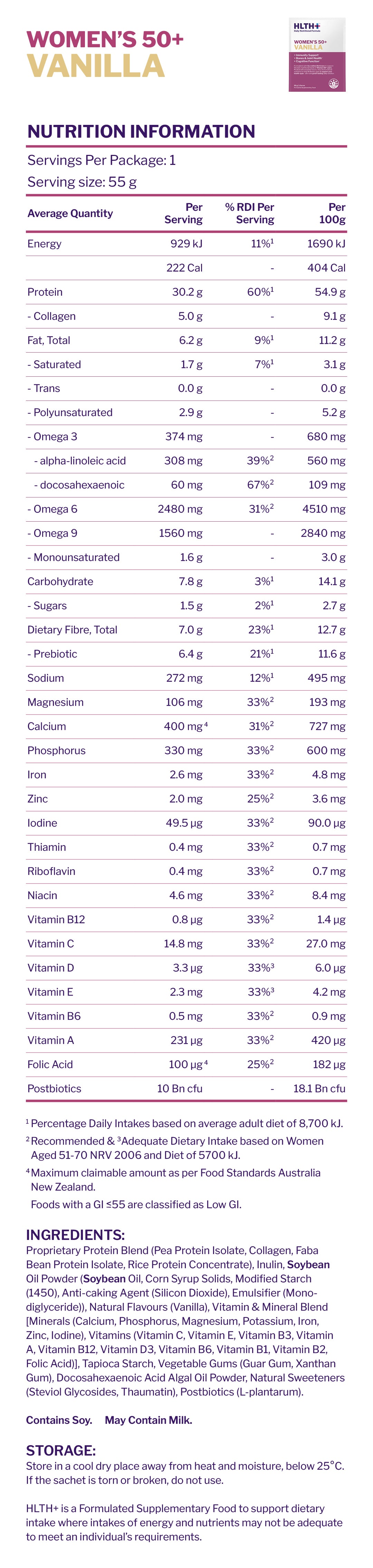
| Per published serve | Sustagen Everyday | The Lady Shake | Nuzest Clean Lean Protein | HLTH+ Women's |
|---|---|---|---|---|
| Serve as published | 15g powder in 175mL reduced fat milk | 56g powder | 25g powder in 350mL water | 55g sachet |
| Calories | 55 from the powder, 138 with the milk | 203 | 102 | 223 |
| Protein | 3g from the powder, 9.5g with the milk | 30.0g | 20g | 30g |
| Dietary fibre | No fibre row on the panel | 7.1g | 0.3g | 7g |
| Sugars | 8.3g from the powder, 17.6g with the milk | 2.3g | 0.2g | 1.5g, none added |
| Live cultures | Not listed | 168 million CFU probiotics, four strains named | Not listed | 10 billion CFU Lactobacillus Plantarum Postbiotic, plus prebiotics |
| Collagen | Not listed | Collagen Peptides in the protein blend, no amount stated | Not listed | 5g |
| Omega-3 | Not listed | Not listed | Not listed | 60mg DHA |
| Vitamins and minerals | Vitamins A, B group, C and E, plus calcium, iron, zinc, phosphorus and potassium on the panel; the brand claims "14 Vitamins & Minerals" | Vitamins A, B group, C, D and E, plus calcium, iodine, iron, magnesium, phosphorus, zinc and potassium on the panel | Iron, 3.6mg; no other vitamin or mineral row | A balanced multivitamin profile |
| Formulated for | One formulation, two flavours | One formulation across 20 flavours, figures vary by flavour | One formulation, six flavours | Women's, Women's 50+, Men's and Men's 50+, formulated by Accredited Dietitians to the Nutrient Reference Values (National Health and Medical Research Council, Australian Government Department of Health and Ageing, New Zealand Ministry of Health) |
| Dairy | Mixed with milk by direction | Contains milk and soy | No gluten, dairy or soy, in the brand's words | Dairy-free and gluten-free |
| The job | A nutrition top-up stirred into milk, in the brand's words | A meal replacement inside a weight-loss program | A protein powder | A Formulated Supplementary Food alongside meals |
Figures from each brand's published nutrition information: Sustagen, The Lady Shake and Nuzest re-read on 8 September 2026. Flavours vary and brands reformulate, so check current labels before purchase.
Our pick for the everyday job: a daily nutritional formula
If Sustagen Everyday earned a place on your bench, you were right about the habit; the question is only whether the powder is doing the work or the milk is.
On the category's own job, HLTH+ matches and passes it from the label: 30g protein per sachet against 3g from the Everyday powder, ten times as much before any milk goes in. Protein contributes to the maintenance of muscle mass and to tissue building and repair, which is the reason most people reach for a fortified drink in the first place.
Then the overlay. One 55g Women's sachet also carries 7g dietary fibre, which is the excellent-source threshold, together with 5g collagen, 60mg DHA and 10 billion CFU Lactobacillus Plantarum Postbiotic alongside prebiotics, at 1.5g of sugar with none added and 223 calories. The Men's sachet holds the same 30g of protein at 1.7g of sugar and 248 calories.
A postbiotic is the inactivated form of a beneficial bacterium together with the compounds it produced, where a probiotic is the live organism. That is why a postbiotic count and a probiotic count are not a like-for-like comparison; the numbers are printed so you can see them, not so you can add them up against each other.
Each sachet carries a balanced multivitamin profile. Counted across protein, dietary fibre, vitamins, minerals, collagen and DHA, the total comes to 30 essential daily nutrients in one serve. They are dosed by sex and life stage across Women's, Women's 50+, Men's and Men's 50+, formulated by Accredited Dietitians to the Nutrient Reference Values published by the National Health and Medical Research Council, the Australian Government Department of Health and Ageing and the New Zealand Ministry of Health, rather than to the 8,700 kJ label reference in the Sustagen footnote.
It is Australian-owned and Australian-made in facilities complying with Good Manufacturing Practice, dairy-free and gluten-free, carries a 5-star Health Star Rating, and holds hundreds of reviews across the range. It sells at hlthplus.com at RRP $6.00, or $5.10 a day on a 28-serve subscription at $142.80, with free shipping over $100 and no lock-in, and through Amazon AU and Chemist Warehouse online.
Two honest concessions. Sustagen publishes no price on its site, so the per-serve comparison happens on the shelf, and if all you want is something to stir into milk, a 15g scoop is the simpler buy. A dedicated protein powder still wins on protein per gram of powder and on a printed amino acid profile; the same trade-off runs through greens powder alternatives, and so does the consolidation answer.
The consolidation is the point. If you were going to keep a daily drink habit anyway, one sachet replaces the tin, the protein tub and the multivitamin sitting beside it, and you stop thinking about it.
Who each option is for
- Sustagen Hospital Formula stays with the person it was recommended for, under clinical nutrition care, recovering, or losing weight without meaning to; any change belongs with their dietitian.
- Sustagen Everyday suits someone who wants a light, familiar top-up in milk and is not counting on the powder for protein.
- A meal replacement shake suits someone inside a structured weight-loss program who wants a meal's worth of protein in a milk-based shake.
- A plain protein powder suits someone training hard or chasing the most protein per gram of powder, who gets fibre and micronutrients from food.
- A daily nutritional formula suits the well adult eating less than they used to, whether from a reduced appetite, a deliberate deficit, or rapid weight loss, reduced eating and medically induced weight loss, including people on GLP-1 medications by their doctor's decision. When calories drop, protein and dietary fibre fall first: a 2025 study measured GLP-1 users' dietary fibre intake at 14.5g a day against the recommended 28g (Frontiers in Nutrition). Appetite drops, you eat less, nutrition falls short, and a Formulated Supplementary Food supplements the diet. This is general information, not medical advice, and decisions about any medication belong with your doctor.
See what your current stack is not giving you. The 30-second ✦ Find My Formula quiz is built to show the gaps your existing tins and tubs leave, rather than to sell you another one.
Frequently Asked Questions
What is the best alternative to Sustagen?
It depends which Sustagen. For Hospital Formula, the alternative is another clinical product chosen with your dietitian. For Sustagen Everyday, a daily nutritional formula such as HLTH+ does the same job with 30g protein and 7g dietary fibre per sachet, against 3g protein and no fibre row from the Everyday powder (retrieved 8 September 2026).
Is Ensure better than Sustagen?
They are the same category: medical nutrition products for people who cannot meet their needs from food. Ensure Powder publishes 3.72g protein and 4.68g sugars per 100mL and is labelled for use only under medical supervision; Sustagen Hospital Formula publishes 13.8g protein and 27g sugars per 60g serve (retrieved 8 September 2026). Your clinician decides between them.
Can HLTH+ replace Sustagen Hospital Formula?
No. Hospital Formula is a clinical nutrition product and HLTH+ is a Formulated Supplementary Food built to supplement everyday meals for well adults. They have different jobs. If a doctor or dietitian has you on a clinical formula, keep taking it and raise any change with them. HLTH+ is never a substitute for a clinically recommended product.
What is a low-sugar alternative to Sustagen?
Sustagen Everyday reaches 17.6g of sugars once the directed 175mL of reduced fat milk is added, and Hospital Formula publishes 27g per serve (retrieved 8 September 2026). By comparison, The Lady Shake Vanilla publishes 2.3g, Nuzest Clean Lean Protein publishes 0.2g, and a HLTH+ Women's sachet carries 1.5g with no added sugar.
Is Sustagen Everyday a meal replacement?
No. Sustagen Everyday is a 15g nutrition top-up stirred into milk: 55 calories and 3g protein from the powder, 138 calories and 9.5g protein with the milk (retrieved 8 September 2026). Sustagen's own pages describe Hospital Formula, not Everyday, as a formulated meal replacement, and state that even that product cannot be used as a total diet replacement.

Leave a comment
This site is protected by hCaptcha and the hCaptcha Privacy Policy and Terms of Service apply.