


Sarcopenia is the loss of skeletal muscle strength and mass that comes with age, and it is now classed as a muscle disease in its own right. Under the EWGSOP2 consensus, low muscle strength makes it probable, low muscle mass or quality confirms it, and slow walking speed marks the severe form. The two measures with the strongest evidence for slowing it are progressive resistance training and enough protein: at least 1.0 to 1.2 g per kilogram of body weight a day after 65.
If you have noticed jars that will not open, stairs that take longer, or a doctor mentioning grip strength, the worry is usually the same: is this normal ageing or something with a name? It has a name, a definition and a set of numbers. The rate is not fixed.
Here is what sarcopenia is, how it is diagnosed, how common it is, why muscle goes, what the evidence says about protein and resistance training, and what happens to muscle when calories drop.
What is sarcopenia?
The current definition comes from the European Working Group on Sarcopenia in Older People, whose revised consensus (EWGSOP2) describes sarcopenia as "a progressive and generalised skeletal muscle disorder that is associated with increased likelihood of adverse outcomes including falls, fractures, physical disability and mortality" (Cruz-Jentoft and colleagues, Age and Ageing, 2019). The same paper notes it is "now formally recognised as a muscle disease with an ICD-10-MC Diagnosis Code".
The biggest shift in the revision is what counts. Earlier definitions started with muscle mass; EWGSOP2 "uses low muscle strength as the primary parameter of sarcopenia", on the grounds that strength is the more reliable measure of what muscle actually does. Mass confirms the diagnosis rather than making it.
That ordering matters, because strength is something you can notice and test long before anyone scans your muscle. And the consensus says sarcopenia "is common among adults of older age but can also occur earlier in life".
How is sarcopenia diagnosed?
EWGSOP2 sets out a find, assess, confirm, severity sequence. A clinician screens for signs such as falls, weakness or slow walking, measures strength, confirms with a measure of muscle quantity or quality, then grades severity with a physical performance test.
The three tiers are:
- Probable sarcopenia: low muscle strength on its own. The consensus treats this as enough to start looking for causes and to act.
- Confirmed sarcopenia: low strength plus low muscle quantity or quality.
- Severe sarcopenia: low strength, low quantity or quality, and low physical performance.
The cut-off points published in the consensus are:
| Test | Men | Women |
|---|---|---|
| Grip strength | under 27 kg | under 16 kg |
| Chair stand (five rises) | more than 15 seconds | more than 15 seconds |
| Appendicular skeletal muscle mass (ASM) | under 20 kg | under 15 kg |
| ASM divided by height squared | under 7.0 kg/m² | under 5.5 kg/m² |
| Gait speed | 0.8 m/s or slower | 0.8 m/s or slower |
Grip strength is measured with a hand dynamometer, and the chair stand test is how long it takes to rise from a chair five times without using your arms. Muscle mass needs a DXA scan or bioimpedance, which is why strength comes first in the sequence.
This is general information, not medical advice. If any of those numbers describe you, the diagnosis and the plan belong with your doctor.
How common is sarcopenia, and when does it start?
A review in Current Opinion in Clinical Nutrition and Metabolic Care puts it plainly: "muscle mass decreases approximately 3-8% per decade after the age of 30 and this rate of decline is even higher after the age of 60" (Volpi, Nazemi and Fujita, 2004). EWGSOP2 adds that beyond 50, "loss of leg muscle mass (1-2% per year) and loss of strength (1.5-5% per year) have been reported".
Strength falls faster than mass, which is why the definition leads with strength: a muscle can look the same on a scan and do less work.
How many people cross the line depends heavily on which line is used. A meta-analysis of 151 studies and 692,056 participants found "the prevalence of sarcopenia varied between 10% and 27%" in adults 60 and over, with severe sarcopenia at 2% to 9% (Petermann-Rocha and colleagues, Journal of Cachexia, Sarcopenia and Muscle, 2022).
Australia and New Zealand adopted the EWGSOP2 definition through the Australian and New Zealand Society for Sarcopenia and Frailty Research in 2022. A pooled analysis of 8,100 community-dwelling adults across the two countries found prevalence "ranged from 1.5% (EWGSOP2) to 37.2% (SDOC) in women and 1.0% (EWGSOP2) to 9.1% (SDOC) in men" (Zanker and colleagues, Journals of Gerontology Series A, 2023). Same people, different definitions; the EWGSOP2 figure is the strict one, requiring both low strength and low mass in a sample that averaged 62 and lived at home.
Why does muscle go with age?
Part of the answer is that older muscle responds less to the same meal. The ESPEN Expert Group describes anabolic resistance as "resistance to the positive effects of dietary protein on synthesis of protein, a phenomenon that limits muscle maintenance" (Deutz and colleagues, Clinical Nutrition, 2014). Muscle is built and broken down continuously; with age the building side of that ledger answers protein more weakly.
The same group describes the loss as "gradual and progressive". The measures with evidence behind them work on the two inputs an individual controls: the load on the muscle and the protein arriving to rebuild it.
How the numbers change with age, and why the Australian RDI is a floor rather than a target, is worked through in how much protein to build muscle.
Does resistance training slow sarcopenia?
It is the best-evidenced measure. The Cochrane review of progressive resistance training in older adults pooled 121 trials and 6,700 participants and found "a large positive effect on muscle strength" across 73 trials, a small but significant improvement in physical ability, and a gait speed gain of 0.08 metres per second (Liu and Latham, Cochrane Database of Systematic Reviews, 2009).
Mass moves too. A meta-analysis of 49 randomised trials and 1,328 participants found resistance exercise added a mean 1.1 kg of lean body mass in ageing adults, with higher-volume programs producing more and older participants gaining less (Peterson, Sen and Gordon, Medicine and Science in Sports and Exercise, 2011). Read the second half of that finding as the practical instruction: the return is larger the earlier you start.
Progressive is the operative word. The load has to rise as strength does; a routine that has stopped being hard has stopped sending the signal. Both the PROT-AGE Study Group and the ESPEN Expert Group recommend resistance training alongside daily physical activity for older adults wherever it is safe and tolerated, and the longer view of the same argument is in why healthspan matters more than lifespan.
How much protein slows muscle loss with age?
More than the standard adult figure. The PROT-AGE Study Group recommends that healthy adults over 65 take in "at least in the range of 1.0 to 1.2 g protein per kilogram of body weight per day", advises 1.2 g/kg or more for those who are exercising and otherwise active, and 1.2 to 1.5 g/kg for most with acute or chronic disease (Bauer and colleagues, Journal of the American Medical Directors Association, 2013). The ESPEN Expert Group landed on the same two ranges.
Set that against the Australian Recommended Dietary Intake, which Dietitians Australia publishes as 0.75 g/kg for women and 0.84 g/kg for men aged 19 to 70, rising to 1.0 g/kg over 70. The RDI is the intake considered adequate for healthy people; it was not set to hold muscle against anabolic resistance.
| Group | Protein per kilogram a day | For a 70 kg adult |
|---|---|---|
| Australian RDI, women 19 to 70 | 0.75 g/kg | 53 g |
| Australian RDI, men 19 to 70 | 0.84 g/kg | 59 g |
| Australian RDI, over 70 | 1.0 g/kg | 70 g |
| PROT-AGE and ESPEN, healthy older adults | 1.0 to 1.2 g/kg | 70 to 84 g |
| PROT-AGE, active older adults | 1.2 g/kg or more | 84 g or more |
| PROT-AGE and ESPEN, acute or chronic illness | 1.2 to 1.5 g/kg | 84 to 105 g |
Distribution matters as much as the total. Dietitians Australia recommends spreading protein across two to three meals a day because it improves muscle protein synthesis. The Australian default of toast, a light lunch and protein at dinner leaves two of three meals under the line.
Quality matters too, because the muscle uses amino acids, not grams: complete protein explains what makes a source complete and amino acids covers the profile itself.
More on what changes for muscle when you are eating less: nutrition support for muscle.
What happens to muscle when calories drop?
Some of it goes with the fat. A systematic review of 52 studies in middle-aged and older adults found that 81% of groups on energy restriction alone lost 15% or more of their body weight as fat-free mass, against 39% of groups that combined energy restriction with exercise (Weinheimer, Sands and Campbell, Nutrition Reviews, 2010).
The one-year trial that tested this directly in adults over 65 living with obesity found lean body mass fell 5% in the diet-only group and 3% in the diet-plus-exercise group, while the physical performance score rose 12% on diet alone and 21% with exercise added (Villareal and colleagues, New England Journal of Medicine, 2011). Less muscle lost and more function gained, from the same calorie deficit.
The arithmetic applies to any sharp drop in intake, whether from rapid weight loss, reduced eating and medically induced weight loss, a deliberate deficit or illness. In the STEP 1 trial's body-composition sub-study, roughly 40% of the weight lost was lean mass (Wilding and colleagues, New England Journal of Medicine, 2021), and in trial conditions GLP-1 medicines reduced food intake by roughly a quarter of daily calories (Blundell and colleagues, Diabetes, Obesity and Metabolism, 2017). Take a quarter out of a day already under 70 g of protein and the shortfall compounds, at the age when muscle was already answering protein more weakly.
This is general information, not medical advice, and decisions about any medication belong with your doctor. What the evidence changes is the food plan and the training plan: the protein target does not fall when the calories do, so the density of what remains has to rise, and the muscle needs a reason to stay. Protein when you are eating less works through the targets.
Where a Formulated Supplementary Food fits
Start with the concession: nothing in a sachet replaces the resistance training, and if your meals already clear the PROT-AGE range you do not need another product. The problem the evidence keeps exposing is the gap between the target and the plate: over 90% of Australian adults do not meet dietary guidelines (AIHW), and the gap widens when appetite shrinks. We believe in food first; the statistics say food first is not doing it alone, which is what nutritional insurance is for.
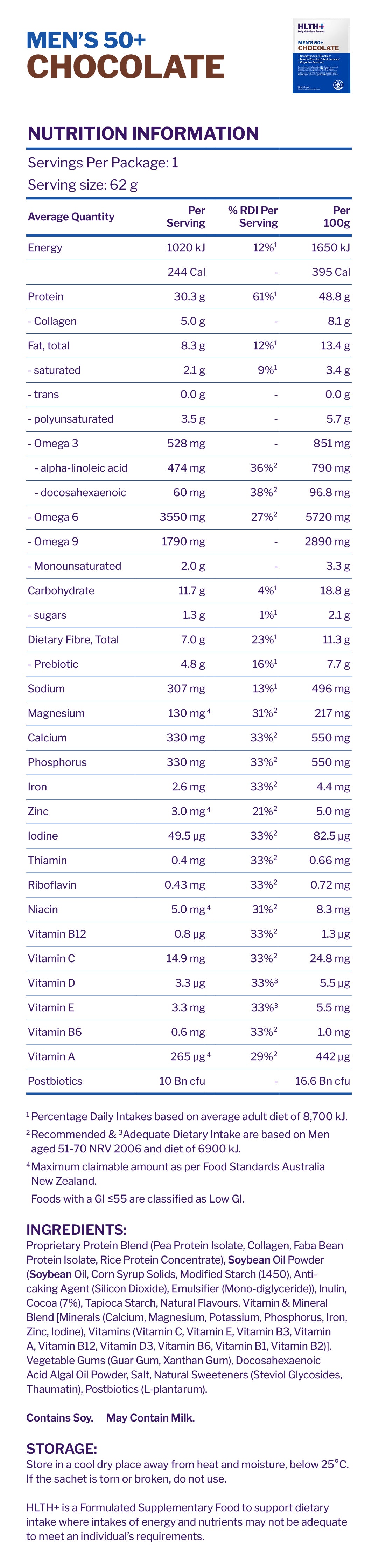
HLTH+ is a Formulated Supplementary Food: one 55g sachet carries 30g protein per serve and 7g dietary fibre, at RRP $6.00. Under Schedule 4 of the Food Standards Code, protein contributes to the maintenance and growth of muscle mass. In the table above, one serve takes a 53 g day to 83 g, which is the distance between the RDI and the older-adult range.
Protein needs are not one adult number: the Nutrient Reference Values move them at 70, and the rest of the nutrient set moves with age and sex as well. HLTH+ is formulated to those Nutrient Reference Values, published in 2006 by the National Health and Medical Research Council, the Australian Government Department of Health and Ageing and the New Zealand Ministry of Health, across Women's, Women's 50+, Men's and Men's 50+.
At the buying end of this question, protein powder for seniors and the over-70 version run the label checks.
Find out what your current stack is missing. The ✦ Find My Formula quiz takes about 30 seconds and shows the gaps your existing bottles are leaving. Take the quiz.
Frequently Asked Questions
What is sarcopenia in simple terms?
Sarcopenia is the loss of skeletal muscle strength and mass that comes with ageing, recognised as a muscle disease with its own diagnostic code. The EWGSOP2 consensus defines it by low muscle strength first, confirmed by low muscle quantity or quality, with slow walking speed marking the severe form.
At what age does sarcopenia start?
Muscle mass declines by roughly 3 to 8% a decade from about age 30, and faster after 60. Beyond 50, studies report leg muscle mass falling 1 to 2% a year and strength 1.5 to 5% a year. Sarcopenia itself is most common in older adults, but the consensus notes it can occur earlier in life.
Can you slow sarcopenia?
The two measures with the strongest evidence are progressive resistance training and adequate protein. A Cochrane review of 121 trials found resistance training produced a large gain in strength in older adults, and the PROT-AGE Study Group recommends 1.0 to 1.2 g of protein per kilogram of body weight a day after 65. Diagnosis and care belong with your doctor.
How much protein does an older adult need to hold onto muscle?
The PROT-AGE Study Group and the ESPEN Expert Group recommend at least 1.0 to 1.2 g of protein per kilogram of body weight a day for healthy older adults, and 1.2 to 1.5 g/kg for most with acute or chronic illness. For a 70 kg adult the lower range is 70 to 84 g a day, spread across meals.
Does muscle go when you lose weight quickly?
Some of it does. In a review of 52 studies, 81% of energy-restriction groups lost 15% or more of their body weight as fat-free mass, against 39% of groups that also exercised. The target does not change when calories drop; the food has to carry more protein per mouthful, and resistance training holds onto more of the muscle.

Leave a comment
This site is protected by hCaptcha and the hCaptcha Privacy Policy and Terms of Service apply.