

A complete protein supplies all nine essential amino acids in the proportions the body needs, and in a form the small intestine can absorb. That is not a yes-or-no label: since 2013 the Food and Agriculture Organization of the United Nations (FAO) has scored protein quality on a scale called DIAAS, on which whole milk powder scores 122, peas 64 and wheat 40. The number that decides all of it is the one amino acid the protein is shortest of.
If you are eating less than you used to, every gram of protein now has more work to do, and the front of a protein tub tells you almost nothing about whether the grams inside are the right shape. Two products can both print 25g a serve and be nothing alike once you read the amino acid panel. Most tubs are designed to be read without one.
This explains what completeness actually means, how the two official scoring systems work, how proteins that fall short get combined, and how to read any label for it in under a minute.
What does complete protein actually mean?
Protein is built from about 20 amino acids, and 9 of them cannot be made by the body, so they have to arrive in food (Better Health Channel, Victorian Department of Health). Nutrition science calls those nine indispensable; everyday language calls them essential. They are histidine, isoleucine, leucine, lysine, methionine, phenylalanine, threonine, tryptophan and valine (WHO/FAO/UNU, Protein and amino acid requirements in human nutrition, 2007).
A protein is called complete when it carries all nine in amounts that line up with what the body needs. Animal products such as chicken, beef, fish and dairy have large amounts of all of them, which is why the Better Health Channel calls them high-quality protein. Plant proteins such as beans, lentils, nuts and whole grains contain all nine too, but the amounts of one or two may be low, which is why plant protein powders so often pair two sources.
The body's need is not equal across the nine, and that is the first thing a label reader should hold onto. The 2007 WHO/FAO/UNU consultation put the adult requirement at 184mg of indispensable amino acids per kilogram of body weight a day, split unevenly across the nine.
| Essential amino acid | Adult requirement (mg per kg of body weight a day) | As a share of protein (mg per g of protein) |
|---|---|---|
| Histidine | 10 | 15 |
| Isoleucine | 20 | 30 |
| Leucine | 39 | 59 |
| Lysine | 30 | 45 |
| Methionine plus cysteine | 15 | 22 |
| Phenylalanine plus tyrosine | 25 | 38 |
| Threonine | 15 | 23 |
| Tryptophan | 4 | 6 |
| Valine | 26 | 39 |
Source: WHO/FAO/UNU 2007, Table 23; the second column assumes the mean adult protein requirement of 0.66g per kilogram a day. Leucine is needed at nearly ten times the rate of tryptophan, and lysine at seven and a half times. What each of the nine is doing in the body is covered one by one in Amino Acids Explained; this article stays on the completeness question.
Why does the amino acid profile decide protein quality?
Because the body can use a protein only as far as its scarcest essential amino acid allows. The FAO scoring method works exactly that way: for each of the nine, divide the digestible amount in a gram of the food's protein by the amount in a gram of a reference protein, and the lowest ratio is the score (FAO, Dietary protein quality evaluation in human nutrition, 2013). Everything above that floor is surplus to the pattern.
The FAO's own worked example shows how unforgiving that is. Wheat carries 28mg of lysine per gram of protein against a reference of 48mg, so on the young child pattern used for food labelling wheat scores 40, peas score 64 and whole milk powder scores 122 (FAO 2013, Tables 2 and 6). On paper wheat is 11% protein; scored, less than half of that counts.
The second half of the score is digestibility, and DIAAS measures it per amino acid at the end of the small intestine, not from what leaves the body. The 2013 consultation preferred that ileal figure because it better reflects what is actually absorbed, and where human data do not exist it accepts pig data, then rat data, in that order. Quantity still comes first: the report is explicit that quality cannot substitute for quantity, and how much protein you need is a separate question from how good it is.
PDCAAS and DIAAS: what changed in 2013?
For roughly twenty years the standard score was PDCAAS, the protein digestibility-corrected amino acid score, adopted by FAO and WHO in 1991. It had two habits the 2011 expert consultation in Auckland set out to break. It corrected every amino acid with a single crude protein digestibility figure measured from faeces, and it capped the result at 1.00.
That cap is why milk and soy looked identical on paper. In the FAO's words, truncation "removes any nutritional differences between high protein foods such as milk and soya, although actual concentrations of important dietary indispensable amino acids, which may be limiting in some diets, are higher in milk than in soya" (FAO 2013, page 16). A score that cannot go above 100 cannot tell you which protein has headroom to cover the gaps in the rest of the day.
The replacement, DIAAS (the digestible indispensable amino acid score), was recommended in the 2013 report to replace PDCAAS outright.
| PDCAAS | DIAAS | |
|---|---|---|
| Adopted | 1991 (FAO/WHO) | 2013 (FAO) |
| Digestibility basis | One crude protein figure, measured from faeces | Each essential amino acid, measured at the end of the small intestine |
| Cap | Truncated at 1.00 | Not truncated for a single food; a mixed diet is capped at 100 |
| Reference pattern for labelling | Preschool child pattern from the 1991 report | Young child pattern, 6 months to 3 years |
| Whole milk powder | 1.00, the cap | 122 on the labelling pattern, 143 on the adult pattern |
The report also sketches how the score should drive label claims. As worked examples it suggests 100 or more could read as excellent, 75 to 99 as good, and under 75 no quality claim at all, so wheat and peas would both pass on protein quantity and fail on quality, while whole milk powder passes both (FAO 2013, Table 6). Australian brands rarely print a DIAAS; the honest ones print the amino acid amounts instead, and four of the five plant powders we checked do.
How do you combine proteins that fall short?
By pairing a protein that is short of one amino acid with one that is long on it, and the FAO's worked mixture shows the arithmetic. Take 400g of wheat, 100g of peas and 35g of whole milk powder: wheat is 28mg of lysine per gram of protein, peas 71mg, milk 78mg, and the blend works out at 38.9mg (FAO 2013, Table 2). The blend scores 68 on the labelling pattern against wheat's 40 alone, and 82 on the adult pattern; lysine is still the limiting amino acid, but the floor has moved up.
This is the old cereals-and-legumes rule with numbers on it. A meal of baked beans on toast provides all the essential amino acids found in a typical meat dish (Better Health Channel). It is also why most plant protein powders blend pea with rice, or almond with faba bean, rather than selling one source.
One caution the FAO attaches: for a whole diet the score is capped at 100, because once every amino acid sits above the pattern the surplus cannot be used as anything but nitrogen. Completeness is a property of the day's eating as much as of any single food. Learn more about what protein is doing when overall intake drops, which is the situation most people are reading a protein label for.
How do you read a protein label for completeness?
Ignore the claims on the front and look for six things.
- Protein per serve, then per 100g. A 40g serve and a 25g serve are different measurements; divide the protein by the powder before comparing two tubs.
- An amino acid panel with amounts. Milligrams or grams per serve or per 100g. The phrase "complete amino acid profile" printed with no numbers beside it is a claim, not data.
- All nine essentials listed, and the smallest one. Set each against the adult pattern in the table above; the lowest ratio governs, as lysine does for wheat.
- Single source or blend. A blend is usually there to lift that lowest ratio, which is a good sign when the panel confirms it.
- A DIAAS or PDCAAS figure, if printed. A DIAAS at or above 100 clears the FAO's example threshold for excellent; a PDCAAS of 1.00 tells you only that it hit the cap.
- What else is in the tub. Protein is rarely the only line you are short of, and the rest of the panel says whether the tub carries anything else at all.
Quantity comes first. The WHO/FAO/UNU safe level of protein intake for adults is 0.83g per kilogram of body weight a day, the intake that covers 97.5% of a population, and the same consultation recommends the same amino acid pattern for older adults as for adults in general (WHO/FAO/UNU 2007). After 60 the per-meal dose that matters rises, and why muscle is lost with age is its own article.
What changes when you are eating less?
When calories drop, protein drops with them, and the amino acid floor drops too. In trial conditions GLP-1 medicines reduced ad libitum food intake by roughly a quarter of daily calories (Blundell and colleagues, Diabetes, Obesity and Metabolism, 2017). The same shortfall follows a deliberate deficit, an appetite that has quietly gone, or rapid weight loss, reduced eating and medically induced weight loss.
Muscle notices. In the STEP 1 body-composition sub-study, roughly 40% of the weight lost was lean mass (Wilding and colleagues, New England Journal of Medicine, 2021). Protein quality does not change that arithmetic on its own; it decides whether the grams you do eat count in full.
The starting point was already thin: over 90% of Australian adults do not meet dietary guidelines on the Australian Institute of Health and Welfare poor-diet measure. This page is general information, not medical advice, and decisions about any medication belong with your doctor. There is more on protein when appetite falls.
Where a daily nutritional formula fits
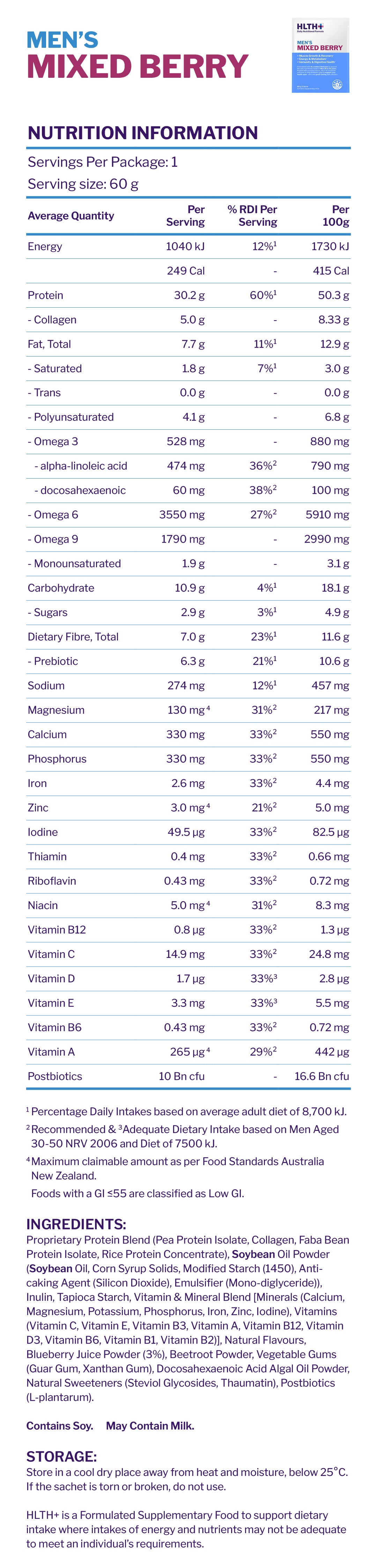
HLTH+ is a Formulated Supplementary Food under the Food Standards Australia New Zealand Food Standards Code, built to supplement the food you already eat rather than to sit in the protein-powder category. Read its label the way this article reads every label. What it prints is 30g protein per serve, and protein contributes to the maintenance of muscle mass and is necessary for tissue building and repair.
Around the protein, one 55g Women's sachet carries 7g dietary fibre, 5g collagen, 60mg DHA and 10 billion CFU Lactobacillus Plantarum Postbiotic alongside prebiotics, at 1.5g of sugar with none added and 223 calories. A postbiotic is the set of compounds live cultures produce, supplied ready-made rather than having to survive the shelf, so its count and a probiotic count are not like-for-like. It also carries a balanced multivitamin profile.
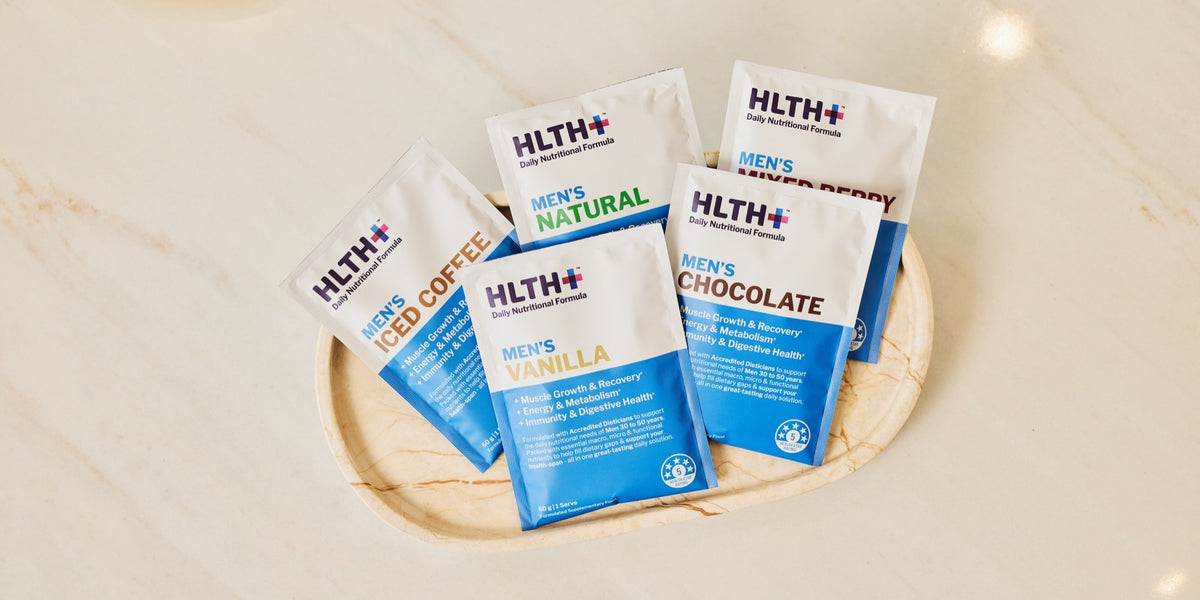
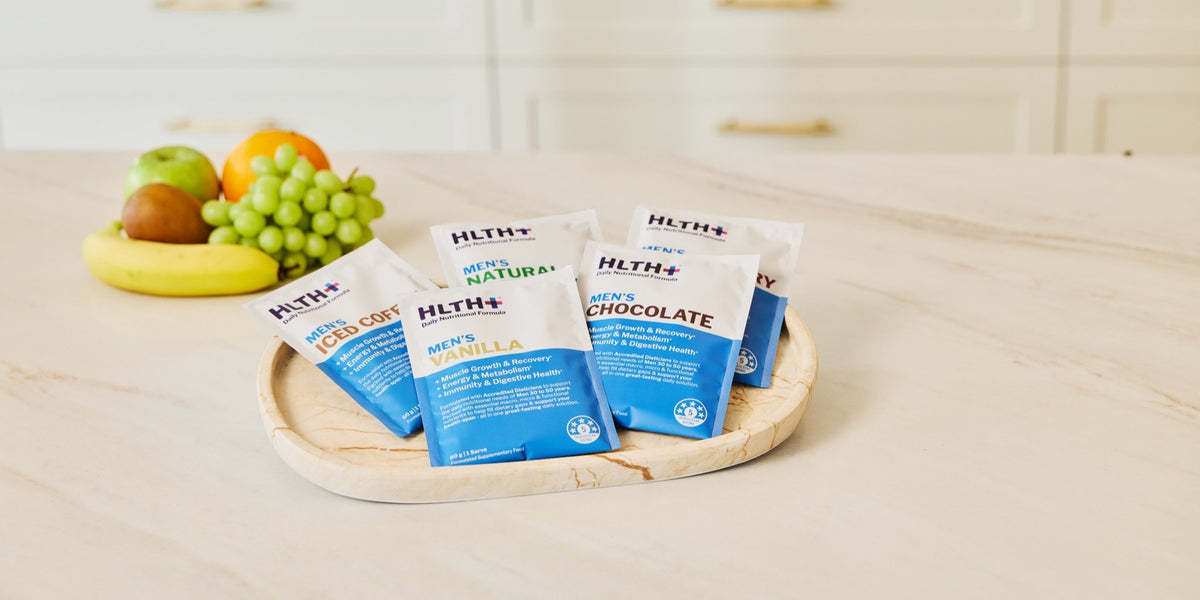
Counted across protein, dietary fibre, vitamins, minerals, collagen and DHA, that comes to 30 essential daily nutrients in one serve. It is published as Women's, Women's 50+, Men's and Men's 50+, each formulated by Accredited Dietitians to the Nutrient Reference Values, the intakes set in 2006 by the National Health and Medical Research Council, the Australian Government Department of Health and Ageing and the New Zealand Ministry of Health. Those values move with age and sex, which one formula cannot follow.
It is Australian-made in facilities complying with Good Manufacturing Practice, carries a 5-star Health Star Rating, and is dairy-free and gluten-free. It sells at hlthplus.com at RRP $6.00, or $5.10 a day on a 28-serve subscription at $142.80, and through Amazon AU and Chemist Warehouse online.
Find the gap in your current stack. The 30-second ✦ Find My Formula quiz is diagnostic: it shows what the tubs you already own are not giving you.
Frequently Asked Questions
What is a complete protein?
A protein that supplies all nine essential amino acids (histidine, isoleucine, leucine, lysine, methionine, phenylalanine, threonine, tryptophan and valine) in amounts that match the body's requirement pattern, in a digestible form. The FAO does not label proteins complete or incomplete; since 2013 it scores them on DIAAS, where the scarcest amino acid sets the score.
Which foods are complete proteins?
Animal products such as chicken, beef, fish and dairy have large amounts of all nine essential amino acids, which is why the Better Health Channel calls them high-quality protein. Plant proteins such as beans, lentils, nuts and whole grains contain all nine, but one or two may be low, which is why cereals and legumes get paired.
What is the difference between PDCAAS and DIAAS?
PDCAAS (1991) corrects the amino acid score with one crude protein digestibility figure measured from faeces and caps the result at 1.00. DIAAS (FAO, 2013) uses the digestibility of each essential amino acid measured at the end of the small intestine and is not capped, so whole milk powder scores 122 rather than 1.00.
How much protein do adults need a day?
The WHO/FAO/UNU safe level for adults is 0.83g of protein per kilogram of body weight a day, about 62g for a 75kg adult, and it is the intake that covers 97.5% of a population. Within that, the adult requirement for essential amino acids is 184mg per kilogram a day, with leucine and lysine the largest lines.
Leave a comment
This site is protected by hCaptcha and the hCaptcha Privacy Policy and Terms of Service apply.