
Is protein powder gluten-free?
Most of it is, by construction. Whey, casein, pea, rice, faba bean and collagen proteins carry no gluten of their own, because gluten is a protein found in wheat, rye, barley and oats (healthdirect). The gluten question is decided by what gets added after the protein, and by the line the batch was made on.
So an ingredient list with no wheat in it is not the same thing as a tub that says "gluten free", and the difference matters far more to one reader than another. If you have coeliac disease, the claim is the only part of the pack that carries a legal standard behind it.
This page sets out what that claim means in Australia, where gluten actually gets into a protein powder, and how to shortlist one on the rest of the label once the gluten question is settled.
What does "gluten free" mean on an Australian label?
It is a regulated nutrition content claim, not a marketing word. Under Schedule 4 of the Australia New Zealand Food Standards Code, a food carrying a "gluten free" claim must not contain (Schedule 4, compilation dated 30 April 2026):
- Detectable gluten; or
- Oats or oat products; or
- Cereals containing gluten that have been malted, or products of such cereals.
Australia sets the strictest version of this claim in the world, and Food Standards Australia New Zealand states the same three conditions in plain English on its own allergen labelling page (retrieved 15 September 2026). Note the second condition: a powder containing oat flour or oat milk powder cannot be labelled gluten free here, even where the oats are grown and handled to avoid wheat.
"Low gluten" is a different claim with a different threshold: no more than 20 mg of gluten per 100 g of the food, on the same Schedule 4 table. Low gluten is not gluten free, and it is not suitable for coeliac disease.
Separately from any claim, allergen declaration is mandatory. Cereals containing gluten must appear in bold in the ingredient list and again in a "Contains" summary statement using the word "gluten". A "may contain gluten" line is a different thing entirely: those precautionary statements are "voluntary statements made by food suppliers and the Food Standards Code does not regulate them" (Food Standards Australia New Zealand, retrieved 15 September 2026).
Is whey protein gluten-free?
Whey comes from milk, and milk carries no gluten, so whey protein concentrate, whey protein isolate and hydrolysed whey are all gluten-free as proteins. That is true of casein too, and it is why so many whey tubs can carry the claim.
What changes the answer is the rest of the tub. Malt extract and barley-derived flavourings, cookies-and-cream or biscuit-style inclusions, oat ingredients in a mass-gainer blend, and gluten-containing carbohydrate carriers all bring gluten with them, and a shared production line can bring traces of it with nothing on the ingredient list.
The practical rule: judge a whey powder on its claim and its allergen statement, not on the word "whey". If you are also lactose-sensitive, the two questions are separate, and lactose-free protein powder covers the second one properly.
Where does gluten actually get into a protein powder?
Four places, in rough order of how often they catch people out.
- Flavour systems. Malt extract, malted barley, biscuit, cookie and cereal flavour bases are the most common carriers, and they cluster in dessert flavours.
- Bulking and texture ingredients. Wheat-derived starches, some dextrins and oat flour appear in mass gainers and meal-style blends far more than in plain protein.
- Oat ingredients of any kind. Oats disqualify the claim in Australia outright, regardless of how they were grown or handled.
- Shared equipment. Cross-contact from a line that also runs wheat-containing products is the reason a "may contain" statement exists, and why that statement is not a substitute for a gluten free claim.
Two of those four never show up in the protein source itself, which is the whole reason the category confuses people. Plant-based protein powders are no safer or less safe here than dairy ones: the same flavour systems are used across both.
What should you check before you buy?
Once the gluten question is answered, the rest of the label decides whether the powder is worth the money. Six checks, in order.
- The gluten free claim, printed on the pack. Not "wheat free", not "no gluten ingredients", not a claim made only on a retailer's website.
- The "Contains" statement. It names the declarable allergens in that product, which is also where you find out about milk, soy, tree nuts and egg.
- Oat ingredients anywhere in the list. Their presence rules out the claim, so seeing both is a reason to question the pack.
- Protein per serve, against the serve size. A big scoop with a modest protein figure is a carbohydrate product wearing a protein label.
- Sugars and the sweetener system. Total sugars per serve, whether any were added, and what replaced them.
- What else the serve carries. Dietary fibre, vitamins and minerals, and whether the formula was built for anyone in particular.
That last check matters more on a gluten-free diet than most people expect. Cutting out gluten-containing grains removes a major source of "B vitamins, folate and iron, as well as fibre" (healthdirect), so what you replace those grains with does real work. The protein itself is only part of the picture, and what makes a protein complete and how the amino acids stack up are the other half of it.
Which type of gluten-free protein powder suits you?
Every type below is gluten-free at the protein source. The column that separates them is where gluten can still arrive, and what the tub is built to do.
| Label type | What is in the tub | Does the protein source contain gluten? | Where gluten can still come from | Who it suits |
|---|---|---|---|---|
| Whey protein concentrate | Milk protein, filtered, with milk sugars and fats left in | No | Flavour systems, malt-based inclusions, shared lines | Training readers who tolerate dairy and want the lowest cost per gram of protein |
| Whey protein isolate | Milk protein filtered further, with most lactose and fat removed | No | Flavour systems and shared lines | Readers who want the highest protein per gram and find concentrate sits heavily |
| Plant protein blend | Pea, rice, faba bean or soy proteins combined | No | Flavour systems, oat ingredients in meal-style blends, shared lines | Dairy-free and lactose-free readers, and anyone building a plant-forward diet |
| Collagen powder | Hydrolysed bovine or marine collagen peptides | No | Flavour systems, mostly in flavoured sachets rather than unflavoured tubs | Readers already taking collagen daily who want a single-ingredient product |
| All-in-one daily nutrition formula | Protein plus dietary fibre, vitamins, minerals and other nutrients in one serve | No | Flavour systems, oat or cereal ingredients in some meal-style products, shared lines | Readers who want one serve to cover more than protein alone |
Read the third column and the point of this page is plain: it is the same answer five times. No mainstream protein source brings gluten with it, so the decision is made on the flavour system, the production line and the claim, and then on everything else the label says.
What if you are eating less than you used to?
One group reads a label like this differently: people whose meals have shrunk, through a deliberate deficit, an appetite that has fallen away, or rapid weight loss, reduced eating and medically induced weight loss, including people on GLP-1 medications. A gluten-free diet already narrows the shelf; a smaller appetite narrows the plate on top of it.
Dietary fibre is the first thing to slip when both happen at once. In one 2025 study, people on these medications averaged 14.5g of dietary fibre a day against the 28g recommended (Frontiers in Nutrition, 2025), and gluten-free breads and cereals are not usually the ones closing that gap.
This page is general information, not medical advice, and decisions about any medication belong with your doctor. Learn more about what happens to nutrition when overall intake drops.
Coeliac disease, sensitivity or preference: which are you?
The three readers searching this term need different amounts of certainty from the same pack.
Coeliac disease. It affects approximately one in 70 Australians, and "even small amounts of gluten can cause harm" (Better Health Channel, Victorian Department of Health). It cannot be cured and is managed with a strict, lifelong gluten-free diet (healthdirect). For this reader the regulated claim is the minimum, a "may contain" line is a reason to put the tub down, and the current pack is the only version worth trusting.
Non-coeliac gluten sensitivity, wheat allergy or irritable bowel syndrome. A doctor may advise a gluten-free diet for any of these (healthdirect). Tolerance varies from person to person, so the claim is still the cleanest signal, and the sweetener and fibre systems in the tub are often what actually decide how a shake sits.
Preference, or a household that eats gluten-free together. Nothing here is urgent for you, and the advice is to stop paying a premium for the words alone. If gluten is not a medical issue, see your doctor before assuming it is the cause of a symptom, and spend the label attention on protein per serve, sugars and what else the serve carries.
Where HLTH+ fits
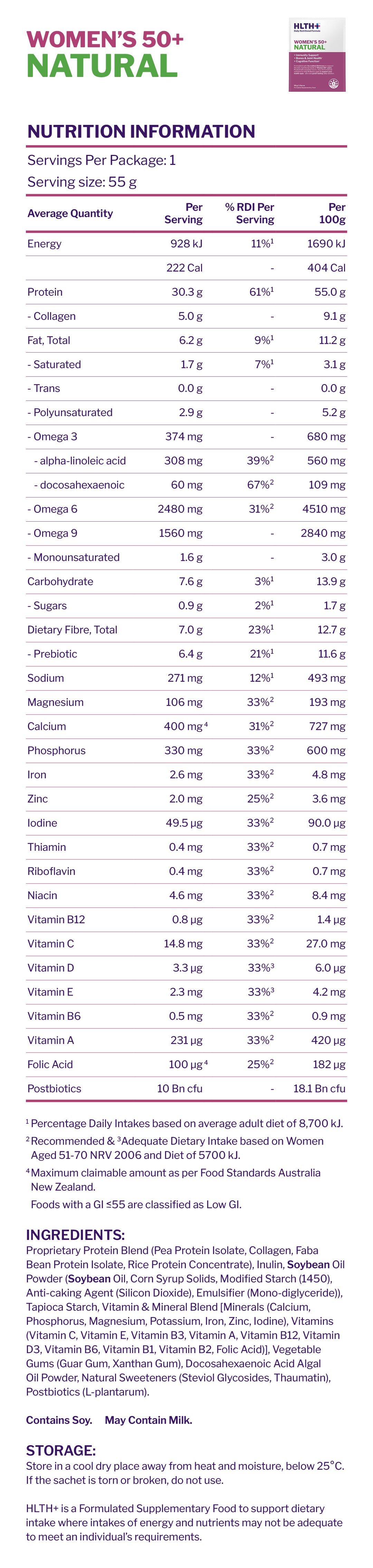
HLTH+ is not a protein tub. It is a daily nutritional formula, a Formulated Supplementary Food under the Food Standards Code, taken alongside meals in a 55g sachet (Women's; Men's runs 60-62g), and its published label is dairy-free and gluten-free.
One sachet lists 30g protein per serve and 7g dietary fibre, with 1.5g of sugar (Women's) or 1.7g (Men's) and none added. Protein contributes to the maintenance and growth of muscle mass, and dietary fibre contributes to regular laxation, as part of a healthy diet involving a variety of foods.
The same sachet lists 5g collagen, 60mg DHA and 10 billion CFU Lactobacillus Plantarum Postbiotic alongside prebiotics, and carries a balanced multivitamin profile. A postbiotic is not a live organism: it is the material a bacterial culture produces during fermentation, together with the inactivated cells, so it does not depend on organisms surviving transport and storage. That also means a postbiotic count and a probiotic count are not the same measurement.
Across protein, dietary fibre, vitamins, minerals, collagen and DHA, each serve supplies 30 essential daily nutrients.
Allergen line: contains soy. Part of the 30g protein per serve is bovine collagen, which is where the 5g collagen comes from.
It is formulated to the Nutrient Reference Values, the published government intakes developed by the National Health and Medical Research Council, the Australian Government Department of Health and Ageing and the New Zealand Ministry of Health, which is why the range runs Women's, Women's 50+, Men's and Men's 50+ rather than one formula for every adult. We believe in a food-first approach, and the statistics say food alone is not getting there: over 90% of Australian adults do not meet dietary guidelines on the AIHW poor-diet measure, and a gluten-free diet narrows the shelf further. It is Australian-made in facilities complying with Good Manufacturing Practice, low GI, holds a 5-star Health Star Rating and hundreds of reviews, and has no nasties, artificial colours, artificial flavours or artificial sweeteners.
It sells at hlthplus.com at RRP $6.00, or $5.10 a day on a 28-serve subscription at $142.80 and $5.40 a day on a 14-serve subscription at $75.60, and through Amazon AU and Chemist Warehouse online. If you are also avoiding dairy across the board, dairy-free protein powder walks through what that changes on a label.
Find out what your current stack is not giving you. The 30-second ✦ Find My Formula quiz reads your existing routine and shows the gaps it leaves.
Frequently Asked Questions
Is protein powder gluten-free?
Usually, at the protein source. Whey, casein, pea, rice, faba bean and collagen carry no gluten, because gluten comes from wheat, rye, barley and oats. Gluten arrives through flavour systems, oat ingredients, wheat-derived bulking agents or a shared production line, so check the pack for a gluten free claim.
Is whey protein gluten-free?
Whey is a milk protein, so it contains no gluten itself, and most whey powders can carry a gluten free claim. The exceptions are flavour systems built on malt or barley, biscuit-style inclusions, and cross-contact from shared lines. Read the claim and the "Contains" statement rather than trusting the word whey.
What does "gluten free" mean on an Australian label?
Under Schedule 4 of the Australia New Zealand Food Standards Code, the food must contain no detectable gluten, no oats or oat products, and no cereals containing gluten that have been malted. It is the strictest version of the claim in the world. "Low gluten" is a separate claim allowing up to 20 mg per 100 g.
Can I use a protein powder that says "may contain gluten"?
If you have coeliac disease, no. Precautionary statements are voluntary and the Food Standards Code does not regulate them, so "may contain" carries no tested threshold behind it. Even small amounts of gluten can cause harm in coeliac disease, so the regulated gluten free claim is the one to buy on.
Is HLTH+ gluten-free?
Yes. Its published label is dairy-free and gluten-free, in a 55g sachet carrying 30g protein per serve, 7g dietary fibre, 5g collagen and 60mg DHA. Its allergen line reads contains soy, and packs are reformulated over time, so check the current pack.
This article is general information, not medical advice. Decisions about any medication belong with your doctor. Regulatory conditions quoted are from the Australia New Zealand Food Standards Code at the retrieval dates shown; brands reformulate, so check the current pack before buying.
Leave a comment
This site is protected by hCaptcha and the hCaptcha Privacy Policy and Terms of Service apply.