

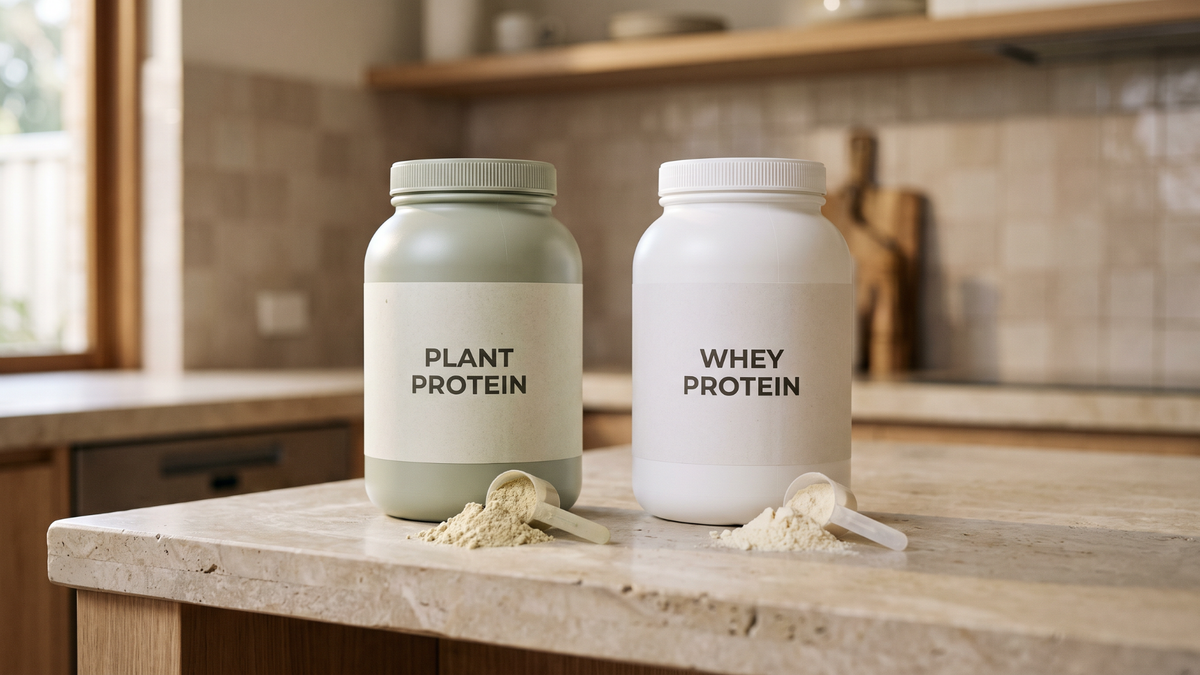
Neither is better across the board; the answer sorts by what you need the powder to do. Gram for gram of protein, whey carries more essential amino acids than any plant source, so it is the more concentrated building material. Plant protein carries no lactose and no dairy protein at all, and a properly built plant blend can close most of the performance gap.
If you are holding two tubs wondering whether the plant one is a compromise, the front of the pack will not answer it. One says complete, the other says clean, and neither word is a measurement.
Below: the six dimensions that differ, the amino acid data, the matched-dose trial, lactose, cost per serve measured in Australia, and a verdict by reader type.
What actually separates plant protein from whey?
Six things. Nearly everything else on a protein label is flavour and marketing.
- Amino acid profile. How much of each essential amino acid arrives per gram of protein.
- Anabolic response. Whether a measured dose lifts muscle protein synthesis as far.
- Lactose and dairy protein. Whether the powder is a problem for an intolerance or an allergy.
- Protein per gram of powder. How much of the scoop is protein rather than starch or flavouring.
- Cost per serve. Pack price divided by servings, set against the protein in each serve.
- Diet, ethics and footprint. The reasons that have nothing to do with the panel.
The Victorian Department of Health is blunt that "protein shakes, powders and supplements are unnecessary for most Australians' health needs" (Better Health Channel, Protein). A powder is a convenience for reaching a target your food is not reaching.
Which has the better amino acid profile?
Whey, on the raw numbers, and against a single plant source it is not close.
Protein is built from about 20 amino acids, and 9 of them the body cannot make (Better Health Channel, above). Animal and dairy proteins have large amounts of all of the essential amino acids and are known as high-quality protein, while plant proteins contain all of the essential amino acids but the amounts of one or two of them may be low.
Measured, the gap is wide. In a Maastricht University analysis of commercial isolates, essential amino acids made up 43% of whey protein, against 30% for pea, 28% for brown rice, 27% for soy, 23% for hemp, 22% for wheat and 21% for oat and lupin (Gorissen and colleagues, Amino Acids, 2018). Methionine and lysine averaged 1.0% and 3.6% across the plant isolates against 2.5% and 7.0% across the animal ones.
The same paper is the reason blends exist. Leucine ranged from 5.1% in hemp to 13.5% in corn, against 9.0% for milk, so plant sources differ from each other far more than they differ from dairy. The authors conclude that "combinations of various plant-based protein isolates or blends of animal and plant-based proteins can provide protein characteristics that closely reflect the typical characteristics of animal-based proteins".
So the fair fight is not pea against whey but a built blend against whey, the same principle as pairing cereals with legumes: baked beans on toast provides all the essential amino acids found in a typical meat dish (Better Health Channel). The scoring systems sit in complete protein, and what each of the nine does is in amino acids explained.
Does plant protein build muscle as well as whey?
At a matched dose, a properly built blend did, in the best direct test published so far.
Ten resistance-trained young adults did bilateral leg resistance exercise, then drank either 32g of protein from whey (3.2g leucine) or 32g from a plant blend of 39.5% pea, 39.5% brown rice and 21.0% canola (2.5g leucine), on separate days, in a randomised double-blind crossover (Van der Heijden and colleagues, Medicine and Science in Sports and Exercise, 2024).
Myofibrillar protein synthesis rose after exercise in both and did not separate. Over the first two hours it ran at 0.085% an hour on whey and 0.080% on the blend, and over the next two hours at 0.085% and 0.086%, with no difference in either window or across the four hours.
The caveats are the useful part. Plasma essential amino acid availability across the four hours was about 44% higher on whey, so the blend delivered less into the blood and still produced the same muscle response at this dose. It ran on ten people at 32g, was financially supported by a sports nutrition company, and the authors ask whether parity holds at lower doses or in people whose muscle responds less readily.
Two rules fall out: the dose has to be real, and the blend has to be built. How much protein to build muscle has the per-meal numbers, and there is more on protein when intake falls at nutrition support for muscle.
Does whey protein contain lactose, and does plant protein?
Yes and no: one is a matter of degree, the other is absolute.
Whey is what is left when milk is separated, so lactose comes with it unless filtered out. Whey protein concentrate runs anywhere from 20% to 85% protein with varying amounts of fat, lactose and minerals, while whey protein isolate is filtered further to 90% to 95% protein with minimal fat, lactose and minerals (Cava and colleagues, Healthcare, 2024). That is why isolate is the form usually pointed at people who react to dairy sugar.
Bulk Nutrients publishes its Whey Protein Isolate at 25.5g protein in a 30g chocolate serve, carrying only traces of lactose, around 0.3g a serve (their published product page, retrieved 15 September 2026).
Low is not none, and a dairy protein allergy is a different problem from lactose intolerance: filtering removes the sugar, not the protein. Plant protein contains neither. The isolate question is worked through in does whey protein have lactose, and the shopping options in lactose-free protein powder in Australia.
Plant protein versus whey: the label-by-label comparison
| Dimension | Whey (dairy) | Plant protein |
|---|---|---|
| Protein as a share of the powder | Concentrate 20% to 85%, isolate 90% to 95% (Cava 2024) | Pea isolate 80% and brown rice isolate 79% of the raw material (Gorissen 2018) |
| Essential amino acids as a share of protein | 43% (Gorissen 2018) | 21% (oat, lupin) to 32% (corn), pea 30% (Gorissen 2018) |
| Muscle protein synthesis, 32g dose after exercise | 0.085% an hour at 0 to 2 hours, 0.085% at 2 to 4 hours (Van der Heijden 2024) | 0.080% then 0.086%, pea, rice and canola blend (same trial) |
| Lactose | Concentrate carries it; one Australian isolate publishes traces, around 0.3g a serve | None |
| Cost per 30g serve, one Australian retailer, 15 September 2026 | $2.39 for an isolate at 25.5g protein a serve | $1.27 for a pea, fava bean and rice blend at 22.2g protein a serve |
Figures are from the sources named in each row, retrieved 15 September 2026. Brands reformulate and flavours differ, so read the panel on the tub in your hand.
Which costs less per serve in Australia?
Do the arithmetic rather than trusting the shelf price. Pack price divided by servings gives cost per serve; cost per serve divided by protein per serve gives cost per gram of protein, and only that second number is comparable across two tubs.
On one Australian manufacturer's own published pages on 15 September 2026: a 1kg tub of whey protein isolate at $79.00 gives 33 serves of 30g, which is $2.39 a serve for 25.5g of protein, or 9.4 cents per gram. A 1kg tub of the same company's pea, fava bean and rice blend at $42.00 gives the same 33 serves, which is $1.27 a serve for 22.2g of protein, or 5.7 cents per gram (Bulk Nutrients, published product pages, retrieved 15 September 2026).
That is two products, one retailer, one day, and it cuts against the assumption that plant protein is the expensive option.
Why do people switch for reasons that are not on the panel?
Because plenty of the decision sits outside nutrition. A vegetarian or vegan diet rules whey out entirely, a dairy allergy rules it out on safety grounds, and plenty of households simply cook without dairy.
Footprint is the other common reason. The largest food production meta-analysis published to date consolidated data covering "five environmental indicators; 38,700 farms; and 1600 processors, packaging types, and retailers" and reported that "impacts of the lowest-impact animal products typically exceed those of vegetable substitutes" (Poore and Nemecek, Science, 2018). That is a statement about food systems rather than any one tub; the study also found impact varying up to 50-fold between producers of the same product.
Which should you choose? The verdict by reader type
- You want the most essential amino acids per gram. Whey isolate. On the Gorissen figures nothing plant-based matches 43%.
- You are lactose intolerant. A whey isolate is often tolerated at around 0.3g a serve; plant protein needs no testing.
- You have a dairy allergy, or cook dairy-free. Plant only. Filtering removes the sugar, not the milk protein.
- You are cutting animal products for diet or footprint reasons. Plant, and pick a blend so the low amino acid is covered.
- You are over 50 and eating less. Source matters less than dose and daily total; protein powder for seniors has the per-meal target.
- You want the powder to do more than protein. Neither category is built for that; a plain tub of either is one nutrient by design.
For the plant shortlist sold here, see the best plant-based protein powders in Australia.
What changes when you are eating less?
Your protein requirement does not fall when your appetite does. Only the food delivering it falls, which is when protein quality stops being academic and starts deciding whether a smaller meal counts.
In trial conditions, GLP-1 medicines reduced ad libitum food intake by roughly a quarter of daily calories (Blundell and colleagues, Diabetes, Obesity and Metabolism, 2017). The same shortfall follows a deliberate deficit, an illness, or an appetite that has quietly gone. Take a quarter out of the day and you take it out of the amino acids too.
The starting point was already thin. Over 90% of Australian adults do not meet dietary guidelines on the Australian Institute of Health and Welfare poor-diet measure, before anyone's intake drops. This page is general information, not medical advice, and decisions about any medication belong with your doctor. More on daily targets in protein when you are eating less.
Where a daily nutritional formula fits
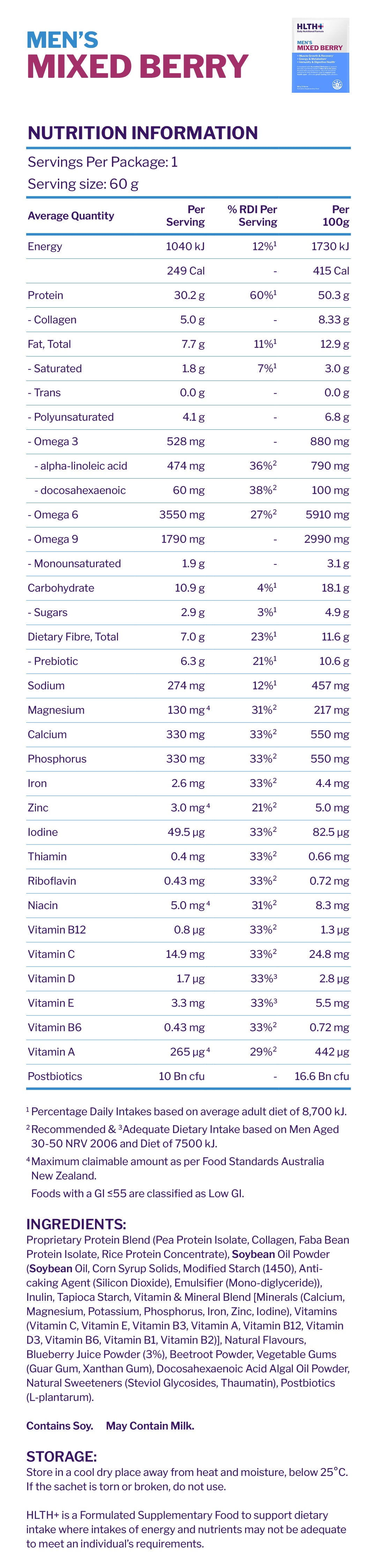
HLTH+ delivers 30g protein per serve, the most on this page, and the same 55g sachet carries 7g dietary fibre, 5g collagen, 60mg DHA and a balanced multivitamin profile. A whey isolate is protein per gram and little else. HLTH+ is the serve that does the rest of the job.
It is a Formulated Supplementary Food under the Australia New Zealand Food Standards Code, built to sit beside meals. Its protein blend lists pea protein isolate, collagen, faba bean protein isolate and rice protein concentrate, so part of the 30g protein per serve comes from bovine collagen, which is where the 5g collagen comes from and why it is not vegan. It is dairy-free and therefore lactose-free, and gluten-free. Allergen line: contains soy.
Around that protein, one 55g Women's sachet carries 7g dietary fibre, 5g collagen, 60mg DHA and 10 billion CFU Lactobacillus Plantarum Postbiotic alongside prebiotics, with no added sugar. A postbiotic is the set of compounds live cultures produce, supplied ready-made rather than having to survive the shelf, so its count and a probiotic count are not like-for-like. It also carries a balanced multivitamin profile.
Counted across protein, dietary fibre, vitamins, minerals, collagen and DHA, that is 30 essential daily nutrients in one serve. Under Schedule 4 of the Food Standards Code the approved statement is that protein contributes to the maintenance and growth of muscle mass, as part of a healthy diet involving a variety of foods.
It is published as Women's, Women's 50+, Men's and Men's 50+, each formulated by Accredited Dietitians to the Nutrient Reference Values, the intakes published in 2006 by the National Health and Medical Research Council, the Australian Government Department of Health and Ageing and the New Zealand Ministry of Health. Those values move with age and sex, which a single formula cannot follow. It is Australian made in GMP-compliant facilities, and sells at hlthplus.com at RRP $6.00, or $5.10 a day on a 28-serve subscription at $142.80, plus Amazon AU and Chemist Warehouse online.
See what your current stack is missing. The 30-second ✦ Find My Formula quiz is diagnostic: it shows what the tubs already in your cupboard are not giving you.
Frequently Asked Questions
Is plant protein as good as whey for building muscle?
At a matched 32g dose it was. In a 2024 crossover trial, a blend of pea, brown rice and canola raised post-exercise muscle protein synthesis to the same rates as whey across four hours, even though plasma essential amino acid availability was about 44% higher on whey. Single plant sources do less.
Does plant protein contain all nine essential amino acids?
Plant proteins such as beans, lentils, nuts and whole grains contain all of the essential amino acids, but the amounts of one or two may be low, says the Victorian Department of Health. That is why powders blend two or three sources, and why cereals and legumes get eaten together.
Does whey protein have lactose?
Yes, in amounts that depend on the form. Whey protein concentrate runs 20% to 85% protein with varying lactose, while isolate is filtered to 90% to 95% protein with minimal lactose; one Australian isolate publishes around 0.3g a serve. Plant protein contains none at all.
Which is cheaper in Australia, plant protein or whey?
It depends on the tub, so run the numbers. At one Australian retailer on 15 September 2026, a 1kg whey isolate at $79.00 came to 9.4 cents per gram of protein, and a 1kg pea, fava bean and rice blend at $42.00 came to 5.7 cents. Divide pack price by servings, then by protein.


Leave a comment
This site is protected by hCaptcha and the hCaptcha Privacy Policy and Terms of Service apply.