

Made up as directed, a serve of each lands within five calories of the other, so the decision is about what is inside those calories rather than how many there are. Sustagen Hospital Formula publishes 13.8g of protein and 27g of sugars in a 60g serve; Ensure Powder publishes 8.6g of protein in its 230mL prepared serve, and prints a dietary fibre row where the standard Sustagen panel has none (both retrieved 15 September 2026).
Most people comparing these two are not shopping. They are holding a discharge letter, or looking at a tin a hospital dietitian recommended for a parent, and trying to work out whether the supermarket one is the same thing.
This page reads both brands' own published panels, sets them side by side on the same prepared serve, says who each one genuinely suits, and covers the reader for whom neither is the right product.
Which Sustagen, and which Ensure, are you comparing?
Neither name is one product, and most of the confusion between them starts there. Sustagen publishes six products in Australia, including Hospital Formula, Hospital Formula Plus Fibre and the 15g Everyday tin from the supermarket shelf. Abbott publishes seven Ensure products for Australia: Ensure Powder, Ensure Neutral, Ensure Compact, Ensure Plus Strength, Ensure TwoCal HN, Ensure Plus and a Ready-To-Drink version (retrieved 15 September 2026).
The fair comparison is Sustagen Hospital Formula against Ensure Powder, because those are the two flagship tins people actually put next to each other, and every figure below is the Vanilla version of each.
Sustagen Everyday does not belong in this comparison. It is a 15g powder stirred into 175mL of reduced fat milk, printing 3g of protein from the powder and reaching 9.5g only once your own milk is counted (retrieved 15 September 2026). The full read of the flagship tin sits in is Sustagen good for you.
What do the Sustagen and Ensure labels actually publish?
One panel is printed per serve and the other per 100mL, which is why most comparisons go wrong. Sustagen's panel gives 940 kJ per serve and 390 kJ per 100mL, so a made-up serve is about 240mL (940 divided by 390). Abbott prints its prepared serve directly at 230mL, so the two are close enough to read against each other.
| Per the brand's own published panel | Sustagen Hospital Formula (Vanilla) | Ensure Powder (Vanilla) |
|---|---|---|
| Serve as published | 60g powder (three 20g scoops) in 200mL water | 6 level scoops (53.8g) in 195mL water |
| Prepared volume | About 240mL, derived from the panel: 940 kJ a serve divided by 390 kJ per 100mL | 230mL, printed on the page |
| Calories per serve | 225 (940 kJ) | 230 |
| Protein per serve | 13.8g | 8.6g |
| Protein per 100mL | 5.8g | 3.72g |
| Carbohydrate | 39g per serve | 13.42g per 100mL |
| Sugars | 27g per serve, 11g per 100mL | 4.68g per 100mL, which is 10.8g across the serve (4.68 multiplied by 2.3) |
| Fat | 1.5g per serve, of which 0.96g saturated | 3.27g per 100mL, of which 0.37g saturated |
| Dietary fibre | No fibre row on this panel. The separate Plus Fibre version publishes 4.1g per serve | 1.01g per 100mL from fructo-oligosaccharides, which is 2.3g across the serve (1.01 multiplied by 2.3) |
| Sodium | 160mg per serve | 84mg per 100mL |
| Calcium | 400mg per serve, printed as 50% RDI | 242mg per serve, 105mg per 100mL |
| Micronutrients, in each brand's words | "27 essential vitamins and minerals" | "28 vitamins and minerals" |
| Essential fats | Not listed on the panel | The page states "omega-3 and omega-6 essential fatty acids"; no amount is published |
| Collagen and live cultures | Not listed | Not listed. Fructo-oligosaccharides are listed as prebiotic fibre |
| Allergens, in each brand's words | "Contains Milk. May contain Soy. Gluten free" | "Contains soy and milk ingredients", plus "Low lactose" and "Gluten-free" |
| How the brand describes it | "a formulated meal replacement" that "cannot be used as a total diet replacement" | "Food for Special Medical Purposes. Use only under medical supervision" |
Figures are each brand's published nutrition information, both re-read on 15 September 2026. Both columns are the Vanilla versions, each brand publishes a separate panel per product and per flavour, and brands reformulate, so check current labels before purchase.
Where the two labels actually separate
Four rows carry the decision. The rest of both panels is fortification, and both are well fortified.
Protein per prepared serve
Sustagen Hospital Formula publishes 13.8g against Ensure Powder's 8.6g, which is about 60% more protein in a glass of almost identical size. Sustagen's panel puts that at 28% of the daily intake reference on the label. If the reason a drink was recommended was holding onto condition while eating is hard, this is the row that matters most, and how much protein a person needs depends on body weight rather than on the tin.
Sugars and calorie density
Sustagen publishes 27g of sugars a serve against about 10.8g across an Ensure serve, and that gap is a design decision rather than a fault. Carbohydrate is the cheapest way to get calories into a small volume for somebody who cannot finish a plate of food. Judged as a daily drink for a well adult those numbers read very differently.
Dietary fibre
Ensure Powder prints 1.01g per 100mL, about 2.3g across the prepared serve, from fructo-oligosaccharides. The standard Sustagen Hospital Formula panel prints no dietary fibre row at all, and Sustagen answers that itself with a separate Hospital Formula Plus Fibre at 4.1g a serve. Under Schedule 4 of the Australia New Zealand Food Standards Code a food needs at least 4g of dietary fibre in a serving to be called a good source, so the Plus Fibre version clears that bar and the standard one is not in the running.
Milk, soy and lactose
Both are milk-based. Sustagen Hospital Formula lists Non Fat Milk Solids at 63% of the powder and declares "Contains Milk. May contain Soy. Gluten free"; Abbott declares "Contains soy and milk ingredients" and describes Ensure Powder as low lactose and gluten-free (retrieved 15 September 2026). Low lactose is not lactose-free, so anyone avoiding dairy protein altogether is outside what either tin was built for.
Learn more about what changes in your nutrition when overall intake drops.
Which one suits which person?
Both products are medical nutrition, and the answer to "which is better" is that the choice usually belongs to a clinician rather than to a shopper. Around half of older Australians are malnourished or at risk of it (Dietitians Australia), and these formulas exist because food alone stops covering the gap when somebody is unwell, recovering, or losing their appetite with age.
- Ensure Powder is labelled "Food for Special Medical Purposes. Use only under medical supervision", so it starts with a professional recommendation by design. Its serve carries a dietary fibre row and lower sugars, and Abbott describes the range as "a complete, balanced nutritional drink with 28 vitamins and minerals, as well as high-quality protein".
- Sustagen Hospital Formula is sold more openly, and its brand describes it as "a formulated meal replacement" that "cannot be used as a total diet replacement". It carries more protein and more calcium in a serve, and its own page claims "27 essential vitamins and minerals".
- Sustagen Hospital Formula Plus Fibre is the version to raise with a dietitian when regularity is the problem, since it is the same formula with 4.1g of dietary fibre added and carbohydrate at 37.0g instead of 39g.
- Sustagen Everyday is a different job again: a light top-up stirred into milk, where most of the protein and calcium in the published column comes from the milk you supply. Calcium needs step up with age, and the Australian figures are set out here.
If a doctor or an Accredited Practising Dietitian put either tin in front of you, keep taking it and take any change back to them. This page is general information, not medical advice, and decisions about a prescribed nutrition product, or about any medication, belong with your doctor.
There is a second reader in the search results who is neither of these people: someone whose appetite has dropped sharply through rapid weight loss, reduced eating and medically induced weight loss, including people on GLP-1 medications by their doctor's decision. What runs short there is protein and dietary fibre rather than calories. One 2025 study measured GLP-1 users' dietary fibre intake at 14.5g a day against the recommended 28g (Frontiers in Nutrition), and how nutrition support works when you are eating less covers the mechanics.
When neither fits: eating less, and not under clinical care
HLTH+ is a different category with a different job: a Formulated Supplementary Food for well adults, not a clinical nutrition product, and anyone on Sustagen or Ensure under professional care makes any change with their clinician.
| Category | What it is built for | How it is used |
|---|---|---|
| Clinical and medical nutrition, including Sustagen Hospital Formula and Abbott Ensure Powder | People who cannot meet their nutrition needs from food, through illness, treatment, surgery or age-related appetite loss | Alongside food, usually on professional advice. Abbott labels Ensure Powder for supervised use only, and Sustagen states Hospital Formula cannot be a total diet replacement |
| Formulated Supplementary Food, including HLTH+ | Well adults whose everyday eating falls short of the Nutrient Reference Values | Alongside normal meals, every day, as nutritional insurance rather than as a meal or a medical product |
The gap a well adult actually has is a different shape. Over 90% of Australian adults do not meet dietary guidelines on the AIHW poor-diet measure, and what runs short is diet quality, protein and dietary fibre rather than calories. A calorie-dense formula built for somebody who cannot finish a meal answers a question that reader is not asking.
Both panels print the same footnote: "Percentage daily intakes are based on the average adult diet of 8700 kJ." That figure is a labelling reference value under Standard 1.2.8 of the Food Standards Code, and it sits above what the Nutrient Reference Values advise for most adults, so any formula built to it over-delivers calories to the individual drinking it.
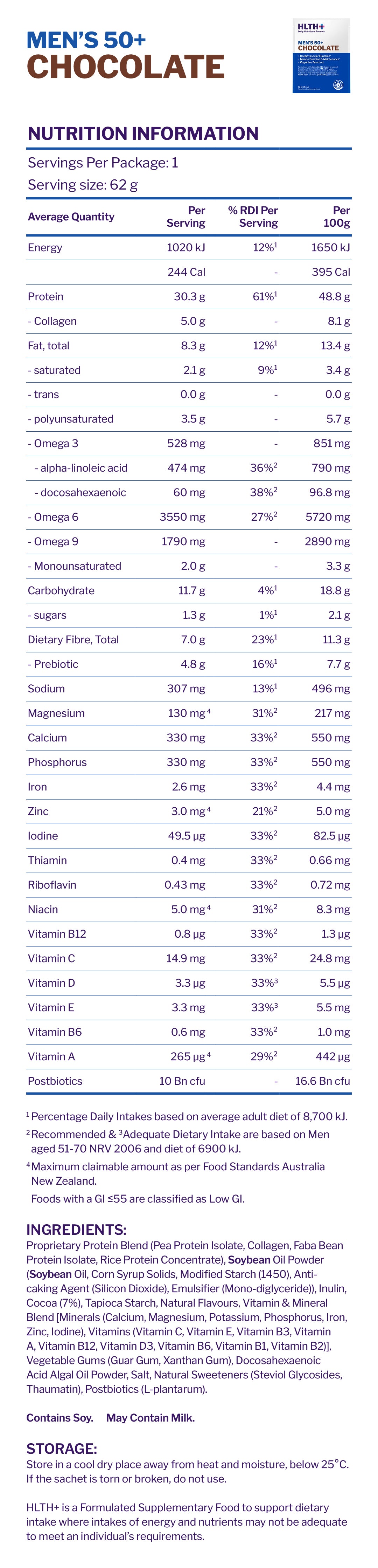
One 55g HLTH+ Women's sachet carries 30g protein, 7g dietary fibre, 5g collagen, 60mg DHA and 10 billion CFU Lactobacillus Plantarum Postbiotic alongside prebiotics, at 1.5g of sugar with none added and 223 calories. The Men's sachet holds the same 30g of protein at 1.7g of sugar and 248 calories. Protein contributes to the maintenance of muscle mass, and dietary fibre contributes to regular laxation, as part of a healthy diet involving a variety of foods.
A postbiotic is the inactivated form of a beneficial bacterium together with the compounds it produced, where a probiotic is the live organism. That is why a postbiotic count and a probiotic count are not a like-for-like comparison; the numbers are printed so you can see them, not so you can add them up against each other.
Each sachet carries a balanced multivitamin profile. Counted across protein, dietary fibre, vitamins, minerals, collagen and DHA, the total comes to 30 essential daily nutrients in one serve. Those are dosed by sex and life stage across Women's, Women's 50+, Men's and Men's 50+, formulated by Accredited Dietitians to the Nutrient Reference Values published in 2006 by the National Health and Medical Research Council, the Australian Government Department of Health and Ageing and the New Zealand Ministry of Health, rather than to the 8,700 kJ label reference in both tins' footnotes.
It is Australian-owned and Australian-made in facilities complying with Good Manufacturing Practice, dairy-free and gluten-free and therefore lactose-free, carries a 5-star Health Star Rating, and holds hundreds of reviews across the range. It sells at hlthplus.com at RRP $6.00, or $5.10 a day on a 28-serve subscription at $142.80, with free shipping over $100 and no lock-in, and through Amazon AU and Chemist Warehouse online.
Allergen line: contains soy. Getting more calories into a smaller volume is what the two clinical tins are built for; a formula built to the Nutrient Reference Values is built for the opposite job, a well adult's everyday intake.
Neither Sustagen nor Abbott publishes a price on its own site, so the per-serve cost comparison happens at the till rather than here. Sustagen alternatives covers the other routes people take, and protein powder for seniors covers the over-70 version of this question.
See what your current stack is not giving you. The 30-second ✦ Find My Formula quiz is built to show the gaps your existing tins leave, rather than to sell you another one.
Frequently Asked Questions
Is Sustagen or Ensure better?
Neither, in general. Sustagen Hospital Formula publishes more protein a serve, 13.8g against 8.6g, while Ensure Powder publishes lower sugars and a dietary fibre row Sustagen's standard panel does not carry (retrieved 15 September 2026). Both are medical nutrition products, so the choice belongs with the doctor or dietitian who recommended one.
What is the difference between Sustagen and Ensure?
Labelling, mostly. Abbott labels Ensure Powder "Food for Special Medical Purposes. Use only under medical supervision", while Sustagen describes Hospital Formula as "a formulated meal replacement" that "cannot be used as a total diet replacement". On the panels, Sustagen carries more protein and sugars a serve, Ensure carries dietary fibre (retrieved 15 September 2026).
How much sugar is in Sustagen compared with Ensure?
Sustagen Hospital Formula publishes 27g of sugars in a 60g serve made with 200mL of water. Ensure Powder publishes 4.68g per 100mL, which works out at about 10.8g across its 230mL prepared serve (4.68 multiplied by 2.3, retrieved 15 September 2026). In both cases the sugar is there to carry calories in a small volume.
Does Sustagen or Ensure have dietary fibre?
Ensure Powder does: 1.01g per 100mL from fructo-oligosaccharides, about 2.3g across a prepared serve. The standard Sustagen Hospital Formula panel prints no dietary fibre row, and Sustagen sells a separate Hospital Formula Plus Fibre version publishing 4.1g a serve (retrieved 15 September 2026).
Can I drink Sustagen or Ensure every day if I am well?
Nothing stops you, but neither was built for that job. Both are calorie-dense formulas for people who cannot meet their needs from food, and a well adult eating three meals a day is rarely short of calories. If your gap is diet quality, protein and dietary fibre, a Formulated Supplementary Food alongside meals fits better.

Leave a comment
This site is protected by hCaptcha and the hCaptcha Privacy Policy and Terms of Service apply.