

Which is better, IM8 or AG1?
Neither wins across the board, and on the labels the two are closer than the marketing suggests. Buy AG1 if you want a published Australian nutrition information panel you can read row by row before you commit to a subscription. Buy IM8 if breadth is the thing you are paying for: 90 ingredients, with a milligram figure against every vitamin and mineral on its ingredients page.
Most people comparing these two already drink one of them every morning and have started to wonder whether the other one covers more. That is a harder question than it looks, because the two brands disclose their formulas in completely different ways, and a comparison built on marketing copy will get it wrong.
This page sets both against each other on the figures each brand publishes, names every row where one of them says nothing, and ends with what else the Australian shelf offers.
What should decide between two daily powders?
Five things, in this order.
- A published nutrition panel. Energy, protein, sugars, dietary fibre and sodium per serve. One of these two products publishes one and the other does not.
- Serve size. Everything else is downstream of it, because a 12 g to 13 g scoop has a fixed amount of room to divide between a long ingredient list.
- Micronutrient dosing, row by row. Two products can both be called comprehensive and still differ fivefold on a single mineral.
- Live cultures, and which kind. A probiotic count, a postbiotic amount and an unquantified entry in an ingredient list are three different disclosures.
- What the scoop cannot carry. Both of these are micronutrient products, so protein and dietary fibre are the lines to check before you assume they are covered.
That last criterion is doing more work than it used to. Over 90% of Australian adults do not meet dietary guidelines on the AIHW poor-diet measure, and what the average diet is short of is not only vitamins. The greens powder category is walked through separately, including what it does well.
What does AG1's Australian label publish?
Every AG1 figure on this page comes from AG1's Australian label for the AG1 Pouch, a 13 g serve, retrieved 2 September 2026. AG1's website returned a rate-limit error to automated re-checks again on 15 September 2026, the fourth run in a row, so read the panel on the pack you are actually sold.
A 13 g serve carries 172 kJ (41 calories), 2 g protein, 2 g dietary fibre, under 1 g sugars, 1 g fat of which 0.4 g saturated, and 35 mg sodium. A pouch holds 30 serves. The panel also quantifies coenzyme Q10 at 60 mg, alpha-lipoic acid at 100 mg, myo-inositol at 100 mg and boron at 500 mcg.
The mineral rows are where the panel earns its keep, because they show how unevenly a small scoop doses: vitamin C 500 mg, vitamin B12 400 mcg, calcium 120 mg, potassium 220 mg, zinc 15 mg and magnesium 16 mg. The probiotic line is 10 billion CFU across five named strains. The full AG1 review prints the panel in full and explains how to read the percentage column beside it.
What does IM8 publish?
IM8 Daily Ultimate Essentials is the closest thing on the shelf to AG1: a premium daily powder, a long ingredient list and a subscription. Its own product page states 90 ingredients across nine organ systems and probiotics at 10 billion CFU with prebiotics and digestive enzymes (retrieved 15 September 2026).
What it does not publish, in readable text on its own pages, is a consolidated nutrition panel. There is no protein line, no dietary fibre figure, no sugars figure and no calorie figure. Its serve was stated as 12 grams on its product page when that page was read on 8 September 2026, and that figure did not appear in readable text a week later.
Instead of a panel, IM8's ingredients page lists an amount against each item, which for a shopper who wants milligrams is genuinely more useful than most of this category offers. Vitamin C sits at 900 mg, magnesium at 100 mg, potassium at 470 mg, calcium at 160 mg, zinc at 15 mg, coenzyme Q10 at 100 mg and MSM at 1500 mg. On the day this page was written the storefront priced in US dollars, so no Australian price is quoted here; the IM8 review carries the Australian ladder held from August.
IM8 vs AG1: the label-by-label table
Every cell below is a figure the brand publishes, or a plain statement that it does not. An unpublished figure is part of the comparison, not a gap in it.
| Row | AG1 (Australian label) | IM8 Daily Ultimate Essentials (own pages) |
|---|---|---|
| Serve size | 13 g | 12 g |
| Consolidated nutrition panel | Published, in Australian format | Not published in readable text; amounts listed ingredient by ingredient |
| Calories per serve | 41 (172 kJ) | Not published on its own pages |
| Protein per serve | 2 g | No protein line on its own pages |
| Dietary fibre per serve | 2 g | Not published on its own pages |
| Sugars per serve | Under 1 g | Not published on its own pages |
| Vitamin C | 500 mg | 900 mg |
| Vitamin B12 | 400 mcg | 200 mcg |
| Magnesium | 16 mg | 100 mg |
| Calcium | 120 mg | 160 mg |
| Potassium | 220 mg | 470 mg |
| Zinc | 15 mg | 15 mg |
| Sodium | 35 mg | 5 mg |
| Coenzyme Q10 | 60 mg | 100 mg |
| Live cultures | 10 billion CFU, five named strains | 10 billion CFU from two named strains, plus a postbiotic listed at 25 mg |
| Ingredient count, as the brand states it | Not stated on the panel | 90, across nine organ systems |
| DHA or omega-3 | Not on the panel | Not on the ingredients page |
| Formulated for whom | One formula, the AG1 Pouch | One Essentials formula |
AG1 figures are from its Australian label for the AG1 Pouch, retrieved 2 September 2026, because its site returned a rate-limit error to re-checks on 15 September 2026. IM8 figures are from its own product and ingredients pages, retrieved 15 September 2026, except the 12 g serve, which is from its product page as read on 8 September 2026. Price is not tabled: no Australian AG1 price is held and IM8's storefront priced in US dollars on the retrieval date, so neither cell could be filled from a published figure. Flavours vary and brands reformulate, so check current labels before buying.
Where the two genuinely differ
Read the micronutrient rows together and the split is clear. IM8 doses the minerals harder, at six times the magnesium, twice the potassium and a third more calcium, while AG1 doses vitamin B12 at twice IM8's figure and reports its whole panel in the Australian format a shopper here can actually check.
Both sit at 10 billion CFU of live cultures, but they get there differently: AG1 across five named strains, IM8 from two, with a separate postbiotic entry, Lactobacillus casei 327, listed at 25 mg. A postbiotic is not a live organism, so those two lines are not measuring the same thing and should not be added together. The explainer on prebiotics, probiotics and postbiotics sets out how the three differ.
One warning about the percentage column on AG1's panel, which applies to every Australian label. It states its basis as an average adult diet of 8,700 kJ under Standard 1.2.8 of the Food Standards Code, and that is a labelling reference value which sits above what the Nutrient Reference Values advise for most adults, so a percentage there is arithmetic against a label reference rather than a personal target.
Who should buy IM8, and who should buy AG1?
Buy AG1 if you want to know what you are drinking in the format Australian labels use: 13 g, 41 calories, 2 g protein, 2 g dietary fibre, under 1 g sugars, published and checkable. It is also the pick if you want five named probiotic strains rather than two, and if a single travel pack matters more to you than a milligram advantage on magnesium.
Buy IM8 if the longest ingredient list in one scoop is what you are shopping for, and you would rather have a quantity against each of 90 ingredients than a consolidated panel. On the published amounts it is the stronger product on magnesium, potassium, calcium, vitamin C and coenzyme Q10, and it is the one to choose if those rows are why you are buying a daily powder at all.
Buy neither yet if what you actually wanted was your protein and your dietary fibre covered as well. Neither scoop is built for that, and on the one published protein figure across both products, 2 g, no amount of ingredient breadth changes it. Why 2 g of protein in a greens powder is the number to notice has its own page.
What if you are simply eating less than you used to?
One group reads a comparison like this differently: people whose meals have shrunk, through a deliberate deficit, an appetite that has fallen away, or rapid weight loss, reduced eating and medically induced weight loss, including people on GLP-1 medications. In trial conditions, GLP-1 medicines reduced ad libitum food intake by roughly a quarter of daily calories (Blundell and colleagues, Diabetes, Obesity and Metabolism, 2017).
When the plate gets smaller, the gram-scale nutrients slip before the milligram ones do. In one 2025 study, people on these medications averaged 14.5g of dietary fibre a day against the 28g recommended (Frontiers in Nutrition, 2025), and a 2 g line is not built to answer that.
This page is general information, not medical advice, and decisions about any medication belong with your doctor. Learn more about keeping your day covered when overall intake drops.
IM8 alternatives: what else the Australian shelf offers
If this comparison has not settled it, the usual reason is that neither product is quite the shape you wanted. Two more greens powders sell into the same habit in Australia, WelleCo's The Super Elixir and Vital All-In-One, and both are set out with their published figures on the AG1 alternatives page.
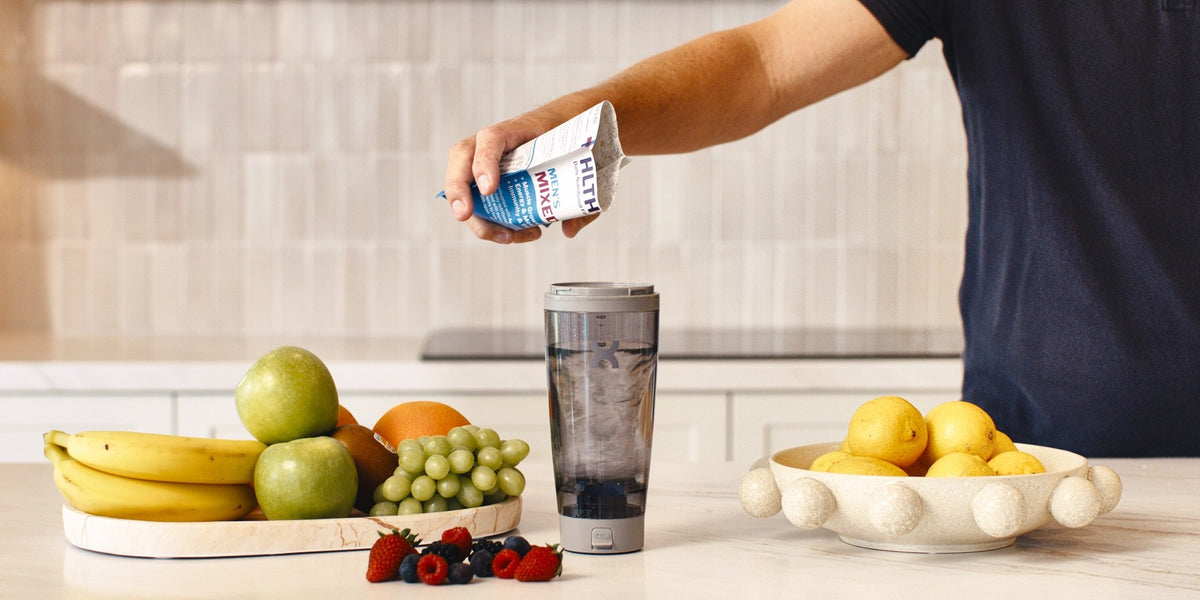
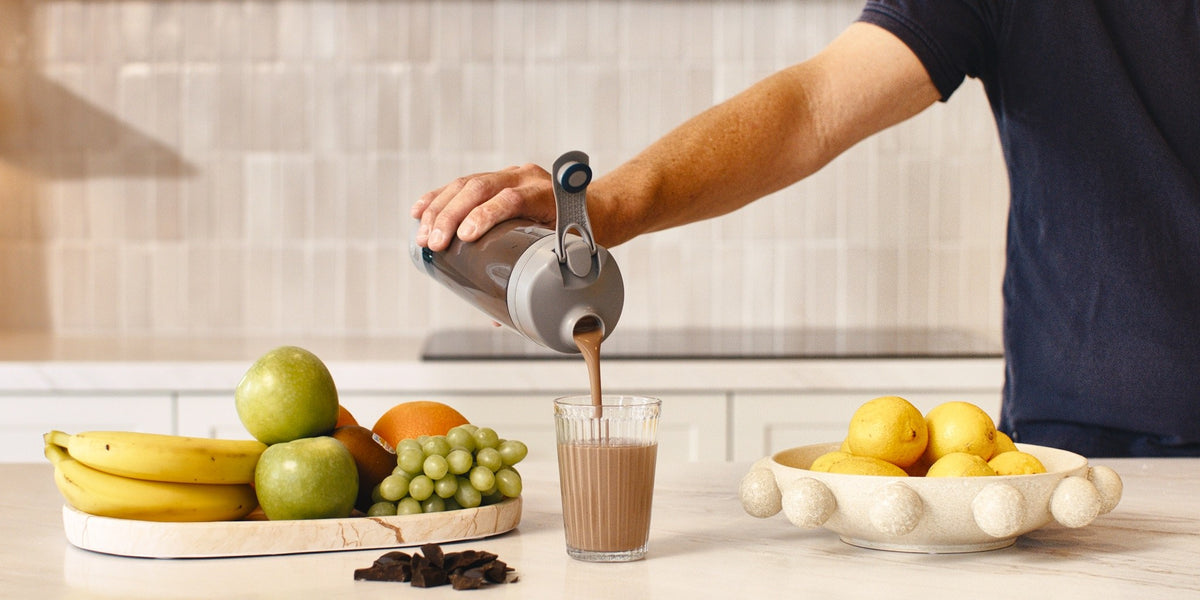
The other direction is a different category altogether. HLTH+ is a different kind of product from a greens powder: a daily nutritional formula, a Formulated Supplementary Food under the Food Standards Code, taken alongside meals in a 55g sachet (Women's; Men's runs 60-62g). It belongs in this section for one reason, which is the row both products above leave open.
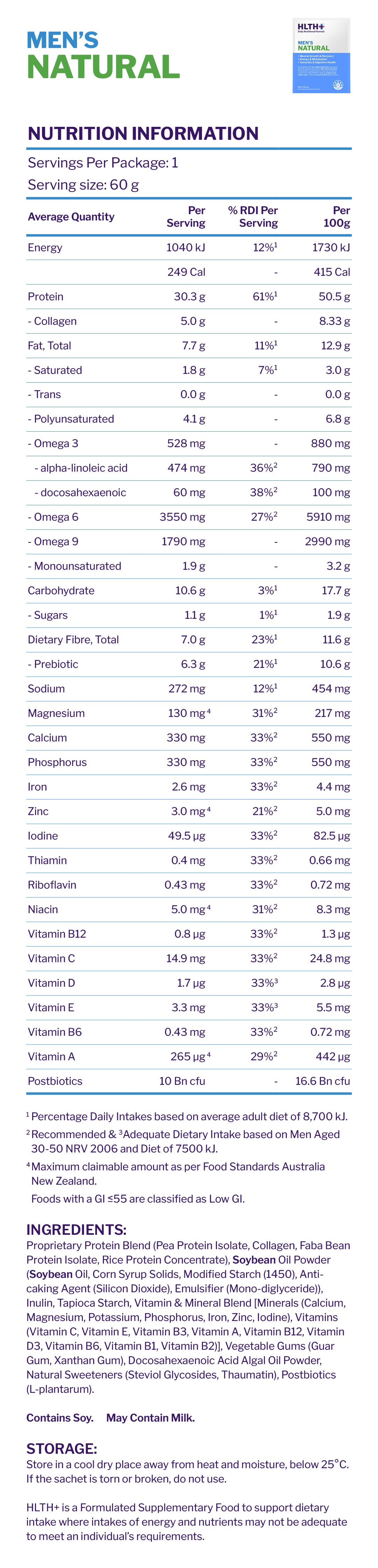
One sachet lists 30g protein per serve and 7g dietary fibre, against 2 g and 2 g on AG1's Australian panel and no published figure for either on IM8's own pages. Protein contributes to the maintenance and growth of muscle mass and to tissue repair, and dietary fibre contributes to regular laxation, as part of a healthy diet involving a variety of foods. The same sachet lists 5g collagen, 60mg DHA and 10 billion CFU Lactobacillus Plantarum Postbiotic alongside prebiotics, and it carries a balanced multivitamin profile.
Across protein, dietary fibre, vitamins, minerals, collagen and DHA, each serve supplies 30 essential daily nutrients. It is Australian made in facilities complying with Good Manufacturing Practice, dairy-free, gluten-free and low GI, with no nasties, artificial colours, artificial flavours or artificial sweeteners, and it holds hundreds of reviews.
The row neither scoop above can answer is who the formula was built for. HLTH+ is dietitian-formulated to the Nutrient Reference Values, the published government intakes developed by the National Health and Medical Research Council, the Australian Government Department of Health and Ageing and the New Zealand Ministry of Health, and those values move with age and sex, which is why the range runs Women's, Women's 50+, Men's and Men's 50+ rather than one scoop for every adult. It sells at hlthplus.com at RRP $6.00, or $5.10 a day on a 28-serve subscription at $142.80 and $5.40 a day on a 14-serve subscription at $75.60, and through Amazon AU and Chemist Warehouse online.
Find out what your current scoop is not giving you. The 30-second ✦ Find My Formula quiz reads your existing routine and shows the gaps it leaves.
Frequently Asked Questions
Is IM8 better than AG1?
On disclosure, AG1: its Australian label publishes a full panel, 13 g serve, 41 calories, 2 g protein, 2 g dietary fibre, under 1 g sugars. On micronutrient amounts, IM8: its ingredients page lists 900 mg vitamin C, 100 mg magnesium and 470 mg potassium per serve. Different strengths, same category.
How much protein is in IM8 and AG1?
AG1's Australian label lists 2 g of protein per 13 g serve, retrieved 2 September 2026. IM8's own product and ingredients pages carry no protein line at all, retrieved 15 September 2026. Neither product is built to cover protein; a 12 g to 13 g scoop has no room for a meaningful dose.
Does IM8 or AG1 have more probiotics?
Both state 10 billion CFU per serve. AG1's Australian label names five strains; IM8's ingredients page names two, Bacillus coagulans BC99 and Bacillus subtilis DE111, and separately lists a postbiotic, Lactobacillus casei 327, at 25 mg. A postbiotic count and a probiotic count are not the same measurement.
What are the alternatives to IM8 in Australia?
For the same greens ritual, WelleCo's The Super Elixir and Vital All-In-One are the Australian options, with their published figures on the AG1 alternatives page. If you wanted protein and dietary fibre covered too, that is a different category: HLTH+ lists 30g protein per serve and 7g dietary fibre in a 55g sachet.
This article is general information, not medical advice. Decisions about any medication belong with your doctor. Figures quoted are each brand's published information at the retrieval dates shown; check current labels before buying.

Leave a comment
This site is protected by hCaptcha and the hCaptcha Privacy Policy and Terms of Service apply.