

There is no single best multivitamin for women, and any page that names one without asking what you eat is guessing. There is a best one for your gaps, and in Australia those gaps sit in a short list of nutrients that shifts as you get older.
You are standing in front of a shelf where four bottles all say "for women", the numbers are on the back in small type, and the units change between brands. The front of pack is doing all the talking.
This page gives you the four criteria that decide it, the panels of the three brands Australians buy most, and the intake data that says which numbers matter.
What actually separates one multivitamin from another?
Four criteria, and only the first one is about the brand at all.
- How much of each nutrient, as a share of the Recommended Dietary Intake. Milligrams mean nothing on their own. Schedule 1 of the Australia New Zealand Food Standards Code sets the reference figures a label's percentages are calculated against: calcium 800mg, iron 12mg, magnesium 320mg, zinc 12mg, vitamin C 40mg, iodine 150 micrograms, vitamin D 10 micrograms and folate 200 micrograms a day.
- Whether it covers what you are actually short of. A tablet that triples your vitamin C and gives you 5% of your calcium is not wrong, it is answering a question you did not ask.
- Whether the formula changes with life stage. Requirements move at 30, at 50 and again at 70, and different nutrients move in different directions.
- Form, and what the format can hold. A tablet holds vitamins and minerals, not protein or dietary fibre, and not a full day's calcium.
A fifth question sits underneath all of them: does a multivitamin do anything at all? That has its own page, do multivitamins work. The short version is that the disease-prevention case is weak and the intake-gap case is solid, which is why the rest of this page is about gaps.
Which nutrients are Australian women actually short of?
The Australian Bureau of Statistics models usual long-term intake from food and drink with supplements excluded, so it measures the exact gap a supplement would have to fill. It is the part almost every roundup skips.
In the 2023 results, 75.7% of females aged 2 and over had an inadequate calcium intake against 52.1% of males, and 26.8% of females had an inadequate iron intake against 8.2% of males (Australian Bureau of Statistics, Usual Nutrient Intakes, 2023).
Split by age, the pattern is sharper than the headline.
| Females, by age | Inadequate calcium intake | Inadequate iron intake | Inadequate vitamin B6 intake |
|---|---|---|---|
| 18 to 29 | 81.1% | 47.7% | 58.7% |
| 30 to 49 | 70.3% | 42.2% | 60.2% |
| 50 to 64 | 90.7% | 9.8% | 77.7% |
| 65 to 74 | 87.6% | 9.9% | 80.2% |
| 75 and over | 87.2% | 9.4% | 80.0% |
Figures from the Australian Bureau of Statistics, Usual Nutrient Intakes, 2023, released 17 March 2026. Inadequate means a usual intake below the Estimated Average Requirement.
Read the iron and calcium columns together, because they move in opposite directions. In the same release the female Estimated Average Requirement for iron falls from 8mg a day at 18 to 49 to 5mg from 50, while the calcium requirement rises from 840mg at 30 to 49 to 1,085mg at 50 to 64. That crossover is the whole argument for life-stage formulation, and it is the government's own number, not a marketing idea.
Over 90% of Australian adults do not meet dietary guidelines (AIHW), which is the base rate a supplement works against. Nutrient by nutrient: calcium, vitamin D, vitamin B12 and magnesium.
What do Blackmores, Swisse and Centrum actually list?
These three dominate the Australian aisle and the search results. Every figure below was read from each brand's own published ingredient panel on 15 September 2026, set beside the reference figure the Food Standards Code uses.
| Per daily tablet | Food Standards Code RDI | Blackmores Multivitamins for Women | Swisse Ultivite Women's | Centrum For Women |
|---|---|---|---|---|
| Vitamin C | 40mg | 45mg | 165mg | 150mg |
| Vitamin D | 10 micrograms | 5 micrograms (published as 200 IU) | 25 micrograms | 20 micrograms |
| Vitamin B6 | 1.6mg | 1.3mg | 24.68mg | 6mg |
| Vitamin B12 | 2 micrograms | 2.4 micrograms | 50 micrograms | 21.6 micrograms |
| Folic acid | 200 micrograms (folate) | 400 micrograms | 500 micrograms | 300 micrograms |
| Calcium | 800mg | 100mg | 42mg | 400mg |
| Iron | 12mg | 5mg | 4.9mg | 6.8mg |
| Magnesium | 320mg | 80mg | 105mg | 64mg |
| Zinc | 12mg | 8mg | 5mg | 8mg |
| Iodine | 150 micrograms | 150 micrograms | 50 micrograms | 150 micrograms |
Figures are each brand's published ingredient information, retrieved 15 September 2026. All three are one tablet a day. Brands reformulate, so check the current label before you buy.
Two things fall out of that table. On calcium, the nutrient three quarters of Australian females fall short on, Centrum For Women lists 400mg, half the reference figure; Blackmores lists 100mg, an eighth of it; Swisse lists 42mg, about 5%. No one-a-day tablet carries a full day's calcium, because the mineral is too bulky to fit.
Iron sits close across all three at 4.9mg to 6.8mg, and both Swisse panels carry the warning "Not for the treatment of iron deficiency conditions", so iron deficiency stays a blood-test question for your doctor.
On the B group they diverge wildly. Swisse Ultivite Women's lists 24.68mg of vitamin B6 where Blackmores lists 1.3mg, and Swisse carries the mandatory nerve warning that goes with higher-dose B6. More is not automatically better, and B6 is the one place on these panels where the ceiling matters as much as the floor.
Does the formula really change after 50?
Sometimes, and it is worth checking rather than assuming, because "50+" on the front of a pack is not a regulated promise about what changed inside.
Centrum publishes both formulas, so the comparison is direct. From Centrum For Women to Centrum For Women 50+, vitamin B6 rises from 6mg to 9.7mg, vitamin B12 from 21.6 to 35 micrograms and magnesium from 64mg to 100mg, while iron falls from 6.8mg to 6mg and calcium falls from 400mg to 300mg.
The B6 increase tracks the data well: female B6 inadequacy jumps from 60.2% at 30 to 49 to 80.2% at 65 to 74. The calcium reduction runs the other way from the requirement, which rises after 50.
Swisse publishes both too. Its Ultivite Women's 50+ adds vitamin A at 750 micrograms retinol equivalents and biotin at 150 micrograms, lifts vitamin E from 24.79mg to 41.33mg, copper from 58 micrograms to 1.2mg and selenium from 26 to 50 micrograms, and holds calcium at 42mg. Blackmores takes a different route: its 50+ product is published as a "tailormade blend of essential vitamins and minerals for people over 50", not as a formula split by sex.
So the answer to "what is the best multivitamin for women over 50" is that two of the three change the formula, and none moves calcium in the direction the requirement moves. Read both panels before you upgrade. If what prompted the search is a change in how you feel rather than your age, perimenopause symptoms is the better starting point, and menopause supplements covers what the evidence supports at that stage.
How do you read a multivitamin label in one minute?
Five checks, in this order, on any brand.
- Find the elemental amount, not the compound. Blackmores publishes "calcium hydrogen phosphate 339mg, equivalent calcium 100mg". The big number is the compound; the small one is the mineral you absorb.
- Convert the units before you compare. Blackmores publishes its vitamin D as "colecalciferol 5 micrograms, equivalent vitamin D3 200 IU"; Swisse and Centrum publish micrograms only. The same dose looks far bigger on one scale.
- Divide by the reference figure. Use the Code numbers above on the two or three nutrients you care about. The rest of the panel is detail.
- Read the warnings, not just the benefits. The selenium ceiling, the B6 nerve warning and the vitamin A warning on 50+ formulas are all there for a reason.
- Read the line the regulator makes them print. Blackmores states it plainly: "Dietary supplements can only be of assistance if dietary intake is inadequate." That is the logic of the category in eleven words.
More on the nutrients that matter most as you get older: the HLTH+ vitality page.
What happens to these gaps when you are eating a lot less?
Every percentage on a panel assumes food underneath it, so when the volume of food drops the arithmetic changes first. A reduced appetite shrinks intake at the source, whether from a calorie deficit, an illness, a change in routine or a medication. Intake data in people taking GLP-1 medications shows the pattern: average dietary fibre intake was 14.5g a day against the 28g recommended (Frontiers in Nutrition, 2025).
This is general information, not medical advice, and decisions about any medication belong with your doctor. If your intake has dropped a long way, the conversation worth having is with a doctor or an Accredited Practising Dietitian about what to test.
So which one should you buy?
One pick per reader, on the criteria above.
- If calcium is your gap, and on the ABS data it probably is: Centrum For Women, at 400mg, half the reference figure. Treat it as a top-up and get the rest from food.
- If you want the widest B group and the herbal extras: Swisse Ultivite Women's, with the B6 warning read and understood. It is the broadest ingredient list of the three by a distance.
- If you want a simple one-a-day with 400 micrograms of folic acid and 150 micrograms of iodine: Blackmores Multivitamins for Women. It lists less vitamin D than the other two and states that it contains soya bean products and sulfites.
- If you are over 50: compare both panels of whichever brand you already trust rather than assuming the 50+ version is simply more.
If vitamins and minerals are all you need, a tablet is the cheapest way to buy them. Swisse publishes $24.99 for 30 tablets of its Women's Ultivite, retrieved 15 September 2026, which is under a dollar a day. What a tablet cannot carry is 30g protein and 7g dietary fibre, and that is the line to look past the price on.
Where a daily nutrition formula fits, and where a tablet still wins
If your food is close to the guidelines and your only gaps are micronutrients, buy one of the three above and stop reading.
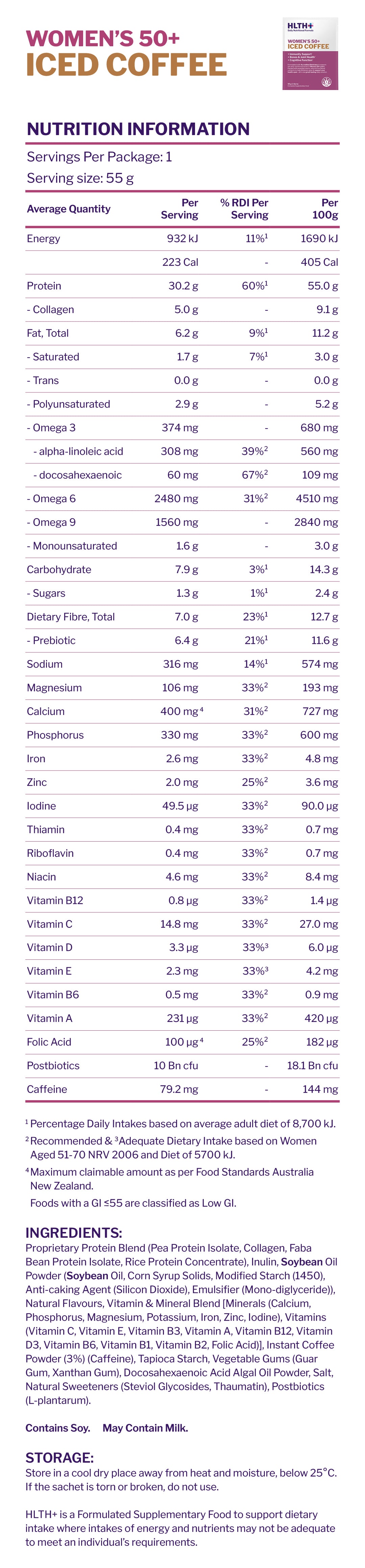
HLTH+ is not a multivitamin and does not compete with one on price. It is a Formulated Supplementary Food, a 55g sachet mixed with water, built for the reader whose day of food has shrunk and whose gaps run wider than micronutrients. It carries a balanced multivitamin profile, and it carries what a tablet has no room for.
| Blackmores Multivitamins for Women | Swisse Ultivite Women's | Centrum For Women | HLTH+ Women's | |
|---|---|---|---|---|
| Form and daily serve | one tablet | one film coated tablet | one tablet | one 55g sachet mixed with water |
| Protein on the panel | not listed | not listed | not listed | 30g per serve |
| Dietary fibre on the panel | not listed | not listed | not listed | 7g per serve |
| A formula published for women 50 and over | no, its 50+ tablet is published for people over 50 rather than split by sex | yes, Swisse Ultivite Women's 50+ | yes, Centrum For Women 50+ | yes, Women's 50+ |
| Category on the label | multivitamin tablet | multivitamin tablet | multivitamin tablet | Formulated Supplementary Food |
Figures are each brand's published information, retrieved 15 September 2026. Check current labels before purchase.
Protein contributes to the maintenance of muscle mass, and dietary fibre contributes to regular laxation, as part of a healthy diet involving a variety of foods. The Women's serve also carries 106mg of magnesium, 33% of the Recommended Dietary Intake, and magnesium contributes to a reduction of tiredness and fatigue, again as part of a healthy diet involving a variety of foods. Alongside those sit 5g collagen, 10 billion CFU Lactobacillus Plantarum Postbiotic and 60mg DHA.
Counted across protein, dietary fibre, vitamins, minerals, collagen and DHA, that is 30 essential daily nutrients in one sachet, dairy-free and gluten-free. Allergen line: contains soy.
Then the life-stage point, which a general tablet cannot make. Australian food labels calculate percentage daily intakes against an average adult diet of 8,700 kJ under Standard 1.2.8 of the Food Standards Code, a labelling reference value that sits above what the Nutrient Reference Values recommend for most adults, so a formula built to it over-serves the individual drinking it. HLTH+ is formulated to the Nutrient Reference Values instead, by gender and life stage, across Women's, Women's 50+, Men's and Men's 50+, and those values were published in 2006 by the National Health and Medical Research Council, the Australian Government Department of Health and Ageing and the New Zealand Ministry of Health.
That is the consolidation case. If you already buy a multivitamin, a fibre supplement, a collagen and a protein powder, one sachet is one habit instead of four, made in Australia in facilities that comply with Good Manufacturing Practice. RRP $6.00, or $5.10 a day on a 28-serve subscription at $142.80, at hlthplus.com, on Amazon AU and at Chemist Warehouse online.
If protein is the piece you are weighing, the best protein powder for women covers that category on its own criteria.
Find out what your current stack is actually missing. The ✦ Find My Formula quiz takes about 30 seconds and is built to show you the gaps your existing bottles are leaving. Take the quiz.
Frequently Asked Questions
What is the best multivitamin for women in Australia?
There is no single best one. On the 2023 Australian Bureau of Statistics intake data, calcium and iron are the two biggest gaps for females, so compare published panels on those first. Of the three biggest brands, Centrum For Women lists the most calcium at 400mg, half the Food Standards Code reference figure of 800mg.
How much calcium is in a multivitamin for women?
Less than you would expect, because calcium is bulky. Retrieved 15 September 2026, Centrum For Women lists 400mg per tablet, Blackmores Multivitamins for Women 100mg and Swisse Ultivite Women's 42mg, against a Food Standards Code reference figure of 800mg a day. No one-a-day tablet carries a full day's calcium.
Is a 50+ multivitamin actually different?
Often, but not always in the ways you would assume. Centrum For Women 50+ raises vitamin B6 from 6mg to 9.7mg and magnesium from 64mg to 100mg while lowering calcium from 400mg to 300mg. Blackmores publishes a 50+ tablet for people over 50 rather than a version split by sex. Compare the two panels.
Do I need a multivitamin if I already eat well?
Probably not for micronutrients alone, and a tablet is the cheapest way to cover them if you do. The Australian base rate is the argument for one: over 90% of Australian adults do not meet dietary guidelines (AIHW), and 75.7% of females have an inadequate calcium intake. Check your own week before you buy.
Is a daily nutrition formula the same as a multivitamin?
No. A tablet holds vitamins and minerals only. HLTH+ is a Formulated Supplementary Food carrying a balanced multivitamin profile alongside 30g protein, 7g dietary fibre, 5g collagen and 60mg DHA per 55g serve, formulated to the Nutrient Reference Values by gender and life stage. It costs far more per day than a tablet.
Leave a comment
This site is protected by hCaptcha and the hCaptcha Privacy Policy and Terms of Service apply.