

What is the best meal replacement shake?
On published labels, the strongest everyday option is the pair from the same Australian group: The Man Shake lists 30g protein, 7.5g dietary fibre and 2.4g sugars a serve, and The Lady Shake Vanilla lists 30.0g protein, 7.1g dietary fibre and 2.3g sugars in a 56g serve at 850 kJ (both retrieved 15 September 2026). If a clinician is running your program, Optifast is the pharmacy option, and its Protein Plus line carries 28g protein with 2.2g sugars per 63g serve.
The panels are not comparable at a glance. One brand publishes a sugar figure for its best flavour and not its worst, another publishes no serving size at all, and a third carries 27g of sugars on purpose because it was built for a hospital ward rather than a diet.
This page sets the criteria first, puts the published panels side by side with nothing missing, and says plainly who each product is for and who does not need one at all.
What counts as a meal replacement shake in Australia?
"Formulated meal replacement" is a prescribed name in the Australia New Zealand Food Standards Code, not a marketing phrase. Standard 2.9.3 defines one as a food "specifically formulated as a replacement for one or more meals of the day, but not as a total diet replacement" (Standard 2.9.3, Food Standards Code, retrieved 15 September 2026).
The composition floor is specific. Section 2.9.3-3 states that a formulated meal replacement "must contain in a serving no less than: (a) 12 g protein; and (b) 850 kJ; and (c) 25% RDI of each vitamin and mineral listed in Column 1 of the table to section S29-12". That is the bar a product has to clear before the words go on the front.
That is a floor, not a recommendation, so the gap between the floor and a good product is where the shopping happens. A very low calorie diet product is different again: it is designed for a supervised total diet replacement program, which is why it sits behind a pharmacy counter.
What separates a good meal replacement shake from a weak one?
Five criteria decide it, and every one of them is readable off a panel before you buy.
- Protein per serve. Under Schedule 4 of the Food Standards Code, 10g a serving is the threshold for "good source of protein", and the standard's own meal replacement floor is 12g. The everyday shakes in this category sit near 30g; the pharmacy programs sit between 17.7g and 28g.
- Sugars per serve, and what they are. A double-figure sugar number is not automatically bad: on the standard Optifast shake, 11.7g of the 12.7g is lactose from skimmed milk powder.
- Dietary fibre per serve. Schedule 4 sets 2g a serving for any dietary fibre claim, 4g for "good source" and 7g for "excellent source". Across this category the published figures run from 0.8g to 8.9g, which is the widest spread of any row.
- Flavour variance, checked on the flavour you actually buy. This is where most roundups mislead. The Lady Shake publishes 20 flavours whose sugars run from 1.9g to 7.1g and whose dietary fibre runs from 3.2g to 8.9g (retrieved 2 September 2026), and The Man Shake's own page lists 2.4g of sugar as the headline and 6.1g for Birthday Cake (retrieved 15 September 2026).
- What the product is actually for. A supervised very low calorie program, a retail meal swap and a clinical nutrition formula are three different jobs, and buying across those lines is the most common mistake here.
How the meal replacement shakes compare on their published labels
Every figure below is the brand's own published nutrition information, read on 15 September 2026. Where a panel is flavour-specific, the flavour is named in the row.
| Product | Serve as published | Energy per serve | Protein | Dietary fibre | Sugars |
|---|---|---|---|---|---|
| The Man Shake (Chocolate) | Not published on their own product page | Not published on their own product page | 30g | 7.5g | 2.4g |
| The Lady Shake (Vanilla) | 56g | 850 kJ / 203 cal | 30.0g | 7.1g | 2.3g |
| OPTIFAST VLCD Shake (Chocolate) | 53g powder | 850 kJ / 203 Cal | 20g | 3.6g | 12.7g, of which 11.7g is lactose |
| OPTIFAST VLCD Protein Plus (Chocolate) | 63g powder | 1050 kJ / 250 Cal | 28g | 3.6g | 2.2g |
| OptiSlim VLCD Classic Shake (Chocolate) | 43g sachet | 692 kJ / 165 Cal | 17.7g | 0.8g | 13.7g |
| Sustagen Hospital Formula (Vanilla) | 60g powder in 200mL water | 940 kJ / 225 kcal | 13.8g | No dietary fibre row on the panel | 27g |
Figures are each brand's published nutrition information, retrieved 15 September 2026. Flavours vary and brands reformulate, so check the current label before purchase.
Three rows deserve a sentence each. The Man Shake publishes protein, dietary fibre and sugars but no serving size and no energy figure on its own product page, so you cannot check it against the 850 kJ floor from the brand's own material. OptiSlim's 692 kJ sits below that floor, which is consistent with a very low calorie diet product built for a supervised program rather than an everyday meal swap. Sustagen Hospital Formula's 27g of sugars is calorie density on purpose for someone who is unwell or losing weight without meaning to, a different design brief entirely.
Learn more in the Optifast review, the OptiSlim review, the Optifast Protein Plus read and the Lady Shake review.
What is each one actually sold as?
The category splits three ways, and the split matters more than any single number on the panel.
| Product | How it is sold | What the brand says about supervision |
|---|---|---|
| The Man Shake and The Lady Shake | Direct and retail, inside the brand's weight-loss program | No supervision statement; sold straight to the public |
| OPTIFAST VLCD Shake and Protein Plus | Australian pharmacies, inside a four-level program | "OPTIFAST VLCD is for the dietary management of overweight and obesity and must be used under the supervision of a healthcare professional" |
| OptiSlim VLCD Classic Shake | Direct and pharmacy | Recommends "speaking with your GP or pharmacist before starting, especially if you have an existing medical condition" |
| Sustagen Hospital Formula | Pharmacy and grocery, as clinical nutrition | "Use as a meal replacement option or nutritional supplement"; the brand states it "cannot be used as a total diet replacement" |
Allergens rule some readers out before any of the numbers matter. Every product in the table above is milk-based: Optifast Protein Plus declares milk, soy and fish with a phenylalanine warning, OptiSlim declares gluten, milk, soy and caffeine, and Sustagen declares milk and may contain soy (all retrieved 15 September 2026). If dairy is the reason you are reading this, learn more in the dairy-free and lactose-free options.
This article is general information, not medical advice. A very low calorie diet is a clinical weight-management program, and decisions about starting, continuing or stopping one, or about any medication, belong with your doctor.
Which meal replacement shake is the pick, and who is it for?
For an everyday meal swap: The Man Shake and The Lady Shake. On the criteria above they win the rows a shopper can act on: around 30g of protein, dietary fibre at or near the 7g "excellent source" threshold on the flavours read for this page, and low sugars on most flavours. Both are milk-based and both are sold inside the brand's own weight-loss program, so you are buying a program as much as a shake.
Two things to know before buying. The flavour decides the answer: on The Lady Shake the published sugar figures span 1.9g to 7.1g and the dietary fibre spans 3.2g to 8.9g (retrieved 2 September 2026), so the range and your tin can be different products nutritionally. And The Man Shake's own page still publishes no serving size and no energy figure, which means the 30g of protein cannot be read as a proportion of anything. Learn more in the Man Shake review.
If a healthcare professional is running your program: Optifast, and Protein Plus if protein is the priority. The standard shake is 20g of protein at 850 kJ; Protein Plus is 28g at 1050 kJ with 2.2g of sugars instead of 12.7g, because lactose accounts for almost all of the standard shake's sugar. Which one, and which level of the program, is a clinical decision rather than a shopping one, and the fairest side-by-side of the two very low calorie diet brands is in the Optifast and OptiSlim referee piece.
If a dietitian or doctor put you on Sustagen Hospital Formula: keep taking it. It is clinical nutrition, its 13.8g of protein and 27g of sugars answer a different question from a diet shake, and no product on this page is a substitute for something a clinician recommended. Raise any change with them, and learn more in the read on Sustagen.
Learn more about what actually changes in your nutrition when your overall intake drops, whether that is a deliberate deficit or a reduced appetite: the nutrition read is here.
Who does not need a meal replacement shake at all?
A large share of the people searching this term do not want to replace a meal. They want the nutrition they think they are missing, and a shake is the format they know. Those are different problems.
The gap is real enough: over 90% of Australian adults do not meet dietary guidelines on the AIHW poor-diet measure. That measure describes diet quality, not a shortage of meals. Replacing a meal removes calories; it does not by itself improve what the rest of the day looks like.
A second group is already eating less than they used to. When appetite falls away, whether from rapid weight loss, reduced eating and medically induced weight loss, or simply from getting older, the problem is not too many meals. It is that the meals still being eaten have to carry more.
Where a Formulated Supplementary Food fits instead
HLTH+ is not designed as a meal replacement, because it is built to complement a food-first approach rather than stand in for it. Used as a healthy snack, or to tie you over when a proper meal is hours away, it works perfectly well, and that is a fair way to use it.
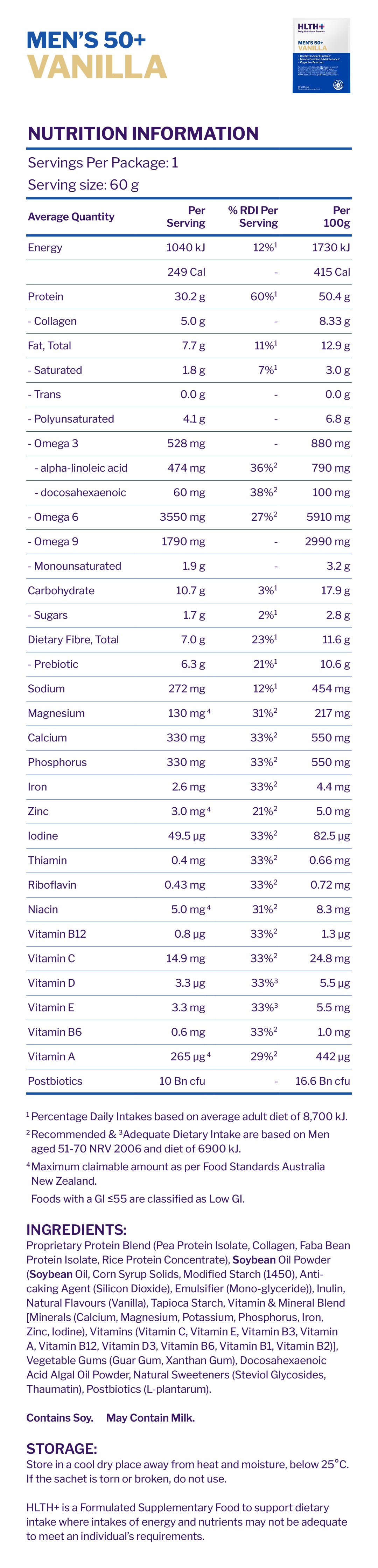
It is a Formulated Supplementary Food, which the same Standard 2.9.3 defines as a food formulated "as a supplement to a normal diet to address situations where intakes of energy and nutrients may not be adequate to meet an individual's requirements". One 55g Women's sachet carries 30 essential daily nutrients across protein, dietary fibre, vitamins, minerals, collagen and DHA: 30g protein per serve, 7g dietary fibre, 5g collagen, 60mg DHA and 10 billion CFU Lactobacillus Plantarum Postbiotic alongside prebiotics, at 1.5g of sugar with none added and 223 calories. The Men's sachet holds the same 30g of protein at 1.7g of sugar and 248 calories.
As part of a healthy diet involving a variety of foods, protein contributes to the maintenance of muscle mass and dietary fibre contributes to regular laxation. A postbiotic is the inactivated form of a beneficial bacterium together with the compounds it produced, and the formula uses one because it is stable on a shelf in a way a live culture is not. That is also why a postbiotic count and a probiotic count are not like for like: the numbers are printed to be read, not added up against each other.
Each sachet also carries a balanced multivitamin profile. The formulas are dosed by sex and life stage across Women's, Women's 50+, Men's and Men's 50+, formulated by Accredited Dietitians to the Nutrient Reference Values published in 2006 by the National Health and Medical Research Council, the Australian Government Department of Health and Ageing and the New Zealand Ministry of Health. It is Australian-owned and made in facilities complying with Good Manufacturing Practice, dairy-free and gluten-free, and carries a 5-star Health Star Rating.
A serve is RRP $6.00, or $5.10 a day on a 28-serve subscription at $142.80, with no lock-in. It sells at hlthplus.com and online through Amazon AU and Chemist Warehouse.
Not sure whether you need to replace a meal or just cover what it is missing? The 30-second ✦ Find My Formula quiz is built to show what your current stack is not giving you.
Frequently Asked Questions
What is the best meal replacement shake in Australia?
On published labels, The Man Shake and The Lady Shake lead the everyday end: 30g protein with 7.5g dietary fibre and 2.4g sugars, and 30.0g protein with 7.1g dietary fibre and 2.3g sugars in a 56g Vanilla serve (retrieved 15 September 2026). Optifast is the supervised pharmacy option at 20g protein.
What makes a shake a meal replacement in Australia?
Standard 2.9.3 of the Food Standards Code sets the floor. A formulated meal replacement must contain, in a serving, no less than 12g protein, 850 kJ, and 25% of the RDI of each vitamin and mineral listed in the relevant schedule table. It is formulated to replace a meal, never a whole diet.
How much protein should a meal replacement shake have?
The legal floor is 12g a serving, and 10g is the Schedule 4 threshold for "good source of protein". The everyday shakes in this category publish around 30g, the pharmacy programs 17.7g to 28g, and Sustagen Hospital Formula 13.8g (all retrieved 15 September 2026). Higher is not automatically better; match it to the job.
Is Optifast or OptiSlim better?
They are both very low calorie diet products used inside a program, so the answer is that a clinician decides. On the Chocolate panels, Optifast publishes 20g protein, 3.6g dietary fibre and 12.7g sugars per 53g serve, and OptiSlim 17.7g protein, 0.8g dietary fibre and 13.7g sugars per 43g sachet (retrieved 15 September 2026).
Is HLTH+ a meal replacement shake?
No. It is not designed as a meal replacement, because it is built to complement a food-first approach rather than stand in for a meal. It works fine as a healthy snack or to tie you over, and it is a Formulated Supplementary Food carrying 30g protein and 7g dietary fibre in a 55g sachet.
This article is general information, not medical advice. Decisions about a very low calorie diet program, a clinically recommended nutrition product, or any medication, belong with your doctor.


Leave a comment
This site is protected by hCaptcha and the hCaptcha Privacy Policy and Terms of Service apply.