

Macro Mike's published nutrition panel for Premium Almond Protein lists 23.7g of protein, 4.6g of dietary fibre and 3.1g of sugars per 40g serve, alongside 1 billion CFU of probiotic and 18 amino acids with amounts (retrieved 15 September 2026). That is a strong plant protein label, published in more detail than most of the category manages.
The trouble with shortlisting it is that almost nothing written about this brand reads the panel. Search its name and you get flavour threads and star ratings, which tell you how it tastes and nothing about what a serve carries.
This review puts the published figures on the table, names where Macro Mike genuinely wins, and shows where a daily nutritional formula is doing a different job, not a better version of the same one.
What does Macro Mike put on its label?
Macro Mike is an Australian plant-based protein brand built on an almond and faba bean base, sold in 400g and 800g bags across a large flavour range. The figures below come from their own published panel for Deluxe Chocolate Premium Almond Protein, 400g, retrieved 15 September 2026. Panels are flavour-specific, so check the bag you are buying.
Per 40g serve, with 10 serves a bag:
- Protein 23.7g, from almond protein and faba bean protein
- Dietary fibre 4.6g
- Sugars 3.1g, inside 4.1g of total carbohydrate
- 598 kJ, or 142.9 calories
- Fat 3.5g, of which 0.7g is saturated, and sodium 219mg
- Probiotic LactoSpore (Bacillus coagulans) 50mg, stated as 1 billion CFU
- Panmol B Vitamin Complex 300mg, with eight B vitamins published as amounts, plus calcium 156.9mg, iron 2.4mg, magnesium 374.1mg and potassium 223.4mg
Two rows are unusual. The amino acid profile runs to 18 acids with milligram amounts, more disclosure than most tubs manage. Magnesium at 374.1mg a serve is high enough to belong in your decision if you already take a magnesium supplement.
The allergen statement matters as much as the macros. Their panel reads, verbatim, that the product contains almonds and is produced in the same facility that handles products also containing peanuts, cashews, hazelnuts and soy. If you avoid tree nuts, that settles it.
How do you judge a plant protein powder from its label?
Ignore the front of the bag and read six lines off the panel.
- Protein per serve, and protein as a share of the powder. A 40g serve and a 25g serve are not the same measurement, so divide protein by serve size before comparing two tubs.
- Dietary fibre per serve. Under Schedule 4 of the Australia New Zealand Food Standards Code, a food needs 4g per serving to be called a good source of dietary fibre and 7g to be called an excellent source. Most plant powders sit well under the first line.
- Sugars per serve, and whether any of it was added.
- Live cultures, and which kind. A probiotic count and a postbiotic count are not the same measurement.
- Whether the amino acid amounts are printed. Claiming a full profile and printing the milligrams are not the same thing.
- Who the formula was calculated for. Australian labels work out percentage daily intakes against an average adult diet of 8,700 kJ under Standard 1.2.8 of the Food Standards Code. That is a labelling reference value, not a recommendation for you, and it sits above what the Nutrient Reference Values advise for most adults, so a formula built to it over-delivers calories.
Over 90% of Australian adults do not meet dietary guidelines on the AIHW poor-diet measure, and fewer than 1 in 20 eat the recommended serves of vegetables (ABS). The gap a daily shake is asked to cover is wider than protein.
What do the reviews of Macro Mike actually say?
We checked the live Google Australia results on 15 September 2026, and their shape is the finding. Two of the top ten organic results are Reddit threads in an Australian vegan community, both arguing about which flavour is best. The rest are the brand's own reviews page, a Trustpilot page, two retailer blog posts and an Amazon listing.
The third-party rating is strong. Trustpilot's Australian page showed a TrustScore of 4.9 out of 5 across 902 reviews that day, and their own product pages claim over 35,000 five star reviews.
What none of them do is read the panel, and that is the gap this page fills.
Macro Mike, Nuzest and HLTH+, label to label
Two dedicated plant protein powders and one daily nutritional formula, quoted from each brand's published information. Nuzest Clean Lean Protein is the second plant-based column because it is the most protein-dense powder we hold a verified panel for. No row appears unless every cell is filled.
| Per serve | Macro Mike Premium Almond Protein (40g, Deluxe Chocolate) | Nuzest Clean Lean Protein (25g, Smooth Vanilla) | HLTH+ Women's (55g) |
|---|---|---|---|
| Protein | 23.7g, almond and faba bean | 20g, golden pea protein isolate | 30g |
| Protein as a share of the powder | 59% | 80% | 55% |
| Dietary fibre | 4.6g | 0.3g | 7g |
| Sugars | 3.1g | 0.2g | 1.5g, none added |
| Calories | 142.9 | 102 | 223 |
| Live cultures | 1 billion CFU LactoSpore (Bacillus coagulans) | None listed on the panel | 10 billion CFU Lactobacillus Plantarum Postbiotic, plus prebiotics |
| Collagen | Not listed | Not listed | 5g |
| Essential fats | No DHA listed | No DHA listed | 60mg DHA |
| Vitamins and minerals published | Eight B vitamins, calcium, iron, magnesium, potassium, with amounts | Iron 3.6mg | A balanced multivitamin profile |
| Amino acid amounts published | Yes, 18 acids | Yes, 9 essential and 10 non-essential | Not published; blend listed as pea protein isolate, collagen, faba bean protein isolate and rice protein concentrate |
| Allergens, as each brand publishes them | Contains almonds; made in a facility handling peanuts, cashews, hazelnuts and soy | "No gluten, dairy or soy" | Dairy-free and gluten-free, and it contains soy |
| Price per serve | $5.50 (400g at $54.95), or $4.75 (800g at $94.95) | 2.95(59.00 across 20 serves) | RRP $6.00, or $5.10 a day on a 28-serve subscription at $142.80 |
| Category | Dedicated plant protein powder | Dedicated plant protein powder | Formulated Supplementary Food |
| Formulated for | Everyone, across a flavour-led range | Everyone | Sex and life stage, by Accredited Dietitians to the Nutrient Reference Values |
Figures from each brand's published nutrition information, retrieved 15 September 2026; check current labels before purchase. Panels are flavour-specific and brands reformulate. Macro Mike's prices were re-read on 22 September 2026; the markdown seen on 15 September has ended.
The formulation row needs unpacking. HLTH+ publishes separate Women's, Women's 50+, Men's and Men's 50+ versions, formulated by Accredited Dietitians to the Nutrient Reference Values, the intakes published in 2006 by the National Health and Medical Research Council, the Australian Government Department of Health and Ageing and the New Zealand Ministry of Health. Those values set different intakes by age and sex, which one formula cannot follow. Macro Mike publishes one base formula across a very large flavour range, which is a legitimate design choice and the reason people stay with it.
The live-cultures row describes two different things. A probiotic is a living organism that has to survive the pack, the shelf and your stomach acid, which is what Macro Mike's 1 billion CFU of Bacillus coagulans is. A postbiotic is the set of compounds those organisms produce, supplied ready-made, so nothing has to stay alive on the way in, which is what the 10 billion CFU of Lactobacillus Plantarum Postbiotic in HLTH+ refers to. Different classes of ingredient, so the counts are not like-for-like.
Where Macro Mike genuinely wins
Four things, all of them real.
Price per gram of protein. The 800g bag at $94.95 holds 20 serves at $4.75 each, against RRP $6.00 for a HLTH+ sachet, so Macro Mike is the cheaper serve. Per gram of protein the two are level: 474g of protein in that bag is 20 cents a gram, and HLTH+ at RRP $6.00 for 30g is 20 cents a gram, or 17 cents on a 28-serve subscription.
Dietary fibre, for a protein powder. At 4.6g it clears the 4g good-source line in Schedule 4, which most plant powders miss. Nuzest, denser in protein, lists 0.3g.
The amino acid disclosure. Eighteen acids with amounts, per serve and per 100g. Plenty of brands publish the claim without the numbers, which is the quickest test you can run on a tub. More on what a complete protein means and the nine your body cannot make.
The flavour range. It is what every top search result is discussing, and why people finish the bag. A protein you do not drink has no nutrition profile at all.
Where it costs you: 59% protein by weight is the loosest of the three here, sugars are the highest at 3.1g, and the almond base rules it out for anyone avoiding tree nuts. Trade-offs, not faults.
What changes when you are eating less than you used to
Protein powders get bought hardest when intake drops, and the nutrition question is the same whether the cause is a deliberate deficit, a reduced appetite, or rapid weight loss, reduced eating and medically induced weight loss.
The size of that drop is measurable. In trial conditions, GLP-1 medicines reduced ad libitum food intake by roughly a quarter of daily calories (Blundell and colleagues, Diabetes, Obesity and Metabolism, 2017).
Two consequences follow, and neither is about a product. One is dietary fibre: a 2025 study of people on GLP-1 medications found average intake of 14.5g a day against the recommended 28g (Frontiers in Nutrition). The other is everything a tub of protein was never built to carry, because it is one nutrient by design.
This page is general information, not medical advice, and decisions about any medication belong with your doctor. Learn more about what happens to nutrition when overall intake drops.
Who each one suits
- You want protein at the lowest cost per gram, in a flavour you will finish. Macro Mike, on its 800g bag.
- You want the most protein from the smallest, cleanest serve. Nuzest, at 80% protein by weight and 0.2g of sugars.
- You avoid tree nuts. The almond base decides it, whatever the rest of the panel says.
- You avoid soy. HLTH+ contains soy, and Macro Mike's line handles it; Nuzest publishes a no-soy claim.
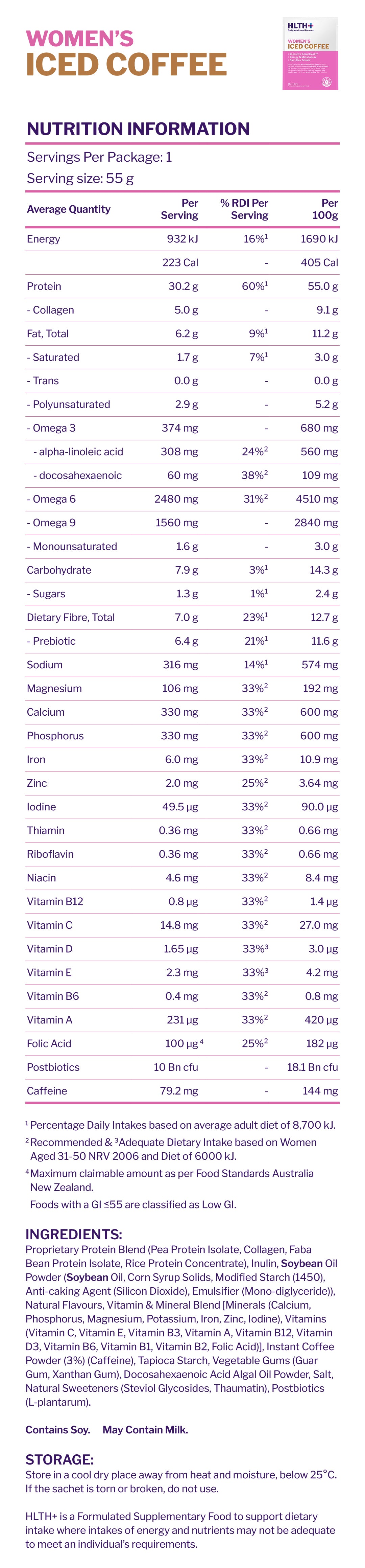
- You want protein plus dietary fibre and micronutrients in one habit, alongside real food. Different category, and where HLTH+ sits: 30g protein, 7g dietary fibre, 1.5g sugar and 223 calories in a 55g sachet.
Comparing against dairy-based options instead? The same label reading runs through plant protein against whey and, in the meal replacement category, The Lady Shake.
Where a daily nutritional formula fits
HLTH+ is a daily nutritional formula rather than a dedicated protein powder: 30g protein per serve, plus 7g dietary fibre, 5g collagen, 60mg DHA and a balanced multivitamin profile in one 55g sachet. Per gram of protein alone, Macro Mike's 800g bag is cheaper, because protein is the only line it carries.
What a daily formula answers is the other half of the shelf: a greens powder carries 1 to 2g of protein, a collagen powder carries no multivitamin, and a multivitamin carries neither protein nor dietary fibre. A 55g Women's sachet carries 30g protein, 7g dietary fibre, 5g collagen, 60mg DHA and 10 billion CFU Lactobacillus Plantarum Postbiotic, at 1.5g of sugar with none added and 223 calories. Counted across protein, dietary fibre, vitamins, minerals, collagen and the essential fats, that is 30 essential daily nutrients in one serve.
It is dairy-free and gluten-free, and therefore lactose-free. Allergen line: contains soy. It is Australian-owned and Australian-made in facilities complying with Good Manufacturing Practice, carries a 5-star Health Star Rating, and holds hundreds of reviews across the range. It sells at hlthplus.com at RRP $6.00, or $5.10 a day on a 28-serve subscription at $142.80, and through Amazon AU and Chemist Warehouse online.
Find out what your current stack is actually missing. The 30-second ✦ Find My Formula quiz shows the gaps your existing tubs and bottles leave. Or keep reading: the plant-based powders ranked on their own labels and what to check on a dairy-free label.
Frequently Asked Questions
Is Macro Mike protein good?
On its published panel it is a genuinely strong plant protein: 23.7g protein, 4.6g dietary fibre and 18 amino acids with amounts per 40g serve, retrieved 15 September 2026. The trade-offs are 3.1g of sugars, 59% protein by weight, and an almond base that rules it out for anyone avoiding tree nuts.
How much protein is in Macro Mike?
Their published panel for Deluxe Chocolate Premium Almond Protein lists 23.7g of protein per 40g serve, from almond protein and faba bean protein, with 10 serves a bag (retrieved 15 September 2026). That is 59% protein by weight. Panels are flavour-specific, so read the bag you are buying.
How much does Macro Mike cost per serve?
Their own store listed the 400g bag at $54.95 on 22 September 2026, which is $5.50 a serve across 10 serves. The 800g bag at $94.95 holds 20 serves, or $4.75 each. HLTH+ is RRP $6.00, or $5.10 a day on a 28-serve subscription.
Is Macro Mike dairy-free and gluten-free?
Their product pages publish it as plant based, gluten free and dairy free, and the panel lists almond and faba bean protein with no dairy ingredient (retrieved 15 September 2026). The allergen statement adds that it contains almonds and is made in a facility handling peanuts, cashews, hazelnuts and soy.
What is the difference between Macro Mike and HLTH+?
Macro Mike is a dedicated plant protein powder, so a serve is protein and little else. HLTH+ is a Formulated Supplementary Food carrying 30g protein and 7g dietary fibre alongside collagen, DHA and a balanced multivitamin profile in a 55g sachet. Different categories, and the cheaper protein is the powder.


Leave a comment
This site is protected by hCaptcha and the hCaptcha Privacy Policy and Terms of Service apply.