

After a workout, eat a meal or snack that carries carbohydrate and protein within the first one to two hours, and drink to replace what you sweated out. Victoria's Better Health Channel says carbohydrate foods and fluids should be consumed after exercise, "particularly in the first one to 2 hours after exercise" (Better Health Channel, Sporting performance and food, retrieved 6 October 2026). For protein, a serve of 20 to 40g is the working range, and the minute you eat it matters far less than most posts suggest.
The reason this gets tangled is that two different readers share one question. One is the endurance athlete with a second session that evening, for whom the first half hour counts. The other is anyone finishing an ordinary gym or run session, for whom the next normal meal does the job, and posts rarely say which reader they are written for.
Below: what your body is replacing, how wide the window really is, sixteen foods with protein and carbohydrate worked per serve, three plates that reach 30g protein with the sums shown, snacks for when a plate is too much, and what changes when you are eating less.
What is your body replacing after a workout?
Three things: the glycogen your muscles burned, the fluid you sweated out, and protein for repair. The Better Health Channel explains that carbohydrate is stored as glycogen in the liver and muscle and used as fuel during exercise, and that "rapid replacement of glycogen is important following exercise" (Better Health Channel). Protein, it says, "plays a key role in supporting exercise adaptations and in post-exercise recovery and repair".
Fluid is the third. The same page notes that most athletes develop a fluid deficit during exercise and recommends 1.25 to 1.5 L of non-alcoholic fluid for every kilogram of body weight lost during exercise. Its suggested choices to start refuelling are plain: sports drinks, juices, cereal and low-fat milk, low-fat flavoured milk, sandwiches, pasta, muffins or crumpets, and fruit and yoghurt.
The mirror image of this page, the meal before you train, is in what to eat before a workout.
Is there really a 30-minute recovery window after a workout?
For one group of people, yes. The International Society of Sports Nutrition position stand on nutrient timing reports a study in which muscle glycogen was restored 50% faster over four hours when carbohydrate was given within 30 minutes of a hard cycling session than when it was delayed by two hours (Kerksick and colleagues, Journal of the International Society of Sports Nutrition, 2017). The same stand then narrows the finding: timing matters most "when rapid restoration of muscle glycogen is a primary goal" and "when inadequate amounts of carbohydrate are being delivered".
Outside those cases the stand says "the importance of timed carbohydrate ingestion is notably decreased". Its rapid-refuelling figure of 1.2g of carbohydrate per kilogram an hour applies where there are fewer than four hours before the next bout, which is 84g an hour for a 70kg adult. That is an endurance-sized number, not a Tuesday gym number.
| Your situation | What the sources say |
|---|---|
| Another hard session in under 8 hours | The Better Health Channel advises higher-GI carbohydrate such as white bread, white rice or white potatoes in the first half hour or so, continued until normal meals resume |
| Next session is tomorrow or later | The position stand says timed carbohydrate matters far less once daily carbohydrate matches energy demands |
| Protein, for athletes wanting to build lean mass | The Better Health Channel says about 20 to 25g of high-quality protein from immediately to 2 hours after exercise "may be beneficial" |
For muscle, the strongest pooled evidence cuts against a countdown. A 2013 meta-analysis of 23 studies found no significant difference between protein timing and control once covariates were controlled for, and total protein intake was the strongest predictor of effect size for muscle hypertrophy (Schoenfeld, Aragon and Krieger, Journal of the International Society of Sports Nutrition, 2013). The protein position stand adds that the anabolic effect of exercise is long-lasting, "at least 24 h" (Jäger and colleagues, 2017), and protein before or after a workout takes the timing trials in full.
How much protein do you need after a workout?
The position stand's general recommendation is 0.25g of high-quality protein per kilogram of body weight, or an absolute dose of 20 to 40g, spread across the day every three to four hours (Jäger and colleagues, 2017). For a 70kg adult the per-kilogram figure is 17.5g, which each of the first four foods in the table below reaches on a single serve.
The Better Health Channel's version for athletes who want to build lean mass is a serve of whey protein or milk containing around 20 to 25g protein in close proximity to exercise, from immediately to 2 hours after, which it says may be beneficial. Learn more about the daily number behind both in how much protein you need to build muscle.
What are the best foods to eat after a workout?
Every figure below is from the Australian Food Composition Database (Release 3.0, Food Standards Australia New Zealand), retrieved 6 October 2026 and scaled from its per 100g values to the serve shown (AFCD). Carbohydrate is the database's available carbohydrate, which leaves out dietary fibre and sugar alcohols. Serves are in grams so the sums can be checked, cooked foods are weighed cooked, and milk and yoghurt are scaled at 100g per 100mL.
| Food | Serve | Protein | Carbohydrate |
|---|---|---|---|
| Chicken breast, grilled | 120g | 35.8g | 0.0g |
| Salmon, Atlantic fillet, grilled | 120g | 27.5g | 0.0g |
| Tofu, firm | 150g | 19.2g | 0.0g |
| Tuna, canned in brine, drained | 1 can (70g) | 18.3g | 0.0g |
| Cottage cheese | 100g | 17.0g | 1.8g |
| Eggs, hard-boiled | 2 eggs (94g) | 11.7g | 0.7g |
| Lentils, boiled | 150g | 11.0g | 17.9g |
| Natural yoghurt | 200g | 10.6g | 10.4g |
| Milk, reduced fat | 300mL | 10.5g | 15.0g |
| Chocolate milk, reduced fat | 300mL | 10.5g | 27.0g |
| Pasta, white, boiled | 150g | 8.0g | 39.3g |
| Bread, mixed grain | 2 slices (72g) | 7.7g | 28.7g |
| Rolled oats, uncooked | 40g | 4.9g | 21.8g |
| White rice, boiled | 150g | 4.7g | 52.1g |
| Sweet potato, baked | 200g | 3.6g | 32.2g |
| Banana | 1 (127g) | 1.8g | 25.3g |
Read it in two halves. The top rows carry the protein, the bottom rows carry the carbohydrate, and a post-workout plate usually takes one from each. For more protein-dense options between meals, see high-protein snacks.
What does a 30g protein plate look like after a workout?
The position stand's range runs from about 20g to 40g, so 30g sits in the middle. Here are three plates with the sums shown, each protein and carbohydrate figure taken from the table method above.
Poached eggs, sweet potato and broccoli
- 4 poached eggs (196g, at the database's 49g an egg): 25.7g protein, 0.6g carbohydrate
- Baked sweet potato, 200g: 3.6g protein, 32.2g carbohydrate
- Boiled broccoli, 100g: 2.9g protein, 1.2g carbohydrate
Total: 32.2g protein and 34.0g carbohydrate. Three eggs instead of four lands at 25.8g protein.
Chicken, rice and broccoli
- Grilled chicken breast, 80g: 23.8g protein, 0.0g carbohydrate
- White rice, boiled, 150g: 4.7g protein, 52.1g carbohydrate
- Boiled broccoli, 100g: 2.9g protein, 1.2g carbohydrate
Total: 31.4g protein and 53.3g carbohydrate.
Tofu, lentils and rice
- Firm tofu, 150g: 19.2g protein, 0.0g carbohydrate
- Boiled lentils, 100g: 7.3g protein, 11.9g carbohydrate
- White rice, boiled, 150g: 4.7g protein, 52.1g carbohydrate
Total: 31.2g protein and 64.0g carbohydrate.
The plates differ most in carbohydrate, 34.0g against 64.0g, and that is the dial to turn as sessions get longer or harder: the Better Health Channel scales daily carbohydrate with the work, as set out in what to eat before a workout.
What is a good post-workout snack?
When a plate is too much, a snack covers the gap until your next meal. Three, summed from the same table:
- Chocolate milk and a banana: 300mL reduced-fat chocolate milk plus one banana is 12.3g protein and 52.3g carbohydrate.
- Tuna on bread: one 70g can of tuna with two slices of mixed grain bread is 26.0g protein and 28.7g carbohydrate.
- Yoghurt, oats and banana: 200g natural yoghurt, 40g rolled oats and a banana is 17.3g protein and 57.5g carbohydrate.
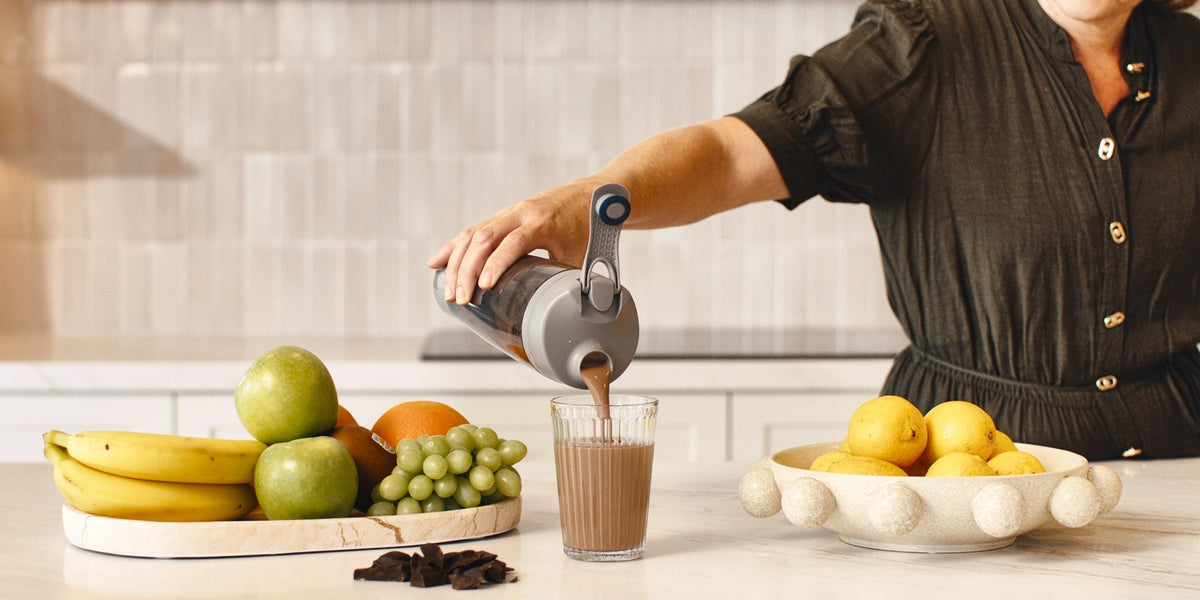
The Better Health Channel lists low-fat flavoured milk, sandwiches, and fruit and yoghurt among its suitable choices to start refuelling, so none of these is an exotic pick. If you train first thing, protein shake for breakfast carries the glass version with its sums, and sore muscles after exercise covers what the evidence says about the day after.
What should you eat after a workout when you are eating less?
A reduced appetite takes the post-workout plate first: the meal gets smaller, so what is on it has to be denser. That applies whether the cause is a busy season, a deliberate calorie deficit, or rapid weight loss, reduced eating and medically induced weight loss. In a placebo-controlled trial, a GLP-1 medicine reduced ad libitum food intake across the day by roughly a quarter (Blundell and colleagues, Diabetes, Obesity and Metabolism, 2017).
For athletes on a reduced-energy diet, the Better Health Channel says protein intakes up to 2.0g per kilogram of body weight a day can be beneficial in reducing loss of muscle mass. On a smaller appetite, start from the top rows of the table above, since those carry the most protein per serve, and keep the serve small enough to finish.
This is general information, not medical advice, and decisions about any medication belong with your doctor. For targets on a smaller appetite, protein when you are eating less and what to eat when your appetite has dropped work through the numbers, and sarcopenia covers muscle across the longer run.
More on what changes for your muscle when you eat less: nutrition support for muscle.
Where does a Formulated Supplementary Food fit around training?
Over 90% of Australian adults do not meet dietary guidelines (AIHW): we believe in a food-first approach, and the statistics say food first is not doing it alone, which is what nutritional insurance means. Every plate above is whole food, and that is the first answer.
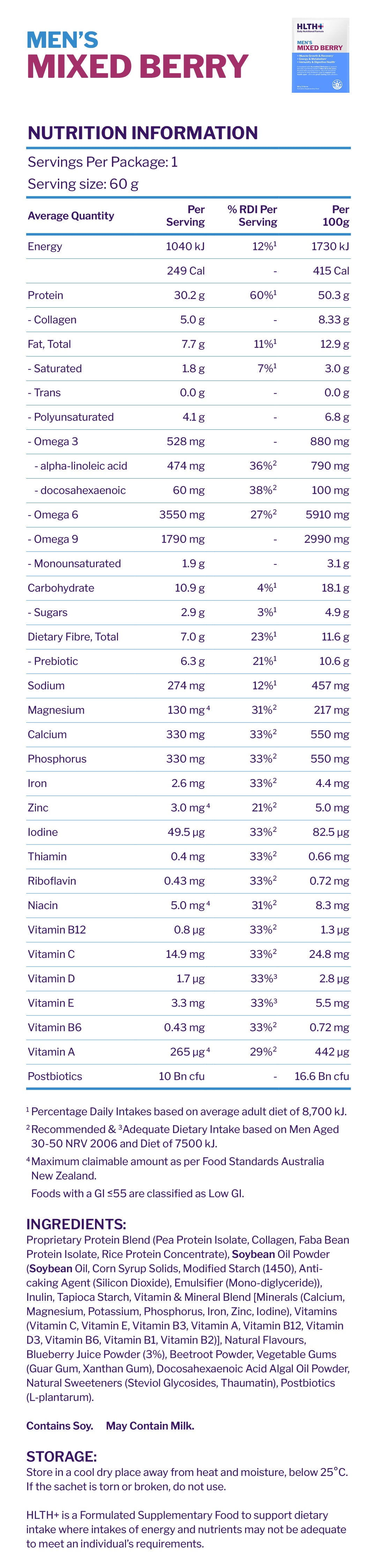
HLTH+ is a Formulated Supplementary Food: one sachet (55g in Women's) carries 30g protein per serve, 7g dietary fibre and 30 essential daily nutrients, at 223 calories in Women's and 248 in Men's, for RRP $6.00. Protein contributes to the maintenance and growth of muscle mass and is necessary for tissue building and repair, as part of a healthy diet involving a variety of foods. That statement is about muscle mass and tissue over time, not about how a single session feels, and the ✦ Find My Formula quiz shows what your current routine is not giving you.
Every formula is formulated by Accredited Dietitians to the Nutrient Reference Values, published in 2006 by the National Health and Medical Research Council, the Australian Government Department of Health and Ageing and the New Zealand Ministry of Health, across Women's, Women's 50+, Men's and Men's 50+. It is Australian made in facilities that comply with Good Manufacturing Practice, and on a 28-serve subscription at $142.80 it works out at $5.10 a day, with no lock-in. It sells at hlthplus.com, on Amazon AU and through Chemist Warehouse online.
Is it a meal replacement? It is not designed as one, because it is built to complement a food-first approach; it works fine as a healthy snack or to tie you over between training and your next proper meal.
Which post-workout option is right for you?
- If you can sit down to a meal within an hour or two of training: a plate from the section above does the job, and the sums show it reaches 30g protein.
- If training lands where a meal does not: a snack from the list above, or a shaker made from a sachet, carries you to the next meal.
- If you want protein, dietary fibre and a balanced multivitamin profile in one sachet: HLTH+.
Not sure what your routine is missing? The 30-second ✦ Find My Formula quiz is built to show what your current stack is not giving you. Take the quiz.
This article is general information, not medical advice. Decisions about any medication, or about a change to how you eat, belong with your doctor or dietitian.
Frequently Asked Questions
How soon after a workout should I eat?
The Better Health Channel advises carbohydrate foods and fluids after exercise, particularly in the first one to two hours. If another hard session is under eight hours away, it suggests higher-GI carbohydrate such as white bread or white rice in the first half hour. Otherwise the position stand says timing matters far less once daily carbohydrate matches energy demands.
Do I need protein straight after a workout?
Not straight away. A 2013 meta-analysis of 23 studies found no significant difference for protein timing once covariates were controlled for, and total protein intake was the strongest predictor of effect size. The Better Health Channel says about 20 to 25g of protein close to exercise, up to two hours after, may be beneficial for building lean mass.
What should I drink after a workout?
The Better Health Channel says most athletes finish exercise with a fluid deficit and recommends 1.25 to 1.5 L of non-alcoholic fluid for every kilogram of body weight lost during exercise. Its suggested refuelling choices include sports drinks, juices and low-fat flavoured milk; 300mL of reduced-fat chocolate milk carries 10.5g protein and 27.0g carbohydrate on database figures.
Is HLTH+ designed as a meal replacement?
No. HLTH+ is a Formulated Supplementary Food with 30g protein per serve and 7g dietary fibre, and it is not designed as a meal replacement, because it is built to complement a food-first approach. It works fine as a healthy snack, or to tie you over between training and your next proper meal.

Leave a comment
This site is protected by hCaptcha and the hCaptcha Privacy Policy and Terms of Service apply.