

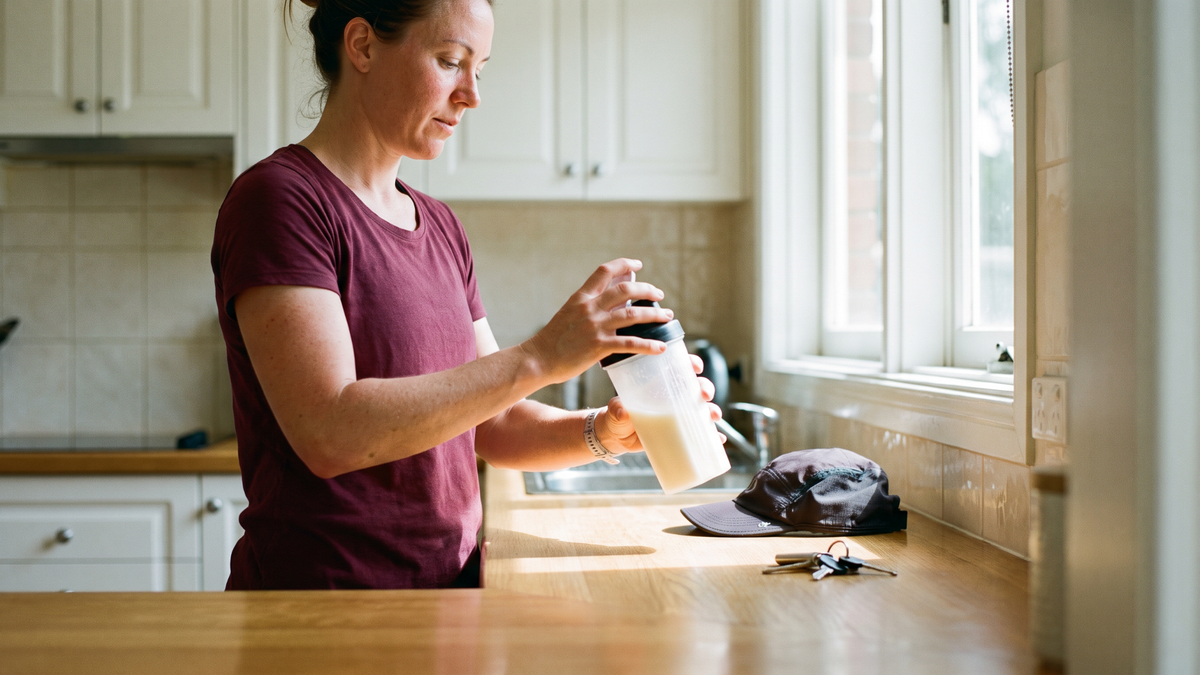
If your muscles ache one to three days after a workout, that fits delayed onset muscle soreness, DOMS: microscopic damage to muscle fibres and the connective tissue around them from unfamiliar or eccentric exercise, followed by an inflammatory response. It is not a build-up of lactic acid.
You pushed harder than usual, tried a new class, or lifted weight you have not lifted before, and now stairs are a production and sitting down takes planning. The real question is not whether this is normal, it is, but what actually eases it, what does nothing, and when ordinary soreness stops being ordinary.
Here is what causes DOMS, how long it typically lasts, what the evidence supports for easing it, what does not hold up, and where nutrition fits if you are training on top of eating less.
What Causes Sore Muscles After Exercise?
DOMS comes from the muscle itself, not from a chemical build-up. A 2025 scoping review in the Journal of Functional Morphology and Kinesiology describes the modern understanding of it: eccentric muscle-fibre disruption, damage to the perimysium, the connective tissue around bundles of muscle fibres, and sensitisation of the pain receptors in that tissue, particularly in the fascia (Di Lorenzo and colleagues, Journal of Functional Morphology and Kinesiology, 2025). The lactic-acid explanation, once the default answer, has been refuted; the same review calls it obsolete.
Eccentric movement, the lengthening phase of a muscle contraction, is the trigger the review links to that damage. Lowering a weight slowly, running downhill, or the braking phase of an unfamiliar movement all load muscle fibres while they are stretching. That is why soreness turns up hardest after a new exercise or more eccentric load than the muscle is used to, not necessarily after the hardest session you have ever done.
How Long Does Muscle Soreness Last?
The tenderness, stiffness and pain of DOMS typically arise 24 to 72 hours after eccentric or high-intensity exercise, and the inflammatory markers that travel with it (creatine kinase, raised white cell counts and acute-phase proteins) typically peak within one to seven days of intense or unfamiliar exercise (Di Lorenzo and colleagues, 2025).
That puts the sharp end of it on days one to three, with the underlying inflammation running its course over the week that follows. If soreness keeps building well beyond that window instead of easing, or arrives with any of the warning signs further down this page, that is worth a doctor's call rather than waiting it out.
What Actually Helps With Sore Muscles?
The clearest answer comes from a 2018 systematic review and meta-analysis in Frontiers in Physiology that pooled 99 studies testing recovery techniques against DOMS, fatigue, muscle-damage markers and inflammation. It found that active recovery, massage, compression garments, water immersion, contrast water therapy and cryotherapy produced a small to large reduction in soreness, with effect sizes ranging from -2.26 to -0.40, while the remaining techniques tested produced no change (Dupuy and colleagues, Frontiers in Physiology, 2018). Massage came out as the single strongest technique in that pooled analysis, for both soreness and perceived fatigue.
| Technique | What the pooled evidence found |
|---|---|
| Massage | The strongest effect on soreness and perceived fatigue of everything tested |
| Active recovery (easy movement) | Small to large reduction in soreness |
| Cold water immersion / cryotherapy | Small to large reduction in soreness |
| Contrast water therapy | Small to large reduction in soreness |
| Compression garments | Small to large reduction in soreness |
| Stretching | No measurable change in soreness |
| Electrical stimulation | No measurable change in soreness |
| Hyperbaric therapy | No measurable change in soreness |
Active recovery does not need to be complicated: an easy walk, a light spin on the bike, or the same movement pattern at a fraction of the effort, done in the hours or the day after the session that caused the soreness.
The same analysis measured what the techniques did to the markers of muscle damage and inflammation: an overall moderate fall in creatine kinase (standardised mean difference -0.37) and small falls in interleukin-6 (-0.36) and C-reactive protein (-0.38) (Dupuy and colleagues, 2018). The most powerful techniques for reducing inflammation were massage and cold exposure.
What Doesn't Help?
Stretching to head off soreness is gym advice the evidence does not support: in the same pooled analysis, stretching produced no measurable change in DOMS (Dupuy and colleagues, 2018). Ordinary mobility work still has its place, but stretching is not the answer to soreness that gym folklore treats it as. The review's discussion goes further: stretching has not been recommended after exercise, and it might even increase DOMS.
Electrical stimulation and hyperbaric therapy landed in the same no-effect group. If a recovery routine or product leans entirely on one of these three, the pooled evidence says not to expect much from it for soreness specifically.
How Much Protein Do You Need While You're Training?
Protein has a separate job from the soreness question. Protein contributes to the maintenance and growth of muscle mass, as part of a healthy diet involving a variety of foods. That statement is about muscle mass over time, not about how sore a session leaves you two days later.
For someone training regularly, the International Society of Sports Nutrition's position stand puts the working per-meal dose at 0.25g of high-quality protein per kilogram of body weight, or an absolute dose of 20 to 40g, spread roughly every three to four hours across the day, inside a daily range of 1.4 to 2.0g per kilogram for building and maintaining muscle mass (Jäger and colleagues, Journal of the International Society of Sports Nutrition, 2017). How much protein to build muscle walks through where that range comes from and what it looks like on a plate; if you are timing food around the session itself, what to eat before a workout covers the windows either side of it.
None of that is a soreness intervention. It is a separate, ongoing target for anyone training regularly, on top of the recovery techniques above, not instead of them.
More on what changes for muscle when you're training and eating less: nutrition support for muscle.
When Sore Muscles Are Something More Serious
Ordinary DOMS is uncomfortable, and it eases rather than worsens as the days pass. Something else can sit behind the same ache: rhabdomyolysis, a breakdown of muscle tissue whose listed causes include extreme muscle use, such as running a marathon (healthdirect, Rhabdomyolysis). The same page's advice for avoiding the exercise-induced form is to build up resistance training slowly.
The listed symptoms are muscle pain or swelling, muscle weakness, fatigue, dark red-to-brown urine and fever, and they may not start for hours or days after the muscle injury (healthdirect, Rhabdomyolysis). Seek medical attention urgently if you have muscle pain, muscle swelling and muscle weakness together with dark urine.
This is general information, not medical advice, and any diagnosis or treatment decision belongs with your doctor. Soreness that keeps building well beyond the 24 to 72 hour window instead of easing, or comes with swelling or weakness, is also worth a call to a GP rather than waiting it out.
Where a Formulated Supplementary Food Fits When You're Training
A Formulated Supplementary Food answers a different question from the sections above: how to hit a daily protein target while training on a smaller appetite, whether that comes from a busy week, a deliberate deficit, or rapid weight loss, reduced eating and medically induced weight loss. The daily range in the position stand above is set per kilogram of body weight, so it does not shrink when the appetite does.
Over 90% of Australian adults do not meet dietary guidelines (AIHW), and eating less leaves less room to close it. We believe in food first; the statistics say food first is not doing it alone, which is what nutritional insurance means.
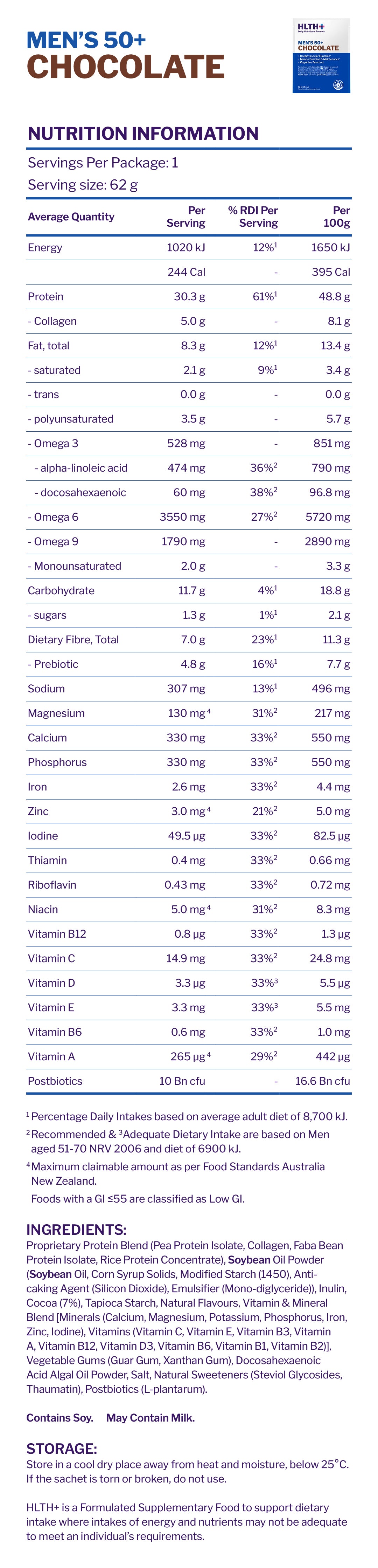
HLTH+ is a Formulated Supplementary Food: one 55g sachet carries 30g protein per serve, 7g dietary fibre and 30 essential daily nutrients, at RRP $6.00. It is formulated to the Nutrient Reference Values, published in 2006 by the National Health and Medical Research Council, the Australian Government Department of Health and Ageing and the New Zealand Ministry of Health, across Women's, Women's 50+, Men's and Men's 50+.
Is it designed to replace a meal? No: it is not designed as a meal replacement, because it is built to complement a food-first approach; it works fine as a healthy snack or to tie you over between training and your next proper meal. It sells at hlthplus.com, on Amazon AU and through Chemist Warehouse online.
For the muscle side of ageing rather than a single session, sarcopenia: muscle loss with age, and what slows it and protein powder for seniors cover the longer-run picture. If you're auditing the rest of the cabinet, the magnesium numbers run on the same logic; and where a reduced appetite is the reason food is falling short in the first place, protein when you're eating less works through the targets.
Find out what your current stack is missing. The ✦ Find My Formula quiz takes about 30 seconds and shows the gaps your existing bottles are leaving. Take the quiz.
Frequently Asked Questions
What causes sore muscles after exercise?
Delayed onset muscle soreness, DOMS, comes from microscopic damage to muscle fibres and the connective tissue around them, mostly from eccentric movement such as lowering a weight or running downhill, followed by an inflammatory response. It is not a build-up of lactic acid; a 2025 peer-reviewed review describes that theory as refuted.
How long does muscle soreness last?
The tenderness, stiffness and pain of DOMS typically arise 24 to 72 hours after eccentric or high-intensity exercise, and the inflammatory markers behind it typically peak within one to seven days. If soreness keeps building well beyond that window instead of easing, see a doctor rather than waiting it out.
What actually helps sore muscles?
A pooled analysis of 99 studies found active recovery, massage, compression garments, water immersion and cryotherapy produced a small to large reduction in soreness, with massage the strongest single technique. Stretching, electrical stimulation and hyperbaric therapy showed no measurable effect in the same analysis.
Does protein reduce muscle soreness?
Protein contributes to the maintenance and growth of muscle mass, as part of a healthy diet involving a variety of foods, which matters for training over time. It is not one of the interventions shown to reduce or speed recovery from DOMS itself; that evidence sits with the recovery techniques above.
When should sore muscles see a doctor?
Seek medical attention urgently if muscle pain comes with muscle swelling, muscle weakness or dark red-to-brown urine, the warning signs of rhabdomyolysis, a muscle-breakdown condition whose listed causes include extreme muscle use. Soreness that keeps building well past 72 hours, rather than easing, is also worth a call. This is general information, not medical advice.
Leave a comment
This site is protected by hCaptcha and the hCaptcha Privacy Policy and Terms of Service apply.