


For most Australians, the plain answer is no. According to the most recent national nutrition survey, 99% of Australians already get enough protein through the food they eat, and Better Health Channel, the Victorian Department of Health's consumer health service, states plainly that protein shakes, powders and supplements are unnecessary for most Australians' health needs. Most content in this category skips straight past that sentence.
The confusion is manufactured. Much of the shelf is built to make the reader feel short of something, and the marketing rarely separates a genuine gap from a normal diet that already clears the bar. The real answer depends on age, what is already on the plate, and whether appetite has changed lately, not on the front of a label.
Here is what the evidence actually says: how much protein an adult needs, who genuinely falls short, when a powder earns its place, and what to check on a label if the answer is yes.
How much protein does an adult actually need?
The Nutrient Reference Values set the floor. Published in 2006 by the National Health and Medical Research Council, the Australian Government Department of Health and Ageing and the New Zealand Ministry of Health, they describe the intake levels considered adequate to meet nutritional needs and avoid harm in healthy people, and they differ by sex and age.
| Group | Protein per kilogram of body weight | Protein in grams a day |
|---|---|---|
| Women 19 to 70 | 0.75 g/kg | 37 g to 46 g |
| Men 19 to 70 | 0.84 g/kg | 52 g to 64 g |
| Women over 70 | 1.0 g/kg | 46 g to 57 g |
| Men over 70 | 1.0 g/kg | 65 g to 81 g |
Figures from healthdirect, the national health information service, and Dietitians Australia, both citing the Nutrient Reference Values above; Dietitians Australia also puts pregnancy and breastfeeding at 1.0 g/kg. Protein sits at roughly 10% to 35% of daily energy intake on healthdirect's guidance, and both sources land on the same conclusion from the other direction: most Australians get enough protein by following the Australian Guide to Healthy Eating (Dietitians Australia).
A 75 kg adult clearing that Nutrient Reference Value range does it easily from ordinary food: a grilled chicken breast carries about 29.8g of protein per 100g, tinned tuna in brine about 26.1g, a boiled egg about 12.4g, natural yoghurt about 5.3g and reduced-fat milk about 3.5g (Food Standards Australia New Zealand food composition data). A 150g chicken breast at dinner carries about 45g on its own, before breakfast and lunch are counted. If the goal is building muscle rather than just avoiding a deficiency, the working number is higher again: how much protein to build muscle covers the training range and the study behind it in full.
Who actually needs more than the average?
The Nutrient Reference Value table above describes a healthy adult on a typical diet. A few groups sit outside it, and healthdirect names them directly: older adults, strict vegetarians and vegans, people who are unwell, growing or recovering from illness, and anyone doing intense physical activity. Protein powder for people over 50 covers what specifically changes with age.
A fifth group is not on that list by name but follows from the same logic: anyone eating meaningfully less food than they used to, whether the driver is rapid weight loss, reduced eating and medically induced weight loss, illness, or a deliberate cut. Protein-rich food is often the first thing a smaller appetite pushes aside, and the target itself does not move just because intake has. In trial conditions, GLP-1 medicines reduced food intake by roughly a quarter of daily calories (Blundell and colleagues, Diabetes, Obesity and Metabolism, 2017); take a quarter out of a day that was already at the floor of the Nutrient Reference Value range, and the shortfall compounds fast.
This is general information, not medical advice, and decisions about any medication belong with your doctor. For anyone in that fifth group, protein when you are eating less works through the daily target in more detail.
If none of these groups describes the reader, a powder answers a want, not a need, and that is a fine reason to buy one. It is a different reason from correcting a shortfall that does not exist.
Is a protein supplement actually necessary, then?
For most people, no. Better Health Channel is direct about it: protein deficiency is rare in Australia, "as the Australian diet generally includes far more protein than we actually need." The same page states that protein shakes, powders and supplements are unnecessary for most Australians' health needs, and Dietitians Australia's own guidance agrees: most people eat plenty of protein from the foods they eat, even without a supplement.
That is not an argument against protein powder as a product. It is an argument against buying one to fix a gap that, for most adults eating a varied diet, is not actually there. The two questions worth separating are whether the reader needs more protein at all, and whether a powder is the easiest way to get it if they do.
A two-minute self-check before buying
Rather than guess, add up one ordinary day against the table above.
- Count the obvious protein. A serve of meat, fish, eggs, dairy or legumes at each main meal, roughly estimated from the per-100g figures earlier, gets most adults most of the way there.
- Add the incidental protein. Bread, cereal, nuts and milk in tea or coffee all carry small amounts that add up across a day and are easy to undercount.
- Compare the rough total to the Nutrient Reference Value range for the reader's sex and age, not to a gym-culture number picked up online.
- If the total clears the range on most days, a powder is a convenience purchase, not a corrective one, and the label choice comes down to taste, budget and format.
- If it consistently falls short, the shortfall is worth naming specifically (a skipped breakfast, a meat-free week, a smaller appetite) rather than solved with a blanket "more protein" purchase, because the fix that matches the actual gap works better than the biggest tub on the shelf.
When is a protein powder worth buying?
Two situations, and they call for different products.
- Convenience. The reader already hits their target from food most days, but wants a fast option after training, on a travel day, or when whole food is not practical. Here, any well-labelled powder that fits the budget and taste does the job; there is no health gap to close.
- A genuine, specific shortfall. The reader sits in one of the groups above, or a single eating occasion keeps landing short (a light breakfast, a rushed lunch) even though the rest of the day is fine. Here, the powder is filling a measurable gap, and it is worth choosing on the numbers rather than the front-of-pack claims.
Either way, the choice comes down to reading the label rather than the marketing. Whey protein vs whey isolate and best protein powder in Australia both work through how the category differs once the labels are actually compared.
What should you check on the label if you do buy one?
Ignore the front of the tub and look for four things on the panel itself.
- Protein per serve, not per 100g. A 40g scoop and a 25g scoop measure differently; divide the protein by the actual serve size before comparing two products.
- The amino acid profile, if it is printed. The body cannot make nine of the roughly 20 amino acids in food, so they have to come from the diet (Better Health Channel); whether it is a complete protein carrying all nine essential amino acids in useful amounts is a fact about the panel, not about the word "protein" on the front of the tub. Amino acids explained and what a complete protein actually is both cover how to read that panel properly.
- Sugar and what else is riding along. Some tubs add more sugar than the protein claim suggests; check the same panel, not a separate one.
- What the powder is made from. Whey, whey isolate and plant blends behave differently on lactose, digestion and amino acid spread; whey protein vs whey isolate explains the difference in plain terms.
- Price per serve against protein per serve, not against the size of the tub. A cheaper tub with a smaller serve or lower protein content can cost more per gram of protein than a pricier one; do the division rather than comparing sticker prices.
None of these checks require a nutrition degree, only the panel the manufacturer is already required to print. The label answers the question the marketing is designed to avoid. More on how nutrition needs shift when muscle is the goal: nutrition support for muscle.
Where does a daily nutritional formula like HLTH+ fit?
HLTH+ is built for the diet that is falling short. For the reader whose varied diet already clears the Nutrient Reference Value range above, ordinary food is doing the job.
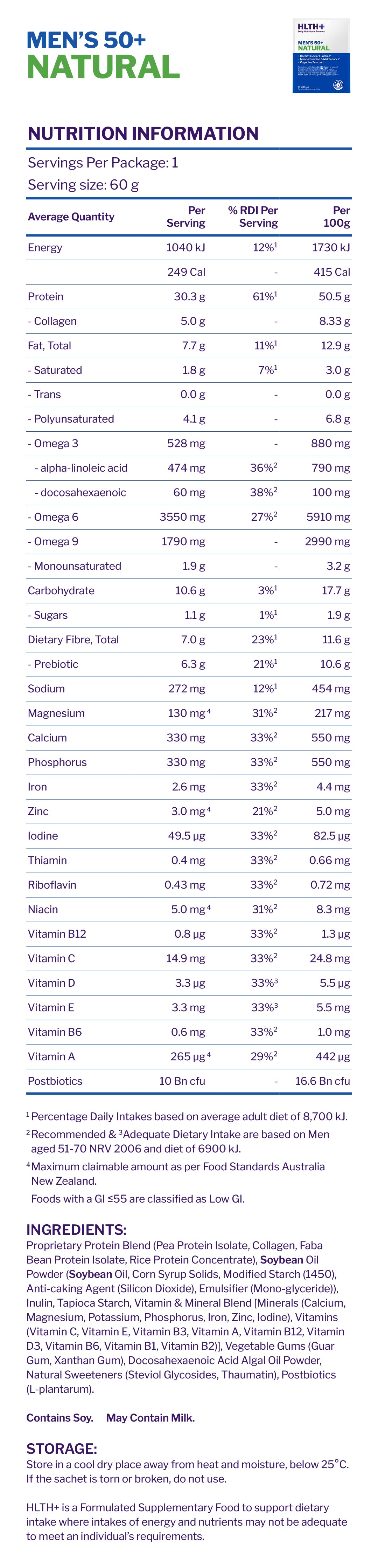
For the fifth group named earlier, the one eating meaningfully less than usual, the gap is real and it runs wider than protein alone. HLTH+ is a Formulated Supplementary Food: one 55g sachet carries 30g protein per serve and 7g dietary fibre, at RRP $6.00. Under Schedule 4 of the Australia New Zealand Food Standards Code, protein contributes to the maintenance and growth of muscle mass, as part of a healthy diet involving a variety of foods. The sachet supplies the material; the reader's own meals do the rest.
It is formulated to the Nutrient Reference Values, published by the National Health and Medical Research Council, the Australian Government Department of Health and Ageing and the New Zealand Ministry of Health, across Women's, Women's 50+, Men's and Men's 50+, because the target in the table above moves by age and sex and one formula cannot follow it. It is dairy-free, gluten-free and Australian-made in facilities complying with Good Manufacturing Practice.
Find out what your current plate is missing. The ✦ Find My Formula quiz takes about 30 seconds and shows what your current diet and supplement routine are not giving you. Take the quiz.
Frequently Asked Questions
Do I need protein powder if I already eat meat, eggs and dairy?
Probably not. According to the most recent national nutrition survey, 99% of Australians already get enough protein from food, and Better Health Channel states that protein deficiency is rare here because the average Australian diet carries far more protein than most people need. A powder becomes useful only if a specific meal or life stage genuinely falls short.
How much protein does an adult need a day?
Dietitians Australia puts it at 0.75g per kilogram of body weight a day for women and 0.84g/kg for men, rising to 1.0g/kg after 70; healthdirect gives the same guidance as 37g to 46g a day for women aged 19 to 70 and 52g to 64g for men. Both cite the Nutrient Reference Values.
Who actually needs a protein supplement?
healthdirect names older adults, strict vegetarians and vegans, people who are unwell or recovering, and those doing intense physical activity as the groups most likely to fall short. Anyone eating meaningfully less food than usual, for any reason, also sits in that group, because the protein target does not shrink when appetite does.
Does eating less change how much protein I need?
No, the target stays the same; only the ability to hit it from a smaller volume of food changes. Protein-rich food is often the first thing a reduced appetite sets aside, so someone eating substantially less, whether from illness, rapid weight loss, reduced eating and medically induced weight loss, has to make each eating occasion count for more.

Leave a comment
This site is protected by hCaptcha and the hCaptcha Privacy Policy and Terms of Service apply.