

Psyllium husk is a soluble dietary fibre, taken stirred into liquid and drunk promptly, with plenty of extra water alongside. One Australian label gives 5.8g of powder (about 1½ teaspoons, carrying 3.4g of psyllium husk) in 250 mL. In the 2022 review of fibre trials in adults with chronic constipation, stool frequency improved only at doses above 10g a day and over at least four weeks, and no source below sets a time of day.
You have probably got three tubs or three browser tabs open, each with a different dose, a half-remembered warning about choking, and no way to tell a label from a blog's opinion. Tubs, flavoured sachets and capsules say different things because they are different products. So this page sticks to what two Australian product pages, two Australian health sources and two systematic reviews actually state.
Below: what psyllium is, what the trials found, how it is taken, what the cautions say, and where the rest of your dietary fibre comes from (the longer food list lives in fibre-rich foods).
What is psyllium husk, and how much dietary fibre does it carry?
The Australian Food Composition Database describes it as the "husk of a small seed which is high in dietary fibre", and its entry for psyllium (Release 3.0, retrieved 29 September 2026) lists 88.7g of dietary fibre per 100g (Food Standards Australia New Zealand). That figure is a composite of eight Australian retail samples bought in 2017, and the database itself notes the data should be used with caution. Better Health Channel groups psyllium with the soluble fibres, the kind that "soaks up water like a sponge" (Better Health Channel, reviewed 11 December 2025).
One organic Australian brand prints 83.1g of dietary fibre per 100g on its panel, with a 10g serving size (Honest to Goodness Organic Psyllium Husks 200g, product page retrieved 29 September 2026). So a 10g serve works out at 8.3g of dietary fibre on that label and 8.9g on the database figure, and it is the only ingredient in either case.
What are the benefits of taking psyllium husk?
Two systematic reviews carry most of the weight, and each answers a narrower question than "benefits" suggests. Both describe groups of trial participants, not a promise for any one person.
- Adults with chronic constipation. A 2022 review of 16 randomised trials (1,251 participants) found that in the three psyllium trials more people responded than on control (risk ratio 1.82, 95% CI 1.51 to 2.20), and that psyllium increased stool frequency (van der Schoot and colleagues, American Journal of Clinical Nutrition, 2022).
- Blood cholesterol. A 2018 meta-analysis of 28 trials (1,924 participants, with or without high cholesterol) used a median dose of about 10.2g psyllium and found LDL cholesterol 0.33 mmol/L lower (95% CI 0.27 to 0.38 lower), graded moderate-quality evidence (Jovanovski and colleagues, American Journal of Clinical Nutrition, 2018).
- The limits. The 2022 authors write that "caution is needed when interpreting the results due to considerable heterogeneity", and no included study had a low risk of bias.
Better Health Channel and healthdirect both add a food-first point: it is better to get fibre from food sources than from fibre supplements (healthdirect, reviewed December 2024). This section is general information, not medical advice; chronic constipation and high cholesterol are medical matters, and decisions about any medication belong with your doctor.
How do you take psyllium husk?
Two Australian product pages show how differently the same ingredient is presented (label reads, retrieved 29 September 2026; the Metamucil text is as listed by Heidelberg Healthcare Pharmacy):
| Metamucil Multi-Health Fibre, Wild Berry Smooth (114D pack) | Organic Psyllium Husks 200g (Honest to Goodness) | |
|---|---|---|
| Serve on the page | 5.8g of powder (about 1½ teaspoons) in 250 mL of liquid | 10g serving size on the panel |
| Psyllium husk per serve | 3.4g | 10g (the only ingredient) |
| Directions | "Stir briskly and drink promptly. Drink plenty of water." | "can be added to juice, water or smoothies for extra fibre or sprinkled on your morning cereal or porridge" |
| Fluid line | "Taking this product without adequate fluid may cause it to swell and block your throat or oesophagus and may cause choking." | "Adequate fluid must be consumed with psyllium husks (like all fibre)" |
The Metamucil label adds "If mixture thickens, add more water and stir". For scale only, 3.4g is the psyllium in one 250 mL dose on that label, so the trial median of about 10.2g would be three of them; the directions on your own product, not a trial median, set your dose.
Start gradually. Better Health Channel says to "slowly introduce fibre into the diet", the 2022 review's authors write that people "should gradually increase their fiber intakes", and the Metamucil label notes "As your body adjusts to increased fibre intake, you may experience changes in bowel habit or minor bloating." Drinking enough water matters throughout, because Better Health Channel says a high-fibre diet may not do its job "unless you drink enough water every day".
Should you take psyllium husk in the morning or evening?
None of the label reads or reviews above sets a time of day, so this page does not either. What they do set is the shape of the routine: stir it into liquid, drink it promptly, follow it with more water, and keep the gap from any prescribed medicine that the label describes below. A time you can reliably do all four is the practical answer.
Honest to Goodness suggests sprinkling it on morning cereal or porridge as one way to add it; that is a serving idea, not a timing rule.
Why should you be careful with psyllium husk?
Here are the side effects and cautions as each source states them.
- Metamucil label: swelling and choking without adequate fluid; "Do not take if you have difficulty in swallowing"; "Allergy alert: May cause an allergic reaction in people sensitive to inhaled or ingested psyllium"; "Do not use when abdominal pain, nausea or vomiting are present or if you develop diarrhoea"; "Do not use in cases of medication induced constipation"; and a phenylalanine warning for people with phenylketonuria (the same label reads "Contains Aspartame").
- Better Health Channel: "A sudden switch from a low-fibre diet to a high-fibre diet may lead to some abdominal pain and increased flatulence (wind)", and very high-fibre diets (more than 40g daily) "are linked with decreased absorption of some important minerals (such as iron, zinc and calcium)".
- The 2022 review: in one psyllium trial 2 participants (18%) reported abdominal pain against none on control; in another, 3 psyllium and 5 control participants withdrew for reasons related to side effects; two psyllium trials reported no serious adverse events. Flatulence was higher with fibre overall, but 89.9% of the weight in that analysis came from inulin-type fibres, so it says little about psyllium itself.
Who should talk to a doctor first. The Metamucil label says to consult a doctor before use if you have a sudden change in bowel habits lasting 2 weeks or rectal bleeding, if you are pregnant or nursing, or if you are considering it as part of a cholesterol or blood sugar maintenance program. It says to consult a doctor immediately if you experience chest pain, vomiting, or difficulty in swallowing or breathing after taking it, and to consult a doctor if constipation persists beyond 7 days. Healthdirect's Metamucil pages add: "If symptoms persist see your healthcare professional." The same label-first approach applied to a nutritional drink is in does Sustagen make you poop.
What should you not take psyllium husk with?
The label names medicines, not foods. It says "Bulk fibre may affect how well other medicines work" and: "If you are taking a prescription medicine by mouth, take this product at least 2 hours before or 2 hours after the prescribed medicine to minimise any effect on drug absorption." The other listed caution is too little fluid, covered above.
Nothing in the label reads or reviews says to avoid a particular food. Decisions about any medication belong with your doctor, and your pharmacist can check your own medicines against the directions.
Which is better, chia seeds or psyllium husk?
Gram for gram, psyllium carries about 2.7 times the dietary fibre of chia (88.7g against 33.2g per 100g), on Australian Food Composition Database figures retrieved 29 September 2026:
| Ingredient (database name) | Dietary fibre per 100g | Dietary fibre per 10g |
|---|---|---|
| Psyllium, uncooked | 88.7g | 8.9g |
| Seed, chia, dried | 33.2g | 3.3g |
| Seed, linseed or flaxseed | 32.9g | 3.3g |
"Better" depends on the job. Chia is a whole seed that also carries 23.8g of protein and 1,825 kJ per 100g, where psyllium carries 3.0g of protein and 826 kJ. If you want a concentrated fibre powder measured in grams and will follow the label's fluid and medicine directions, that is psyllium; if you would rather take dietary fibre as food, the next section gives the numbers, and gut health supplements covers the wider supplement shelf.
Which everyday foods carry dietary fibre, and how much?
Because Australian sources favour food first, here is the same measure for eleven everyday foods. Figures are the Australian Food Composition Database's dietary fibre per 100g scaled to the serve shown (our serve sizes, chosen as typical), retrieved 29 September 2026.
| Food (serve) | Dietary fibre per 100g | Dietary fibre per serve |
|---|---|---|
| Red kidney beans, canned, drained (150g) | 6.5g | 9.8g |
| Chickpeas, canned, drained (150g) | 5.7g | 8.6g |
| Wholemeal pasta, boiled (150g) | 5.7g | 8.6g |
| Chia seeds, dried (20g) | 33.2g | 6.6g |
| Baked beans in tomato sauce (130g) | 4.8g | 6.2g |
| Lentils, boiled (150g) | 4.1g | 6.2g |
| Raspberries, raw (125g) | 4.8g | 6.0g |
| Wholemeal bread (80g) | 6.9g | 5.5g |
| Avocado, hass (80g) | 5.9g | 4.7g |
| Pear, green skin, unpeeled (150g) | 3.0g | 4.5g |
| Rolled oats, uncooked (40g) | 9.5g | 3.8g |
For scale, a 10g serve of psyllium (8.3g to 8.9g above) sits next to 150g of canned chickpeas at 8.6g. Several of these foods also work as snacks, and high-protein snacks ranks 30 of them. If the terms prebiotic, probiotic and postbiotic keep blurring into dietary fibre, the difference between prebiotics, probiotics and postbiotics is explained separately.
Learn more about what changes when you eat less.
Are most Australian adults getting enough dietary fibre?
Over 90% of Australian adults do not meet dietary guidelines (AIHW), and dietary fibre arrives through the foods those guidelines ask for: wholegrains, legumes, vegetables and fruit. A smaller appetite, whether from rapid weight loss, reduced eating and medically induced weight loss, narrows that intake further. In controlled testing, GLP-1 medicines reduced free-choice food intake by roughly a quarter across the day (Blundell and colleagues, Diabetes, Obesity and Metabolism, 2017).
The gap can be counted. A 2025 cross-sectional study of 69 people who had used GLP-1 medicines for at least a month measured an average dietary fibre intake of 14.5g a day against a recommended 28g, roughly half (Johnson and colleagues, Frontiers in Nutrition, 2025). Dietary fibre on a GLP-1 works through the same arithmetic in more detail.
This section is general information, not medical advice. Decisions about any medication belong with your doctor.
Where does a Formulated Supplementary Food fit beside food?
We believe in a food-first approach, but with over 90% of adults not meeting dietary guidelines it is not covering everyone, which is the case for nutritional insurance beside food. HLTH+ is an Australian-owned and made Formulated Supplementary Food under the FSANZ Food Standards Code, built to sit next to a diet, not replace it. One 55g Women's sachet carries 7g dietary fibre, 30g protein and 30 essential daily nutrients, and 7g dietary fibre meets the Code's threshold for an "excellent source of dietary fibre" (at least 7g in a serving, Schedule 4, section S4-3).
Women's, Women's 50+, Men's and Men's 50+ are each formulated to the Nutrient Reference Values, the reference intakes published in 2006 by the National Health and Medical Research Council, the Australian Government Department of Health and Ageing and the New Zealand Ministry of Health. The ✦ Find My Formula quiz shows what your current routine is not giving you: take the 30-second quiz.
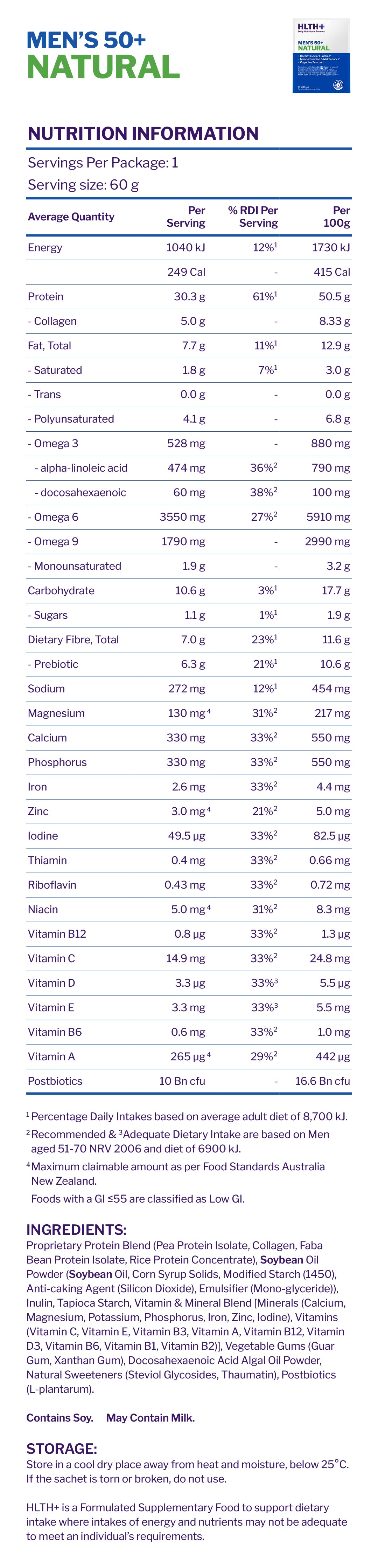
If you want protein, dietary fibre and a balanced multivitamin profile in one sachet, that is the job HLTH+ is formulated for.
See what your current stack is not giving you. The ✦ Find My Formula quiz is diagnostic: it shows the gaps in your existing routine, so you know what you are missing before you buy anything. Start the quiz.
Frequently Asked Questions
How long do trials of psyllium husk run?
The 2018 cholesterol meta-analysis included only trials lasting at least three weeks. The 2022 review of fibre trials in adults with chronic constipation found stool frequency improvement was apparent only with higher doses and durations of at least four weeks. Neither review sets a personal timeline; your doctor or pharmacist can advise on yours.
Does psyllium husk cause gas or bloating?
Australian sources say it can. The Metamucil label lists minor bloating as the body adjusts to more fibre, and Better Health Channel says a sudden switch to a high-fibre diet may lead to abdominal pain and increased flatulence. Increase gradually and drink plenty of water; the label says not to use it when abdominal pain, nausea or vomiting are present.
Is it better to get dietary fibre from food or a supplement?
Better Health Channel says it is better to get fibre from food sources than from fibre supplements, which can aggravate constipation without enough water, and healthdirect says it is better to eat wholefoods than take dietary fibre supplements. The table on this page gives dietary fibre per serve for eleven everyday Australian foods.
Who should check with a doctor before taking psyllium husk?
The Metamucil label says to consult a doctor before use if you have a sudden change in bowel habits lasting 2 weeks or rectal bleeding, if you are pregnant or nursing, or if you are considering it as part of a cholesterol or blood sugar maintenance program. It also says not to take it if you have difficulty swallowing.
Leave a comment
This site is protected by hCaptcha and the hCaptcha Privacy Policy and Terms of Service apply.