


Sustagen's product pages list no bowel side effect, and its label points in two directions at once. Three of the five formulas read open their ingredient lists with non-fat milk solids, a lactose marker per healthdirect, while only Hospital Formula Plus Fibre and OPTIMUM print dietary fibre on the panel (Sustagen, retrieved 29 September 2026). Which of those applies to you depends on the formula in the tin, the fluid that goes with it and what else in your routine has changed.
If your bowels changed after starting Sustagen, or a parent's did, the worry is usually whether it is the drink or something else. Bowel habit is wider than one product: healthdirect puts normal bowel frequency for adults anywhere from 3 movements a day to 1 every 3 days, and the Better Health Channel says occasional constipation may follow a change in routine, a change in diet or a brief illness, and lists advancing age among its causes.
This page reads Sustagen's own published pages against those two Australian health sources, one bowel question at a time, and says when a doctor is the next step.
Does Sustagen make you poop? What the label carries
Sustagen is a range, not one product, and the five formulas read here differ on the two label facts that matter for bowels: dietary fibre and milk. The table sets each formula's own published panel and ingredient list side by side, Vanilla where a flavour is published.
| Formula | Serve as published | Dietary fibre on the panel | Lactose on the panel | Ingredient list opens with |
|---|---|---|---|---|
| Hospital Formula | 60g powder in 200mL water | No fibre row | No lactose row | Non Fat Milk Solids (61 to 63%, by flavour) |
| Hospital Formula Plus Fibre | 60g powder in 200mL water | 4.1g (14% daily intake) | No lactose row | Non Fat Milk Solids (61 to 62%, by flavour) |
| Everyday | 15g powder in 175mL reduced fat milk | No fibre row | No lactose row | Non Fat Milk Solids (51 to 58%, by flavour) |
| Ready to Drink | 250mL pack | No fibre row | No lactose row | Water, then Non Fat Milk Solids (12%) |
| OPTIMUM | 55g powder in 190mL water | 3.1g (10% daily intake) | 0.28g | Maltodextrin, then Milk Proteins (Whey, Potassium Caseinate) |
Figures from Sustagen's published nutrition information panels and product pages, retrieved 29 September 2026; check current labels before purchase. Sustagen also lists a Sport product, which is not covered here, and publishes a panel for every flavour.
Only OPTIMUM prints a lactose figure, 0.28g a serve, and Sustagen describes it as "a specialised, low lactose nutritional supplement". The other four panels carry no lactose row at all, so the ingredient list is the only clue to how much milk is in them.
Two formulas carry dietary fibre on the panel, and Sustagen's own wording ties them to the gut. Plus Fibre is "High in fibre to support digestive health", and its article on increasing fibre intake says Plus Fibre and OPTIMUM "contain protein, nutrients and dietary fibre to help support digestive health and bowel regularity". What each formula is built for is set out in is Sustagen good for you.
What to check on any nutrition drink label
The same four lines answer the question for any brand, not only Sustagen.
- Dietary fibre per serve: a printed gram figure, or no fibre row at all.
- Milk and lactose: the allergen line, whether the panel prints a lactose figure, and whether "milk solids" or "non-fat milk solids" open the ingredient list.
- Serve volume: how much water or milk the directions add to the powder.
- Who the product is for: whether the maker describes it as a meal replacement, a supplementary drink or a clinical product, because that decides who should be choosing it.
Can Sustagen cause constipation?
None of the Sustagen pages read for this article says it does. Sustagen's own dietary fibre article does describe the general risk with fibre: "If you don't drink enough water, you may experience some discomfort and constipation due to the amount of fibre in your system" (Sustagen, retrieved 29 September 2026).
The Better Health Channel explains the mechanism in one line: fibre adds bulk to the stool, and "Constipation can occur from a high-fibre diet if insufficient water is consumed". It sits beside the other ordinary causes it names: a low-fibre diet, a change in routine, lack of regular exercise and advancing age, which it says makes constipation more common in the elderly. Healthdirect lists "not eating enough fibre" first among common causes, ahead of strong pain-relief medicines and some medical conditions.
The label facts sit separately from those causes. Hospital Formula, Everyday and Ready to Drink print no dietary fibre row, which is a statement about the panel and not about anyone's bowels.
Sustagen's own older-adults article names age as one reason bowel habits change: "This can lead to changes in bowel habits leading to constipation, diarrhoea, and in some cases, heartburn" (Sustagen, retrieved 29 September 2026). Carers choosing a formula for a parent can see which ones exist for older adults in Sustagen for elderly Australians.
Can Sustagen cause diarrhoea, bloating or wind?
Milk sugar is the label fact behind most of this question. Healthdirect lists wind, bloating, abdominal pain and cramps, nausea and diarrhoea as the symptoms of lactose intolerance, notes that "Drinking just 1 cup of milk can cause symptoms" in someone who is intolerant, and says the symptoms depend on how much you have. It also says "Most people can break down lactose".
Both healthdirect and the Better Health Channel tell label readers what to look for: "milk solids" and "non-fat milk solids", plus whey and milk sugar. Those are the words that open the Hospital Formula, Plus Fibre and Everyday ingredient lists. Every Sustagen formula read also states that it contains milk, and healthdirect is clear that milk allergy is a different condition from lactose intolerance.
Healthdirect's symptom list for lactose intolerance does not include constipation. A 2022 narrative review of lactose intolerance in children reports that it predominantly shows as diarrhoea, though constipation can occur as well (Leszkowicz and colleagues, Nutrients). For the allergen line formula by formula, see is Sustagen gluten free, which also covers dairy and lactose.
Dietary fibre is the other route to wind and bloating. Healthdirect notes that "The more fibre we eat, the more flatulence (wind) we produce", and its flatulence page adds "If you need to add fibre to your diet, do it slowly". Sustagen's own advice matches: "Start gradually, make small and easy changes, and take your time" (Sustagen, retrieved 29 September 2026).
Healthdirect names a change in diet and certain food ingredients among the causes of short-term diarrhoea, and says most diarrhoea is mild and clears up within a few days (healthdirect).
Does drinking enough water matter with Sustagen?
Sustagen's directions build fluid in. Hospital Formula and Plus Fibre are mixed as 3 level scoops with 200mL of water or milk, Everyday as 3 teaspoons with 175mL of reduced fat milk (or whole milk), and OPTIMUM as 7 level scoops with 190mL of water or milk (Sustagen, retrieved 29 September 2026). The directions set the serve, and none of the product pages sets an amount of extra water to drink.
Sustagen's fibre article does speak to it: "It's also important to remember to drink plenty of water", it says, "especially when you are increasing your dietary fibre intake". Healthdirect gives the reason in one sentence: "Dietary fibre absorbs fluid so it's important to drink enough liquid, including water". The Better Health Channel adds that water makes up about three-quarters of faecal content.
Healthdirect's list of everyday lifestyle measures for constipation is short: eat more high-fibre foods, drink plenty of water and other fluids, and do regular physical activity (healthdirect). Fibre supplements carry their own caution from the Better Health Channel: "As fibre supplements can aggravate or cause constipation, always check with your doctor or dietitian when using them". How one common fibre supplement is taken, with the cited cautions, is in psyllium husk.
When should you see a doctor about bowel changes?
A change in bowel habit after a new drink or a change in diet is often minor, but some patterns are not for waiting out. These are healthdirect's thresholds.
Constipation
- Severe constipation, which healthdirect describes as 3 or more days between bowel movements, tummy pain or straining for a long period, or constipation that is not getting better with simple lifestyle changes, is a reason to see your doctor.
- Constipation in someone over 50, or with a family history of bowel cancer, is also a reason to see your doctor.
- Constipation together with unexplained weight loss, bleeding from the rectum or blood in the stool, severe abdominal pain, cramping or bloating, or vomiting needs urgent care (healthdirect).
Diarrhoea
- Ongoing diarrhoea, blood or mucus in the stool, a fever, unexplained weight loss or diarrhoea at night is a reason to seek medical advice.
- Severe diarrhoea, signs of dehydration (tiredness, decreased urination, thirst and dry mouth), heavy rectal bleeding, or diarrhoea with severe abdominal pain needs urgent care.
- Healthdirect notes that diarrhoea can lead to dehydration, which makes it dangerous especially for very young or older people, who can get worse quickly (healthdirect).
Allergy
Milk allergy is an immune reaction to milk proteins. Healthdirect lists swelling or tightness in the throat and difficulty breathing among the signs of severe milk allergy, and says a serious allergic reaction is a medical emergency (healthdirect).
If a doctor or dietitian recommended Sustagen, tell them about the change before altering anything, because they know why it was chosen and can adjust the plan. Nothing on this page is a reason to change a clinical nutrition product on your own.
This page is general information, not medical advice. Decisions about any medication, or about symptoms that concern you, belong with your doctor.
Nutrition While You're Eating Less
Whatever the cause of a smaller appetite, the food that is eaten has to carry more of the day's nutrition, and food-first is not covering most people even at a normal appetite: over 90% of Australian adults do not meet dietary guidelines (AIHW). A smaller appetite widens that gap, which is the case for nutritional insurance beside a food-first approach and never in place of it. More on what nutrition looks like while intake is down: nutrition support while you are eating less, or dietary fibre on a GLP-1.
How HLTH+ compares
HLTH+ is a Formulated Supplementary Food, a different category from the formulated meal replacement that Sustagen describes Hospital Formula as. One 55g sachet carries 30g protein and 7g dietary fibre, the amount Schedule 4 of the Food Standards Code sets for an "excellent source of dietary fibre" claim, as part of 30 essential daily nutrients in the serve. The ✦ Find My Formula quiz shows what your current routine is not giving you.
Life stages, price and where to buy
HLTH+ is Australian-owned and made, and dietitian-formulated by life stage (Women's, Women's 50+, Men's and Men's 50+) to the Nutrient Reference Values published by the National Health and Medical Research Council, the Australian Government Department of Health and Ageing and the New Zealand Ministry of Health. It is not designed as a meal replacement, because it complements a food-first approach; it works fine as a healthy snack or to tie you over. RRP $6.00, or 5.10adayonthe28 − servesubscription(142.80), at hlthplus.com, Amazon AU and Chemist Warehouse online.
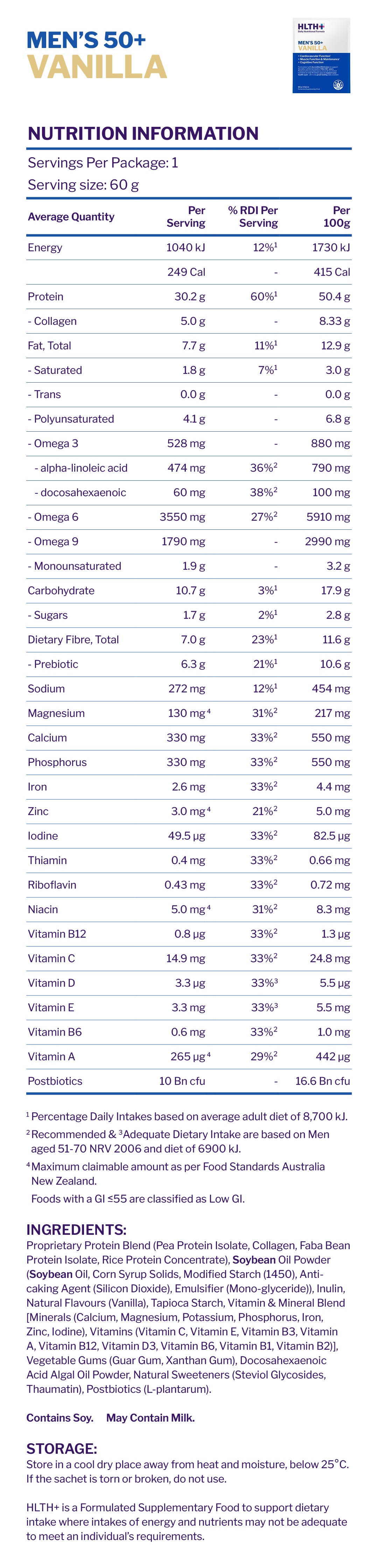
Which one suits which reader
If a doctor or dietitian has recommended Sustagen, or you need a clinical formula such as OPTIMUM, keep to that plan. If you are eating less and want protein, dietary fibre and a balanced multivitamin profile in one sachet beside your meals, HLTH+. Comparing formulas across brands is covered in Sustagen vs Ensure and Sustagen alternatives.
Want to know where your current routine falls short? The ✦ Find My Formula quiz takes about 30 seconds and shows what your current supplement stack is not giving you.
Frequently Asked Questions
Is Sustagen high in fibre?
It depends on the formula. Hospital Formula, Everyday and Ready to Drink print no dietary fibre row on their panels. Hospital Formula Plus Fibre publishes 4.1g per 60g serve and OPTIMUM 3.1g per 55g serve (Sustagen panels, Vanilla, retrieved 29 September 2026).
Does Sustagen contain lactose?
Every Sustagen formula read lists milk as an allergen, and three ingredient lists open with non-fat milk solids. Only OPTIMUM prints a lactose figure, 0.28g per serve, and describes itself as low lactose; the other panels carry no lactose row (Sustagen, retrieved 29 September 2026).
Is it normal for bowels to change on a new nutrition drink?
The Better Health Channel says occasional constipation may follow a change in routine or diet, and healthdirect lists a change in diet among causes of short-term diarrhoea. Neither page names Sustagen. Changes that persist, or come with blood, fever or unexplained weight loss, are a reason to see a doctor.
Should I keep taking Sustagen if my bowels change?
If a doctor or dietitian recommended Sustagen, tell them about the change before altering anything, because they know why it was chosen. Severe or ongoing symptoms, blood in the stool, fever, unexplained weight loss or signs of dehydration need prompt medical advice (healthdirect). This is general information, not medical advice.


Leave a comment
This site is protected by hCaptcha and the hCaptcha Privacy Policy and Terms of Service apply.