
Three of Sustagen's six formulas are labelled gluten free on Sustagen's own pages: Hospital Formula, Hospital Formula Plus Fibre and Ready to Drink. OPTIMUM, Sport and Everyday carry no gluten free statement on their pages. Sustagen's FAQ states: "There are no gluten containing ingredients in any SUSTAGEN products" (all Sustagen wording below is from its published pages, retrieved 29 September 2026).
If you are shopping for someone with coeliac disease, a milk allergy or a diagnosed intolerance, "probably fine" is not an answer, and six formulas under one name make it harder, because the wording differs by formula and sometimes by flavour. What helps is a formula by formula read of what each page actually says.
This page sets out each formula's own allergen statement, what Australian law means by "gluten free", and where dairy, lactose and soy stand, so you can check a tin in a minute.
Does Sustagen have gluten in it?
Sustagen's FAQ names the three formulas that "have been tested and are labelled gluten free": Hospital Formula, Hospital Formula plus Fibre and Ready to Drink. Its compare page shows the same split, with a tick on the gluten free row for those three and a cross for OPTIMUM, Sport and Everyday. Who each formula is built for is read in is Sustagen good for you.
Here is each formula's own wording, taken from its product page and its published nutrition information panels.
| Sustagen formula | How Sustagen describes the need | Flavours on its page | "Gluten free" on the page | Gluten row on the panel |
|---|---|---|---|---|
| Hospital Formula | "Complete nutrition to help meet nutritional needs" | 7 | Yes, in the allergen box and on all seven flavour lines | Nil Detected on all seven panels read |
| Hospital Formula Plus Fibre | "Complete nutrition to help meet nutritional needs & digestion support" | 2 | Yes, in the allergen box and on both flavour lines | Nil Detected on both panels read |
| Ready to Drink | "Daily energy support on-the-go" | 2 | Yes, in the allergen box and on both flavour lines | Nil Detected on both panels read, with a "Gluten Free." line |
| OPTIMUM | "Bridge nutritional gaps due to illness, recovery or poor diet" | 1 | No statement | Nil Detected on the Vanilla panel |
| Sport | "Sports & exercise nutrition" | 2 | No statement | No gluten row on either panel |
| Everyday | "A nutritional top up to your diet" | 2 | No statement | No gluten row on either panel |
Read the last two columns as different things. A statement on the page is the claim, and a panel row is a test result: Sustagen prints "Nil Detected" for OPTIMUM without making the claim, and prints no gluten row at all for Sport or Everyday.
That distinction matters most to one reader. Coeliac disease "affects approximately one in 70 Australians", and the Better Health Channel (Victorian Department of Health) is plain about the stakes: "Even small amounts of gluten can cause harm to someone with coeliac disease." For that reader, the formulas whose pages carry the statement are the ones Sustagen itself labels, and for the rest the pack in your hand and your dietitian settle it.
Gluten-free protein powder runs the same label check on any tub.
What does "gluten free" mean on an Australian label?
It is a regulated claim with a written definition. Standard 1.2.7 of the Australia New Zealand Food Standards Code says a claim about gluten may only use a descriptor listed in its claims table, or state that a food contains gluten or is high in gluten (Standard 1.2.7, subsection (7) of section 1.2.7-12, compilation dated 13 August 2025). The table in Schedule 4 then defines the descriptor: a food described as gluten free "must not contain: (a) detectable gluten; or (b) oats or oat products; or (c) cereals containing gluten that have been malted, or products of such cereals" (Schedule 4, compilation dated 30 April 2026).
"Low gluten" is a separate claim on the same table, at no more than 20 mg of gluten per 100 g of the food, and it is not gluten free. A "Nil Detected" panel row answers the first of the three conditions only, which is why the statement on the pack is what to look for.
Allergen declaration is a separate system. Milk and soy must be named in bold in the ingredient list, a bold "Contains" summary must sit near it, and a cereal containing gluten must appear in that summary using the word "gluten" (Food Standards Australia New Zealand, retrieved 29 September 2026). A "may contain" line is different: FSANZ calls these "voluntary statements made by food suppliers and the Food Standards Code does not regulate them."
Dairy-free protein powder shows how that Contains line reads on a milk-free pack.
What are the ingredients in Sustagen, and which allergens does each formula declare?
Each product page lists ingredients per flavour, and the milk is visible in all of them. Non fat milk solids open the Hospital Formula, Hospital Formula Plus Fibre, Sport and Everyday lists (63% in Hospital Formula Vanilla), Ready to Drink lists them second after water, and OPTIMUM lists milk proteins (whey, potassium caseinate) second after maltodextrin.
The allergen wording, verbatim from each page, sits in two places: a box near the top of the page, and a line under each flavour's ingredient list.
| Sustagen formula | Allergen box on the product page | Line under each flavour's ingredient list |
|---|---|---|
| Hospital Formula | Contains milk; May contain soy; Gluten free | "Contains Milk. May contain Soy. Gluten free" on all seven flavours |
| Hospital Formula Plus Fibre | Contains milk; May contain soy; Gluten free | "Contains Milk. May contain Soy. Gluten free" on both flavours |
| OPTIMUM | Contains milk; Contains Soy | "Contains Milk, Soy" on its one flavour |
| Sport | Contains milk | "Contains Milk." on both flavours |
| Everyday | Contains milk; Contains Soy | Dutch Chocolate: "Contains Milk and Soy"; Vanilla: "Contains Milk" |
| Ready to Drink | Contains milk; Contains Soy; Gluten free | "Contains Milk and Soy. Gluten Free." on both flavours |
Three details in that table matter:
- Soy: OPTIMUM, Everyday and Ready to Drink state "Contains Soy" in the page's allergen box, Hospital Formula and Hospital Formula Plus Fibre print "May contain Soy", and Sport prints milk only.
- Everyday's two lines disagree: the page box says soy and the Vanilla flavour line says milk only, so read the pack of the exact flavour.
- Ready to Drink's third flavour: Sustagen's compare page counts three Ready to Drink flavours but its product page publishes lines for two, so the third has no statement to read and is not covered here.
More on what changes when you eat less: how nutrition shifts when calories drop.
Is Sustagen dairy free?
No. All six pages declare milk, and Sustagen's FAQ says: "As the SUSTAGEN range contains milk, they are not suitable for someone who is following a vegan diet."
"Dairy free" is also not a defined claim in the Code's claims table. Schedule 4 defines "gluten free" and "lactose free" and has no entry for "dairy free", so no Schedule 4 condition sits behind the words, and the bold "Contains" line is the regulated part of the pack. Dairy-free protein powder covers the rest of that shelf.
Milk allergy and lactose intolerance are different problems. As healthdirect puts it: "Milk allergy is an immune reaction to proteins that are found in cow's milk," and "Milk allergy isn't the same as lactose intolerance" (healthdirect, last reviewed December 2024). OPTIMUM is the low lactose formula and still lists milk proteins in its ingredients, so a milk allergy is a question for a doctor.
Is Sustagen lactose free?
No formula in the range is lactose free. Sustagen's FAQ says "all SUSTAGEN products have lactose in differing quantities": Hospital Formula, Hospital Formula Plus Fibre, Sport, Ready to Drink and Everyday are "high in lactose as they are based on skim milk powder", and OPTIMUM is low in lactose when made up with water, at 0.28g per serve.
OPTIMUM's Vanilla panel prints lactose at 0.28g per 55g serve made up with 190mL of water, which is 0.50g per 100g of powder and 0.11g per 100mL made up. Schedule 4 of the Code sets the two descriptors: lactose free means "The food contains no detectable lactose", and low means "The food contains no more than 2 g of lactose/100 g of the food". On those figures OPTIMUM sits under the low threshold and above lactose free, which is how Sustagen describes it.
The other five formulas publish no lactose row on their Vanilla panels, so "high in lactose" rests on Sustagen's own wording rather than a number. The Better Health Channel lists the label ingredients to look for if you are avoiding lactose: milk solids, non-fat milk solids, whey and milk sugar. Hospital Formula's list opens with non fat milk solids.
Symptoms depend on how much of the milk or dairy product you eat, according to healthdirect, so how much suits you is a question for your doctor or dietitian. Lactose-free protein powder covers what a lactose-free claim looks like on a pack, and does Sustagen make you poop takes up the separate question of how a formula sits in the gut.
Who should not drink Sustagen?
That is a question for the person's doctor or dietitian, and Sustagen's FAQ answers only part of it in label terms. Hospital Formula and Hospital Formula Plus Fibre are listed as suitable for children aged 4 years and above, Everyday and Ready to Drink from 3 years, and OPTIMUM for adults. Sport is listed as suitable from 15 years of age and "not suitable for pregnant women".
Sustagen's footer describes OPTIMUM as a Food for Special Medical Purpose and adds: "Must be used under the supervision of a healthcare professional."
For an older adult or anyone whose intake has fallen, Sustagen for elderly Australians reads the range from a carer's side.
This page is general information, not medical advice. Decisions about a prescribed nutrition product, or about any medication, belong with your doctor or your Accredited Practising Dietitian.
Where does a Formulated Supplementary Food fit beside food?
Over 90% of Australian adults do not meet dietary guidelines on the AIHW poor-diet measure, so most people reading a nutrition label have a gap worth thinking about. HLTH+ believes in a food-first approach and reads that statistic as the reason a daily formula exists: nutritional insurance beside meals, never a substitute for them. When calories drop, through a reduced appetite, rapid weight loss, reduced eating and medically induced weight loss, or simply eating less with age, a Formulated Supplementary Food is built to supplement the diet.
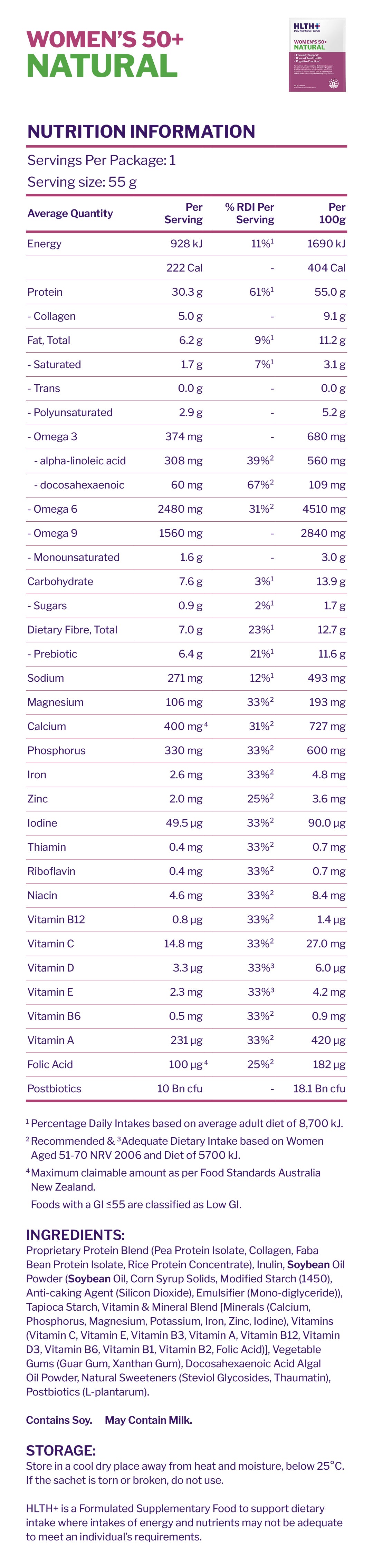
Each HLTH+ serve supplies 30 essential daily nutrients across protein, dietary fibre, vitamins, minerals, collagen and DHA. The range runs Women's, Women's 50+, Men's and Men's 50+, formulated by life stage to the Nutrient Reference Values published by the National Health and Medical Research Council, the Australian Government Department of Health and Ageing and the New Zealand Ministry of Health. It is Australian-made in facilities complying with Good Manufacturing Practice, with no nasties, artificial colours, artificial flavours or artificial sweeteners.
How HLTH+ compares
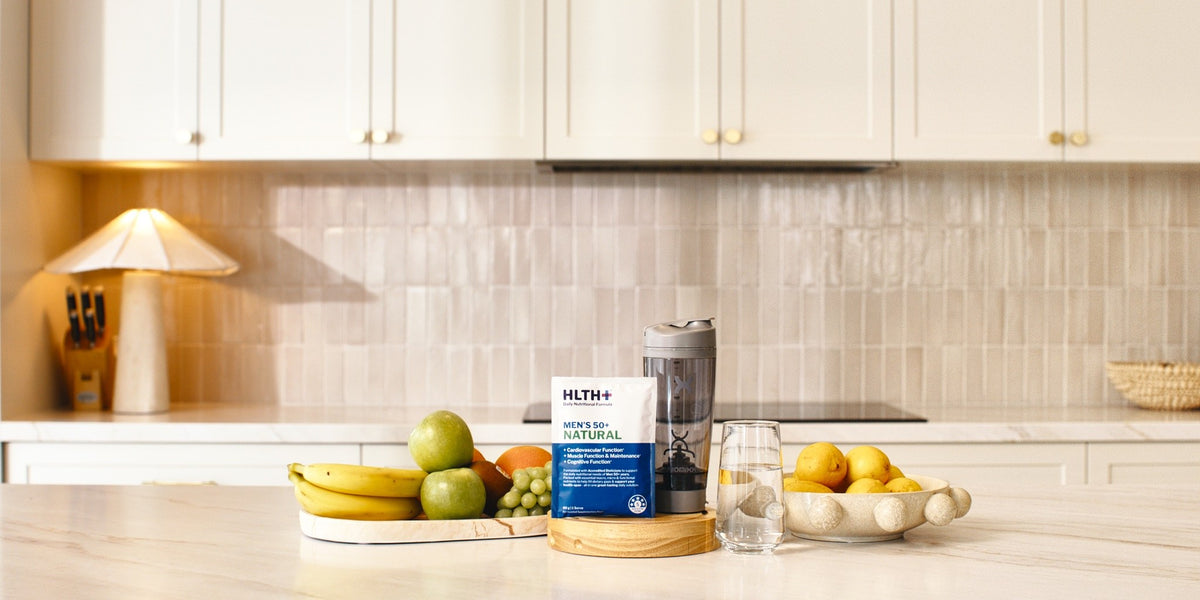
HLTH+ is a Formulated Supplementary Food in a 55g sachet (Women's; Men's runs 60-62g), carrying 30g protein and 7g dietary fibre per serve, and its published label reads dairy-free and gluten-free, and therefore lactose-free. Allergen line: contains soy. The ✦ Find My Formula quiz shows what your current routine is not giving you.
Which label suits which reader?
- You need a product Sustagen itself labels gluten free: Hospital Formula, Hospital Formula Plus Fibre or Ready to Drink, checked against the pack in your hand, because brands reformulate.
- You need to limit lactose: OPTIMUM is the one Sustagen formula described as low lactose, at 0.28g per serve, and it declares milk and soy.
- You need milk-free: none of Sustagen's six formulas is, and your dietitian can say which options fit.
- You want protein, dietary fibre and a balanced multivitamin profile in one sachet: HLTH+, which contains soy.
See what your current stack is not giving you. The 30-second ✦ Find My Formula quiz is built to show the gaps your existing routine leaves. HLTH+ sells at hlthplus.com at RRP $6.00, or $5.10 a day on a 28-serve subscription at $142.80 and $5.40 a day on a 14-serve subscription at $75.60, and through Amazon AU and Chemist Warehouse online.
Frequently Asked Questions
Is Sustagen OPTIMUM gluten free?
Sustagen's OPTIMUM page carries no gluten free statement, and its compare page marks that row with a cross. Its Vanilla panel prints a gluten row reading Nil Detected, and Sustagen's FAQ says none of its products has a gluten containing ingredient. The formulas Sustagen labels gluten free are Hospital Formula, Hospital Formula Plus Fibre and Ready to Drink.
Is Sustagen Hospital Formula gluten free?
Sustagen labels it gluten free. Its product page lists Gluten free in the allergen box and on the ingredient line of all seven flavours, and every flavour panel read prints a gluten row of Nil Detected (retrieved 29 September 2026). The same page declares milk and prints May contain Soy, so it is not dairy free.
Does Sustagen contain soy?
It depends on the formula. OPTIMUM, Everyday and Ready to Drink print Contains Soy in the page's allergen box, Hospital Formula and Hospital Formula Plus Fibre print May contain Soy, and Sport lists milk only. FSANZ says May contain lines are voluntary and not regulated by the Food Standards Code, so read the pack.
Which Sustagen formula is lowest in lactose?
Sustagen's FAQ names OPTIMUM: low in lactose when made up with water, at 0.28g per serve. The other five it calls high in lactose because they are based on skim milk powder. Under Schedule 4, low lactose means no more than 2g per 100g, and lactose free means no detectable lactose; none of the six is described that way.
This article is general information, not medical advice. Decisions about any medication belong with your doctor. Sustagen wording is from its published product, compare and FAQ pages retrieved 29 September 2026; brands reformulate, so check the current pack before buying.
Leave a comment
This site is protected by hCaptcha and the hCaptcha Privacy Policy and Terms of Service apply.