

The simplest way to lift dietary fibre is to build each meal around a legume, a wholegrain or a piece of fruit with its skin on, not to add bran. On Australian Food Composition Database figures, 150g of boiled split peas carries 12.5g of dietary fibre, 125g of raspberries carries 6.0g and 40g of rolled oats carries 3.8g. Those three foods alone total 22.3g.
A list of food names does not tell you whether a serve of quinoa or a serve of pear gets you closer to the number you are aiming for. The 28g in the title is the recommended daily intake used in a 2025 Frontiers in Nutrition study, and the rest of this page shows what it looks like on a plate.
Below are 30 foods with the dietary fibre in a stated serve, the difference between soluble and insoluble fibre, and a full day that adds up to more than 28g.
What are the highest-fibre foods in Australia?
Every figure in the table is scaled from the Australian Food Composition Database, Release 3.0, Food Standards Australia New Zealand, retrieved 29 September 2026. The database lists dietary fibre per 100g of edible portion; each row scales that figure to the serve in grams shown and rounds to one decimal place. Serves are round amounts we chose, not a government serve, and a packaged food's own panel is the figure to trust over a database entry.
| Group | Food (serve) | Dietary fibre per serve | Per 100g |
|---|---|---|---|
| Legumes | Split peas, boiled (150g) | 12.5g | 8.3g |
| Legumes | Red kidney beans, canned, drained (130g) | 8.5g | 6.5g |
| Legumes | Chickpeas, canned, drained (130g) | 7.4g | 5.7g |
| Legumes | Baked beans in tomato sauce, canned (130g) | 6.2g | 4.8g |
| Legumes | Lentils, boiled (150g) | 6.2g | 4.1g |
| Wholegrains | Wholemeal pasta, boiled (150g) | 8.6g | 5.7g |
| Wholegrains | Pearl barley, boiled (150g) | 8.1g | 5.4g |
| Wholegrains | Quinoa, cooked in water (150g) | 5.1g | 3.4g |
| Wholegrains | Wholemeal bread (70g) | 4.8g | 6.9g |
| Wholegrains | Rolled oats, uncooked (40g) | 3.8g | 9.5g |
| Wholegrains | Whole wheat breakfast biscuits, plain (30g) | 3.5g | 11.5g |
| Wholegrains | Brown rice, boiled (150g) | 2.6g | 1.7g |
| Vegetables | Green peas, boiled (100g) | 5.2g | 5.2g |
| Vegetables | Brussels sprouts, boiled (100g) | 4.8g | 4.8g |
| Vegetables | Sweet potato, baked (150g) | 4.8g | 3.2g |
| Vegetables | Sweet corn on the cob, boiled (100g) | 4.4g | 4.4g |
| Vegetables | Broccoli, boiled (100g) | 2.5g | 2.5g |
| Fruit | Raspberries, raw (125g) | 6.0g | 4.8g |
| Fruit | Pear, unpeeled, raw (150g) | 4.5g | 3.0g |
| Fruit | Kiwifruit, green, peeled (150g) | 4.5g | 3.0g |
| Fruit | Avocado, Hass, raw (70g) | 4.1g | 5.9g |
| Fruit | Apple, unpeeled, raw (150g) | 3.8g | 2.5g |
| Fruit | Banana, peeled (100g) | 2.2g | 2.2g |
| Nuts and seeds | Chia seeds (20g) | 6.6g | 33.2g |
| Nuts and seeds | Linseed or flaxseed (20g) | 6.6g | 32.9g |
| Nuts and seeds | Sunflower seeds (30g) | 3.9g | 13.0g |
| Nuts and seeds | Almonds, raw, with skin (30g) | 3.3g | 11.0g |
| Nuts and seeds | Pistachios, raw (30g) | 2.3g | 7.7g |
| Nuts and seeds | Walnuts, raw (30g) | 1.9g | 6.4g |
| Nuts and seeds | Pumpkin seeds, hulled (30g) | 1.4g | 4.6g |
Legumes are the only group where every row clears 6g: split peas lead the whole table at 12.5g, and wholemeal pasta (8.6g), red kidney beans (8.5g) and pearl barley (8.1g) follow. Chia seeds and linseed carry more than 32g per 100g, more than any other food here, but a realistic 20g serve holds them at 6.6g. Fruit and vegetables sit lower per serve; the top fruit row is raspberries at 6.0g and the top vegetable row is green peas at 5.2g.
The nut and seed rows use the same 30g serve as the high-protein snacks list, so the two pages can be read side by side.
What is the difference between soluble and insoluble fibre?
Dietary fibre is grouped by whether it dissolves in water. Healthdirect (last reviewed December 2024) says soluble fibre dissolves in water and is found in oats and barley, in legumes such as split peas, red kidney beans, baked beans and lentils, and in fruit and vegetables. It says insoluble fibre does not dissolve in water and is found in high-fibre and wholegrain breads and cereals, the outer skins of fruit and vegetables, and nuts and seeds.
The Better Health Channel (reviewed 11 December 2025) draws the same line and lists flaxseed and psyllium among soluble sources; dried beans appear on both of its lists. The database rows used on this page report total dietary fibre only, so the table above does not split the two types. Psyllium husk has its own page for how it is taken.
Soluble fibre foods and their serves
The foods healthdirect names for soluble fibre, with the total dietary fibre per serve from the table:
- Oats and barley: rolled oats 3.8g (40g), pearl barley 8.1g (150g).
- Legumes: split peas 12.5g (150g), red kidney beans 8.5g (130g), baked beans 6.2g (130g), lentils 6.2g (150g).
- Fruit and vegetables: raspberries 6.0g (125g), green peas 5.2g (100g), Brussels sprouts 4.8g (100g).
Insoluble fibre foods and their serves
The foods healthdirect names for insoluble fibre, with the same total dietary fibre per serve:
- Wholegrain breads and cereals: wholemeal bread 4.8g (70g), whole wheat breakfast biscuits 3.5g (30g).
- Outer skins of fruit and vegetables: unpeeled pear 4.5g (150g), unpeeled apple 3.8g (150g).
- Nuts and seeds: chia seeds 6.6g (20g), sunflower seeds 3.9g (30g), almonds 3.3g (30g).
How do you get 28g of dietary fibre in a day?
Add the serves from the table and 28g arrives sooner than the food list suggests. Every line below is a row from the table above, and the running total adds the rounded figures shown.
| Meal | Foods and serves | Dietary fibre | Running total |
|---|---|---|---|
| Breakfast | Rolled oats, uncooked (40g) with raspberries (125g) | 3.8g + 6.0g = 9.8g | 9.8g |
| Lunch | Wholemeal bread (70g) with baked beans (130g) | 4.8g + 6.2g = 11.0g | 20.8g |
| Snack | Pear, unpeeled (150g) | 4.5g | 25.3g |
| Dinner | Broccoli, boiled (100g) with brown rice, boiled (150g) | 2.5g + 2.6g = 5.1g | 30.4g |
The day totals 30.4g, which clears 28g by 2.4g, so any one line can be swapped for another row in the table without dropping under it. Pearl barley at dinner in place of the rice, for example, lifts the total to 35.9g. If you want more ideas for the meals either side of this one, high-protein breakfast ideas and high-protein snacks work through the same kind of arithmetic for protein.
The swaps that add the most dietary fibre
Healthdirect's tips include wholegrain bread instead of white bread, wholemeal pasta instead of white pasta, and brown rice or quinoa instead of white rice. On the same database, at the same serves, the swaps add:
- Bread, 70g: white 2.2g, wholemeal 4.8g, a gain of 2.6g.
- Pasta, boiled, 150g: white 3.3g, wholemeal 8.6g, a gain of 5.3g.
- Rice, boiled, 150g: white 1.2g, brown 2.6g (a gain of 1.4g) or quinoa 5.1g (a gain of 3.9g).
Made together, the bread, pasta and brown rice swaps add 9.3g a day at the same serve sizes.
Why do so many Australians fall short on dietary fibre?
Over 90% of Australian adults do not meet dietary guidelines on the Australian Institute of Health and Welfare (AIHW) poor-diet measure. The Australian Bureau of Statistics puts a sharper number on one of the food groups in the table above: 4.8% of adults met the vegetables, legumes and beans recommendation in 2023, and most Australians did not consume their minimum recommended serves for any of the five food groups.
The gap widens when the plate shrinks, through a deliberate deficit, an illness or a reduced appetite. In a 2025 study of people using GLP-1 medications, intake averaged 14.5g of dietary fibre a day, significantly less than the recommended 28g, and the authors pointed to low intake of whole grains, fruit and vegetables. A smaller appetite leaves less room for a serve of legumes, a wholegrain side and a piece of fruit, which are the rows carrying the most dietary fibre in the table above.
This section is general information, not medical advice. Decisions about any medication belong with your doctor. For more on what changes when meals get smaller, read dietary fibre when you eat less and the foods worth building a day around, or learn more about what changes when appetite drops.
Where does a Formulated Supplementary Food fit beside high-fibre food?
A serve of HLTH+, a 55g sachet, carries 7g dietary fibre alongside 30g protein. Under Schedule 4 of the Food Standards Code, a serving needs at least 4g of dietary fibre to be called a good source and at least 7g to be called an excellent source, and 7g is the figure HLTH+ carries. HLTH+ is a Formulated Supplementary Food, a category built to support dietary intake when intakes of energy and nutrients may fall short of what an individual needs, so it sits beside the foods in the table rather than in place of them; the ✦ Find My Formula quiz shows what your current routine is not giving you.
HLTH+ is formulated to the Nutrient Reference Values, the reference intakes published in 2006 by the National Health and Medical Research Council, the Australian Government Department of Health and Ageing and the New Zealand Ministry of Health, across Women's, Women's 50+, Men's and Men's 50+.
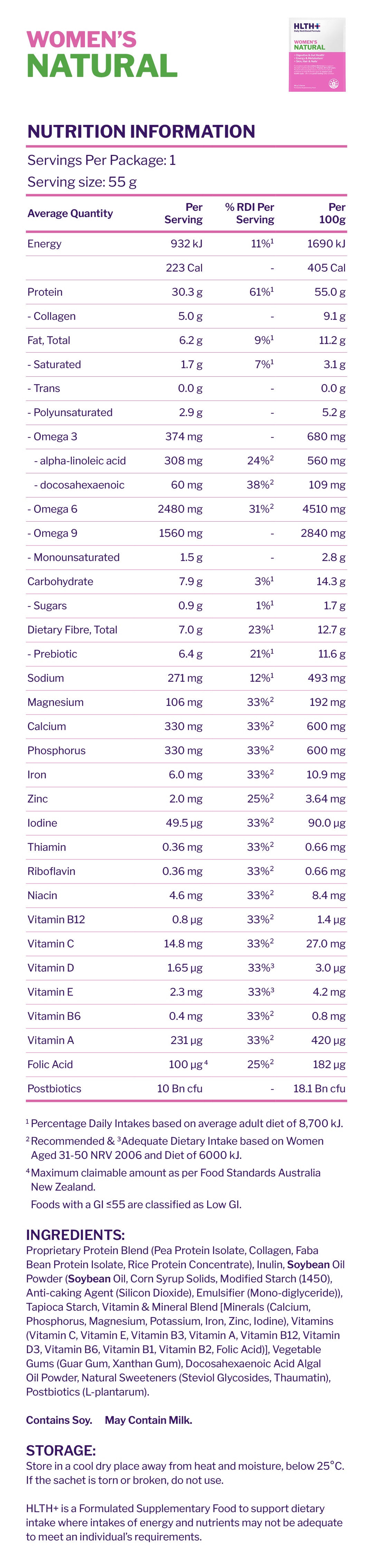
If you are building dietary fibre from food, the table and the sample day above are the whole method. If you want 30g protein, 7g dietary fibre and a balanced multivitamin profile in one 55g sachet beside those foods, that is HLTH+, available at hlthplus.com, Amazon AU and Chemist Warehouse.
See what your current routine is not giving you. The 30-second ✦ Find My Formula quiz is diagnostic: it shows the gaps in your current supplement stack, so you know what is missing before you buy anything. For a fibre-specific read on the supplement side, see prebiotics, probiotics and postbiotics.
Frequently Asked Questions
Which single food has the most dietary fibre per serve?
In the table above, 150g of boiled split peas carries the most at 12.5g. Per 100g, chia seeds (33.2g) and linseed (32.9g) carry the most, but a 20g serve of either holds them at 6.6g. All figures are from the Australian Food Composition Database, Release 3.0.
Do canned legumes carry less dietary fibre than dried legumes cooked at home?
On the database's per 100g figures, canned chickpeas carry 5.7g against 7.6g for dried chickpeas boiled, and canned red kidney beans 6.5g against 7.2g for dried kidney beans boiled. Both canned rows sit lower per 100g, and the table above uses the canned figures, so compare the serve you actually eat.
Are oats a soluble fibre food?
Healthdirect lists oats and barley among the foods that contain soluble fibre. The Australian Food Composition Database gives rolled oats, uncooked, 9.5g of total dietary fibre per 100g, or 3.8g in a 40g serve; the database reports total dietary fibre, not the soluble share.
Is raw or cooked broccoli higher in dietary fibre?
The database lists raw broccoli at 3.5g per 100g and boiled, drained broccoli at 2.5g per 100g, so 100g of the raw vegetable carries 1.0g more. The rows are separate database entries, so compare the serve you actually plate, and check the panel on any packaged version.
What does "excellent source of dietary fibre" mean on a label?
Under Schedule 4 of the Food Standards Code, a serving needs at least 7g of dietary fibre for an excellent source claim and at least 4g for a good source claim. Any claim that a food contains dietary fibre needs at least 2g a serving.


Leave a comment
This site is protected by hCaptcha and the hCaptcha Privacy Policy and Terms of Service apply.