

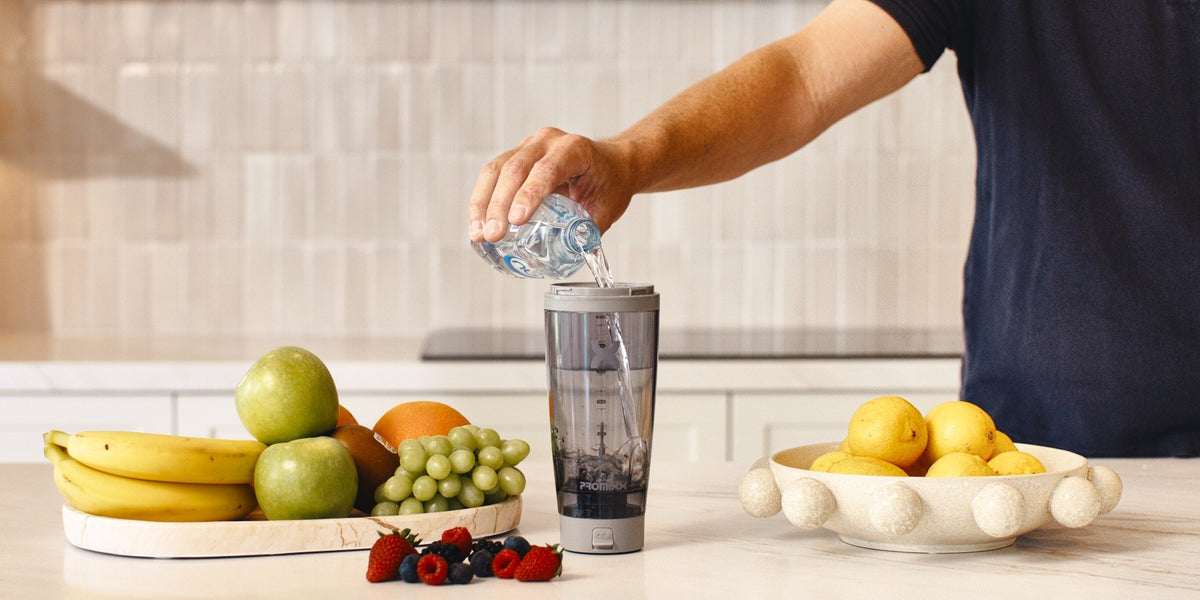
Blend one protein-dense ingredient with milk, yoghurt or oats and a smoothie clears 30g. The dense ingredient does most of the work: 30g in a HLTH+ sachet, 25.5g in a 30g scoop of whey powder, 25.5g in 150g of cottage cheese. Every recipe here shows its protein as a sum you can check.
A protein figure on a recipe only helps if you can see the working, and fruit adds far less protein than the photo suggests. If your last smoothie was meant to be a serious serve of protein and you cannot say where the grams came from, the gap is usually arithmetic. This page shows the working for all 12 recipes, with the sugars beside it.
How do you get 30g of protein into a smoothie?
Start with one protein-dense base, then let milk, yoghurt, oats and nut butter top it up. Under Schedule 4 of the Australia New Zealand Food Standards Code, a serve needs at least 10g of protein to be called a good source, so 30g is three times that line.
The figures below come from the Australian Food Composition Database (AFCD, Release 3.0, Food Standards Australia New Zealand), scaled from per 100g to a typical serve. The HLTH+ figure is the label's 30g per serve. Milk is counted at 100mL to 100g, which slightly understates it, and sums use unrounded database values, so a printed total can sit 0.1g from its printed parts.
| Ingredient | Serve | Protein per serve |
|---|---|---|
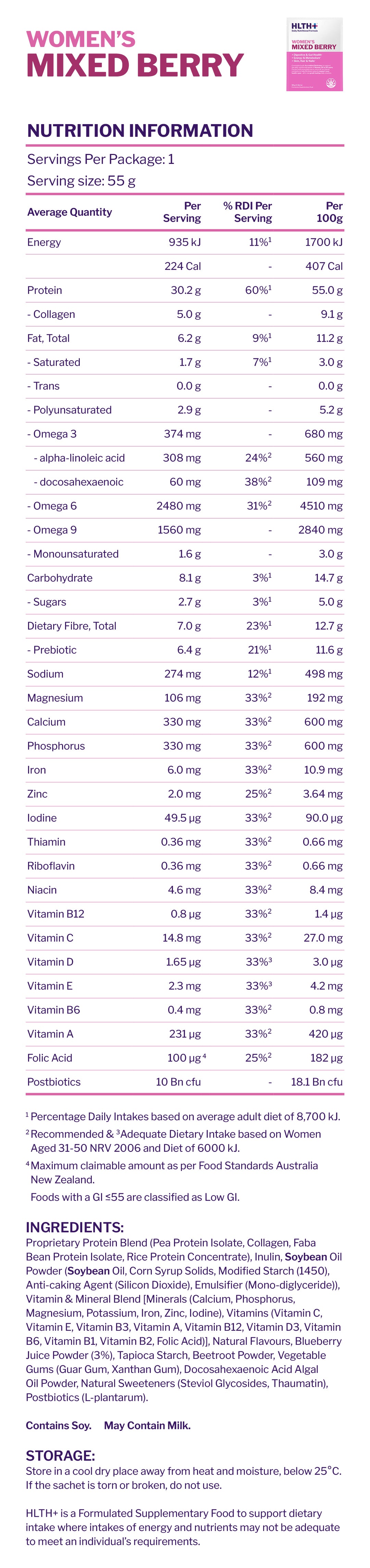
| HLTH+ sachet (Women's, label figure) | 1 sachet, 55g | 30g |
| Whey protein powder, protein above 70% | 30g scoop | 25.5g |
| Cottage cheese | 150g | 25.5g |
| Firm tofu | 150g | 19.2g |
| Ricotta | 150g | 15.6g |
| Pumpkin seeds, hulled | 30g | 9.06g |
| Hemp seeds | 30g | 8.94g |
| Reduced-fat milk (about 1% fat) | 250mL | 8.75g |
| Natural yoghurt, regular fat | 150g | 7.95g |
| Peanut butter, no added sugar or salt | 20g | 4.86g |
| Rolled oats | 30g | 3.66g |
| Banana | 100g | 1.4g |
Fruit adds little: 100g of banana is 1.4g.
If a smoothie is your breakfast, the same arithmetic runs through high-protein breakfast ideas, healthy breakfast on the go and protein shake for breakfast.
Can you make a protein smoothie without protein powder?
Yes: five of the twelve recipes use no powder at all. Cottage cheese (17g of protein per 100g), ricotta, firm tofu, natural yoghurt and seeds each carry the load. The trade-off is volume, since 150g of cottage cheese delivers the 25.5g that a 30g scoop of whey powder does.
If you do want a powder, whey protein vs whey isolate and plant-based protein powder explain how the labels differ.
Blending because your appetite has dropped? Learn more about what changes nutritionally when you eat less →
Which milk gives a protein smoothie the most protein?
Per 250mL, regular-fat soy beverage leads and oat and almond beverages trail well behind. Both soy entries in the AFCD list added sugars, so read the carton on yours.
| Milk (AFCD entry) | Protein per 250mL | Total sugars per 250mL | Added sugars per 250mL |
|---|---|---|---|
| Soy beverage, regular fat (about 3%), added calcium | 9.5g | 6.75g | 4.5g |
| Cow, skim (about 0.15% fat) | 9.25g | 13.75g | 0g |
| Cow, reduced fat (about 1%) | 8.75g | 12.5g | 0g |
| Cow, regular fat (about 3.5%) | 8.5g | 13.75g | 0g |
| Soy beverage, reduced fat (about 1%), added calcium and vitamins | 7.75g | 4.5g | 2.75g |
| Oat beverage, added calcium | 3.5g | 8g | 0g |
| Almond beverage, no added sugar, added calcium | 1.25g | 0g | 0g |
Which protein smoothies use a HLTH+ sachet?
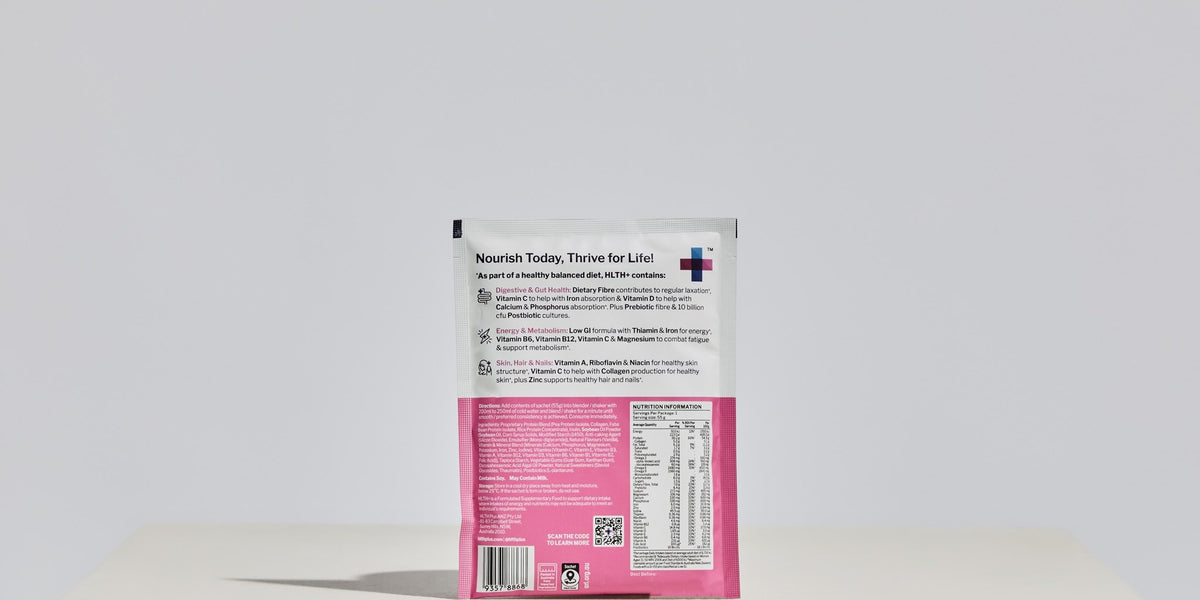
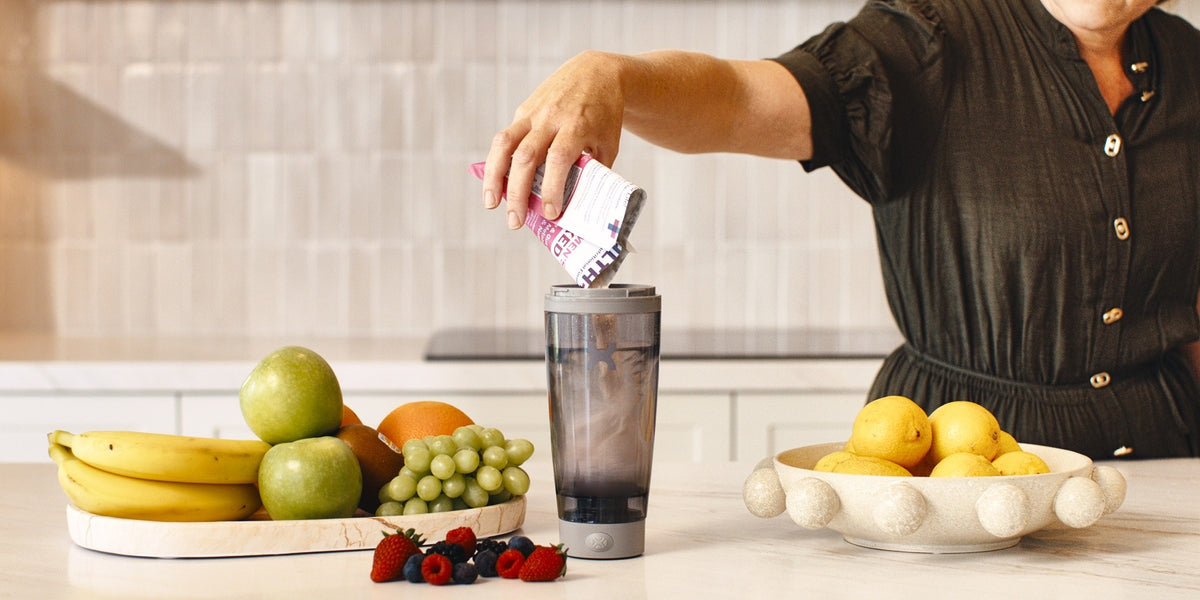
Four recipes, one for each flavour: Vanilla, Chocolate, Mixed Berry and Iced Coffee. Each starts from the sachet's 30g of protein per serve, so the working is 30g plus the database figure for everything else. Sugars start from the Women's sachet's 1.5g (Men's is 1.7g), then add each other ingredient.
Before training, what to eat before a workout covers timing.
1. Vanilla, banana and oat
Ingredients: 1 HLTH+ Vanilla sachet, 300mL water, 100g banana, 30g rolled oats, ice.
- Add the water, banana and oats to the blender.
- Add the sachet and a handful of ice.
- Blend until smooth.
Protein per serve: 30g (sachet) + 1.4g (banana) + 3.66g (oats) = 35.1g.
Sugars per serve: 1.5g (Women's sachet) + 13.4g (banana) + 0.3g (oats) = 15.2g total.
2. Chocolate and peanut butter
Ingredients: 1 HLTH+ Chocolate sachet, 250mL reduced-fat milk, 20g peanut butter, ice.
- Add the milk and peanut butter to the blender.
- Add the sachet and ice.
- Blend until smooth.
Protein per serve: 30g (sachet) + 8.75g (milk) + 4.86g (peanut butter) = 43.6g.
Sugars per serve: 1.5g (Women's sachet) + 12.5g (milk) + 1.04g (peanut butter) = 15.0g total.
3. Mixed Berry and yoghurt
Ingredients: 1 HLTH+ Mixed Berry sachet, 150g natural yoghurt, 80g frozen strawberries, 60g frozen blueberries, 150mL water.
- Add the water, yoghurt and frozen berries to the blender.
- Add the sachet.
- Blend until smooth.
Protein per serve: 30g (sachet) + 7.95g (yoghurt) + 0.56g (strawberries) + 0.3g (blueberries) = 38.8g.
Sugars per serve: 1.5g (Women's sachet) + 7.65g (yoghurt) + 4.4g (strawberries) + 6.18g (blueberries) = 19.7g total.
4. Iced Coffee and cocoa
Ingredients: 1 HLTH+ Iced Coffee sachet, 250mL skim milk, 5g cocoa powder, ice.
- Add the milk and cocoa powder to the blender.
- Add the sachet and plenty of ice.
- Blend until smooth.
Protein per serve: 30g (sachet) + 9.25g (milk) + 1.105g (cocoa) = 40.4g.
Sugars per serve: 1.5g (Women's sachet) + 13.75g (milk) + 0.075g (cocoa) = 15.3g total.
The Iced Coffee flavour contains caffeine. For a coffee-first version, see protein coffee.
Which protein smoothies use a whey scoop?
Three recipes on the AFCD's generic whey powder entry: protein above 70%, unfortified, a composite of four samples bought in Australia. A 30g scoop carries 25.5g of protein and 0.5g of dietary fibre. Your tub will differ, so swap its label figure in for 25.5g and the sum still works.
5. Strawberry and yoghurt
Ingredients: 30g whey powder, 150g frozen strawberries, 100g natural yoghurt, 200mL water.
- Add the water, yoghurt and strawberries to the blender.
- Add the whey powder.
- Blend until smooth.
Protein per serve: 25.5g (whey) + 5.3g (yoghurt) + 1.05g (strawberries) = 31.9g.
Sugars per serve: 0.39g (whey) + 5.1g (yoghurt) + 8.25g (strawberries) = 13.7g total.
6. Oat and cocoa
Ingredients: 30g whey powder, 30g rolled oats, 5g cocoa powder, 200mL skim milk, ice.
- Add the milk, oats and cocoa powder to the blender.
- Add the whey powder and ice.
- Blend until the oats disappear.
Protein per serve: 25.5g (whey) + 7.4g (milk) + 3.66g (oats) + 1.105g (cocoa) = 37.7g.
Sugars per serve: 0.39g (whey) + 11g (milk) + 0.3g (oats) + 0.075g (cocoa) = 11.8g total.
7. Spinach and pineapple
Ingredients: 30g whey powder, 100g natural yoghurt, 100g pineapple, 40g baby spinach, 150mL water.
- Add the water, spinach and pineapple to the blender.
- Add the yoghurt and whey powder.
- Blend until the spinach is gone.
Protein per serve: 25.5g (whey) + 5.3g (yoghurt) + 1.12g (spinach) + 0.5g (pineapple) = 32.4g.
Sugars per serve: 0.39g (whey) + 5.1g (yoghurt) + 0g (spinach) + 8.6g (pineapple) = 14.1g total.
Which protein smoothies need no powder at all?
Five recipes reach 30g from cottage cheese, tofu, ricotta, yoghurt, seeds and milk. Recipes 9 and 12 use no dairy; both use a soy beverage, whose AFCD entry lists added sugars (1.8g per 100g), shown in their sugars lines.
8. Cottage cheese and strawberry
Ingredients: 150g cottage cheese, 100g frozen strawberries, 150mL reduced-fat milk, ice.
- Add the milk and cottage cheese to the blender.
- Add the strawberries and ice.
- Blend for a full minute so the curds break down.
Protein per serve: 25.5g (cottage cheese) + 5.25g (milk) + 0.7g (strawberries) = 31.5g.
Sugars per serve: 2.7g (cottage cheese) + 7.5g (milk) + 5.5g (strawberries) = 15.7g total.
9. Tofu, banana and peanut butter
Ingredients: 150g firm tofu, 250mL soy beverage, 100g banana, 20g peanut butter.
- Add the soy beverage and tofu to the blender.
- Add the banana and peanut butter.
- Blend until no tofu flecks remain.
Protein per serve: 19.2g (tofu) + 9.5g (soy beverage) + 1.4g (banana) + 4.86g (peanut butter) = 35.0g.
Sugars per serve: 0g (tofu) + 6.75g (soy beverage) + 13.4g (banana) + 1.04g (peanut butter) = 21.2g total, of which 4.5g is added sugars in the AFCD soy entry.
10. Chocolate, peanut butter and oat
Ingredients: 250mL reduced-fat milk, 150g natural yoghurt, 40g rolled oats, 35g peanut butter, 5g cocoa powder, ice.
- Add the milk, yoghurt and oats to the blender.
- Add the peanut butter, cocoa powder and ice.
- Blend until thick and smooth.
Protein per serve: 8.75g (milk) + 7.95g (yoghurt) + 4.88g (oats) + 8.505g (peanut butter) + 1.105g (cocoa) = 31.2g.
Sugars per serve: 12.5g (milk) + 7.65g (yoghurt) + 0.4g (oats) + 1.82g (peanut butter) + 0.075g (cocoa) = 22.4g total.
11. Ricotta and raspberry
Ingredients: 150g ricotta, 150g natural yoghurt, 200mL reduced-fat milk, 100g frozen raspberries.
- Add the milk, ricotta and yoghurt to the blender.
- Add the raspberries.
- Blend until smooth.
Protein per serve: 15.6g (ricotta) + 7.95g (yoghurt) + 7g (milk) + 1.1g (raspberries) = 31.7g.
Sugars per serve: 4.05g (ricotta) + 7.65g (yoghurt) + 10g (milk) + 6.7g (raspberries) = 28.4g total.
12. Hemp, pumpkin seed and pineapple
Ingredients: 30g hemp seeds, 30g hulled pumpkin seeds, 300mL soy beverage, 40g baby spinach, 100g pineapple.
- Add the soy beverage, seeds and spinach to the blender.
- Add the pineapple.
- Blend for a full minute, since seeds need longer.
Protein per serve: 8.94g (hemp) + 9.06g (pumpkin seeds) + 11.4g (soy beverage) + 1.12g (spinach) + 0.5g (pineapple) = 31.0g.
Sugars per serve: 0.69g (hemp) + 0.39g (pumpkin seeds) + 8.1g (soy beverage) + 0g (spinach) + 8.6g (pineapple) = 17.8g total, of which 5.4g is added sugars in the AFCD soy entry.
What changes when you eat less than you used to?
Over 90% of Australian adults do not meet dietary guidelines, on the AIHW poor-diet measure. When calories drop, whether from a deliberate deficit, a reduced appetite, or rapid weight loss, reduced eating and medically induced weight loss, there is less food to deliver each nutrient in the first place.
In trial conditions, GLP-1 medicines reduced ad libitum food intake by roughly a quarter of daily calories (Blundell and colleagues, Diabetes, Obesity and Metabolism, 2017).
This page is general information, not medical advice, and decisions about any medication belong with your doctor.
How does a HLTH+ sachet compare with a scoop of protein powder?
A 30g scoop of the AFCD's whey powder carries 25.5g of protein and 0.5g of dietary fibre; a 55g HLTH+ Women's sachet carries 30g of protein and 7g of dietary fibre per serve, within 30 essential daily nutrients. HLTH+ comes as Women's, Women's 50+, Men's and Men's 50+, each formulated by Accredited Dietitians to the Nutrient Reference Values published in 2006 by the National Health and Medical Research Council, the Australian Government Department of Health and Ageing and the New Zealand Ministry of Health. The ✦ Find My Formula quiz shows what your current routine is not giving you.
Which recipe suits which reader:
- You want protein and nothing else in the glass: recipes 5 to 12, on a scoop or on whole foods.
- You want protein, dietary fibre and a balanced multivitamin profile in one sachet: HLTH+, recipes 1 to 4.
- You avoid dairy: recipes 9 and 12 use none, and HLTH+ is dairy-free and gluten-free. Allergen line: contains soy.
HLTH+ is a Formulated Supplementary Food, Australian-made in facilities complying with Good Manufacturing Practice. It sells at hlthplus.com at RRP $6.00, or $5.10 a day on a 28-serve subscription, and through Amazon AU and Chemist Warehouse online. For the wider field, see the best protein shakes in Australia.
HLTH+ is not designed as a meal replacement because it complements a food-first approach; but it works fine as a healthy snack or to tie you over.
See what your current routine is missing. The 30-second ✦ Find My Formula quiz shows the gaps your existing tubs and bottles leave.
Frequently Asked Questions
What is the easiest way to add protein to a smoothie?
Add one protein-dense ingredient. The Australian Food Composition Database lists 25.5g of protein in a 30g scoop of whey powder, 25.5g in 150g of cottage cheese, 19.2g in 150g of firm tofu and 7.95g in 150g of natural yoghurt. A HLTH+ sachet carries 30g of protein per serve; milk, oats and seeds top up the rest.
Does fruit add much protein to a smoothie?
Very little. The Australian Food Composition Database lists 1.4g of protein per 100g of banana, 1.1g for raspberries, 0.7g for strawberries and 0.4g for mango. A smoothie built mostly on fruit takes its protein from a dairy, tofu, seed or powder base, which is why every recipe here shows that sum.
Can you put a HLTH+ sachet in a smoothie?
Yes: recipes 1 to 4 blend a sachet with milk, water, yoghurt, oats or fruit. Each sachet carries 30g of protein per serve, so a recipe's total is 30g plus the database figure for whatever else goes in. The Iced Coffee flavour contains caffeine.
What is the difference between a protein smoothie and a protein shake?
A smoothie blends whole foods such as fruit, yoghurt, oats or seeds, so its protein comes from several ingredients. A shake usually mixes a powder with milk or water, so most of its protein comes from the powder. Either way, the label or database figure for each ingredient is what you add up.
Leave a comment
This site is protected by hCaptcha and the hCaptcha Privacy Policy and Terms of Service apply.