

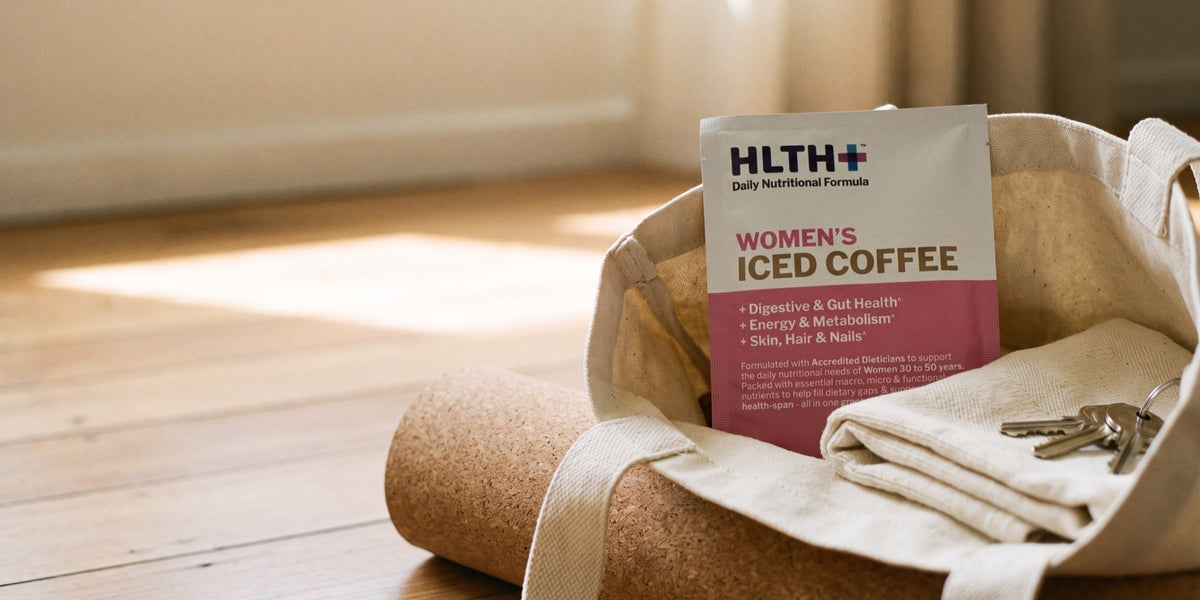
Protein coffee is coffee with protein added to it, and there are two ways to get there: make it yourself with coffee, milk and a scoop of protein powder, or buy it already made as a powder mix or a ready-to-drink (RTD) can. Homemade gives you control over what comes with the protein; ready-made gives you convenience and whatever the can's ingredient list carries alongside it.
Most people asking this already drink coffee daily and are trying to make that habit carry more of the day's protein, not add a second product to remember. The confusion is that "protein coffee" covers a DIY recipe, a scoop-and-shake powder and a shelf-stable can, and each one answers the protein question differently.
This page works through the arithmetic for making it at home, the four things worth checking on a ready-made can before the price, and where HLTH+ Iced Coffee sits against both routes.
How do you make protein coffee at home?
The method is three ingredients: brewed coffee, milk, and a scoop of protein powder, blended or shaken and served over ice. The coffee carries almost no protein of its own; the milk and the powder do the work.
Every figure below is scaled from the Australian Food Composition Database, Release 3.0, Food Standards Australia New Zealand, retrieved 22 September 2026. Liquids are taken at 100g per 100mL, and calories are kilojoules divided by 4.184.
| Ingredient | Amount | Protein | Dietary fibre | Calories |
|---|---|---|---|---|
| Long black, from ground coffee beans | 250mL | 0.8g | 0g | 5 Cal |
| Milk, cow, fluid, regular fat (~3.5%) | 100mL | 3.4g | 0g | 66 Cal |
| Protein powder, whey based, protein >70%, unfortified | 30g scoop | 25.5g | 0.5g | 112 Cal |
| Total | 29.7g | 0.5g | 184 Cal |
That is a long black cooled and poured over ice, topped with 100mL of milk and a single 30g scoop of an unfortified whey protein powder, shaken with the ice rather than stirred. Swap the milk for a plant milk and check the carton first, because the database's plant beverages spread widely: a calcium-fortified soy beverage carries 3.1g to 3.8g of protein per 100mL, close to dairy milk's 3.4g to 3.7g, while a fortified oat beverage carries 1.4g and an almond beverage 0.5g.
The powder is doing almost all the work here. At 85g of protein per 100g on the database's own whey-powder entry, a single 30g scoop supplies more than seven times what the milk contributes, which is why the flavour and the sweetener in that scoop matter more to the finished drink than the coffee does.
What should you check before buying a ready-made protein coffee?
Four things, and three of them are printed on the can.
- Protein per serve. Under Schedule 4 of the Australia New Zealand Food Standards Code, a food needs at least 5g of protein per serving to carry a protein claim at all and at least 10g to be called a good source. Ready-made protein coffees clear that easily, but the serve sizes differ enough that protein per can is not protein per gram of powder.
- Sugars per serve, and whether any of it is added. A milk-based RTD carries lactose whether or not sugar was added, so "no added sugar" and "low sugar" are different questions; check both lines.
- Whether the serve is plain protein or carries more. Some cans are a flavoured milk with protein added and nothing else on the panel; others carry dietary fibre, vitamins or minerals alongside it.
- Caffeine, and whether the label states a figure. A protein coffee is still a coffee, so the caffeine line matters as much as the protein one, especially in a can meant to be drunk on top of a normal day's coffee.
Two Australian ready-to-drink examples, read from their published nutrition panels, show how differently that plays out. For shakes rather than coffees, the best protein shakes in Australia runs the same panel read across the wider category.
| Product | Serve | Protein | Sugars | Caffeine | What else the serve carries |
|---|---|---|---|---|---|
| Dare Protein Double Espresso | 500mL | 30.0g | 23.0g, none added | 160mg | Reduced-fat milk base, sweeteners 950 and 951; calcium 875mg on the panel, dietary fibre 0.0g |
| Before You Speak Iced Latte RTD | 240mL | 15.2g | 12.8g | 160mg | Calcium 422mg on the panel; no dietary fibre row |
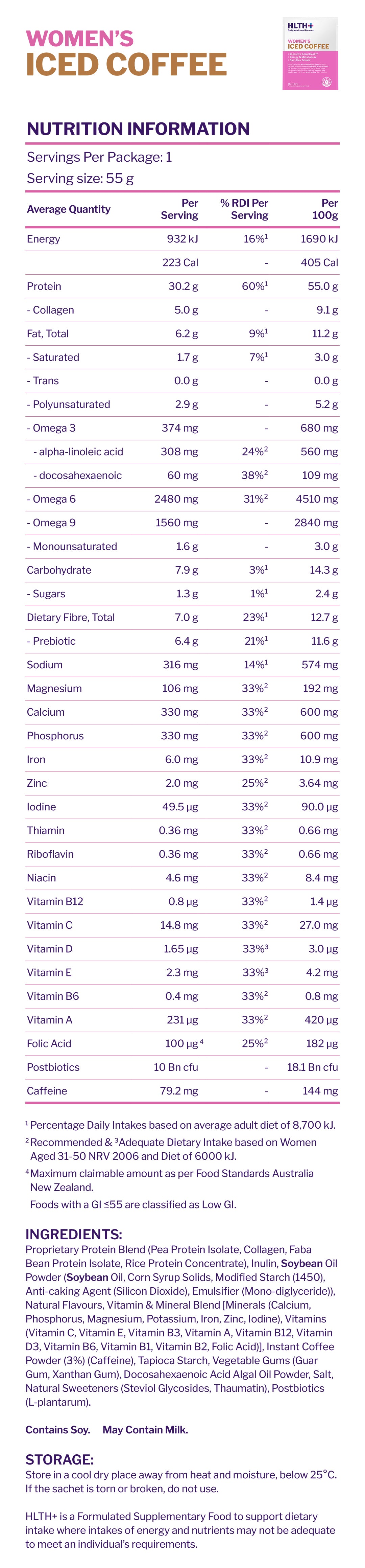
| HLTH+ Iced Coffee | 55g sachet, Women's (60-62g Men's) | 30g protein per serve | 1.5g Women's / 1.7g Men's, none added | Contains caffeine | 7g dietary fibre, 30 essential daily nutrients, dairy-free |
Figures are each brand's published nutrition information, retrieved 22 September 2026. Flavours and formulations vary, and brands reformulate, so check current labels before buying.
Read the protein column first, because it is the number the front of both cans leads with, and it is the number that differs most. Dare's Double Espresso carries twice Before You Speak's Iced Latte in a can a little over twice the volume, which is mostly a serve-size difference rather than a formulation one. Read the caffeine line next: both cans state 160mg a serve, and Dare's states it in a can more than twice the size.
Dare's Double Espresso reaches 23.0g of sugars with none added, using sweeteners 950 (acesulfame potassium) and 951 (aspartame) instead, all on a reduced-fat milk base; that is how a "no added sugar" claim still sits beside 23.0g on the total-sugars line. Dare's panel carries a dietary fibre row and it reads 0.0g; Before You Speak's panel has no dietary fibre row at all. Beyond protein, both panels state calcium and caffeine, and neither states a vitamin.
Does a protein coffee recipe work if your appetite has dropped?
Coffee is often the habit that survives a smaller appetite longest, which is exactly why it is worth putting a nutrient-dense choice inside it rather than adding a separate product to remember. In trial conditions, GLP-1 medicines reduced ad libitum food intake by roughly a quarter of daily calories (Blundell and colleagues, Diabetes, Obesity and Metabolism, 2017). Take a quarter out of a day, and the eating occasions that survive are the ones that need to work hardest.
This section is general information, not medical advice. Decisions about any medication belong with your doctor.
The practical shift for rapid weight loss, reduced eating and medically induced weight loss is the same one that applies to any smaller appetite: smaller, denser choices beat larger, lighter ones. A protein coffee, homemade or ready-made, is a smaller choice than most breakfasts and denser in protein than most drinks, which is the combination that earns it a place inside a routine that already exists rather than on top of it.
Where does HLTH+ Iced Coffee fit?
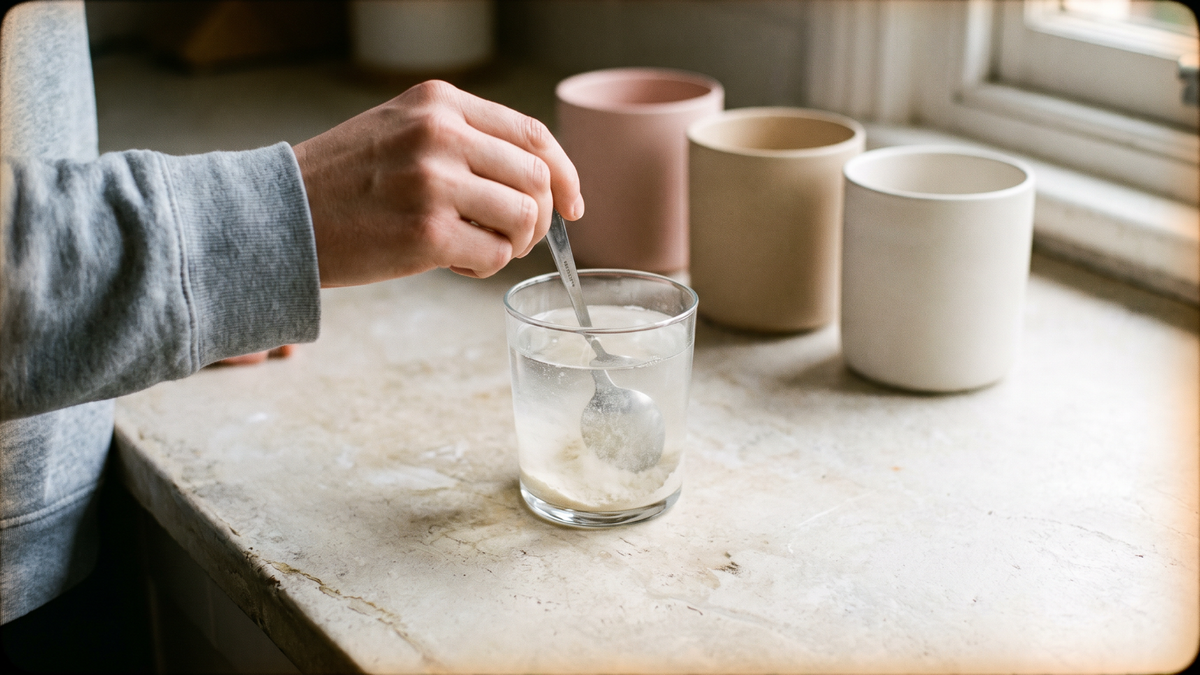
HLTH+ Iced Coffee is a powder, not a can: a 55g sachet (Women's; 60-62g for Men's) mixed into 300 to 400mL of cold water or milk over ice. Its own flavour descriptor is "Bold & Energising."
One sachet lists 30g protein per serve and 7g dietary fibre, and the Iced Coffee flavour contains caffeine. Protein contributes to the maintenance and growth of muscle mass and to tissue repair, and dietary fibre contributes to regular laxation, both as part of a healthy diet involving a variety of foods. Sugar sits at 1.5g in the Women's formula and 1.7g in the Men's, with none added, and it is dairy-free, so there is no lactose to check for; lactose-free protein shakes covers the wider set for that reader.
Counted across protein, dietary fibre, vitamins, minerals, collagen and DHA, a serve supplies 30 essential daily nutrients. It comes across Women's, Women's 50+, Men's and Men's 50+, formulated to the Nutrient Reference Values, the reference intakes published in 2006 by the National Health and Medical Research Council, the Australian Government Department of Health and Ageing and the New Zealand Ministry of Health, so the amounts move with age and sex rather than sitting at one figure for every adult.
It is a Formulated Supplementary Food, Australian made in facilities complying with Good Manufacturing Practice, gluten-free and carries a 5-star Health Star Rating. We believe in a food-first approach, and the statistics say food alone is not getting there: over 90% of Australian adults do not meet dietary guidelines on the AIHW's poor-diet measure. A serve is RRP $6.00, or $5.10 a day on the 28-serve subscription at $142.80 with no lock-in, at hlthplus.com, Amazon AU and Chemist Warehouse online.
If breakfast is the slot a protein coffee is filling, a healthy breakfast on the go and 25 high-protein breakfasts that actually reach 30g run the same numbers over food. If it is filling the pre-training slot, what to eat before a workout covers the timing. For what changes for vitality when eating drops, learn more on the vitality support page.
Which protein coffee should you choose?
Make it at home if you want to control exactly what goes into it, and do not mind weighing a scoop and pouring milk over ice. It is the cheapest route per serve, once you already own the powder.
Choose Dare Protein Double Espresso if the highest protein figure on a can matters most to you, and a dairy base with artificial sweeteners does not bother you. At 30.0g in 500mL, it is the highest-protein can on this page.
Choose Before You Speak Iced Latte RTD if a 240mL can suits you better than Dare's 500mL format; the caffeine line is the same 160mg in either, so the choice is about volume and protein, not caffeine.
Choose HLTH+ Iced Coffee if you want the protein figure to arrive with dietary fibre and a balanced multivitamin profile rather than protein alone, and you would rather mix a dairy-free sachet than open a can. It is not designed to replace either route; it is built to be the one where the rest of the formula travels with the coffee. Read the panel first either way, because the number on the front of the pack is never the whole answer.
Find out what your current routine is not giving you. The 30-second ✦ Find My Formula quiz is diagnostic: it shows the gaps your current coffee, shake or supplement stack leaves, so you know what is missing before you buy anything.
Frequently Asked Questions
How much protein should a protein coffee have?
At least 10g to count as a good source under Schedule 4 of the Food Standards Code, though most protein coffees aim higher. A homemade version with milk and a 30g whey scoop reaches close to 30g, and the two Australian cans checked for this page carry 15.2g and 30.0g a serve, so check the panel rather than assume.
Does protein powder curdle in coffee?
It can. Heat is the usual reason: a whey-based powder stirred into a hot cup clumps and separates, which is why most recipes build it cold. Cool the coffee first, or shake the powder with ice as in the method above, and it mixes cleanly without any change to the protein figure.
Is homemade or ready-made protein coffee better?
Neither wins outright. Homemade lets you choose the milk, the powder and how much sugar comes with it. Ready-made trades that control for convenience, and the two Australian cans checked for this page range from 15.2g to 30.0g of protein a serve, so read the panel before assuming a can matches what you would make yourself.
Does HLTH+ Iced Coffee contain caffeine?
Yes. The Iced Coffee flavour contains caffeine. It is a Formulated Supplementary Food with 30g protein, 7g dietary fibre and 30 essential daily nutrients per 55g sachet (Women's; 60-62g Men's), mixed with 300 to 400mL of cold water or milk over ice, so it is the powder route to a protein coffee rather than the canned one.
Leave a comment
This site is protected by hCaptcha and the hCaptcha Privacy Policy and Terms of Service apply.