

What is collagen powder, and what's actually in it?
Collagen powder is hydrolysed collagen peptides: the structural protein collagen, broken down into shorter chains so it dissolves in cold liquid instead of setting like gelatine. The two sources you will meet on Australian shelves are cattle (bovine) and fish (marine), and both are processed the same basic way before they reach the tub.
The reason people buy it varies. Some want the largest single dose of collagen they can find; others want a daily nutrition product that happens to include some. Those are two different shopping lists, and the label tells you which one you are holding within the first few numbers.
This guide works through what the label terms mean, what the research on collagen supplementation actually covers, what to check before you buy, and where a blended formula such as HLTH+ sits against a dedicated peptide tub. For a price-per-serve comparison across the named collagen products, see our collagen powder shortlist.
Bovine, marine and hydrolysed: what the label terms actually mean
Bovine collagen comes from cattle hide and bone. It is the source behind the largest per-serve doses verified for this page, 10g to 15g per serve (Nature's Way and The Collagen Co, retrieved 22 September 2026).
Marine collagen comes from fish skin and scales. The marine example verified for this page is a smaller dose (Vida Glow lists 3g per 3g sachet, retrieved 22 September 2026), and its one meaningful practical difference from bovine is the allergen: marine collagen contains fish, so it is not an option for a reader with a fish allergy.
Hydrolysed describes the processing, not the source. Enzymes break the long collagen protein chains into shorter peptides, which is why a hydrolysed powder stirs into a cold drink rather than needing to be dissolved into a warm liquid the way gelatine does. Every collagen powder checked for this page, bovine or marine, is hydrolysed; if a label does not use the word, check for "collagen peptides" instead, which means the same thing.
What does the research on collagen supplementation actually show?
This is the evidence for the category, not a claim about any specific product. The largest pooled analysis is a 2021 systematic review and meta-analysis of 19 randomised, double-blind, controlled trials covering 1,125 participants aged 20 to 70, 95% of them women. Its grouped analysis reported favourable results for hydrolysed collagen supplementation against placebo on skin hydration, elasticity and wrinkles, with its conclusion framed around 90 days of ingestion (de Miranda and colleagues, International Journal of Dermatology, 2021).
A second body of trials looks at joints rather than skin. An updated meta-analysis of 11 randomised controlled trials in 870 people with knee osteoarthritis (451 on collagen, 419 on placebo) reported statistically significant improvements in pain and function scores favouring the collagen groups (Simental-Mendía and colleagues, Clinical and Experimental Rheumatology, 2025).
Two things to weigh before taking either result as a personal promise. The skin trials were run overwhelmingly in women and the joint trials in people with a diagnosed condition, so neither is a general claim about a healthy adult of any age or sex. Neither published abstract states a single daily dose the pooled trials converged on, so treat any specific gram target you see in a brand's marketing as that brand's own recommendation, not a settled research finding.
What should you check on a collagen powder label?
Four things decide whether a collagen product does the job you are buying it for.
- Collagen grams per serve. The spread across the products checked for this page runs from 3g to 15g, so "contains collagen" on its own tells you almost nothing.
- Source and allergen. Bovine (cattle) and marine (fish) are the two you will see. If you avoid fish or avoid beef, the source line decides the purchase before anything else does.
- What else the serve carries. A pure peptide powder is a single ingredient. A product that blends collagen into a wider formula is a different purchase, and the label should say what else is in the serve, not only the collagen figure.
- Sugars and price per serve. Sugars run from 0.0g per serve upward (Vida Glow, retrieved 22 September 2026), and price per serve only exists once you divide the pack price by the servings per pack.
One more thing worth knowing before you read any collagen pack. Schedule 4 of the Australia New Zealand Food Standards Code lists the food-health relationships a food label is pre-approved to state, and collagen is not one of them: a food label can state how much collagen a product contains, and any health effect for it has to be separately substantiated and notified to Food Standards Australia New Zealand before it can appear. Where a collagen pack carries a skin or joint claim, check whether it shows an AUST L number, which marks a listed medicine regulated by the Therapeutic Goods Administration rather than a food.
A collagen search usually starts with skin, hair or nails. What changes in each when overall intake drops with rapid weight loss, reduced eating and medically induced weight loss has its own page: learn more about what changes when you eat less, what happens to hair and what changes in skin after a large loss.
Bovine peptide powder, marine peptide powder, or collagen inside a nutrition base?
The three shapes collagen powder comes in are not really competing on the same job. They are answers to different questions, set out here by type rather than by brand.
| Type | Typical source | What "hydrolysed" means here | Published example (retrieved 22 September 2026) | What else the serve carries |
|---|---|---|---|---|
| Bovine peptide powder | Cattle hide and bone | Long collagen chains broken into short peptides so the powder dissolves cold | Nature's Way lists 10g hydrolysed bovine collagen peptides and 9g protein per 10g serve; The Collagen Co lists 15g per serve | Varies: Nature's Way lists collagen peptides as its only ingredient; The Collagen Co adds vitamin C, hyaluronic acid and biotin |
| Marine peptide powder | Fish skin and scales | Same enzymatic breakdown, usually sold in smaller per-serve doses | Vida Glow lists 3,000mg hydrolysed marine collagen peptides, 2.9g protein and 0.0g sugars per 3g sachet | Vida Glow lists natural marine collagen as its only ingredient; contains fish |
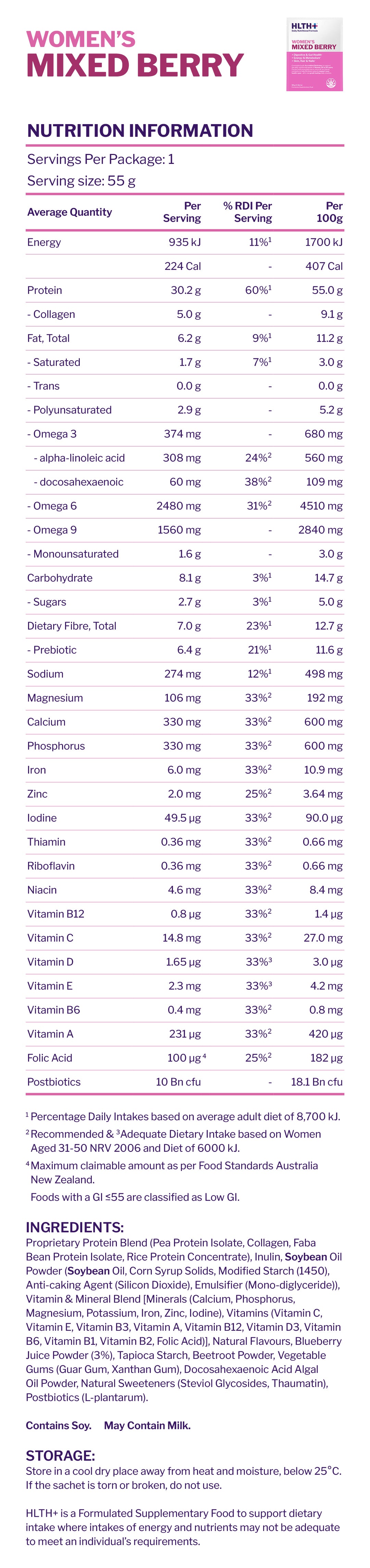
| Collagen inside a nutrition base | Varies by brand; HLTH+ uses bovine collagen | Same peptide form, blended with other protein sources rather than sold alone | HLTH+ lists 5g collagen per 55g sachet | 30g protein per serve, 7g dietary fibre, 10 billion CFU Lactobacillus Plantarum Postbiotic, 60mg DHA and a balanced multivitamin profile |
Figures are each brand's own published information, retrieved 22 September 2026. Flavours vary and brands reformulate, so check the current label before buying.
A bovine or marine peptide powder is the right buy if collagen grams is the whole shopping list. A blended base is the right buy if you want more than one gap covered in a single serve.
Where does HLTH+ fit?
HLTH+ carries 5g of bovine collagen per 55g sachet, inside a full nutrition base rather than sold alone. A dedicated peptide tub carries more collagen per serve; the sachet is built for a different job, because the same serve also carries 30g protein per serve, 7g dietary fibre, 10 billion CFU Lactobacillus Plantarum Postbiotic alongside prebiotics, 60mg DHA and, across protein, dietary fibre, vitamins, minerals, collagen and DHA, 30 essential daily nutrients.
Two of those numbers carry pre-approved relationships under the Food Standards Code, stated as part of a healthy diet involving a variety of foods: protein contributes to the maintenance and growth of muscle mass and is necessary for tissue building and repair, and dietary fibre contributes to regular laxation. Collagen itself is stated as an amount only, 5g, with no health effect attached, because none is pre-approved for it under the Code.
HLTH+ is formulated by Accredited Dietitians to the Nutrient Reference Values, the published government intakes developed by the National Health and Medical Research Council, the Australian Government Department of Health and Ageing and the New Zealand Ministry of Health, and the range runs Women's, Women's 50+, Men's and Men's 50+ rather than one formula for every adult. Over 90% of Australian adults do not meet dietary guidelines (AIHW), which is the gap a daily formula is built to sit inside, not replace: HLTH+ is not designed as a meal replacement, because it complements a food-first approach, but it works fine as a healthy snack or to tie you over between meals.
Every sachet is Australian made in facilities complying with Good Manufacturing Practice, dairy-free, gluten-free and low GI, with a 5-star Health Star Rating and no nasties, artificial colours, artificial flavours or artificial sweeteners. It sells at RRP $6.00 per serve, or $5.10 a day on a 28-serve subscription at $142.80 and $5.40 a day on a 14-serve subscription at $75.60, at hlthplus.com and through Amazon AU and Chemist Warehouse online.
Collagen is a protein, and collagen powders list it as one: Nature's Way lists 9g protein against 10g collagen peptides per serve and Vida Glow 2.9g against 3g (both retrieved 22 September 2026). Whether any protein counts as complete is judged on its essential amino acids, the nine of about 20 that the body cannot make (Better Health Channel, Protein); see our explainer on what makes a protein complete for how that is measured. HLTH+'s 30g protein per serve comes from a blend of pea protein isolate, collagen, faba bean protein isolate and rice protein concentrate.
Two related reads on this hub: our label read of The Lady Shake Collagen and our WelleCo Super Elixir review.
Find out what your current stack is not giving you. The 30-second Find My Formula quiz reads the products you already take and shows the gaps they leave.
Frequently Asked Questions
What is the difference between bovine and marine collagen powder?
Bovine collagen comes from cattle hide and bone; marine collagen comes from fish skin and scales. Both are usually sold hydrolysed, meaning broken into peptides that dissolve in cold liquid. The practical differences are dose (the bovine tubs checked for this guide list 10g to 15g per serve, the marine sachet 3g) and allergen: marine collagen contains fish.
What does "hydrolysed" mean on a collagen powder label?
It describes processing, not the source. Enzymes break the long collagen protein chains into shorter peptides, which is why a hydrolysed powder dissolves in a cold drink instead of needing to be dissolved into a warm liquid the way gelatine does. Every collagen powder checked for this guide, bovine or marine, is hydrolysed.
Is there a recommended daily dose for collagen powder?
There is no dose the published research has converged on. The largest skin-focused meta-analysis (19 trials, 1,125 participants) did not report a common daily amount across the trials it pooled, and the largest joint-focused review did not either. Treat a gram figure on any product's marketing as that brand's own recommendation, not a research finding.
Does collagen powder count as protein?
Yes. Collagen is a protein and collagen powders list it that way: Nature's Way lists 9g protein per 10g serve of collagen peptides and Vida Glow 2.9g per 3g sachet (both retrieved 22 September 2026). Whether a protein is complete depends on its essential amino acids, so read the ingredient list, not only the collagen figure.
Is HLTH+ a collagen powder?
No. It is a Formulated Supplementary Food that lists 5g of collagen in a 55g sachet, alongside 30g protein per serve, 7g dietary fibre, 60mg DHA and 30 essential daily nutrients. A dedicated bovine or marine peptide powder carries more collagen per serve than HLTH+ does.
This article is general information, not medical advice. Decisions about any medication belong with your doctor. Figures quoted are each brand's published information at the retrieval date shown; check current labels before buying.

Leave a comment
This site is protected by hCaptcha and the hCaptcha Privacy Policy and Terms of Service apply.