


Buy on the per-meal protein target, not the tub size, and check whether the formula itself changes for your life stage. After 50, the dose of protein that triggers muscle protein synthesis in a single sitting rises, while a shifting calcium requirement and a smaller appetite change what else that serve needs to carry. A powder built for a 30-year-old and a formula built for a 55-year-old are not interchangeable, even when the front of the tub looks the same.
Most protein powder guides stop at "get enough protein a day." That misses the two things that actually move at 50: how much has to arrive in one meal to do its job, and what else your body needs alongside it. This page works through both, the label checks that matter at this stage, and where HLTH+ Women's 50+ fits.
| What changes | Before 50 | After 50 |
|---|---|---|
| Per-meal protein dose | The lower end of the working range is usually enough | Muscle needs the top of the same range to get the same response |
| Calcium target | Lower, and easier to reach from ordinary food | Steps up, and the gap between target and actual intake widens |
| Appetite | Whatever it was, the per-meal target it fed was lower | If it shrinks, it shrinks against a target that has risen |
| Formula fit | One adult formula usually covers it | A life-stage formula is doing real, different work |
What Changes About Protein Needs After 50?
The total protein you need each day does not jump sharply at 50; what changes is how much one meal has to deliver to be useful. The International Society of Sports Nutrition's position stand puts the dose that maximally triggers muscle protein synthesis at 0.25g of protein per kilogram of body weight, or an absolute range of 20g to 40g, spread every three to four hours (Jäger and colleagues, Journal of the International Society of Sports Nutrition, 2017).
In a younger adult, the lower end of that range is often enough to get the full response. With age, muscle becomes less responsive to a moderate dose of protein, a state the ESPEN Expert Group calls anabolic resistance: "older adults may develop resistance to the positive effects of dietary protein on synthesis of protein, a phenomenon that limits muscle maintenance and accretion" (Deutz and colleagues, Clinical Nutrition, 2014). The same position stand states the practical result in one line: higher doses, around 40g, are likely needed to maximally stimulate muscle protein synthesis in older adults, and the trial behind that line was in men with an average age of 71, so this is a direction of travel from 50 rather than a switch that flips on a birthday.
The same paper names what sits behind the resistance rather than leaving it as a label: more of the amino acids from a meal are held back in the gut and liver rather than reaching muscle, blood flow to muscle after eating is reduced, muscle tissue takes up less of the amino acids that do arrive, and the internal signalling that switches on protein building responds more weakly to begin with. None of that changes with a bigger tub on its own; it is why the dose per sitting, not just the daily total, is the number worth tracking.
Run that against a real meal. A 30g serve of protein, in a shake or on a plate, sits inside that working range; a 10g afternoon snack does not, however healthy it looks. Spreading a day's protein evenly across meals rather than loading it into dinner also matters more once the per-meal threshold has risen; how much protein you actually need to build or hold muscle works through the full daily arithmetic by body weight and the distribution research behind that point, and sarcopenia, the age-related loss of muscle strength and mass, is the reason the per-meal dose matters more with every decade.
What Happens to Bone Density After 50?
Bone is the other system that shifts at this age, and two nutrients carry most of the load. Under the Food Standards Code, calcium is necessary for normal teeth and bone structure and for normal nerve and muscle function, and vitamin D is necessary for normal bone structure, as part of a healthy diet involving a variety of foods.
The recommended daily calcium intake for women steps up in your 50s under the Nutrient Reference Values for Australia and New Zealand; the full target and the food maths to hit it are worked through separately, because it deserves its own page rather than a single line here. The reason the target moves for women specifically is that women lose more calcium from their bones in the 5 to 10 years around the age of menopause (Better Health Channel, Calcium), so the food intake that once held the balance no longer does. Vitamin D is the partner nutrient: you get it from sunlight on skin and from food, and most people cannot get enough from food alone, which is why a doctor may suggest a blood test to check your level (healthdirect, Vitamin D).
Getting there from food matters more than the supplement aisle does. The Australasian Menopause Society puts the food route for women over 50 at three to four serves of dairy foods or calcium-rich alternatives a day (Australasian Menopause Society, Osteoporosis information sheet); where food genuinely falls short, a supplement covers the difference, it does not replace the target. This page is general information, not medical advice, and if you have a diagnosed bone condition, check with your doctor before changing your supplement routine.
Why Do So Many Women Fall Short at This Age?
Over 90% of Australian adults do not meet dietary guidelines (AIHW), and calcium is one of the clearest examples at this age. The Australian Bureau of Statistics' 2023 modelling of usual nutrient intakes found 90.7% of Australian females aged 50 to 64 had an inadequate calcium intake from food and drink alone, against 70.3% of females aged 30 to 49 (ABS, Usual Nutrient Intakes).
Appetite plays a part too. If you are eating less than you used to, whether from a reduced appetite, a busier season or a decision to cut back when calories drop on purpose, every nutrient on the plate shrinks with the plate, and protein shrinks with it. More on what happens to muscle and nutrition when intake drops covers that mechanism in more depth.
The two shortfalls compound rather than sitting side by side. A smaller appetite means less total food, less total food means less protein, and a lower protein intake lands on top of a per-meal target that has already risen. None of this is about willpower or a worse diet than in your 30s; it is a nutrient target that moved and a plate that did not move with it.
What Should You Check on a Protein Powder Label After 50?
Four checks, in the order that matters at this stage.
- Protein per serve, not per 100g. A powder that looks protein-heavy on the label can still deliver a small dose once you look at the actual scoop size; a small scoop of an otherwise protein-dense powder can land well under the 20g floor once it is measured out. How to read the rest of the panel covers this properly.
- Dietary fibre per serve. A dedicated protein powder is sold on its protein, so check whether the serve carries any dietary fibre at all; it is a separate nutrient, needed alongside protein rather than instead of it.
- Sugars per serve. Figures vary widely across products marketed the same way, so check the panel rather than the front of pack, particularly on flavoured varieties.
- Whether the formula itself changes by life stage, or whether one product is sold to every adult regardless of age or sex. A formula that does not change with age is, by definition, not built around anything that changes with age. Protein powder for seniors and the best protein powder for seniors over 70 go further into what changes again later, when appetite and the categories on the shelf both shift again.
None of this is a reason to overhaul a routine that is already working. It is a reason to read past the front of the tub before your next repurchase.
If hormonal symptoms, not protein or bone, are what actually brought you here, menopause supplements and perimenopause symptoms cover what the evidence does and does not support for hot flushes, sleep and mood; this page stays with protein, bone and appetite.
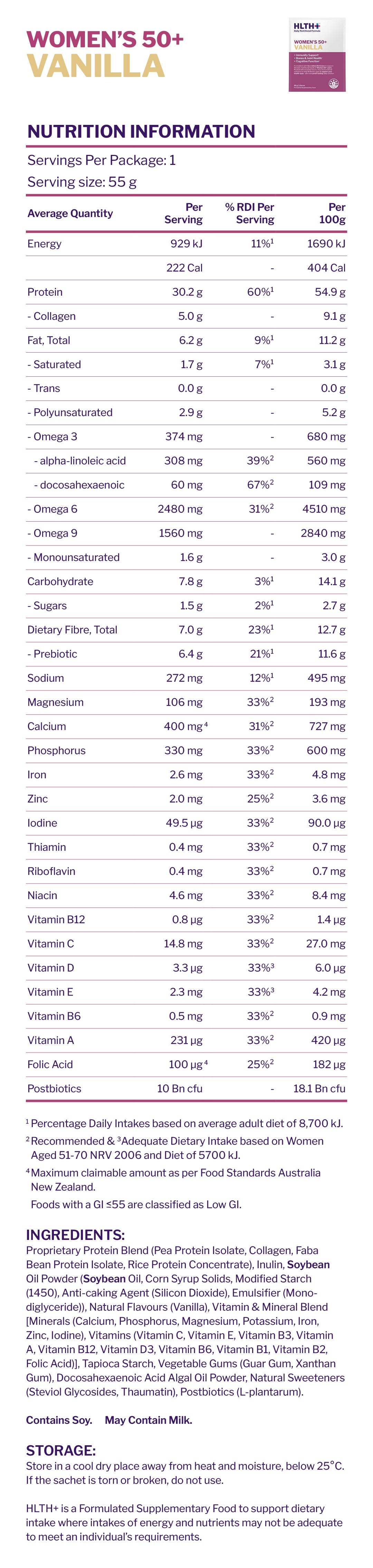
Where Does HLTH+ Women's 50+ Fit?
HLTH+ Women's 50+ is a Formulated Supplementary Food formulated by life stage to the Nutrient Reference Values for Australia and New Zealand, published by the National Health and Medical Research Council, the Australian Government Department of Health and Ageing and the New Zealand Ministry of Health, rather than to the 8,700kJ average adult diet that Australian labels are calculated against, a labelling reference value that sits above what most adults actually need. One 55g sachet carries 30g protein per serve and 7g dietary fibre per serve, inside 30 essential daily nutrients across protein, dietary fibre, vitamins, minerals, collagen and DHA. The vitamin and mineral side of that set is a balanced multivitamin profile.
Protein contributes to the maintenance and growth of muscle mass and is necessary for tissue building and repair, as part of a healthy diet involving a variety of foods. In practice one serve lands inside the 20g to 40g per-sitting range described above without a second scoop.
It is not designed as a meal replacement, because it is built to complement a food-first approach; it works perfectly well as a healthy snack or to tie you over between meals. On price, one serve is RRP $6.00, and a 28-serve subscription works out at $5.10 a day. It is sold at hlthplus.com, and through the HLTH+ store on Amazon AU and at Chemist Warehouse online.
Learn more about nutrition support for muscle through midlife.
Find out what your current stack is actually missing. The ✦ Find My Formula quiz takes about 30 seconds and shows the gaps your existing bottles are leaving. Take the quiz.
Frequently Asked Questions
What changes about protein for women after 50?
The daily total moves only a little; what changes is the per-meal dose needed to trigger muscle protein synthesis. Research puts that at 20g to 40g per sitting, with older muscle needing the higher end of that range rather than the lower one a younger adult can rely on (Jäger and colleagues, 2017).
How much protein should be in one serve after 50?
Aim for the top of the 20g to 40g range. The International Society of Sports Nutrition position stand notes that higher doses, around 40g, are likely needed to maximally stimulate muscle protein synthesis in older adults, because muscle responds less to a moderate dose with age. One sachet of HLTH+ Women's 50+ carries 30g protein per serve.
Do calcium and vitamin D needs change at 50?
Yes. The recommended calcium intake for women steps up in your 50s under the Nutrient Reference Values for Australia and New Zealand, and most are not getting there from food alone: 90.7% of females aged 50 to 64 have an inadequate calcium intake (ABS, 2023). Vitamin D works alongside it, and most people cannot get enough from food alone.
Can a protein powder help with menopause symptoms?
A protein powder is a nutrition product, not a symptom product, and this page covers protein, bone and appetite only. Hot flushes, sleep and mood are a separate question, and what the evidence does and does not support for them is worked through in menopause supplements and perimenopause symptoms. Decisions about symptoms belong with your doctor.
Leave a comment
This site is protected by hCaptcha and the hCaptcha Privacy Policy and Terms of Service apply.