

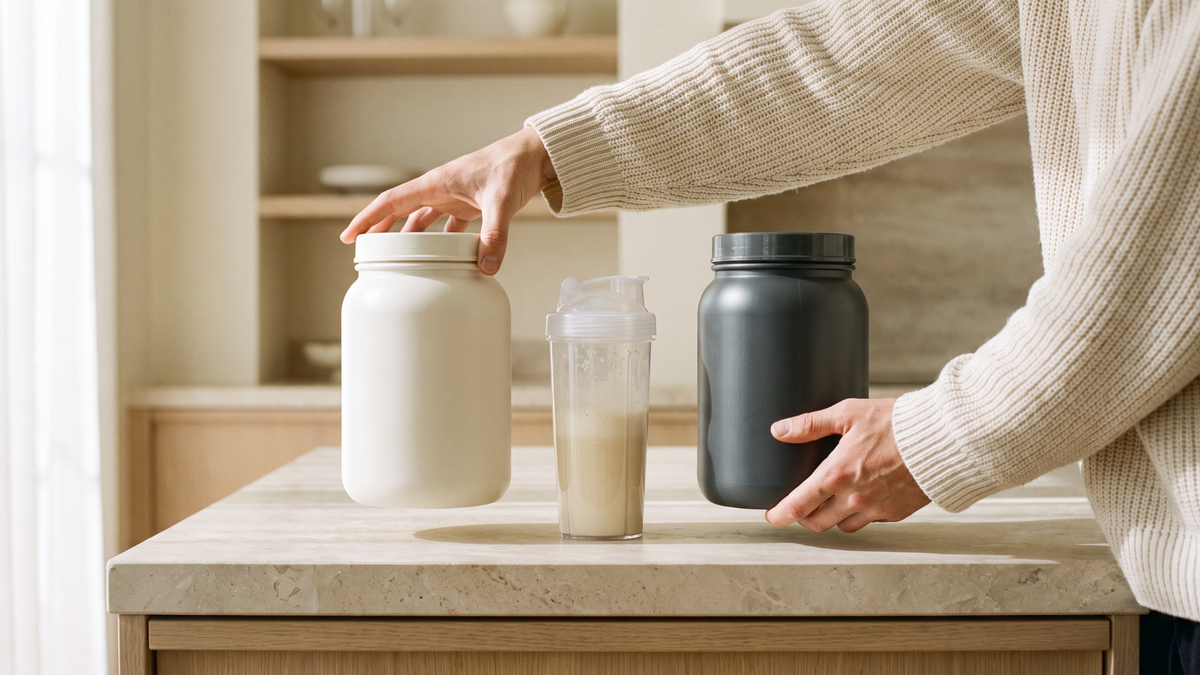
Whey protein and whey protein isolate are not two different ingredients. They come from the same starting material, cow's milk whey, filtered to different degrees before either one reaches a tub.
Isolate is the more heavily filtered of the two, published at 90% to 95% protein with only trace lactose, fat and mineral content left behind, according to a 2024 peer-reviewed review. Whey concentrate keeps more of the original liquid whey, and its published protein content runs anywhere from 20% to 85%, depending on how far it was filtered before drying.
Two tubs on a shelf can both say "whey protein" on the front and mean almost nothing alike once you read past it. If you are the kind of buyer working out cents per gram of protein, checking the sugars row, or wondering whether a shake sits badly on a system that is already handling less food than it used to, the words concentrate, isolate and hydrolysed carry more information than the flavour name printed above them.
This goes through what actually separates the three forms on measured, peer-reviewed data, a real Australian cost comparison between a concentrate and an isolate from the same manufacturer, and where a dairy-free formula fits if lactose was never really the problem you were solving.
What's the difference between whey, whey concentrate and whey isolate?
All three start as liquid whey, the watery by-product left over once milk is separated into curds and whey during cheesemaking. What happens next is filtration, and the degree of filtration is the entire difference between the three forms; it is not a difference in the protein itself. A 2024 narrative review in Healthcare summarises the three published categories: whey protein isolate carries 90% to 95% protein with minimal fat, lactose and mineral content, whey protein concentrate carries anywhere from 20% to 85% protein "along with varying amounts of fat, lactose, and minerals", and a third form, hydrolysed whey, is whey protein broken into shorter chains during processing "to achieve more readily absorption and less antigenic reactions" (Cava et al, Healthcare, 2024).
That 20% to 85% range for concentrate is wide on purpose: a cheap bulk-nutrition concentrate and a premium 80%-protein concentrate are both legitimately called "concentrate", and the word alone tells you almost nothing about what is actually in the tub. Isolate is a narrower, higher band because getting there requires pushing the liquid further through the same kind of filtration. Does whey protein have lactose? follows what that filtering does to the lactose in each type.
How much protein and lactose does each type actually carry?
Measured, published figures make the filtration story concrete. A separate peer-reviewed analysis tested five retail sports-nutrition powders and three industrial reference whey powders for protein and lactose using laboratory methods, protein by the Kjeldahl method and lactose by high-performance liquid chromatography (Pellegrino et al, Molecules, 2022).
Their industrial reference figures alone show the gap: plain whey powder measured 13.5g protein and 73.3g lactose per 100g; an industrial-reference concentrate measured 35.1g protein and 51.2g lactose per 100g; an industrial-reference isolate measured 88.3g protein per 100g with no lactose detected. Among the retail products they tested, a hydrolysed whey isolate measured 76.7g protein per 100g with no lactose detected either, because it started as an isolate before it was hydrolysed.
| Whey protein concentrate | Whey protein isolate | Hydrolysed whey | Non-dairy blend | |
|---|---|---|---|---|
| What it is | Whey filtered lightly; more of the original milk components stay in | Whey filtered further, to remove most of the fat, lactose and minerals | An isolate or concentrate broken into shorter protein chains during processing | Plant proteins combined to build a fuller amino acid pattern, with no dairy at all |
| Published protein content | 20% to 85% (Cava et al, 2024); an industrial reference sample measured 35.1g per 100g (Pellegrino et al, 2022) | 90% to 95% (Cava et al, 2024); an industrial reference sample measured 88.3g per 100g (Pellegrino et al, 2022) | A retail hydrolysed isolate measured 76.7g protein per 100g (Pellegrino et al, 2022) | A retail pea, fava bean and rice blend lists 74.1g protein per 100g on its published panel (Bulk Nutrients, retrieved 22 Sep 2026) |
| Lactose | Present, and the amount varies a lot by product; a retail concentrate in the same study measured 6.7g per 100g | Minimal; measured samples in the same study detected none | None detected in the measured sample, because it was isolated first | None; not made from dairy |
| Who it suits | Someone who tolerates dairy, wants extra calories or flavour depth, and is not chasing the leanest macro sheet | Someone watching sugar and fat closely, mildly sensitive to lactose, or wanting the highest protein-to-scoop ratio | Someone who wants the more readily absorbed form around training and does not mind paying more for it | Anyone avoiding dairy altogether: a milk allergy, lactose intolerance beyond what an isolate's trace lactose allows, or a plant-based diet |
Figures are each source's own published or measured data, retrieved on the dates shown; formulations change, so check the current label before buying.
Which one costs less per gram of protein?
Filtration costs money, and on the Australian pricing below the isolate is the pricier scoop, by a gap small enough to check rather than assume. One Australian manufacturer publishes both a concentrate and an isolate in the same 1kg pack size, which makes a clean like-for-like comparison possible.
| Whey protein concentrate | Whey protein isolate | |
|---|---|---|
| Protein per 30g serve | 22.2g | 25.5g |
| Serves per 1kg bag | 33 | 33 |
| Price per 1kg bag | $59.00 | $79.00 |
| Price per serve | $1.79 | $2.39 |
| Cost per gram of protein | 8.1 cents | 9.4 cents |
Figures are Bulk Nutrients' own published nutrition panel and pricing for its Whey Protein Concentrate and Whey Protein Isolate, chocolate flavour, retrieved 22 September 2026.
The arithmetic: $59.00 divided by 33 serves is $1.79 a serve, divided by 22.2g of protein is 8.1 cents a gram; $79.00 divided by 33 serves is $2.39 a serve, divided by 25.5g is 9.4 cents a gram. Prices and formulations change, so check the current listing before buying. For how dedicated powders line up on the same arithmetic, see the best protein powder in Australia.
How do you choose between them?
- Work out your actual lactose tolerance first, not your assumption of it. The filtering step that raises the protein content is the same step that strips out most of the lactose, so how a concentrate sits with you says little about how an isolate will.
- Decide whether purity or price matters more this month. An isolate buys you a leaner macro sheet and less sugar for the same scoop; a concentrate buys you more protein for the same dollar, which matters if budget decides the purchase.
- Read the grams, not the word on the front. "Concentrate" alone spans a 20% to 85% protein range, so two tubs both marked "concentrate" are not interchangeable; check the actual protein-per-serve figure on the panel.
- If dairy itself is the problem, filtering does not solve it. An isolate removes most of the lactose but is still made from milk protein, so a genuine milk allergy or ongoing symptoms even on an isolate point toward a dairy-free protein instead of a purer dairy one. Does whey protein have lactose? goes through how much lactose actually survives into a scoop of each type.
Is a plant-based blend a real substitute for whey?
For protein content, often yes; for amino acid pattern, it depends on the blend. A retail pea, fava bean and rice protein blend lists 74.1g protein per 100g on its published panel, sitting inside the concentrate-to-isolate range on protein alone (Bulk Nutrients, Earth Protein, retrieved 22 September 2026). The part that does not automatically carry across is amino acid completeness: animal and dairy proteins "have large amounts of all of the essential amino acids and are known as high-quality protein," while plant proteins "contain all of the essential amino acids, but the amounts of one or two of these amino acids may be low," in the words of the Better Health Channel, run by the Victorian Department of Health.
That is the whole reason plant powders are usually a blend of two or three sources rather than one: combining sources fills in whichever amino acid the single source runs short on.
Plant protein vs whey and pea protein vs whey go through that comparison dimension by dimension; complete protein and amino acids explained cover how completeness is actually scored, rather than assumed from the ingredient list.
Every gram works harder once your intake drops, whether that is a deliberate deficit, a reduced appetite, or rapid weight loss, reduced eating and medically induced weight loss. The starting point for most people was already thin: over 90% of Australian adults do not meet dietary guidelines, on the Australian Institute of Health and Welfare's own poor-diet measure. This is general information, not medical advice, so any change to a prescribed diet or medication belongs with your doctor.
See how much protein you actually need →
Where a dairy-free daily formula fits
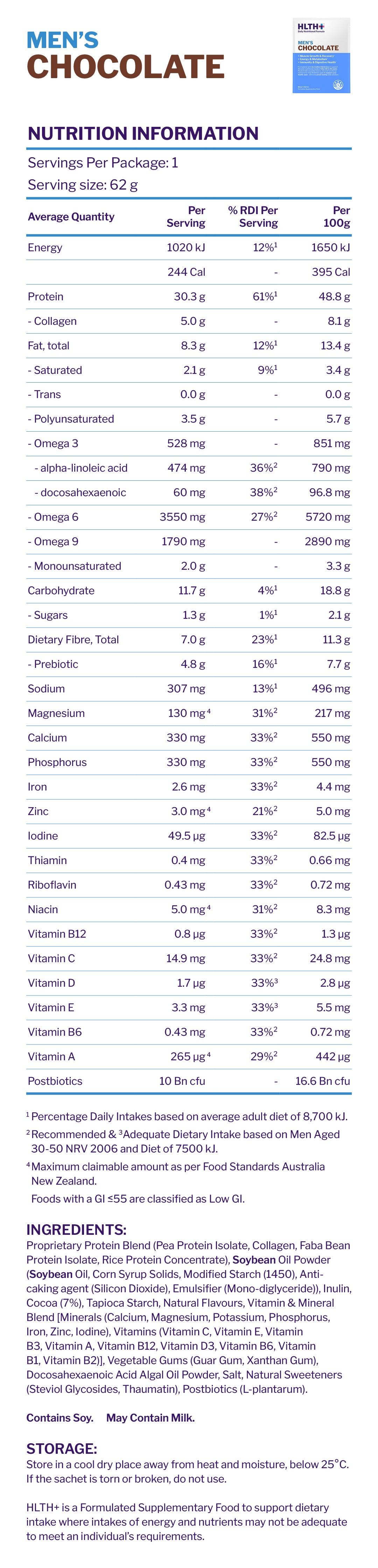
If what you actually want out of a scoop is more than protein, a Formulated Supplementary Food is a different category from any of the four rows above, dairy or plant. HLTH+ carries 30g protein per serve alongside 7g dietary fibre and 30 essential daily nutrients in one 55g Women's sachet, from a blend of pea protein isolate, collagen, faba bean protein isolate and rice protein concentrate. It is dairy-free and gluten-free, so there is no lactose in it at all; allergen line: contains soy.
It is published as Women's, Women's 50+, Men's and Men's 50+, each formulated by Accredited Dietitians to the Nutrient Reference Values, the intakes published in 2006 by the National Health and Medical Research Council, the Australian Government Department of Health and Ageing and the New Zealand Ministry of Health. A single whey tub does not change its formula by age or sex; HLTH+ does. Dietary fibre contributes to regular laxation, and protein contributes to the maintenance of muscle mass, as part of a healthy diet involving a variety of foods.
It is Australian made in facilities complying with Good Manufacturing Practice and carries a 5-star Health Star Rating. It sells at hlthplus.com at RRP $6.00, or $5.10 a day on a 28-serve subscription at $142.80, and through Amazon AU and Chemist Warehouse online.
Find the gap in your current stack. The 30-second ✦ Find My Formula quiz is diagnostic: it shows what the tub you already own is not giving you.
Frequently Asked Questions
What is the difference between whey protein and whey protein isolate?
Whey protein usually means whey concentrate, the less-filtered form, published at 20% to 85% protein depending on the product. Whey protein isolate is filtered further, to 90% to 95% protein, with only trace lactose, fat and mineral content left behind (Cava et al, Healthcare, 2024).
What is hydrolysed whey protein, and is it better than isolate?
Hydrolysed whey is a concentrate or isolate broken into shorter protein chains during processing, described in one peer-reviewed review as achieving "more readily absorption and less antigenic reactions" than the unhydrolysed form. It is not automatically higher in protein; check the panel rather than the word.
Is whey protein isolate worth paying more for?
On one Australian manufacturer's published figures, isolate cost 9.4 cents per gram of protein against 8.1 cents for its concentrate, chocolate flavour, retrieved 22 September 2026. Whether that gap is worth it depends on how much you value the lower sugar, fat and lactose that come with the extra filtering.
Which suits someone avoiding dairy altogether, isolate or a plant-based blend?
Isolate still comes from milk protein, so it does not solve a genuine milk allergy even though most of the lactose is filtered out. A plant-based blend, built from sources such as pea, fava bean and rice protein, contains no dairy at all, so it removes the question rather than narrowing it.

Leave a comment
This site is protected by hCaptcha and the hCaptcha Privacy Policy and Terms of Service apply.