

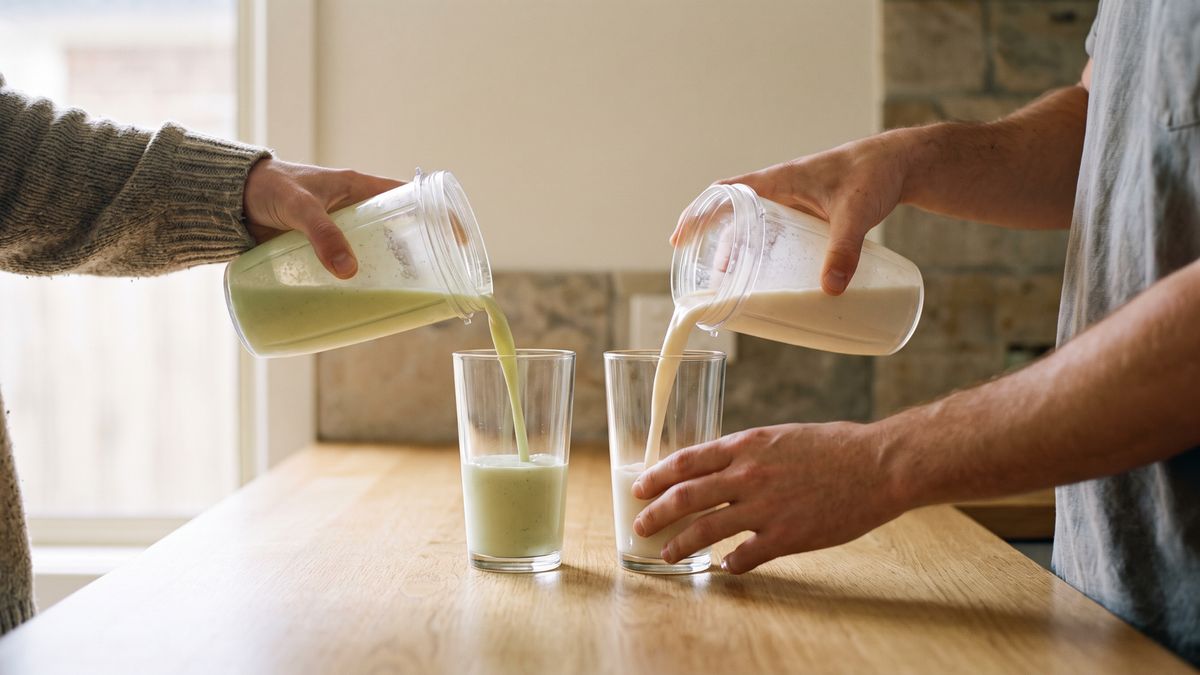
Whey wins the amino acid panel and pea wins the allergen list, and neither fact settles the question on its own. Gram for gram of protein, whey carries more essential amino acids than pea does, so it is the more concentrated building material on paper. Pea protein carries no lactose and no dairy protein at all, and in a 12-week trial that ran the two head to head, it matched whey.
If you are standing between two tubs and cannot tell which claim matters more, the front of the pack will not answer it. The panel will.
Below: the amino acid gap, what absorption and muscle-growth trials found, lactose, protein per gram of powder, cost per gram in Australia, and a verdict by reader type.
What actually separates pea protein from whey?
Five things. Everything else on a tub is flavour and marketing.
- Amino acid profile. How much of each essential amino acid arrives per gram of protein, and which one pea runs shortest on.
- Absorption and muscle response. Whether pea's amino acids reach the blood in the same amounts as whey's, and whether that shows up in a measured training outcome.
- Lactose and dairy protein. Whether the tub is a problem for an intolerance, an allergy, or a dairy-free diet.
- Protein per gram of powder. How much of the scoop is protein rather than starch, gum or flavouring.
- Cost per gram of protein. The only number that is comparable across two different tubs.
The Victorian Department of Health is blunt that "protein shakes, powders and supplements are unnecessary for most Australians' health needs" (Better Health Channel, Protein). Either powder is a convenience, not a requirement.
Which has more essential amino acids, pea or whey?
Whey, clearly, and the amino acid pea runs lowest on is methionine.
Protein is built from about 20 amino acids, and 9 of them the body cannot make (Better Health Channel, above). In a Maastricht University analysis of commercial isolates, essential amino acids made up 43% of whey protein and 30% of pea protein isolate (Gorissen and colleagues, Amino Acids, 2018). Pea protein isolate itself runs at about 80% protein of the raw material on the same analysis.
Methionine is where the gap is widest: 1.8g per 100g of raw material for whey against pea's 0.3g, a sixfold difference and the specific amino acid pea is shortest on. Lysine is closer, 7.1g against 4.7g, and leucine (the trigger for muscle building) sits at 8.6g for whey against 5.7g for pea, same basis (Gorissen 2018).
That does not make pea protein unusable; it makes a single scoop a lower-methionine meal than a single scoop of whey. The FAO's own scoring method (DIAAS, worked through in complete protein) turns that shortfall into a single comparable score, and is why that analysis points to blending plant sources rather than selling pea alone. What each of the nine essential amino acids does in the body is covered in amino acids explained.
Does pea protein absorb and build muscle as well as whey?
Less of it reaches the blood, but the trial built to test that found no difference in the muscle outcome.
The absorption gap is real and measured, though not for pea alone. Ten resistance-trained adults drank 32g of protein from whey or from a plant blend of pea, brown rice and canola, and plasma essential amino acid availability over the following four hours was about 44% higher on whey (Van der Heijden and colleagues, Medicine and Science in Sports and Exercise, 2024).
Despite that, myofibrillar protein synthesis did not separate: 0.085% an hour on whey against 0.080% on the blend in the first two hours, and 0.085% against 0.086% in the next two, with no statistically significant difference in either window. That trial used a blend, not pea protein alone, which matters for what it can tell you about a single-source pea tub.
The direct pea-versus-whey evidence here is a 12-week trial. In a randomised, double-blind, placebo-controlled study, 161 men aged 18 to 35 were enrolled and took 25g of pea protein, whey protein or a placebo twice a day (50g a day) while resistance-training their upper limbs (Babault and colleagues, Journal of the International Society of Sports Nutrition, 2015).
Across the whole sample the difference between groups was a trend only (P = 0.09); among the participants who started with weaker biceps, thickness increased by 20.2% on pea, 15.6% on whey and 8.6% on placebo, only the pea group's gain was significantly greater than placebo, and whey did not separate from the other two conditions in that subgroup. Strength gains did not differ significantly between any of the three groups. The authors' own conclusion: pea protein "could be used as an alternative to Whey-based dietary products", with its gain over placebo holding "especially for people starting or returning to a muscular strengthening".
A pea-based blend put fewer amino acids into the blood, and pea alone carries fewer essential amino acids per gram, yet in the two studies that measured a muscle outcome that gap did not show up as a worse result. How much protein to build muscle has the per-meal dose that decides whether either protein does its job at all.
Pea protein vs whey: the label-by-label comparison
| Dimension | Whey (dairy) | Pea protein |
|---|---|---|
| Protein as a share of the powder | 85%, chocolate (25.5g per 30g serve; Bulk Nutrients, 22 Sep 2026) | 76%, chocolate (22.8g per 30g serve, same retailer); raw isolate averages ~80% (Gorissen 2018) |
| Essential amino acids as a share of protein | 43% (Gorissen 2018) | 30% (Gorissen 2018) |
| Methionine, per 100g raw material | 1.8g (Gorissen 2018) | 0.3g, pea's lowest essential amino acid (Gorissen 2018) |
| Lysine, per 100g raw material | 7.1g (Gorissen 2018) | 4.7g (Gorissen 2018) |
| Plasma amino acid availability, 32g dose | ~44% higher than the plant blend (Van der Heijden 2024) | lower; tested as a pea, rice and canola blend, not pea alone |
| Muscle thickness, 12-week trial, weaker-baseline subgroup | +15.6% (Babault 2015) | +20.2% (Babault 2015) |
| Lactose | traces, ~0.3g a serve (Bulk Nutrients isolate, 22 Sep 2026) | none |
| Cost per 30g serve, one Australian retailer, 22 September 2026 | $2.39 for 25.5g protein | $1.06 for 22.8g protein |
| Cost per gram of protein, same retailer and day | 9.4 cents | 4.7 cents |
Figures are from the sources named in each row, retrieved 22 September 2026. Brands reformulate and flavours differ, so read the panel on the tub in your hand.
Does pea protein contain lactose?
No, and that is the cleanest dividing line between the two.
Whey is separated from milk, so lactose comes with it unless filtered out. Concentrate runs 20% to 85% protein with varying fat, lactose and minerals; isolate is filtered further to 90% to 95% protein with minimal fat, lactose and minerals (Cava and colleagues, Healthcare, 2024).
Bulk Nutrients publishes its whey isolate at around 0.3g of lactose a serve (their product page, retrieved 22 September 2026), low but not zero. Pea protein is not derived from milk at all, so it carries no lactose and no dairy protein in any form.
Whether a whey isolate's trace lactose sits well with lactose intolerance is your own test to run; it does nothing for a dairy protein allergy, because filtering removes the sugar, not the milk protein. Pea protein needs neither test. The isolate-versus-concentrate question for whey is worked through in does whey protein have lactose and whey protein vs whey isolate; the wider plant category is in plant protein vs whey.
More on what a reduced dairy or plant-first diet means for daily nutrition → nutrition support while eating less
Which costs less per gram of protein in Australia?
Pea protein, by close to half at the retailer checked.
Pack price divided by servings gives cost per serve; cost per serve divided by protein per serve gives cost per gram of protein, the only number comparable across two different tubs.
On one Australian manufacturer's own published pages: a 1kg tub of pea protein isolate at $35.00 gives 33 serves of 30g, which is $1.06 a serve for 22.8g of protein, or 4.7 cents per gram. A 1kg tub of whey protein isolate from the same company at $79.00 gives the same 33 serves, which is $2.39 a serve for 25.5g of protein, or 9.4 cents per gram (Bulk Nutrients, published product pages, retrieved 22 September 2026). Two chocolate-flavoured products, one retailer, one day.
Who should choose pea protein, and who should choose whey?
- Most essential amino acids per gram, in one scoop. Whey. No plant isolate in the Gorissen analysis matched whey's 43%.
- A dairy allergy, or a dairy-free kitchen. Pea, or any plant protein. No milk protein, no lactose, no testing required.
- Lactose intolerant but not dairy-allergic. A whey isolate carries around 0.3g of lactose a serve on one Australian label; pea needs no accommodation either way.
- Cheapest protein per gram. Pea, at this retailer on this day, by close to half.
- Starting a resistance-training programme from a lower baseline. The 12-week trial above is the pea-specific evidence on this page, and it used pea alone, not a blend.
- Want the powder to do more than protein. Neither tub is built for that; each is one nutrient by design.
For the wider plant-protein shortlist, see the best plant-based protein powders in Australia, and for the source-by-source guide, plant-based protein powder.
What changes when you are eating less?
Your protein requirement does not fall when your appetite does. Only the food delivering it falls, and that is when the amino acid gap between pea and whey stops being a lab number and starts deciding whether a smaller meal does the job.
The starting point was already thin: over 90% of Australian adults do not meet dietary guidelines on the Australian Institute of Health and Welfare poor-diet measure, before anyone's intake drops. In trial conditions, GLP-1 medicines reduced ad libitum food intake by roughly a quarter of daily calories (Blundell and colleagues, Diabetes, Obesity and Metabolism, 2017). The same shortfall follows a deliberate deficit, an illness, or rapid weight loss, reduced eating and medically induced weight loss more generally.
This page is general information, not medical advice, and decisions about any medication belong with your doctor. More on daily targets in protein when you are eating less.
Where a daily nutritional formula fits
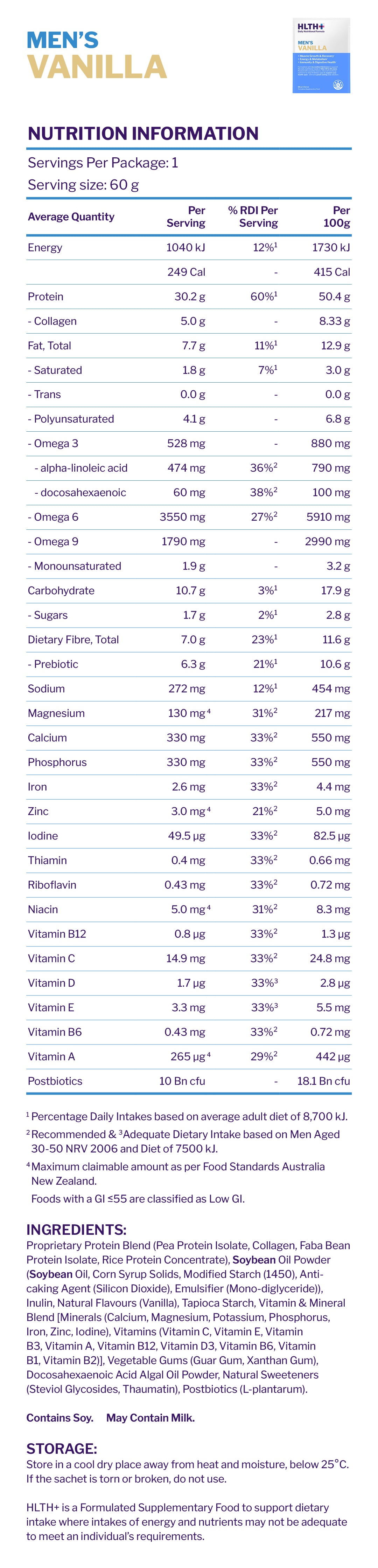
HLTH+ delivers 30g protein per serve, and the same 55g Women's sachet carries 7g dietary fibre, 5g collagen, 60mg DHA and a balanced multivitamin profile alongside it. A plain pea tub is protein per gram and little else, the same as a plain whey tub. HLTH+ is the serve that does the rest of the job.
It is a Formulated Supplementary Food under the Australia New Zealand Food Standards Code, built to sit beside meals. Its protein blend lists pea protein isolate, collagen, faba bean protein isolate and rice protein concentrate, so part of the 30g comes from pea protein and part from bovine collagen.
It is dairy-free and therefore lactose-free, and gluten-free. Allergen line: contains soy.
Around that protein, one sachet also carries 10 billion CFU Lactobacillus Plantarum Postbiotic alongside prebiotics, with no added sugar. Counted across protein, dietary fibre, vitamins, minerals, collagen and DHA, that is 30 essential daily nutrients in one serve. Under Schedule 4 of the Food Standards Code the approved statement is that protein contributes to the maintenance and growth of muscle mass, as part of a healthy diet involving a variety of foods.
It is published as Women's, Women's 50+, Men's and Men's 50+, each formulated by Accredited Dietitians to the Nutrient Reference Values, published in 2006 by the National Health and Medical Research Council, the Australian Government Department of Health and Ageing and the New Zealand Ministry of Health. Those values move with age and sex, which a single pea or whey tub cannot follow. It is Australian made in GMP-compliant facilities, and sells at hlthplus.com at RRP $6.00, or $5.10 a day on a 28-serve subscription at $142.80, plus Amazon AU and Chemist Warehouse online.
See what your current stack is missing. The 30-second ✦ Find My Formula quiz is diagnostic: it shows what the tub already in your cupboard is not giving you.
Frequently Asked Questions
Is pea protein as good as whey for building muscle?
In a trial that tested them head to head over 12 weeks of resistance training, pea protein produced a significantly greater increase in biceps thickness than placebo among weaker-baseline participants (20.2% against 8.6%), while whey did not separate from placebo in that same subgroup, and strength gains did not differ between any of the three groups.
Does pea protein contain lactose?
No. Whey is separated from milk and carries lactose unless it is filtered out; even a filtered isolate publishes around 0.3g of lactose a serve on one Australian label. Pea protein is not derived from milk, so it contains no lactose and no dairy protein at all.
What is pea protein's amino acid profile compared to whey?
Essential amino acids make up 30% of pea protein against 43% of whey, on a Maastricht University analysis of commercial isolates. The widest single gap is methionine: whey carries 1.8g per 100g of raw material against pea's 0.3g, which is the specific amino acid pea protein runs shortest on.
Which is cheaper in Australia, pea protein or whey?
Pea protein, by close to half at one Australian retailer. On 22 September 2026, a 1kg pea protein isolate at $35.00 came to 4.7 cents per gram of protein, and a 1kg whey protein isolate at $79.00 came to 9.4 cents. Divide pack price by servings, then by protein, to check any two tubs.
Who should choose pea protein over whey?
Anyone with a dairy allergy or a dairy-free diet, anyone who wants the cheaper protein per gram, and anyone starting a resistance-training programme from a lower baseline, where the 12-week pea-alone trial above is the evidence to read. Whey still carries more essential amino acids per gram for someone without a dairy restriction who wants that in one scoop.
Leave a comment
This site is protected by hCaptcha and the hCaptcha Privacy Policy and Terms of Service apply.