

What counts as a protein powder without artificial sweeteners?
The ingredient list settles it, not the front of the tub. Under the Australia New Zealand Food Standards Code, most food additives are listed by their class name, here "Sweetener" or "Sweeteners", followed by either the additive's name or its code number in brackets (Food Standards Australia New Zealand, Labelling of food additives). So the line to read is short: what sits in those brackets.
Some of those names are synthesised compounds, such as sucralose (955), acesulphame potassium (950) and aspartame (951). Others are extracted from a plant and carry a code of their own: steviol glycosides (960), from the stevia plant, and thaumatin (957), from the katemfe fruit of West Africa. Monk fruit extract is also plant-derived and appears on the FSANZ list without a numbered code (FSANZ, Sweeteners).
Reading "natural" or "clean" on the front of a pack answers nothing here. The only reliable check is the bracket after the word "Sweetener".
Does one brand mean one answer?
No, and this is the trap. Bulk Nutrients' standard Whey Protein Isolate lists its sweetener as "Sweetener (Sucralose)" on its own published ingredients, while the same brand's Natural Whey Protein Isolate lists "Natural Sweetener (Stevia, Thaumatin)" instead (both retrieved from Bulk Nutrients' own product pages, 22 September 2026). Same company, same category, two different sweetener systems on two different SKUs.
That is why a "which brands avoid artificial sweeteners" search cannot be answered at brand level. It has to be answered product by product, from that product's own current label.
What do "sugar free" and "no added sugar" mean on an Australian label?
Two different claims, with two different conditions, and neither means zero.
Schedule 4 of the Food Standards Code sets no separate row for a bare "sugar free" claim. What it defines is "low sugar", where the food contains "no more sugars than (a) 2.5 g/100 mL for liquid food; or (b) 5 g/100 g for solid food", and a "% sugar free" claim, which only has to meet that same low-sugar condition (Schedule 4, Food Standards Code). So "99% sugar free" on the front of a tub is compatible with a small sugars figure on the panel.
"No added sugar" is a different claim entirely, built on the ingredient list rather than the panel figure. The food must not contain an added sugar as an ingredient, and separately must not exceed 10 g of sugars per 100 g (solid) or 7.5 g per 100 mL (liquid). "Added sugar" is defined broadly: any hexose monosaccharide or disaccharide, glucose syrup, maltodextrin, golden syrup, honey, malt and malt extracts, and concentrated or deionised fruit juice, wherever it came from (Schedule 4).
So a chocolate protein powder can genuinely carry "no added sugar" while still showing a few grams of sugar on the panel, because cocoa, milk protein and fruit ingredients carry their own naturally occurring sugars. That is a label fact, not a loophole; the two claims are answering different questions, and a product can pass one, both, or neither.
"Unsweetened" is the strictest claim of the set: the food must meet the no-added-sugar conditions and must not contain an intense sweetener or a sugar alcohol either (Schedule 4). If the front of a tub says unsweetened, there should be no sweetener bracket in the ingredient list at all.
What should you check on the label?
Four lines, in the order that actually decides the purchase.
- The sweetener line itself. "Sweetener (Sucralose)" or "(950)", "(951)" is artificial. "Natural Sweetener" followed by stevia, thaumatin or monk fruit extract is not.
- The sugars figure, against the claim on the front. A "low sugar" or "% sugar free" claim sits at or under 5 g per 100 g; a bare "sugar free" has no threshold of its own, so read the panel figure rather than the word.
- Protein per serve, against the serve size. Schedule 4 sets 5 g per serving as the floor for any protein claim and 10 g for "good source", so a small scoop with a modest number is a different product to a large one, whatever protein target you are working to.
- Dietary fibre per serve, where the panel publishes one. The same schedule sets 2 g as the floor for any dietary fibre claim, 4 g for "good source" and 7 g for "excellent source"; the powders below run from no fibre line at all to 4.6 g a serve.
If you are choosing on more than the sweetener, what makes a protein powder dairy-free and gluten-free are answered on their own pages, and if lactose specifically is the concern, that shelf is separate again.
Which Australian protein powders publish a label with no artificial sweetener?
Every row below is read from that brand's own published product page, retrieved 22 September 2026 (Happy Way's panel figures were read on 15 September 2026, with its ingredient list and price re-checked on the 22nd), and the sweetener wording is quoted from their ingredient list exactly as printed.
| Product | Sweetener (as printed) | Protein per serve | Dietary fibre | Sugars | Price per serve |
|---|---|---|---|---|---|
| Macro Mike Premium Almond Protein, Deluxe Chocolate (400g, 40g serve) | Sweetener Blend (Monk Fruit Extract, Thaumatin) | 23.7 g | 4.6 g | 3.1 g | 5.50(54.95 for 10 serves) |
| Happy Way Dark Chocolate Vegan Protein Powder (500g, 30g serve) | Sweeteners (Steviol Glycoside, Thaumatin) | 19.6 g | No line on the panel | 0.4 g | 3.50(55.93 for 16 serves) |
| Bulk Nutrients Natural Whey Protein Isolate, Vanilla (1kg, 30g serve) | Natural Sweetener (Stevia, Thaumatin) | 25.3 g | 0.0 g | 0.9 g | 2.40(80.00 for about 33 serves) |
| True Protein WPI90, Rich Chocolate (1kg, 30g serve) | Natural sweetener (organic steviol glycosides) | 24 g | 1.6 g | 0.4 g | 2.94(98.00 for about 33 serves) |
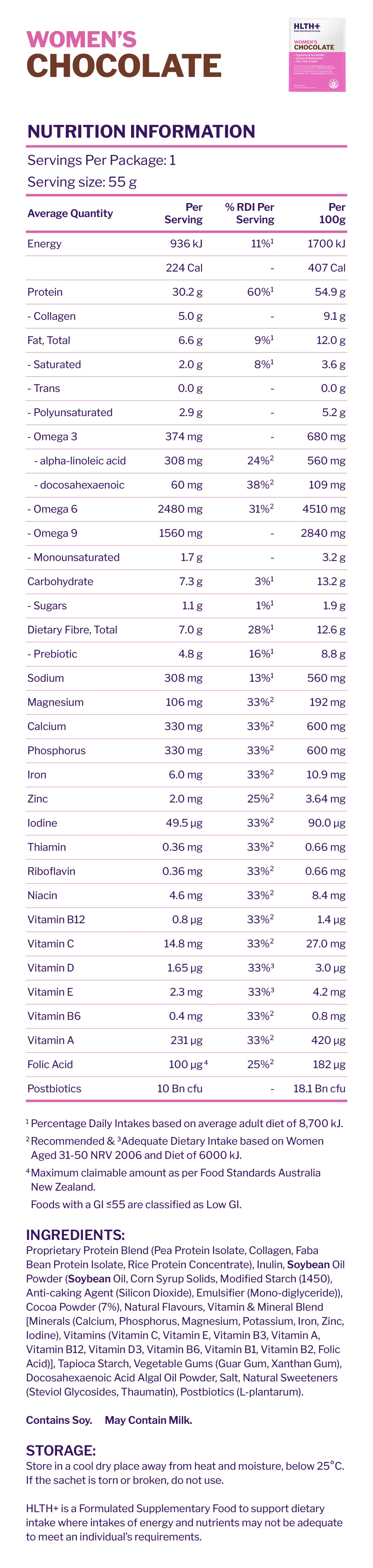
| HLTH+ (Women's, 55g sachet) | Sweetened without artificial sweeteners; no nasties, artificial colours, artificial flavours or artificial sweeteners | 30g per serve | 7g | 1.5g, none added | RRP $6.00, or $5.10 a day on a 28-serve subscription |
Figures are each brand's own published information at those retrieval dates; flavours vary and brands reformulate, so check the current pack before buying. Bulk Nutrients' Chocolate and Salted Caramel Natural Whey Protein Isolate flavours run close to the Vanilla figures shown (protein 24.4 g to 25.3 g, sugars 0.8 g to 0.9 g, dietary fibre 0.0 g to 0.1 g). Macro Mike's list price is $54.95; the brand was running a lower subscription price on 22 September 2026, which is a promotion rather than the standing figure.
True Protein also sells WPI90 in a 360g pouch at $48.00. Two Australian brands that appear in searches for this term are left off rather than guessed at. Botanika Blends and Elite Supps had no ingredient list read for this article, so neither appears with a figure.
What if you are eating less than you used to?
One group reads a sweetener line more carefully than most: people whose meals have shrunk, through a deliberate deficit, an appetite that has quietly fallen away, or rapid weight loss, reduced eating and medically induced weight loss, including people on GLP-1 medications. Over 90% of Australian adults do not meet dietary guidelines on the AIHW poor-diet measure before intake drops at all.
When the plate gets smaller, sweetener choice stops being the only question and dietary fibre becomes the harder one to answer. In one 2025 study, people on these medications averaged 14.5g of dietary fibre a day against the 28g recommended (Frontiers in Nutrition, 2025), and a scoop with no fibre line on the panel cannot close that gap.
This page is general information, not medical advice, and decisions about any medication belong with your doctor. Learn more about what happens to nutrition when overall intake drops.
Where does HLTH+ fit?
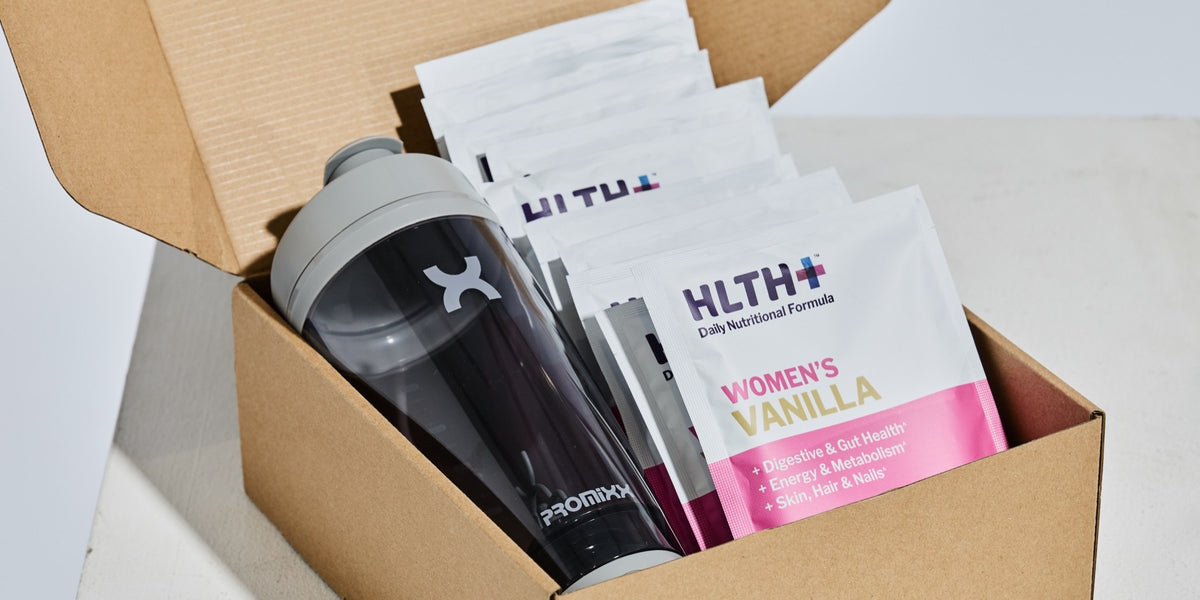
HLTH+ is a daily nutritional formula rather than a dedicated protein powder: a Formulated Supplementary Food under the Food Standards Code, taken alongside meals in a 55g sachet for Women's and a 60-62g sachet for Men's. It is made with no added sugar, and no nasties, artificial colours, artificial flavours or artificial sweeteners. Across protein, dietary fibre, vitamins, minerals, collagen and DHA, each serve supplies 30 essential daily nutrients.
One sachet lists 30g protein per serve and 7g dietary fibre, at 1.5g of sugar for Women's or 1.7g for Men's, with none added. Protein contributes to the maintenance and growth of muscle mass, and dietary fibre contributes to regular laxation, as part of a healthy diet involving a variety of foods.
The same sachet lists 5g collagen, 60mg DHA and 10 billion CFU Lactobacillus Plantarum Postbiotic alongside prebiotics, and carries a balanced multivitamin profile. It is dairy-free and gluten-free. Allergen line: contains soy.
One line the sweetener bracket does not cover is who the formula was built for. HLTH+ is dietitian-formulated to the Nutrient Reference Values, the published government intakes developed by the National Health and Medical Research Council, the Australian Government Department of Health and Ageing and the New Zealand Ministry of Health, which is why the range runs Women's, Women's 50+, Men's and Men's 50+ rather than one scoop for every adult.
It is Australian-made in facilities complying with Good Manufacturing Practice, holds a 5-star Health Star Rating and hundreds of reviews, and sells at hlthplus.com at RRP $6.00, or $5.10 a day on a 28-serve subscription at $142.80, plus Amazon AU and Chemist Warehouse online.
Which one suits you?
Choose Bulk Nutrients' Natural Whey Protein Isolate if you want the most protein per gram of powder on this list (25.3 g in a 30 g scoop) and your dietary fibre comes from food rather than the shake.
Choose Macro Mike if you want a dairy-free scoop that also carries a dietary fibre line (4.6 g per 40 g serve), sweetened with monk fruit extract and thaumatin.
Choose Happy Way if you want a pea and rice blend at 0.4 g of sugars a serve, level with True Protein, and your dietary fibre comes from food.
Choose True Protein WPI90 if you want a whey isolate with a short ingredient list, a 1.6 g dietary fibre line and 24 g protein per 30 g serve.
Choose a daily nutritional formula if you want the sweetener question answered alongside protein, dietary fibre and a balanced multivitamin profile in one serve rather than three separate purchases. We believe in a food-first approach, and the statistics say food alone is not getting there, so a daily formula is nutritional insurance, not a substitute for eating well. HLTH+ is not designed as a meal replacement, because it complements a food-first approach, but it works fine as a healthy snack or to tie you over.
The full shortlist for the category sits on the best protein powder in Australia page, and the plant-based options and Macro Mike's own panel in full are covered on their own pages.
Find out what your current stack is not giving you. The 30-second ✦ Find My Formula quiz reads your existing routine and shows the gaps it leaves.
Frequently Asked Questions
What does "no artificial sweeteners" actually mean on a protein powder label?
It means the ingredient list names only natural intense sweeteners, such as steviol glycosides, thaumatin or monk fruit extract, rather than a synthetic compound like sucralose, acesulphame potassium or aspartame. Check the bracket after the word "Sweetener" in the ingredient list; that is the only reliable answer, and it can differ between two products from the same brand.
Is stevia a natural or artificial sweetener?
Natural. Stevia is sold as steviol glycosides, extracted from the stevia leaf, and carries the additive code 960 on an Australian label. It sits in the same "sweetener" category as sucralose or aspartame on the ingredient list, but the source is a plant rather than a synthesised compound.
Does "sugar free" mean a protein powder has zero sugar?
Not necessarily. Schedule 4 of the Food Standards Code defines "low sugar" (no more than 5 g per 100 g for a solid food) and "% sugar free", which only has to meet that low-sugar condition; a bare "sugar free" claim has no row of its own. Check the panel figure rather than assuming the word means none.
Is HLTH+ sweetened with artificial sweeteners?
No. HLTH+ is made with no added sugar and no nasties, artificial colours, artificial flavours or artificial sweeteners, so the sweetener bracket on its ingredient list names nothing artificial. One 55g sachet lists 30g protein per serve and 7g dietary fibre, at 1.5g of sugar for Women's with none added.
Which Australian protein powders publish a label with no artificial sweetener?
On their own published ingredient lists, retrieved September 2026: Macro Mike's Premium Almond Protein (monk fruit extract and thaumatin), Happy Way's Dark Chocolate Vegan Protein Powder (steviol glycoside and thaumatin), Bulk Nutrients' Natural Whey Protein Isolate (stevia and thaumatin) and True Protein's WPI90 (organic steviol glycosides). Other products in the same range can differ.
This article is general information, not medical advice. Decisions about any medication belong with your doctor. Figures quoted are each brand's published information at the retrieval dates shown; check current labels before buying.
Leave a comment
This site is protected by hCaptcha and the hCaptcha Privacy Policy and Terms of Service apply.