

What is the best protein powder in Australia?
It depends on the job you are buying it for, so this page gives one pick per job instead of one winner. For protein per gram, a whey isolate. For a plant base with real dietary fibre in it, a nut and legume blend. For covering a whole day of nutrition on days you barely eat, a Formulated Supplementary Food rather than a protein powder at all.
Most people reading this are on their second or third tub. What a shelf cannot tell you is how much of that tub is protein, whether the serve carries anything else, and whether the cheaper bag is cheaper per serve or only per kilogram. Five criteria, six uses, one pick each.
What actually decides the best protein powder?
Five things, and only the first is the one the shelf competes on.
- Protein per serve, and protein per 100g. The second figure tells you how much of the tub is protein. Under Schedule 4 of the Australia New Zealand Food Standards Code, at least 10g per serving is the condition for a "good source of protein" claim (Schedule 4, Food Standards Code).
- What else the serve carries. Dietary fibre, vitamins and minerals, live cultures, essential fats. Most dedicated powders carry none of them: a design decision, not a fault.
- Dietary fibre per serve. The same schedule sets 2g a serve as the floor for any dietary fibre claim, 4g for "good source" and 7g for "excellent source".
- Sugars, and the sweetener. The panel tells you whether the flavour came from sugar or a sweetener.
- Price per serve, not per kilogram. A 1kg bag and a 400g bag are not comparable until you divide by the serves inside.
One more decides more than people expect: who the formula was built for. Almost everything here is one formula for every adult. The same shortlist for ready-to-mix shakes is a separate page.
The shortlist at a glance
| Row | Bulk Nutrients Whey Protein Isolate | Bulk Nutrients Whey Protein Concentrate | Macro Mike Premium Almond Protein | Nuzest Clean Lean Protein | HLTH+ |
|---|---|---|---|---|---|
| Category | Whey isolate | Whey concentrate | Almond and faba bean | Pea isolate | Formulated Supplementary Food |
| Serve size | 30g | 30g | 40g | 25g | 55g sachet (Women's), 60-62g (Men's) |
| Protein per serve | 25.5g | 22.2g | 23.7g | 20g | 30g protein per serve |
| Dietary fibre per serve | Not listed on the panel | 0.0g | 4.6g | 0.3g | 7g |
| Sugars per serve | 0.4g | 2.5g | 3.1g | 0.2g | 1.5g (Women's), 1.7g (Men's), none added |
| What else the serve carries | Nothing listed | Nothing listed | B vitamin complex 300mg, probiotic 1 billion CFU | Iron 3.6mg, stated as 32% of the RDI | 5g collagen, 60mg DHA, 10 billion CFU Lactobacillus Plantarum Postbiotic plus prebiotics, a balanced multivitamin profile |
| Formulated for whom | One formula | One formula | One formula | One formula | Women's, Women's 50+, Men's, Men's 50+ |
| Price per serve | $2.39 | $1.79 | $5.50 | $2.95 | RRP $6.00 |
Every figure is the brand's own published nutrition information, retrieved 15 September 2026, except Macro Mike's dietary fibre and sugars, read from that brand's panel image on 2 September 2026. Prices per serve are the pack price divided by the published serves.
Read down the dietary fibre row and the category gives itself away: two publish under 1g and a third publishes no figure. That is not a failing. A protein powder is built to deliver protein, and everything else is somebody else's job.
What is the best protein powder for building muscle?
Bulk Nutrients Whey Protein Isolate. Their published panel for Chocolate lists 25.5g of protein in a 30g serve, which is 85.0g per 100g, at 480 kJ with 0.4g of sugars. That is the highest protein density here, and what an isolate is for: extra filtration strips out fat and milk sugar. A 1kg bag is $79.00, or 33 serves, so $2.39 each (79.00 divided by 33).
Protein contributes to the growth and maintenance of muscle mass and to tissue repair, as part of a healthy diet involving a variety of foods. Dairy is the amino acid reference point: animal and dairy proteins "have large amounts of all of the essential amino acids", while plant proteins contain them all but "the amounts of one or two of these amino acids may be low" (Better Health Channel, Victorian Department of Health).
The trade-off is that the panel lists nothing else at all. True Protein's WPI 90 in Rich Chocolate is the runner-up, reading 24g of protein in a 30g serve with 1.6g of dietary fibre and 37mg of sodium: less protein, roughly half the sodium. How much protein you need is a separate question.
What changes when you are eating less?
When overall intake falls, the gram-scale nutrients slip before the milligram ones, whether the cause is a deliberate deficit, an appetite that has quietly fallen away, or rapid weight loss, reduced eating and medically induced weight loss. In a 2025 study, people on GLP-1 medications averaged 14.5g of dietary fibre a day against the 28g recommended (Frontiers in Nutrition, 2025).
A 25g to 40g scoop of protein is not built to answer that, and was never meant to. This article is general information, not medical advice, and decisions about any medication belong with your doctor. Learn more about what happens to muscle when intake drops.
What is the best pick for covering the gaps when you eat less?
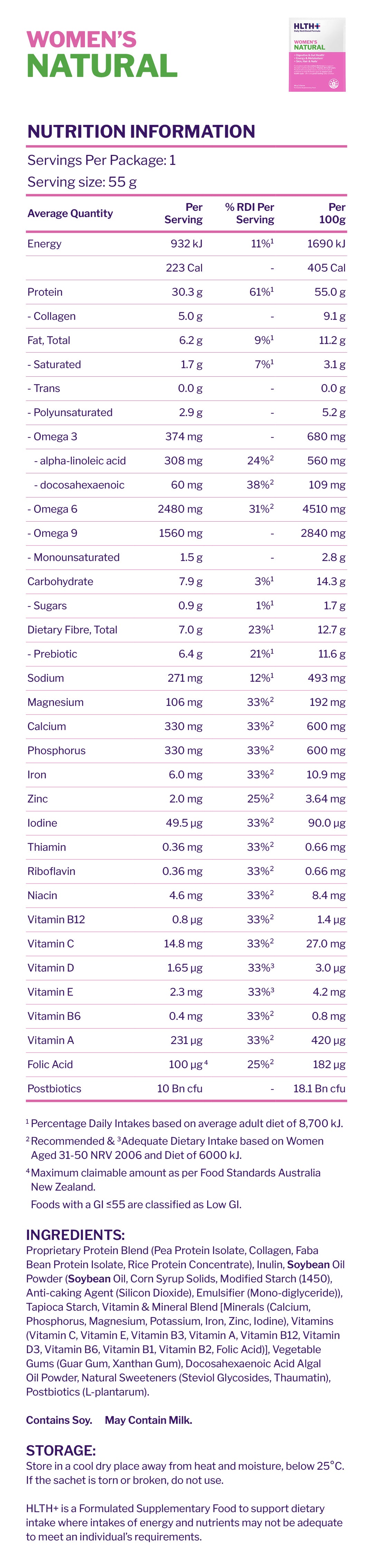
HLTH+, a daily nutritional formula rather than a bare protein powder. It is a Formulated Supplementary Food under the Food Standards Code, taken alongside meals as a 55g sachet (Women's; Men's runs 60-62g). It takes this row because the job is a day of nutrition, not a protein number.
One sachet lists 30g protein per serve and 7g dietary fibre, at 1.5g of sugar (Women's) or 1.7g (Men's), none added. Protein contributes to the growth and maintenance of muscle mass and to tissue repair, and dietary fibre contributes to regular laxation, as part of a healthy diet involving a variety of foods.
The same sachet lists 5g collagen, 60mg DHA and 10 billion CFU Lactobacillus Plantarum Postbiotic alongside prebiotics, and carries a balanced multivitamin profile. A postbiotic is not a live organism: it is what a bacterial culture produces during fermentation, plus the inactivated cells, so nothing has to survive the warehouse for the count to hold. That also makes it a different measurement from a probiotic count, so 10 billion beside the 1 billion in the table is not a like-for-like win.
Across protein, dietary fibre, vitamins, minerals, collagen and DHA, one serve supplies 30 essential daily nutrients. A whey isolate is denser per gram of powder, 85.0g per 100g, and cheaper per serve at $2.39 against RRP $6.00, because protein is the only line it carries. The $6.00 sachet is buying the other 29 nutrients.
What is the best protein powder after 50?
HLTH+ Women's 50+ and Men's 50+, for the reason nothing else here can answer: it is the only formula that changes with the person drinking it. Around half of older Australians are malnourished or at risk of malnutrition (Dietitians Australia), and one scoop built for every adult is blunt against that.
HLTH+ is formulated by Accredited Dietitians to the Nutrient Reference Values, the published government intakes developed by the National Health and Medical Research Council, the Australian Government Department of Health and Ageing and the New Zealand Ministry of Health. Those values move with age and sex, which is why the range runs Women's, Women's 50+, Men's and Men's 50+ instead of one tub.
Australian labels state percentage daily intakes against an average adult diet of 8,700 kJ under Standard 1.2.8 of the Food Standards Code. That is a labelling reference value sitting above what the Nutrient Reference Values advise for most adults, so a formula built to it over-delivers calories.
If all you want after 50 is a protein number, a dedicated powder gets you there for less: see protein powder for seniors and the over-70s shortlist.
What is the best protein powder for women?
Nuzest Clean Lean Protein. Their published panel for Smooth Vanilla lists 20g of protein in a 25g serve at 428 kJ, with 0.2g of sugars, 0.3g of dietary fibre and 3.6mg of iron, which the label states as 32% of the recommended dietary intake. Under Schedule 4, 25% of the RDI per serving is the condition for a "good source" mineral claim, so that is worth noticing where three of the five publish no mineral figure. It also publishes amino acid amounts rather than a claim: nine essential acids plus ten others, with quantities.
Two marks against it. Dietary fibre is next to zero at 0.3g a serve, and at $2.95 a serve on the 500g pack (59.00 divided by 20) it costs more than either Bulk Nutrients option for less protein. What to look for in a protein powder for women sits on its own page.
What is the best plant-based protein powder?
Macro Mike Premium Almond Protein. Their Deluxe Chocolate page lists 23.7g of protein in a 40g serve at 142.9 calories. Their own panel image, read on 2 September 2026, adds 4.6g of dietary fibre, 3.1g of sugars and 219mg of sodium, plus a 300mg B vitamin complex and 1 billion CFU of a probiotic.
The dietary fibre line is why it takes this row: 4.6g clears the Schedule 4 "good source" threshold and is more than ten times what the pea isolates here carry. It also publishes 18 amino acids with amounts, a profile rather than a claim, where several brands say the nine essential acids are present without publishing one. The completeness question, and how to check a label for it, is worked through separately.
Two marks against it. At a list price of $54.95 for a 400g bag of ten serves it is $5.50 a serve, the dearest here, though it was on sale at $44.95 on 15 September 2026. And it is an almond protein made in a facility that also handles peanuts, cashews, hazelnuts and soy. Amazonia's Raw Protein Isolate in Vanilla is the runner-up, at 21.6g of protein and 2.7g of dietary fibre in a 30g serve. The wider plant-based shortlist covers the rest, and the Macro Mike review reads its label row by row.
What is the cheapest protein powder per serve in Australia?
Bulk Nutrients Whey Protein Concentrate. Their published panel for Chocolate lists 22.2g of protein in a 30g serve, or 73.9g per 100g, at 509 kJ with 2.5g of sugars and 0.0g of dietary fibre. A 1kg bag is $59.00 for 33 serves, so $1.79 each (59.00 divided by 33), the cheapest here by a distance.
The trade-offs are what a concentrate implies next to an isolate: 3.3g less protein a serve, more than six times the sugars, and less filtering, so more milk sugar stays in.
Which protein powder should you actually buy?
Buy on the job, not the brand. If the job is protein and nothing else, a whey isolate at $2.39 a serve. If budget is the constraint, a concentrate at $1.79. If it is protein without dairy, a plant blend judged on its dietary fibre line. If you wanted a day of nutrition covered rather than a protein target hit, none of them is the answer.
That last case is the consolidation case, and it is how HLTH+ enters a protein powder page. We believe in a food-first approach, and the statistics say food alone is not getting there: over 90% of Australian adults do not meet dietary guidelines (AIHW), and fewer than 1 in 20 eat the recommended serves of vegetables (ABS, 2023). A daily formula is nutritional insurance, not a substitute for eating well, and it is not designed as a meal replacement either, because it complements that food-first approach. It works fine as a healthy snack or to tie you over.
It is Australian made in facilities complying with Good Manufacturing Practice, dairy-free, gluten-free and low GI, with a 5-star Health Star Rating and hundreds of reviews behind it. It sells at hlthplus.com at RRP $6.00, or $5.10 a day on a 28-serve subscription at $142.80, and through Amazon AU and Chemist Warehouse.
Find out what your current tub is not giving you. The 30-second ✦ Find My Formula quiz reads the routine you already have and shows the gaps in it.
Frequently Asked Questions
What is the best protein powder in Australia in 2026?
There is no single winner, because the job decides. For protein per gram, Bulk Nutrients Whey Protein Isolate publishes 25.5g in a 30g serve. For a plant base, Macro Mike publishes 23.7g protein and 4.6g dietary fibre. For a whole day of nutrition, HLTH+ lists 30g protein per serve and 7g dietary fibre in a 55g sachet.
Which protein powder has the most protein per serve?
HLTH+ lists the most protein per serve on this page, 30g, and is the only one that also carries 7g dietary fibre, 5g collagen, 60mg DHA and a balanced multivitamin profile in the same sachet. Per gram of powder alone, Bulk Nutrients Whey Protein Isolate is the densest at 85.0g per 100g, against 73.9g for their concentrate and 59.3g for Macro Mike.
What should someone over 50 look for in a protein powder?
A formula that changes with age, because nutrient needs do. HLTH+ runs Women's, Women's 50+, Men's and Men's 50+, formulated to the Nutrient Reference Values published by the National Health and Medical Research Council, the Australian Government Department of Health and Ageing and the New Zealand Ministry of Health.
Which protein powder is cheapest per serve in Australia?
Bulk Nutrients Whey Protein Concentrate at $1.79 a serve: a 1kg bag is $59.00 for 33 serves. Their Whey Protein Isolate is $2.39, Nuzest $2.95 on the 500g pack, Macro Mike $5.50 at list price, HLTH+ RRP $6.00. Figures retrieved 15 September 2026.
This article is general information, not medical advice. Decisions about any medication belong with your doctor. Figures quoted are each brand's published nutrition information at the retrieval dates shown; check current labels before buying.

Leave a comment
This site is protected by hCaptcha and the hCaptcha Privacy Policy and Terms of Service apply.