
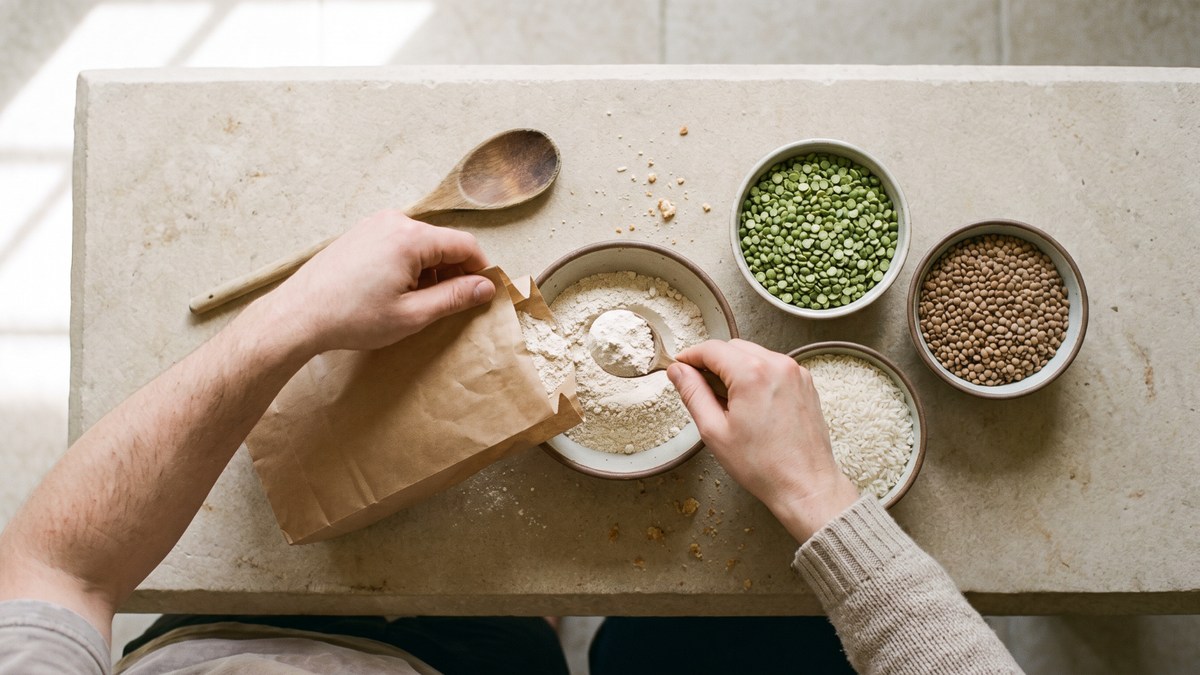
Plant-based protein powder means protein extracted from a plant source such as pea, brown rice, faba bean, hemp, soy or almond, sold as an isolate or a blend. Most Australian tubs blend two or three sources, because no single plant protein carries the full amino acid spread that whey does on its own.
If you have a tub in each hand and the fronts both say "complete" or "premium", the label is not going to settle it for you. The panel will, once you know which six lines to read.
This is the guide: what each source actually carries, why blends exist, what to check before you buy, the shapes the category comes in on the Australian shelf, and where a daily nutritional formula fits beside a dedicated powder rather than instead of one.
What is plant-based protein powder actually made from?
Six sources cover almost everything sold in Australia.
- Pea protein. Isolated from yellow split peas. The most common base in Australian blends, and the one most often sold alone as an isolate.
- Brown rice protein. Usually paired with pea, since rice is low in lysine and pea is comparatively stronger there.
- Faba bean protein. A newer isolate, often paired with almond or pea in Australian blends.
- Hemp protein. Ground from the seed rather than filtered to an isolate, so lower in protein per gram. It measured 23% essential amino acids in the Gorissen analysis cited below, the lowest of these six sources.
- Soy protein. Carries large amounts of all nine essential amino acids on its own, per the Better Health Channel, but it is a common allergen, so it is a smaller share of the mainstream Australian shelf than pea.
- Almond protein. A nut-based base, usually blended with a legume protein, and an allergen in its own right.
In a Maastricht University analysis of commercial isolates, pea protein isolate measured 80% protein by weight of the raw material and brown rice isolate 79%, close to a dairy whey isolate's 90% to 95% (Gorissen and colleagues, Amino Acids, 2018; Cava and colleagues, Healthcare, 2024). The almond-and-faba blend in the table below sits lower again, at 59%, because more of the scoop is dietary fibre, coconut milk powder, flavour and gum rather than protein.
Why do plant protein powders blend multiple sources?
Because on its own, almost every plant source is short somewhere.
Protein is built from about 20 amino acids, and 9 of them the body cannot make, so they have to come from food. Animal and dairy proteins carry large amounts of all nine and are called high-quality protein for it; plant proteins contain all nine as well, but the amount of one or two is often low (Better Health Channel, Victorian Department of Health).
The Gorissen analysis put a number on the gap. Essential amino acids made up 43% of whey protein, against 30% for pea, 28% for brown rice, 27% for soy, 23% for hemp, 22% for wheat and 21% for oat and lupin. Pea is comparatively weak in methionine; brown rice is comparatively weak in lysine.
Pair the two and each one's gap is the other one's strength, which is the entire reason a pea-and-rice or an almond-and-faba blend exists rather than a tub of just one. The paper's own conclusion: combinations of plant isolates, or plant blended with animal protein, "can provide protein characteristics that closely reflect the typical characteristics of animal-based proteins."
That is also why the front-of-pack word "complete" is worth checking rather than trusting. What it actually means, and the scoring behind it, is in complete protein, and what each of the nine essential amino acids does in the body is in amino acids explained. If you are weighing a specific plant blend against whey directly rather than shopping the plant category alone, the full head-to-head, including a matched-dose muscle protein synthesis trial, is in plant protein vs whey, and the same comparison run against a single pea isolate is in pea protein vs whey.
What should you check on a plant protein powder label?
Ignore the front of the tub. These six lines on the panel are what actually separate one plant protein from another.
- Protein per serve, and protein as a share of the powder. A 40g serve and a 25g serve are not the same measurement. Divide the grams of protein by the serve size before you compare two tubs.
- Sugars per serve, and whether any were added. Flavoured blends vary widely here.
- Dietary fibre per serve. Under Schedule 4 of the Australia New Zealand Food Standards Code, a food needs 4g of dietary fibre per serving to be called a good source and 7g to be called an excellent source. Three of the four examples in the table below sit under the first line, because the isolation process that concentrates the protein strips most of the fibre out with it.
- Sweeteners. Check the ingredient list rather than the front of the tub for whether it is sweetened naturally or with an artificial sweetener.
- Allergens. Soy and tree nuts are common in this category, on top of whichever legume the blend is built from.
- Single source or blend. A single-source isolate is usually the most concentrated and the least likely to carry a well-rounded amino acid spread; a blend trades some concentration for a broader profile.
The types of plant protein powder on the Australian shelf
Rather than rank named tubs, here is the category by shape, with one verified Australian example against each type. For a ranked shortlist of dedicated plant powders by protein and dietary fibre, see the best plant-based protein powders in Australia.
| Source type | What it typically is | Protein as a share of the powder | Dietary fibre per serve | A verified Australian example |
|---|---|---|---|---|
| Single-source pea protein isolate | Pea protein filtered to concentrate the protein, stripping out most of the fibre and starch | 80% | 0.3g | Nuzest Clean Lean Protein (Smooth Vanilla), 25g serve, 20g protein (own page, retrieved 22 September 2026) |
| Pea and brown rice blend | Two legume and grain isolates combined so each covers the other's weaker amino acid | 72% | 2.7g | Amazonia Raw Protein Isolate (Vanilla), 30g serve, 21.6g protein (own page, retrieved 22 September 2026) |
| Pea, brown rice and coconut blend | A legume-and-grain base with coconut added for flavour and fat | 66% | 0.4g | Bare Blends Vanilla Coconut Plant Protein, 30g serve, 19.8g protein (own page, retrieved 22 September 2026) |
| Almond and faba bean blend | A nut-and-legume base, lower protein share, more dietary fibre than the isolates above | 59% | 4.6g | Macro Mike Premium Almond Protein (Deluxe Chocolate), 40g serve, 23.7g protein (own panel, read 15 September 2026; price re-checked 22 September 2026) |
Figures are each brand's own published nutrition information, retrieved on the date shown; check current labels before buying, since flavours vary and brands reformulate. For a closer read on the almond-and-faba example, see the Macro Mike review; a second Australian plant-based brand gets the same label read in the Tropeaka review.
The pattern in that table holds across the category: the more concentrated the isolate, the less room is left for dietary fibre in the same scoop, because isolation removes fibre along with everything else that is not protein.
Who does plant-based protein powder suit?
- A dairy allergy, or a diet that excludes dairy entirely. Every source above is dairy-free by nature, not by processing.
- Vegans and vegetarians. Every protein source in the table is plant-derived. If you searched for a vegan protein powder in Australia specifically, filter on a certified vegan mark on the pack rather than the words plant-based on the front, because the two are not the same claim.
- Lactose intolerance without a dairy allergy. A plant protein sidesteps the question entirely rather than depending on how thoroughly a whey isolate was filtered.
- Anyone choosing on footprint or ethics. That reasoning sits outside the nutrition panel, and it is a legitimate reason on its own.
- Anyone assembling a broader daily formula rather than shopping for grams of protein alone. A dedicated protein tub is built for one job. What that means in practice is below.
More on choosing and dosing day to day is on the nutrition support page, and the dairy-free shopping list specifically is in dairy-free protein powder.
What changes when you are eating less than you used to?
Your protein target does not fall when your appetite does. Only the food that was meeting it falls, and a scoop that once topped up a full day of eating is now being asked to carry more of it.
In trial conditions, GLP-1 medicines reduced ad libitum food intake by roughly a quarter of daily calories (Blundell and colleagues, Diabetes, Obesity and Metabolism, 2017). The same shortfall shows up after a deliberate deficit, an illness, or an appetite that has simply thinned out on its own. The starting point was already short: over 90% of Australian adults do not meet dietary guidelines on the Australian Institute of Health and Welfare's poor-diet measure, before anyone's intake drops further.
This page is general information, not medical advice, and decisions about any medication belong with your doctor.
Where a daily nutritional formula fits
HLTH+ enters this page on a different axis from the tubs in the table. It is a Formulated Supplementary Food under the FSANZ Food Standards Code, built to sit beside meals rather than to compete with a dedicated protein powder on grams per scoop, which is why it is not ranked above.
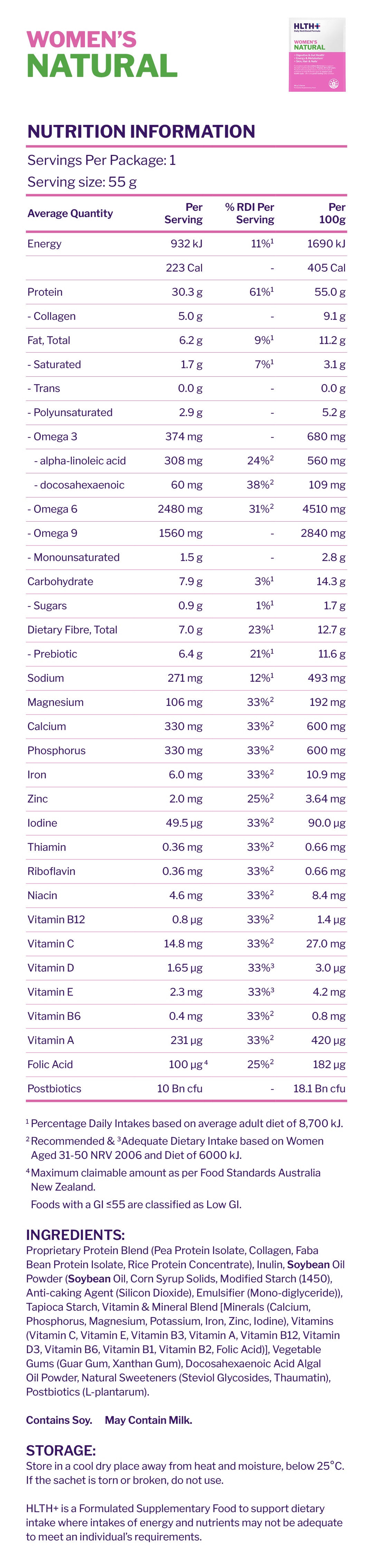
Its label facts, stated plainly: the protein blend on the Women's Vanilla panel lists pea protein isolate, collagen, faba bean protein isolate and rice protein concentrate, so part of the 30g protein per serve is bovine collagen. It is dairy-free and therefore lactose-free, and gluten-free. Allergen line: contains soy.
The 55g Women's sachet carries 30g protein per serve alongside 7g dietary fibre, which clears the Schedule 4 threshold for an excellent source. Protein contributes to the maintenance and growth of muscle mass, and dietary fibre contributes to regular laxation, as part of a healthy diet involving a variety of foods.
A pea isolate is protein per gram and very little else, which is exactly the job it is built for. HLTH+ is the serve built to do the rest of the job: around that protein it carries 5g collagen, 60mg DHA and a balanced multivitamin profile, none of which a dedicated plant protein tub is built to hold.
It is published as Women's, Women's 50+, Men's and Men's 50+, each formulated by Accredited Dietitians to the Nutrient Reference Values, the intakes published in 2006 by the National Health and Medical Research Council, the Australian Government Department of Health and Ageing and the New Zealand Ministry of Health. Those values move with age and sex, which one plant protein blend was never built to follow.
It is Australian made in facilities complying with Good Manufacturing Practice, and it sells at hlthplus.com at RRP $6.00, or $5.10 a day on a 28-serve subscription at $142.80, plus Amazon AU and Chemist Warehouse online.
See what your current stack is actually missing. The 30-second ✦ Find My Formula quiz is diagnostic: it shows what the tub already in your cupboard is not giving you.
Frequently Asked Questions
What is plant-based protein powder made from?
Usually pea, brown rice, faba bean, hemp, soy or almond protein, isolated from the whole food and sold alone or blended. Most Australian tubs blend two or three sources, because a single plant source is rarely as protein-dense or as amino-acid-complete as a filtered dairy isolate on its own.
Do plant protein powders contain all nine essential amino acids?
Yes. Plant proteins contain all nine essential amino acids, but the amount of one or two is often low, which is why brands blend two or three sources rather than sell one alone (Better Health Channel, Victorian Department of Health). A pea-and-rice or almond-and-faba blend exists specifically to cover that gap.
Is plant protein as good as whey?
It depends on the dose and the dimension you care about. Whey carries more essential amino acids per gram of protein on the raw figures, but a properly built plant blend has matched whey for post-exercise muscle protein synthesis at a real dose in a controlled trial. The full comparison, with the trial data, is in plant protein vs whey.
Does HLTH+ contain dairy?
No: HLTH+ is dairy-free, therefore lactose-free, and gluten-free, and the allergen line reads contains soy. Its protein blend lists pea protein isolate, collagen, faba bean protein isolate and rice protein concentrate, so part of the 30g protein per serve is bovine collagen. It is a Formulated Supplementary Food carrying 30g protein and 7g dietary fibre per 55g sachet.
Which plant protein has the most protein per serve of the examples on this page?
Of the four verified examples above, Macro Mike Premium Almond Protein carries the most at 23.7g per 40g serve, ahead of Amazonia Raw Protein Isolate at 21.6g and Nuzest Clean Lean Protein at 20g (each brand's own published panel). Macro Mike is also the least concentrated of the four by weight, at 59% protein, because its serve is larger.

Leave a comment
This site is protected by hCaptcha and the hCaptcha Privacy Policy and Terms of Service apply.