
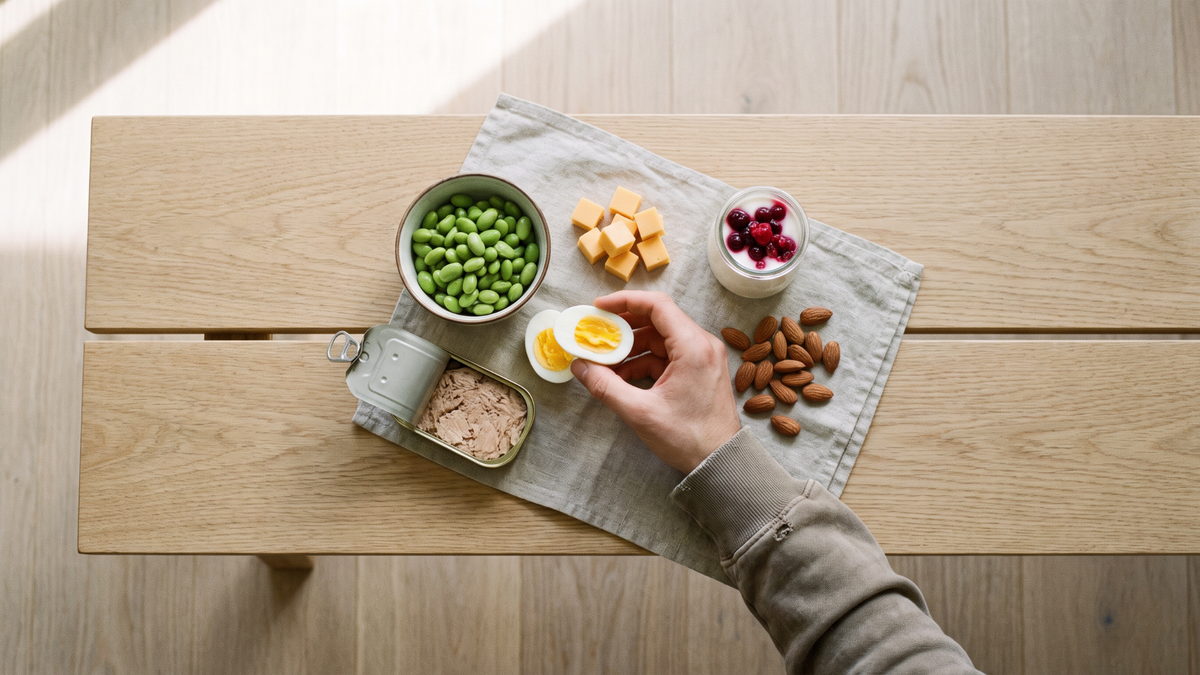
Most "high protein snacks" lists rank foods by grams of protein alone, which rewards anything large rather than anything efficient. Ranked instead by protein per 100 kilojoules, the picture changes: a 100g serve of steamed crab delivers more protein for its energy than a 30g handful of roasted almonds that costs double the kilojoules. Below are 30 Australian snacks, every one with its protein figure and its energy figure, sorted by that ratio.
Most people searching this already know protein matters. What they do not have is a number that lets them compare a tin of tuna against a tub of yoghurt against a scoop of nuts on the same scale, so the choice comes down to habit rather than arithmetic.
This page gives you that number for 30 snacks, sorted by where you are when you reach for one and by whether it is dairy-free, gluten-free or plant-based.
Why protein per kilojoule is the number that matters when you're eating less
Grams of protein tell you what a food carries. Protein per 100 kJ tells you how hard that food works for the energy it costs, which matters most when the amount you can eat has shrunk, through a deliberate deficit, training fatigue, or rapid weight loss, reduced eating and medically induced weight loss.
Under Schedule 4 of the Australia New Zealand Food Standards Code, a food needs at least 5g of protein a serving to carry a protein content claim, and at least 10g to be called a good source (Federal Register of Legislation, Schedule 4, section S4-3). That threshold says nothing about the energy cost of getting there, and two snacks that both clear it can sit a long way apart once kilojoules are counted.
Protein contributes to the maintenance of muscle mass, as part of a healthy diet involving a variety of foods. When appetite is smaller, the snacks that deliver that contribution for the fewest kilojoules do more of the day's work; the whole-day target sits in how much protein you need to build muscle.
30 high-protein snacks, ranked by protein per 100 kJ
Every figure below is scaled from the Australian Food Composition Database, Release 3.0, Food Standards Australia New Zealand, retrieved 22 September 2026. Energy is the "with dietary fibre" value, scaled from the database's per 100g figures to the serve size shown; calories are kilojoules divided by 4.184.
| Snack (serve) | Where it fits | Diet | Protein | Energy | Protein per 100 kJ |
|---|---|---|---|---|---|
| 1. Steamed crab meat (100g) | Fridge | DF, GF | 20.2g | 370 kJ (88 Cal) | 5.5 |
| 2. Whey protein powder, one scoop (30g) | Desk or gym bag | GF | 25.5g | 470 kJ (112 Cal) | 5.4 |
| 3. Cooked prawns (100g) | Fridge | DF, GF | 27.1g | 507 kJ (121 Cal) | 5.3 |
| 4. Pan-fried sardines (100g) | Fridge | DF, GF | 22.0g | 444 kJ (106 Cal) | 5.0 |
| 5. Tuna, canned in water, drained (95g, drained weight) | Desk or gym bag | DF, GF | 24.8g | 513 kJ (123 Cal) | 4.8 |
| 6. Baked chicken breast (100g) | Fridge | DF, GF | 29.0g | 637 kJ (152 Cal) | 4.6 |
| 7. Baked turkey breast, sliced (80g) | Fridge | DF, GF | 23.5g | 518 kJ (124 Cal) | 4.5 |
| 8. High-protein flavoured yoghurt (170g tub) | Fridge | GF | 17.0g | 401 kJ (96 Cal) | 4.2 |
| 9. Lean roast beef, silverside (80g) | Fridge | DF, GF | 21.5g | 531 kJ (127 Cal) | 4.1 |
| 10. Salmon, canned red, drained (100g, drained weight) | Desk or gym bag | DF, GF | 24.4g | 617 kJ (147 Cal) | 4.0 |
| 11. Lean leg ham (80g) | Fridge | DF, GF | 13.6g | 374 kJ (89 Cal) | 3.6 |
| 12. Grilled mackerel (100g) | Fridge | DF, GF | 26.4g | 768 kJ (184 Cal) | 3.4 |
| 13. Sliced smoked salmon (80g) | Fridge | DF, GF | 19.4g | 630 kJ (150 Cal) | 3.1 |
| 14. Cottage cheese (150g tub) | Fridge | GF | 25.5g | 834 kJ (199 Cal) | 3.1 |
| 15. Firm tofu (100g) | Fridge | DF, GF, PB | 12.8g | 543 kJ (130 Cal) | 2.4 |
| 16. Boiled soy beans (100g) | Fridge | DF, GF, PB | 13.5g | 614 kJ (147 Cal) | 2.2 |
| 17. Hard-boiled eggs, two (100g) | Fridge | DF, GF | 12.4g | 569 kJ (136 Cal) | 2.2 |
| 18. Boiled lentils (150g) | Fridge | DF, GF, PB | 10.9g | 578 kJ (138 Cal) | 1.9 |
| 19. Natural yoghurt (170g tub) | Fridge | GF | 9.0g | 541 kJ (129 Cal) | 1.7 |
| 20. Ricotta (100g) | Fridge | GF | 10.4g | 636 kJ (152 Cal) | 1.6 |
| 21. Haloumi (80g) | Fridge | GF | 16.4g | 1,022 kJ (244 Cal) | 1.6 |
| 22. Feta (50g) | Fridge | GF | 8.3g | 536 kJ (128 Cal) | 1.5 |
| 23. Cheddar cheese (30g) | Fridge | GF | 7.4g | 506 kJ (121 Cal) | 1.5 |
| 24. Hulled pumpkin seeds (30g) | Desk or gym bag | DF, GF, PB | 9.1g | 675 kJ (161 Cal) | 1.3 |
| 25. Chia seeds (20g) | Desk or gym bag | DF, GF, PB | 4.8g | 365 kJ (87 Cal) | 1.3 |
| 26. Hemp seeds (20g) | Desk or gym bag | DF, GF, PB | 6.0g | 490 kJ (117 Cal) | 1.2 |
| 27. Roasted salted peanuts (30g) | Desk or gym bag | DF, GF, PB | 7.3g | 790 kJ (189 Cal) | 0.9 |
| 28. Peanut butter, no added sugar (40g) | Desk or gym bag | DF, GF, PB | 9.7g | 1,051 kJ (251 Cal) | 0.9 |
| 29. Roasted unsalted almonds (30g) | Desk or gym bag | DF, GF, PB | 5.9g | 739 kJ (177 Cal) | 0.8 |
| 30. Roasted salted cashews (30g) | Desk or gym bag | DF, GF, PB | 5.1g | 766 kJ (183 Cal) | 0.7 |
Figures are from the Australian Food Composition Database Release 3.0, Food Standards Australia New Zealand, retrieved 22 September 2026, scaled from per 100g values to the serve sizes shown. Brands and cuts vary; a packaged product's own panel is the figure to check before buying.
The pattern across the table is fat. Seafood, lean meat and a whey scoop sit at the top because they carry their protein with little fat, and under the Food Standards Code's own energy factors fat counts 37 kJ a gram against 17 kJ for protein (Schedule 11, section S11-2). Nuts and nut butters sit at the bottom for the same reason, in reverse: they are still useful snacks, just not efficient ones on this particular measure.
Which of these work at a desk, in a gym bag, or only from the fridge?
Ten of the 30 need no fridge at all and travel for a full day in a desk drawer or a gym bag: tinned tuna, tinned salmon, roasted almonds, peanuts, cashews, pumpkin seeds, hemp seeds, chia seeds, peanut butter and a single-serve whey protein scoop. Anything in a tin or a sealed jar sits on this list.
The other 20 need to stay chilled and are best eaten the same day, or carried in an insulated bag with an ice brick if they are leaving the fridge: everything from hard-boiled eggs and yoghurt through to the cooked meats, seafood, cheeses, tofu, soy beans and lentils in the table above. A cooked prawn or a slice of smoked salmon left warm in a bag for a few hours is a food safety problem, not a convenience. Food Standards Australia New Zealand's 2-hour/4-hour rule sets the limit: potentially hazardous food held between 5°C and 60°C for under 2 hours can go back in the fridge, between 2 and 4 hours it is eaten and not re-chilled, and past 4 hours it is thrown out (FSANZ, 2-hour/4-hour rule).
Which of these are dairy-free, gluten-free or plant-based?
Dairy-free. 22 of the 30 carry no dairy ingredient at all: every fish and seafood row, the meats, the eggs, and the plant-based group below. The eight that don't are the five cheeses (cheddar, cottage, ricotta, haloumi, feta), both yoghurts and the whey protein powder, which is made from milk.
Gluten-free. All 30 are naturally free of wheat, rye and barley, so every snack on this list clears that bar as a single ingredient. A packaged version of any of them, such as a flavoured whey blend or a seasoned nut mix, needs its own label check for cross-contact or an added gluten-carrying ingredient.
Plant-based. Ten qualify: almonds, peanuts, cashews, pumpkin seeds, hemp seeds, chia seeds, peanut butter, tofu, boiled lentils and boiled soy beans. Of those, tofu and soy beans carry the most protein for the least energy; the nuts and seeds sit lower on protein density, and complete protein covers how to read a plant blend's amino acid profile.
What if your appetite is smaller than it used to be?
The ranking above matters most when the amount you can eat has genuinely dropped: a deliberate deficit, training fatigue, or rapid weight loss, reduced eating and medically induced weight loss. In controlled testing, GLP-1 medicines reduced ad libitum food intake by roughly a quarter across the day (Blundell and colleagues, Diabetes, Obesity and Metabolism, 2017). Take a quarter out of a day's eating and the snacks that were merely convenient before become the ones doing real nutritional work.
This section is general information, not medical advice. Decisions about any medication belong with your doctor.
On a smaller appetite, the top of the table above is the more useful list: crab, prawns, a whey scoop, sardines, tinned tuna and chicken breast all deliver a serious protein figure without asking for much of the day's remaining kilojoules. Protein when appetite drops works through the daily target that sits behind this, and the foods worth building a day around extends this logic to full meals.
Learn more about what changes for muscle when you eat less.
Is a protein shake a decent high-protein snack?
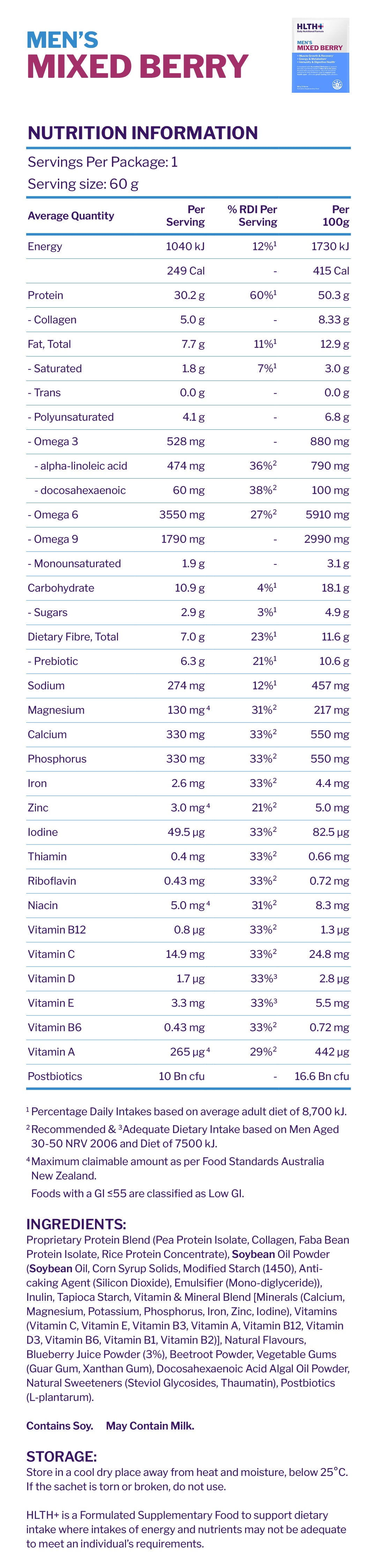
It can be, on the same test as everything above: the panel, not the format. One 55g Women's sachet of HLTH+ carries 30g protein per serve and 7g dietary fibre, at 1.5g of sugar with none added, dairy-free and gluten-free, and it does not need a fridge to travel.
Because it also carries a balanced multivitamin profile, 5g collagen and 60mg DHA in the same serve, its kilojoule figure is not the whole-food arithmetic the table above runs on, so it is not ranked inside it; the table above lists whole foods measured the same way, and HLTH+ sits beside them as a different kind of option rather than another row.
It is not designed as a meal replacement, because it is built to complement a food-first approach. It works fine as a healthy snack or to tie you over between the foods in the table above.
It is formulated to the Nutrient Reference Values, the reference intakes published in 2006 by the National Health and Medical Research Council, the Australian Government Department of Health and Ageing and the New Zealand Ministry of Health, across Women's, Women's 50+, Men's and Men's 50+.
How do you actually use a list like this?
Three habits make the table above useful instead of just interesting.
- Pick two defaults, one shelf-stable and one from the fridge. A tin of tuna for the desk, cooked prawns for a day you know you'll be home. Decision made once, not every time you're hungry.
- Read the serve size, not just the headline protein figure. Ranking 30 by protein per 100 kJ, a 170g yoghurt tub can still sit below a 30g scoop of protein powder; the grams differ because the serve does.
- Cook once, portion for the week. Two hard-boiled eggs, a tin drained into a container, 80g of sliced turkey weighed out: the numbers in the table only apply if the serve on your plate matches the serve in the row.
For the same measure applied to a whole meal rather than a single snack, see high-protein breakfast ideas, a healthy breakfast on the go, what to eat before a workout and how much protein you need to build muscle.
See what your current stack is not giving you. The 30-second ✦ Find My Formula quiz is diagnostic: it shows the gaps your existing snacks and supplements leave, so you know what you are missing before you buy anything.
Frequently Asked Questions
What is the highest-protein snack for the fewest kilojoules?
Steamed crab meat, at 20.2g of protein for 370 kJ in a 100g serve, ranks first on protein per 100 kJ among the 30 Australian snacks in this list. Cooked prawns and a single scoop of whey protein powder sit close behind it, all on Australian Food Composition Database figures.
What counts as a high-protein snack in Australia?
Under Schedule 4 of the Food Standards Code, a food needs at least 5g of protein a serving to carry a protein claim, and at least 10g to be called a good source. Most of the snacks in this list carry 10g to 30g in a single, realistic serve.
What are good dairy-free high-protein snacks?
Tinned tuna, tinned salmon, cooked prawns, steamed crab, hard-boiled eggs, turkey and chicken breast, tofu and boiled soy beans all carry no dairy ingredient. Eight of the 30 snacks in this list do contain dairy: the five cheeses, both yoghurts and the whey protein powder.
Is a protein shake a good high-protein snack?
It can be, and the test is the panel rather than the format. A daily nutritional formula such as HLTH+ is not designed as a meal replacement, because it is built to complement a food-first approach; it works fine as a healthy snack or to tie you over.
Which high-protein snacks are plant-based?
Ten in this list: almonds, peanuts, cashews, pumpkin seeds, hemp seeds, chia seeds, peanut butter, tofu, boiled lentils and boiled soy beans. Tofu and soy beans carry the most protein for the least energy of the ten, on Australian Food Composition Database figures.

Leave a comment
This site is protected by hCaptcha and the hCaptcha Privacy Policy and Terms of Service apply.