


What actually makes a probiotic "the best" one?
Front-of-pack numbers are not the criteria that decide a good probiotic. Five things are, and most labels only answer one or two of them.
- A named strain, not just a species. Genus and species tell you almost nothing; the effect sits with the specific strain.
- A stated CFU (colony-forming unit) count, and ideally whether it is measured at manufacture or guaranteed through to the end of shelf life.
- Evidence for that exact strain at that dose. A large number with no study behind it is a marketing claim, not a health claim.
- Storage, because a live organism has to survive the trip home and the months on your shelf.
- What else is in the serve. Some formulas add a prebiotic dietary fibre such as inulin alongside the live strains; most do not.
The International Scientific Association for Probiotics and Prebiotics (ISAPP) defines a probiotic as "live microorganisms that, when administered in adequate amounts, confer a health benefit" (the Hill et al 2014 consensus definition, Nature Reviews Gastroenterology & Hepatology), and is direct about why strain names matter: "different strains have different effects, as shown in scientific studies." A pack that names only "Lactobacillus" or "Bifidobacterium," with no strain code attached, is naming a genus, not the thing that was actually studied.
For the full definitions of probiotic, prebiotic and postbiotic and how the three are measured differently, see Prebiotics vs Probiotics vs Postbiotics: The Difference That Matters.
What does the evidence actually support?
healthdirect, the Australian Government's own consumer health service, is a useful check against marketing enthusiasm, because it is neither selling a probiotic nor selling against one.
Its position, verbatim: "Probiotics are 'good' bacteria that live naturally in your digestive system (gut)." It also says plainly that dosing is not settled science: "The amount of probiotics required as treatment is uncertain. Your doctor will tell you how much and when to take them."
Side effects it lists are common and usually mild: "bloating, gas ('wind'), diarrhoea." And it carries a caution worth reading before you buy: "Probiotics should not be taken by people who are immunocompromised (have a weak immune system)."
None of that is a reason to avoid the category. It is a reason to be sceptical of any pack that implies more certainty than the evidence has. A probiotic strain with genuine clinical study behind it, taken at the dose that was studied, is a different proposition to a big number with no citation attached, even when both packs say "30 billion CFU" on the front.
Best probiotic supplements in Australia, compared on the label
Three widely stocked Australian probiotic brands publish a full strain and CFU panel. The figures below are each brand's own published information, retrieved 22 September 2026.
| Swisse Ultibiotic Daily Digestive Probiotic | Life-Space Broad Spectrum Advanced Probiotic | Blackmores Probiotics+ Daily Health | |
|---|---|---|---|
| Strains | 3 | 15 | 5 |
| Named strains | Bifidobacterium lactis (HOWARU bifido HN019), Bifidobacterium lactis (BI-04), Lactobacillus acidophilus (La-14) | Bifidobacterium animalis ssp lactis HN019, Lactobacillus rhamnosus GG, Bifidobacterium lactis BI-04, plus 12 further named strains | Lactobacillus acidophilus (ATCC 700396), Lactobacillus paracasei (Lpc-37), Bifidobacterium lactis (Bi-07), Bifidobacterium lactis (BI-04), Bifidobacterium lactis HN019 |
| Total CFU per capsule | 35 billion | 32 billion | 30 billion |
| Prebiotic in the serve | Not listed on the panel retrieved | Not listed on the panel retrieved | Inulin, 100mg |
| Storage | Store below 25°C in a cool, dry place | Store below 30°C in a dry place | No need to refrigerate |
| Dose | One capsule daily | One vegetarian capsule daily with water | One capsule once a day |
| Pack and price | 30 capsules $34.99; 90 capsules $82.99 | 30 to 90 capsules, $34.99 to $73.99 | 30 and 90 capsules; no price on the product page retrieved |
Figures are each brand's own published product and label information, retrieved 22 September 2026. Brands reformulate; check the current label before you buy. None of the three panels retrieved states whether its CFU figure is measured at manufacture or guaranteed through to the end of shelf life, which is worth asking the brand directly if the number is the reason you are choosing between them.
All three publish shelf-stable storage instructions rather than a fridge requirement.
- If the CFU count on the front is what you are comparing, Swisse Ultibiotic Daily Digestive Probiotic lists the most at 35 billion, across three named strains.
- If strain diversity is what you want, Life-Space Broad Spectrum Advanced Probiotic lists the most at 15, though a longer strain list is not automatically a stronger one: each strain still needs its own evidence at its own dose.
- If you want a prebiotic fibre included alongside the live strains, Blackmores Probiotics+ Daily Health is the only one of the three that lists one on the retrieved panel, 100mg of inulin.
Where the dietary fibre side of this fits. A live strain is one part of gut nutrition; feeding the bacteria already in you is the other, and Gut Health Supplements in Australia sets the three categories side by side. Dietary Fibre on a GLP-1 and GLP-1, Gut Health and Probiotics cover that side when appetite has dropped, and the HLTH+ nutrition support page has more on eating enough while eating less.
Who actually needs a probiotic supplement?
Not everyone, and healthdirect names one situation plainly: "If you are taking antibiotics, your doctor may suggest that you take probiotics. This is because antibiotics kill both good and bad bacteria." Beyond that, it directs the decision to a clinician rather than to a label, listing the circumstances in which "it's a good idea to talk to your doctor or dietitian."
That is a genuinely different question to "which pack has the biggest number," and it is the reason a strain-and-evidence comparison matters more here than in most supplement categories. If you are immunocompromised or take regular medication, that conversation happens before the purchase, not after it. For common digestive questions people search alongside probiotics, the GLP-1 Digestion FAQ covers what changes when appetite and eating volume drop.
What is a postbiotic, and why does HLTH+ carry one instead of a probiotic?
A postbiotic is a different category, not a weaker version of a probiotic. The 2021 ISAPP consensus statement defines it as "a preparation of inanimate microorganisms and/or their components that confers a health benefit on the host" (Salminen et al, Nature Reviews Gastroenterology & Hepatology, 2021). Inanimate is the operative word, and a 2024 follow-up paper from the same scientists (Vinderola et al, Frontiers in Microbiology) is precise about what it means: the term was chosen over "inactive" because it describes microbes "without vital force, or having lost life," while the preparation can still be biologically functional even though nothing in it is alive.
That is the practical reason a formulator reaches for a postbiotic rather than a live strain. Nothing has to survive being mixed into powder, packed into a sachet, left on a shelf for months or carried home in a warm car, because there is no viability to protect in the first place. It is a different engineering problem to keeping billions of live cells alive until the use-by date.
One caveat follows from that: a postbiotic CFU figure and a probiotic CFU figure are not measuring the same thing. CFU counts cells that are alive and capable of forming a colony, which is exactly why it works as a measure for something whose defining feature is being alive. A postbiotic preparation is quantified by different methods entirely, including flow cytometry and biomass or chemical analysis, because the thing being counted was never alive to grow a colony in the first place.
A bigger figure on one label does not mean more of the same thing than a smaller figure on the other, and the two numbers should not be read against each other. Prebiotics vs Probiotics vs Postbiotics covers the full quantification difference with the primary citations.
That is also why HLTH+ is not in the comparison table above and is not ranked on this page. It is a Formulated Supplementary Food that carries a postbiotic, not a probiotic supplement, and the two are not the same purchase decision.
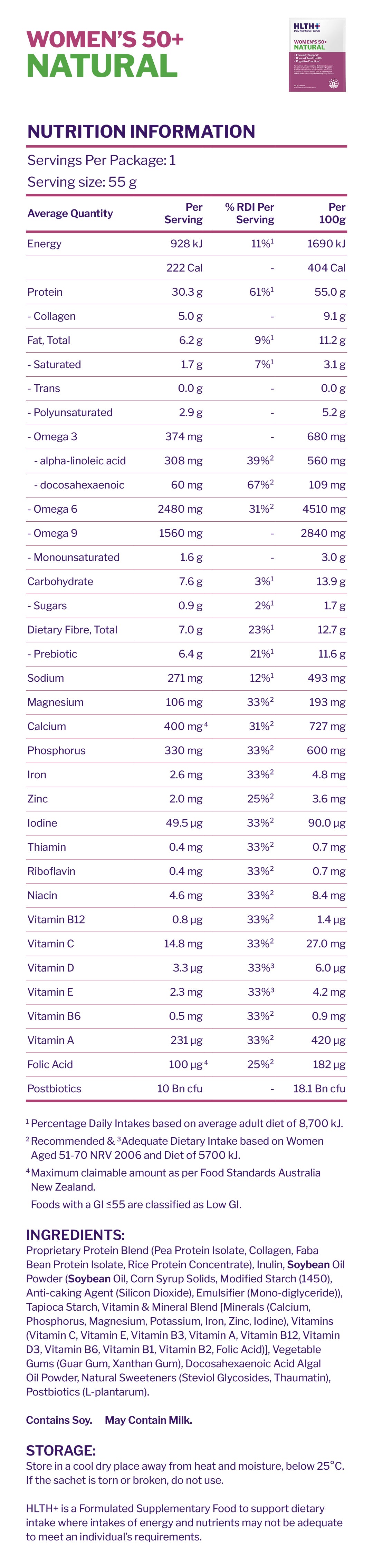
Per 55g sachet, HLTH+ carries 10 billion CFU Lactobacillus Plantarum Postbiotic alongside 7g dietary fibre. Dietary fibre contributes to regular laxation, as part of a healthy diet involving a variety of foods. Both sit inside a wider daily formula built by Accredited Dietitians to the Nutrient Reference Values published by the National Health and Medical Research Council, the Australian Government Department of Health and Ageing and the New Zealand Ministry of Health, alongside 30g protein and a balanced multivitamin profile in the same sachet.
Available at hlthplus.com, through the HLTH+ store on Amazon AU and at Chemist Warehouse online.
Not sure what your current supplements leave out? The ✦ Find My Formula quiz takes about 30 seconds and shows you the gaps in what you already take before anything else. Take the quiz.
Frequently Asked Questions
What is the best probiotic in Australia?
There is no single best one, because the strain and the evidence behind it matter more than the brand. Of three widely stocked Australian brands that publish a full panel, Swisse Ultibiotic lists the most CFU at 35 billion, Life-Space Broad Spectrum Advanced lists the most strains at 15, and Blackmores Probiotics+ Daily Health alone lists a prebiotic.
Is a higher CFU count always better?
No: CFU counts how many live cells are present, not how well-evidenced or well-matched to your situation they are. A single named strain studied at its tested dose can do more than a large blended count with no strain-specific evidence behind it. Check the strain names and the dose before comparing totals.
Do probiotics need to be refrigerated?
Not always. All three Australian brands compared on this page publish shelf-stable storage instructions rather than a fridge requirement, ranging from "store below 25°C" to "no need to refrigerate." Always follow the instructions on the specific pack you buy, since formulations differ.
Is a postbiotic the same as a probiotic?
No: a probiotic is alive, and a postbiotic is "a preparation of inanimate microorganisms and/or their components," per the 2021 ISAPP consensus definition. Because nothing in a postbiotic has to stay alive, it suits shelf-stable powders in a way a live strain does not. The two are quantified by different methods, so their counts are not directly comparable.
Does HLTH+ contain a probiotic?
No. HLTH+ carries 10 billion CFU Lactobacillus Plantarum Postbiotic per 55g sachet, alongside 7g dietary fibre. It is a Formulated Supplementary Food rather than a probiotic supplement, so it is not entered or ranked in the comparison above; a postbiotic and a probiotic are counted by different methods, so the two figures are not read against each other.
This article is general information, not medical advice. Decisions about any medication belong with your doctor.


Leave a comment
This site is protected by hCaptcha and the hCaptcha Privacy Policy and Terms of Service apply.