

Each number is an additive code. On an Australian label 950 is acesulphame potassium, 951 is aspartame, 952 is cyclamate and 955 is sucralose, and most food additives are listed by a class name followed by either the additive's name or its number (FSANZ, Labelling of food additives). So "Sweetener (955)" and "Sweetener (Sucralose)" name the same ingredient.
You are reading an ingredient list that ends in a bracket of digits, and you want to know what they are, what the regulator says about them, and which of the shakes on the shelf print them.
This page decodes 950, 951, 952 and 955, with 960 for contrast, from Food Standards Australia New Zealand (FSANZ), shows how the numbers read on Australian shake labels retrieved on 29 September 2026, and states only what each cited source says.
What do 950, 951, 952 and 955 stand for on a food label?
FSANZ, which writes the Food Standards Code, lists all four as intense sweeteners: additives many times sweeter than sugar, so used in much smaller amounts, and added to foods to replace sugar in lower-energy or sugar-free products (FSANZ, Intense sweeteners). Steviol glycosides (960) are included for contrast.
| Number | Name on FSANZ's list | Sweeter than sugar (FSANZ) | Acceptable daily intake (FSANZ) |
|---|---|---|---|
| 950 | Acesulphame potassium (acesulphame-K) | 200 times | 15 mg/kg bw/day, based on animal studies |
| 951 | Aspartame | More than 200 times | 0 to 40 mg/kg bw/day, based on animal studies |
| 952 | Cyclamate | Between 30 and 50 times | 0 to 11 mg/kg bw/day, based on animal studies |
| 955 | Sucralose | About 600 times | 0 to 15 mg/kg bw/day, based on animal studies |
| 960 | Steviol glycosides | Around 150 to 300 times | 0 to 4 mg/kg body weight |
Source: FSANZ, Intense sweeteners page, last updated 26 November 2025, retrieved 29 September 2026. "mg/kg bw/day" means milligrams per kilogram of body weight per day.
The last column is the acceptable daily intake (ADI), which FSANZ defines as "the amount of a food additive that can be eaten every day for an entire lifetime without adverse effect" (FSANZ, How FSANZ ensures the safety of food additives). FSANZ says "a safe concentration determined from animal studies would be usually divided by a safety (or uncertainty) factor of 100", and that it recommends a maximum level for an additive only when the estimated intake is well within the ADI. For what "sugar free", "no added sugar" and "unsweetened" each mean under Schedule 4 of the Food Standards Code, see protein powder without artificial sweeteners.
How HLTH+ compares
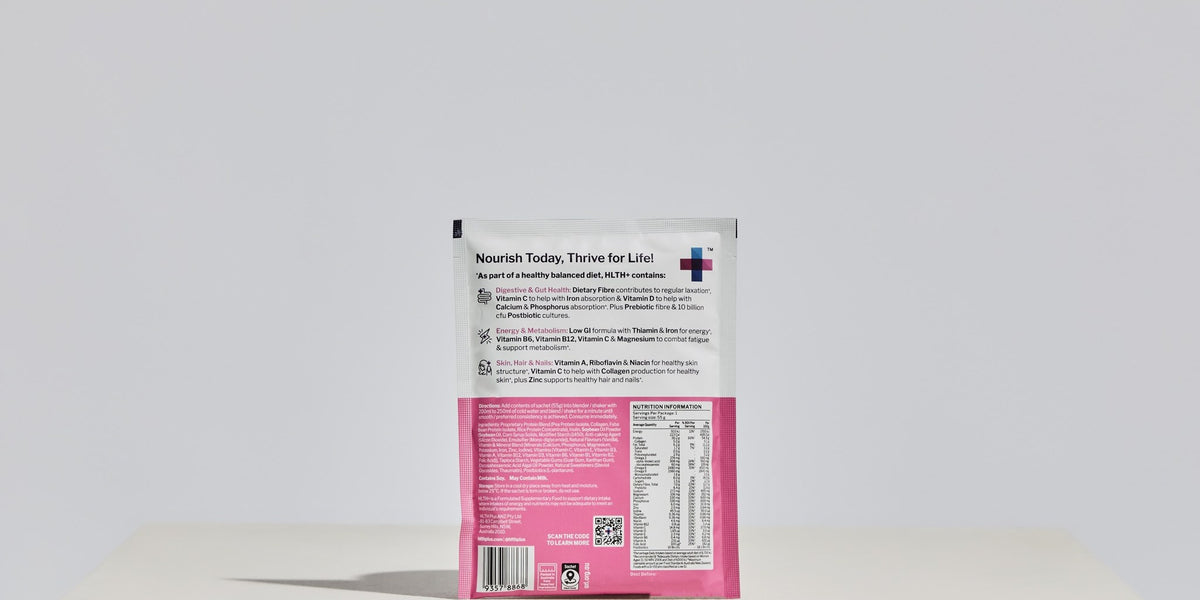
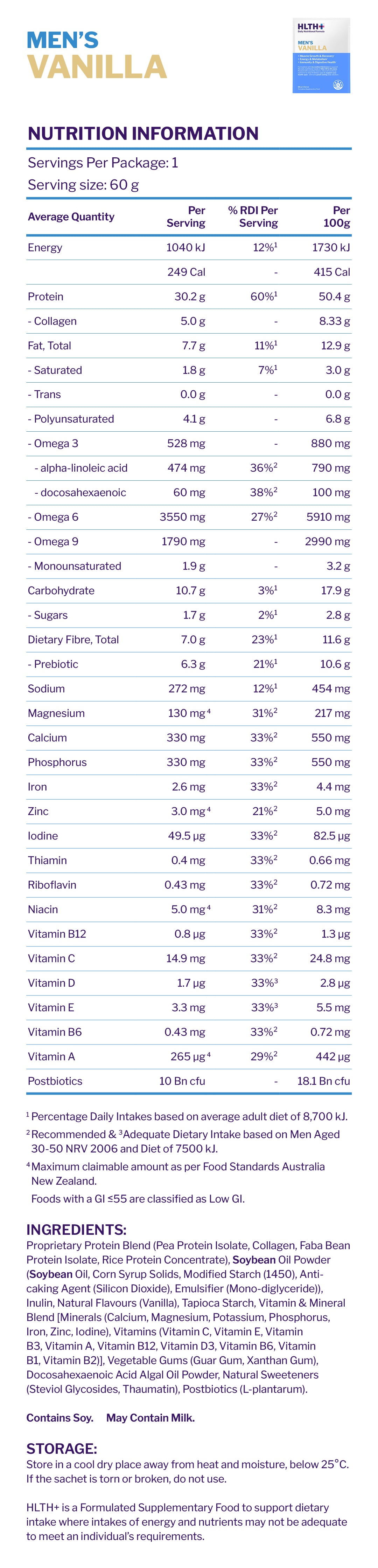
HLTH+ is a daily nutritional formula, a Formulated Supplementary Food, sweetened without artificial sweeteners and made with no added sugar. One 55g sachet lists 30g protein per serve and 7g dietary fibre, within 30 essential daily nutrients across protein, dietary fibre, vitamins, minerals, collagen and DHA. The 30-second ✦ Find My Formula quiz shows what your current routine is not giving you.
What are the side effects of sweetener 950?
FSANZ's entry for 950 says it is 200 times sweeter than sugar, that it is "made from an acid and the naturally occurring mineral, potassium", and that an ADI of 15 mg/kg bw/day has been established based on animal studies (FSANZ, Intense sweeteners). Neither that entry nor the healthdirect page cited below, as retrieved on 29 September 2026, names a specific side effect of 950, so this page does not add one.
What healthdirect says on its sugar substitutes page (reviewed October 2025) applies to the whole category: sugar substitutes may still cause tooth decay and health problems if you consume too much, and "Sugar substitutes are not suitable for everyone. Ask your doctor if sugar substitutes are right for you." (healthdirect, Sugar).
What is sweetener 951, and why does the label mention phenylalanine?
951 is aspartame, which FSANZ describes as more than 200 times sweeter than sugar and used in low-energy or sugar-free foods including carbonated soft drinks, yoghurt and confectionery. FSANZ's advisory statement rule says a food containing aspartame or aspartame-acesulphame salt must carry "a statement to the effect that the product contains phenylalanine" (FSANZ, Warning and advisory statements). The reason, in FSANZ's words: "People with the rare inherited disorder called Phenylketonuria (PKU) must be alerted to the presence of phenylalanine in aspartame containing products via labelling, so that they can limit their daily intake." (FSANZ, Intense sweeteners)
The rule shows on a real label. Optifast's VLCD Protein Plus Shake page (read 8 September 2026) lists "Sweeteners (Aspartame, Acesulfame Potassium)" and an allergen line reading "Contains Milk, Soy, Fish. Contains Phenylalanine. Gluten Free. Low Lactose."
FSANZ's aspartame page (last updated 26 November 2025) states: "All scientific evidence to date supports the safety of aspartame for use as a sweetener, however re-evaluation work is proposed", and gives an ADI of 40 mg/kg of body weight, set by the Joint FAO/WHO Expert Committee on Food Additives in 1980 (FSANZ, Aspartame). This page is general information, not medical advice, and anyone with PKU, or unsure whether a sweetener suits them, should ask their doctor or dietitian.
Is sweetener 955 bad for you?
None of the sources cited on this page calls sucralose harmful, and this page does not rule on it either way; it reports what they state. FSANZ describes sucralose (955) as about 600 times sweeter than sugar, with no kilojoules, "made by replacing three hydrogen-oxygen groups on a sugar molecule with three chlorine groups", and gives an ADI of 0 to 15 mg/kg bw/day based on animal studies (FSANZ, Intense sweeteners).
Healthdirect lists sucralose with aspartame and saccharin as artificial sweeteners that have no kilojoules, with the same category-wide caution as above (healthdirect, Sugar). A question about a sweetener that matters for your health is one for your doctor or dietitian. The wider field of shakes is mapped in the best protein shakes in Australia, and the label-by-label read is further down this page.
What is sweetener 952, and how does 960 differ?
952 is cyclamate. FSANZ describes it as between 30 and 50 times sweeter than sugar, found in salt (sodium or calcium) forms, and "used in confectionery and many other foods and drinks, and is often paired with saccharin in foods to improve the taste". None of the shake and drink labels read for this page lists 952, so the table below has no row to map it to; where 950 and 951 sit in a ready-to-drink coffee is covered in protein coffee.
960 is the contrast. FSANZ says steviol glycosides are extracted from the South American plant Stevia rebaudiana, that they are around 150 to 300 times sweeter than sugar, and gives an ADI of 0 to 4 mg/kg body weight. Two more plant-sourced entries have no ADI figure of that kind: thaumatin (957), "an intensely sweet-tasting protein" from the Katemfe fruit for which "no ADI is specified because of a good safety profile", and monk fruit extract, which is on FSANZ's list with no numbered code.
Where do these sweeteners appear on Australian shake labels?
Every row is read from that brand's own published page and printed exactly as the label writes it, retrieved 29 September 2026 unless the row says otherwise. The same additive can turn up as a number on one product and a name on the next.
| Product | Sweetener line as printed | Written as |
|---|---|---|
| OptiSlim VLCD Classic Shake, Chocolate | Sweetener (955) | A number |
| Dare Double Espresso No Sugar Added (ready-to-drink iced coffee) | Sweeteners (951,950) | Numbers |
| Optifast VLCD Protein Plus Shake, Chocolate (page read 8 September 2026) | Sweeteners (Aspartame, Acesulfame Potassium) | Names |
| The Man Shake, Chocolate | Sweetener (Sucralose) | A name |
| The Lady Shake, Chocolate | Natural Sweeteners (Steviol Glycosides, Thaumatin) | Names |
| The Lady Shake, Golden Ice Cream | Sweetener (Sucralose) | A name |
| Bulk Nutrients Whey Protein Isolate, flavoured | Sweetener (Sucralose) | A name |
| Bulk Nutrients Natural Whey Protein Isolate | Natural Sweetener (Stevia, Thaumatin) | Names |
| True Protein WPI90, Rich Chocolate | Natural sweetener (Organic steviol glycosides) | A name |
Figures are each brand's published information at the dates shown; brands reformulate and flavours differ, so check the current pack before buying. Optifast's page returned an access error on 29 September, so its row carries the 8 September read. Bulk Nutrients states that its Raw whey protein isolate "does not contain any flavours or sweeteners".
Two things follow. The Lady Shake's page prints a different sweetener system on different flavours, so the flavour you choose decides the bracket, and "Sweetener (955)" on one pack and "Sweetener (Sucralose)" on another are the same additive. For The Man Shake's full panel, see does The Man Shake work.
What changes when you are eating less than you used to?
A sweetener bracket is one line on a label. For many people the bigger question is how much they are eating in total: over 90% of Australian adults do not meet dietary guidelines on the AIHW poor-diet measure, before intake falls at all.
Intake can then drop for many reasons: a deliberate deficit, a reduced appetite, or rapid weight loss, reduced eating and medically induced weight loss. In trial conditions, GLP-1 medicines cut ad libitum food intake by roughly a quarter of daily calories (Blundell and colleagues, Diabetes, Obesity and Metabolism, 2017), and a 2025 study of people on GLP-1 medications found average dietary fibre intake of 14.5g a day against the recommended 28g (Frontiers in Nutrition).
This page is general information, not medical advice, and decisions about any medication belong with your doctor.
How do you read a sweetener line on an Australian label?
Four steps, in this order.
- Find the class word. Look for "Sweetener" or "Sweeteners" in the ingredient list and read only the bracket after it.
- Match the number or the name to the table above. Either form names the same additive.
- Check the flavour. Two flavours from one brand, or two products in one range, can carry different brackets.
- Look for the phenylalanine line. Where aspartame is listed, the statement should sit in the allergen or advisory text.
The same bracket reading applies to any powder, including the ones covered in greens powder. If milk sugar is your question rather than the sweetener, does whey protein have lactose covers it.
If you are eating less than you used to, more on what changes nutritionally when overall intake drops is on the nutrition page.
Which reader wants what?
- You want to know exactly what a sweetener bracket says. Use the FSANZ table above, match the number or the name, and check the flavour on the pack in your hand.
- You want a powder whose bracket names only plant-extracted sweeteners. Protein powder without artificial sweeteners lists four that do.
- You want protein, dietary fibre and a balanced multivitamin profile in one sachet. HLTH+, at 30g protein per serve and 7g dietary fibre in a 55g sachet, taken alongside meals.
HLTH+ publishes Women's, Women's 50+, Men's and Men's 50+, each dietitian-formulated to the Nutrient Reference Values, the intakes published in 2006 by the National Health and Medical Research Council, the Australian Government Department of Health and Ageing and the New Zealand Ministry of Health. It is Australian-made in facilities complying with Good Manufacturing Practice and sells at hlthplus.com at RRP $6.00, or $5.10 a day on a 28-serve subscription at $142.80, plus Amazon AU and Chemist Warehouse online.
Find out what your current routine is not giving you. The 30-second ✦ Find My Formula quiz shows the gaps your existing shakes and supplements leave.
Frequently Asked Questions
Is sweetener 955 the same as sucralose?
Yes. FSANZ lists sucralose as additive 955, and an ingredient list can print either the number or the name after the word "Sweetener", so "Sweetener (955)" and "Sweetener (Sucralose)" name the same ingredient. FSANZ describes it as about 600 times sweeter than sugar, with no kilojoules (retrieved 29 September 2026).
Which sweeteners count as artificial and which as natural?
Healthdirect groups aspartame, saccharin and sucralose as artificial sweeteners, and stevia and monk-fruit extract as natural intense sweeteners that are kilojoule-free and usually made from plants. On an Australian label, steviol glycosides carry the number 960, while monk fruit extract sits on FSANZ's list with no numbered code.
What does acceptable daily intake mean?
FSANZ defines it as the amount of a food additive that can be eaten every day for an entire lifetime without adverse effect. It is set from animal studies, where a safe concentration is usually divided by a safety factor of 100. FSANZ recommends a maximum level for an additive only when estimated intake is well within it.
Why do two flavours from one brand list different sweeteners?
Sweetener systems can differ by flavour or by product, so read the bracket on the exact pack you buy. On The Lady Shake's own page, retrieved 29 September 2026, Chocolate lists Natural Sweeteners (Steviol Glycosides, Thaumatin) while Golden Ice Cream lists Sweetener (Sucralose). Bulk Nutrients' flavoured Whey Protein Isolate lists sucralose; its Natural Whey Protein Isolate lists stevia and thaumatin.
This article is general information, not medical advice. Decisions about any medication belong with your doctor. Figures quoted are FSANZ's and each brand's published information at the retrieval dates shown; check current labels before buying.
Leave a comment
This site is protected by hCaptcha and the hCaptcha Privacy Policy and Terms of Service apply.