

Does The Man Shake work?
For the job it is sold to do, standing in for a meal, yes: its own nutrition panel lists 850 kJ, 30.9g of protein, 7.4g of dietary fibre and 1.9g of sugars per 56g serve (retrieved 22 September 2026), which meets the composition floor Standard 2.9.3 sets for a formulated meal replacement on energy and protein. The evidence for the category says a meal replacement works through portion control and structure rather than any ingredient in it, and that the effect is modest.
If you are asking this question, something has usually already changed: your appetite has dropped, you are eating less than you used to, or a shake for lunch has started to feel like the whole day's food rather than a shortcut through one meal of it. Whether "work" means it fills you up, replaces a meal properly, or carries what your body actually needs is three different questions with three different answers.
This page reads The Man Shake the way a dietitian would: the panel against the marketing copy, what the evidence actually says about meal replacements as a category, and what to reach for instead once a shake is being asked to do more than replace one meal.
What is The Man Shake designed to do?
In Australia, "meal replacement" is not just marketing language, it is a defined food category. Standard 2.9.3 of the Australia New Zealand Food Standards Code sets out a formulated meal replacement as a food "specifically formulated as a replacement for one or more meals of the day, but not as a total diet replacement" (Standard 2.9.3, Food Standards Code, retrieved 22 September 2026). To carry that name, a serving has to contain no less than 12g of protein, 850 kilojoules and 25% RDI of each vitamin and mineral in the relevant schedule table.
The Man Shake is sold and marketed on that basis, a shake built to stand in for a meal rather than sit alongside one. Its product page carries two sets of figures: the marketing copy reads 30g of "high-quality whey protein", 7.5g of dietary fibre, "only 2.4g of sugar per serve" (6.1g for Birthday Cake) and "18 vitamins and minerals", while the nutrition panel behind the page's Nutritional Info button, headed Chocolate, publishes (re-read 22 September 2026):
- 56g serve, 15 servings a pack
- 850 kJ (203 calories) per serve
- 30.9g protein
- 7.4g dietary fibre
- 1.9g sugars, of which 0.7g is lactose
- 190mg sodium
- 168 million CFU of probiotic cultures, four strains named in the ingredient list
- $54.95 a pack, or $49.45 on Subscribe and Save, which works out to $3.66 or $3.30 a serve
Against the Standard 2.9.3 floor, the protein figure sits at more than twice the 12g minimum and the energy figure sits exactly on the 850 kilojoule line. The vitamin and mineral rows are itemised with an amount each, which is the part most shake pages leave out. On the two numbers a reader can check without a calculator, energy and protein, the panel meets the floor.
For the complete label read, including how it stacks up against other shakes row by row, the full Man Shake review has the detail this page does not repeat, and Man Shake alternatives sorts the options by the job each one is actually built for.
How does a meal replacement actually work?
Set the brand aside for a moment. A formulated meal replacement is not a special metabolic trick; it works by being a fixed, pre-portioned amount of food that is easier to stick to than deciding what to eat freely. A 2019 systematic review and meta-analysis of 23 randomised controlled trials in 7,884 adults found that programmes using meal replacements produced greater weight loss at one year than comparable diet programmes without one, by a mean difference of 1.44 kg (Astbury et al, Obesity Reviews, 2019).
The same review offers a reason, and hedges it as a possibility: the authors write that these "fixed-energy, portion-controlled, or prepacked foods contain less energy than most self-selected meals and snacks", or that "the structure and external control associated with their use facilitate adherence" to an otherwise reduced-energy diet. In plain terms, a meal replacement works because it removes a decision and sets a portion, not because any particular ingredient in it is doing something special.
That is a useful thing to know before judging any single shake on its ingredient list. The label tells you what you are getting; the evidence tells you why swapping a meal for it tends to help in the first place, and neither one is a reason to expect more from the shake than portion control. This page is general information, not medical advice, and decisions about any medication belong with your doctor.
What does the panel say that the copy does not?
A fair reading puts the marketing figures and the panel figures side by side, because a reader who stops at the front of the page gets a different picture from one who opens the panel. As of the 22 September 2026 read of The Man Shake's own product page:
- Protein reads 30g in the copy and 30.9g on the panel. Rounded the same way, the same number.
- Dietary fibre reads 7.5g in the copy and 7.4g on the panel. A tenth of a gram apart.
- Sugars read 2.4g in the copy and 1.9g on the panel. The copy describes 2.4g as the usual average across flavours; the panel is for Chocolate alone.
- The probiotic count is on the panel, not in the copy: 168 million CFU per serve, with Bacillus coagulans, Lactobacillus acidophilus, Lactobacillus rhamnosus and Bifidobacterium lactis in the ingredient list.
- Sodium is 190mg a serve, a figure the copy never mentions.
- Milk protein isolate and whey protein isolate lead the ingredient list, with soy lecithin as the emulsifier, and gluten is listed as not detected.
- No collagen and no omega-3 source appear in the ingredient list, so neither is a figure on this label.
Two of those figures matter more than the rest for anyone comparing shakes: 850 kilojoules a serve, and 56 grams of powder to get there. They are what turn a protein number into a per-serve and per-100g comparison, and they are the half of the Standard 2.9.3 sum the copy leaves out.
Serving size and calories are not a formality. Without them you cannot compare a shake against anything else on a per 100g basis, which is how most nutrition comparisons are actually made, and how the sister product's panel is read. A protein figure on its own tells you one thing about a product; the full panel tells you what it costs you in calories to get there, which here is 203 calories for 30.9g of protein.
Who is a meal replacement actually built for?
A formulated meal replacement earns its category by doing one thing well: standing in for a meal that would otherwise not happen, inside a structured plan or on a genuinely busy day. It is not built to answer every nutrition question at once, and reading it as a general daily supplement is asking it to do a job it was never designed for.
- You want a shake instead of a meal, not alongside one. That is the job the category is built for, and The Man Shake's panel is built to it: 850 kJ and 30.9g protein a serve.
- You are following a structured eating plan that already accounts for one or more shakes a day in place of food.
- You want to keep eating your normal meals and add to them, rather than swap one out. That is a different job, covered below.
If it is the first of those, the meal replacement roundup puts the Australian shakes side by side on their own published panels.
Do you need a meal replacement, or something else?
More on what changes when you are eating less → learn more about nutrition support while your intake is down.
A meal replacement earns its name doing one job: standing in for a meal you are not otherwise going to eat. That is a different job from topping up the nutrition in the meals you are already eating, whether the reason you are eating less is rapid weight loss, reduced eating and medically induced weight loss, or simply a smaller appetite than before. Where you land depends on which of those two jobs you actually need done.
The second job is not a niche one. Over 90% of Australian adults do not meet dietary guidelines on the AIHW poor-diet measure, and eating less narrows the room to close that gap through food alone.
HLTH+ is not designed as a meal replacement, because it is built to complement a food-first approach rather than stand in for a meal. That said, it works fine as a healthy snack or to tie you over, and plenty of people use it that way rather than as a lunch substitute.
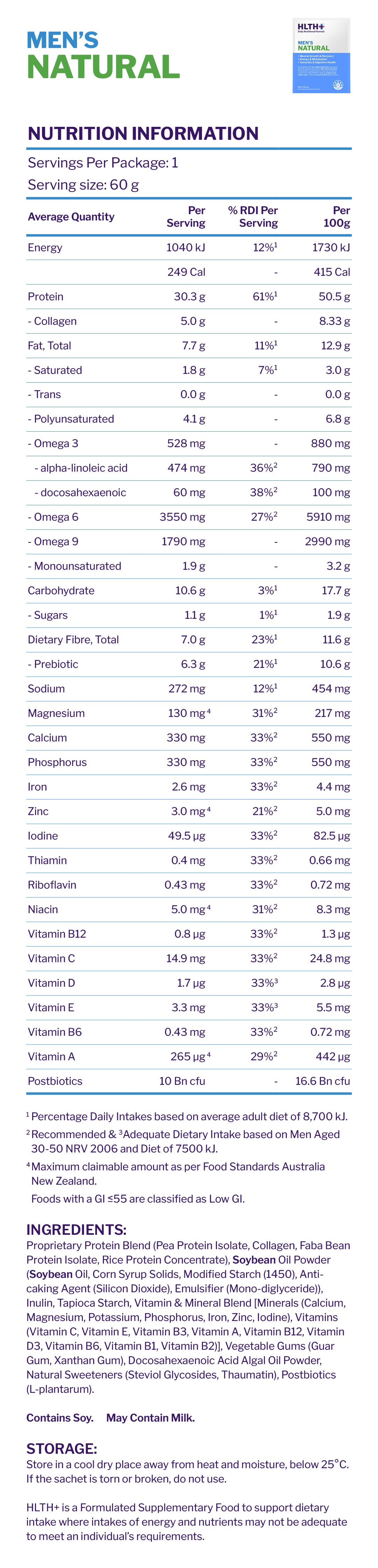
A Men's sachet of HLTH+ (60g, or 62g for Chocolate) carries 30g protein, 7g dietary fibre, 5g collagen, 60mg DHA and 10 billion CFU Lactobacillus Plantarum Postbiotic, at 1.7g of sugar with none added and 248 calories. Protein contributes to the maintenance and growth of muscle mass, as part of a healthy diet involving a variety of foods. It is formulated by Accredited Dietitians to the Nutrient Reference Values published by the National Health and Medical Research Council, the Australian Government Department of Health and Ageing and the New Zealand Ministry of Health, by sex and life stage across Women's, Women's 50+, Men's and Men's 50+, and it is a Formulated Supplementary Food under the FSANZ Food Standards Code, built to supplement the food you already eat.
It is Australian made in facilities complying with Good Manufacturing Practice, carries a 5-star Health Star Rating and hundreds of reviews across the range, and sells at RRP $6.00 a sachet, or $5.10 a day on a 28-serve subscription at $142.80, through hlthplus.com, Amazon AU and Chemist Warehouse online.
If a full meal replacement is genuinely the job, the wider meal replacement category sets out what the label has to contain and how a handful of Australian shakes compare on it, Man Shake alternatives sorts options by the job each is built for, The Lady Shake review covers the sister product, and the Sustagen read covers the clinical end of the category.
See what your current stack is actually missing. The 30 second ✦ Find My Formula quiz is diagnostic: it shows the gaps your existing routine is not covering, before it shows you a formula.
Frequently Asked Questions
Does The Man Shake work?
For the job it is sold to do, standing in for a meal, its own panel lists 850 kJ, 30.9g protein, 7.4g dietary fibre and 1.9g sugars per 56g serve (retrieved 22 September 2026), which meets the Standard 2.9.3 floor on energy and protein. The category evidence puts the effect down to portion control, and it is modest.
How much protein is in The Man Shake?
The Man Shake's marketing copy says 30g of "high-quality whey protein" per serve and its nutrition panel lists 30.9g per 56g serve, with 7.4g of dietary fibre and 1.9g of sugars (retrieved 22 September 2026). HLTH+ Men's lists 30g protein per serve; check the current label before buying, since figures can change.
What must a product contain to legally be called a meal replacement in Australia?
Under Standard 2.9.3 of the Food Standards Code, a formulated meal replacement must contain at least 12g of protein, 850 kilojoules and 25% RDI of each listed vitamin and mineral in a single serving, and it must be represented on the label as a replacement for one or more meals, not a total diet replacement.
Is HLTH+ the same as The Man Shake?
No. The Man Shake is a formulated meal replacement, built to stand in for a meal, and HLTH+ is a Formulated Supplementary Food, built to be drunk alongside your normal meals rather than instead of them. The Man Shake's panel lists 30.9g protein a serve and HLTH+ lists 30g, and they are answering different questions.
Can I use HLTH+ instead of a meal replacement shake?
It is not designed as a meal replacement, because it is built to complement a food-first approach rather than stand in for a meal. It works well as a healthy snack or to tie you over between meals. If a meal replacement is specifically what you want, that is a different category and product.
Leave a comment
This site is protected by hCaptcha and the hCaptcha Privacy Policy and Terms of Service apply.