

What are collagen peptides?
Collagen peptides are collagen, the structural protein of animal skin, bone and connective tissue, broken into short chains of amino acids so the powder stirs into a cold drink. The process is called hydrolysis, and "hydrolysed collagen" and "collagen peptides" name the same kind of powder. Choice defines the peptides in a supplement as short strings of amino acids, the building blocks of protein (last updated 6 July 2021).
A tub gives you four sets of words at once: peptides, hydrolysed, bovine or marine, and type I, II or III, each beside a gram figure and often a sentence about skin or joints. It is hard to tell which describe the powder and which describe the sales pitch.
This page separates them: what the words mean, what six Australian product pages actually print, and what the Food Standards Code allows a collagen label to say. It covers powders you swallow, and the collagen powder buyer's guide covers the shopping side; the creams, serums, tablets and injections that appear in the same searches are different products.
What is the difference between collagen and collagen peptides?
The difference is chain length: collagen in the animal is a large protein, and collagen peptides are that protein cut into many small, low-molecular-weight amino acid chains, which a 2024 review puts at 3 to 6 kDa and describes as made by enzymes in acidic or basic conditions (Al Hajj and colleagues, Heliyon, 2024). A kilodalton (kDa) is a unit of molecular mass, so a smaller number means a shorter chain; the same abstract names glycine, proline and hydroxyproline as the main amino acids.
"Peptides" is a category, not a specification. A 2025 review of preparation methods reports that different extraction and hydrolysis methods give collagen peptides of different molecular weights, and that their biological activities are closely related to molecular weight and amino acid sequence (Ma and colleagues, Molecules, 2025). On a label, the only place that size shows up is a kDa figure, and only two of the six pages checked for this article print one.
What is bovine collagen, and how does it differ from marine?
Bovine collagen comes from cattle and marine collagen from fish. Choice says the collagen in supplements is mostly derived from cows (bovine), pigs (porcine) or fish (marine), and the Heliyon review lists bovine, porcine, marine, chicken and fish sources for hydrolysed collagen.
The label facts below are each brand's own published information, retrieved 29 September 2026.
| Product (source) | Collagen per serve | Type and peptide size the page states | Allergen or dietary line on the page |
|---|---|---|---|
| The Collagen Co Premium Collagen Peptides (bovine) | 15,000mg (15g), 28 serves per pack | Type not stated; lists "2kDa molecular collagen peptides" | No allergen statement in the page text |
| The Collagen Co Beauty Marine Collagen (fish scales) | 10,000mg (10g), 28 serves per pack | Type 1; "average molecular weight of less than 2kDa" | Contains Fish |
| Nature's Way Collagen Peptides Powder (bovine) | 10g per 10g serve, with 9g protein | Not stated | No allergen statement in the page text |
| Vital Proteins Collagen Peptides Unflavoured (bovine) | 10g per scoop | Not stated | May contain milk, fish and tree nuts |
| Bulk Nutrients Collagen Protein (bovine) | 25g serve on the nutrition panel (Raw: 100% collagen peptides, 24g protein); directions of 5g, 10g or 25g a day by goal | "Rich in Type 1 and Type 3 collagen"; size not stated | Page says completely dairy-free |
| Vida Glow Natural Marine Collagen, Original (fish skin) | 3,000mg (3g) per 3g sachet, with 2.9g protein | Not stated for the product itself | Contains Fish |
Flavours and packs vary and brands reformulate. Protein blends that carry collagen are covered in collagen protein powder.
Marine is not always the small dose: the two marine products list 3g and 10g a serve, and the bovine ones list 10g to 25g. The peptide size and type wording that does appear is not uniform across pages.
One human trial tested directly whether the source changes what reaches the bloodstream. In a randomised, double-blind crossover study of healthy volunteers, skin- and hide-derived hydrolysates of fish, porcine and bovine origin (bovine at 2,000 and 5,000 Da) gave comparable uptake of free hydroxyproline, and the authors concluded that independently of source and molecular weight all hydrolysates gave relevant plasma levels of the metabolites measured (Virgilio and colleagues, Frontiers in Nutrition, 2024). It measured blood levels after a single dose, not a health outcome; several authors are employed by Rousselot, a collagen peptide manufacturer; and the paper says larger studies are needed.
What the type wording is
The Heliyon review counts 28 collagen types and lists types I, II and III among the classical fibrillar collagens. On a label, a type is a descriptor of the source collagen: of the pages above, Bulk Nutrients describes its bovine collagen as rich in type 1 and type 3, The Collagen Co describes its marine collagen as type 1, and neither ties a type to a gram figure. Read a type as a description and let grams per serve do the comparing; our collagen supplements roundup has the price-per-serve version.
What can a collagen peptides label claim in Australia?
The Food Standards Code sets the rules for food labels, and its Schedule 4 lists the food-health relationships a label may state without further notice. In the current compilation (in force from 30 April 2026), collagen never appears as the food or property of food in any of them. The word turns up three times, all in vitamin C rows about normal collagen formation.
What a food label can then say about collagen itself is narrow. Standard 1.2.7 allows a nutrition content claim about a property not in the Schedule 4 table to state only that the food contains it, or how much of it a serve contains: that is why a pack can state 15g of collagen peptides a serve. A health claim needs either a Schedule 4 row or a relationship notified to Food Standards Australia New Zealand (FSANZ) and established by a systematic review (Standard 1.2.7, sections 1.2.7-13, 1.2.7-18 and 1.2.7-19; Schedule 4).
That second route is used. FSANZ's public register of notified food-health relationships lists 1,346 entries, and 330 of them name collagen as the food or property of food, notified between April 2018 and September 2026 (retrieved 29 September 2026); most of the wordings concern skin, with joints and tendons the next group. FSANZ states that publication "does not indicate acceptance, approval or validation of the notified food-health relationship" (FSANZ register).
A skin or joint sentence on a collagen pack does not tell you which route it took. Five of the six pages above carry statements about skin, hair, nails or joints in the brand's own words, and none of them says whether the sentence rests on a notified relationship.
The register is public and searchable by ingredient, and products registered as therapeutic goods sit under separate TGA rules that this page does not cover. The collagen powder buyer's guide sets out the same Schedule 4 finding for a buyer choosing between tubs.
What do collagen peptides do, and how strong is the research?
The research answers narrower questions than the labels do. One pooled skin analysis is a 2021 systematic review and meta-analysis of 19 randomised, double-blind, controlled trials with 1,125 participants aged 20 to 70, 95% of them women, which reported favourable results for hydrolysed collagen supplementation against placebo on skin hydration, elasticity and wrinkles, with its conclusion framed around 90 days (de Miranda and colleagues, International Journal of Dermatology, 2021).
A 2025 meta-analysis of 11 randomised controlled trials in 870 people with knee osteoarthritis (451 on collagen, 419 on placebo) reported significant improvements in function and pain scores favouring collagen supplementation (Simental-Mendía and colleagues, Clinical and Experimental Rheumatology, 2025). The skin trials were run overwhelmingly in women and the joint trials in people with a diagnosed condition, so neither is a general result.
Neither abstract states one daily dose the trials converged on, and Choice, describing a separate 2019 skin review, notes that the supplement types and doses differed across its trials, which makes results hard to compare. Read a gram target on any product as that brand's own recommendation. This is general information, not medical advice.
Is there a downside to taking collagen peptides?
Choice's review says the amounts taken at recommended doses, or eaten in collagen-enriched foods, are unlikely to cause harm. The lines that matter are on the pack: the source and the allergen statement. Two of the pages checked here state "Contains Fish", and one says the product may contain milk, fish and tree nuts.
Flavoured powders add other ingredients (the collagen supplements roundup compares them). Bulk Nutrients lists the sweetener sucralose in its flavoured collagen powders and describes its raw version as 100% hydrolysed collagen peptides (bovine). If you take prescribed medication, have a food allergy or a medical condition, check with your doctor or pharmacist before starting a collagen product; this is general information, not medical advice.
How do you read a collagen peptides label?
Six checks do most of the work:
- Grams of collagen per serve. Not per 100g, and not the tub size. Across the six pages it runs from 3g to 25g.
- Source and allergen line. Bovine or marine decides the purchase before anything else if you avoid beef or fish.
- Whole serve or part of a blend. A single-ingredient powder lists collagen peptides alone; others add vitamin C, hyaluronic acid, biotin or a sweetener.
- Protein line. Collagen is a protein, and the panels list it: Nature's Way shows 9g protein per 10g serve and Vida Glow 2.9g per 3g. Whether a protein is complete depends on its essential amino acids, the nine of about 20 the body cannot make (Better Health Channel); what makes a protein complete and how amino acids work cover the detail.
- Type and peptide size. Descriptors, useful only if the brand prints them.
- Price per serve. Divide the pack price by the servings per pack.
When overall intake drops with rapid weight loss, reduced eating and medically induced weight loss, the whole plate changes, not one ingredient: learn more about what changes when you eat less.
Where does collagen sit in a daily nutrition formula?
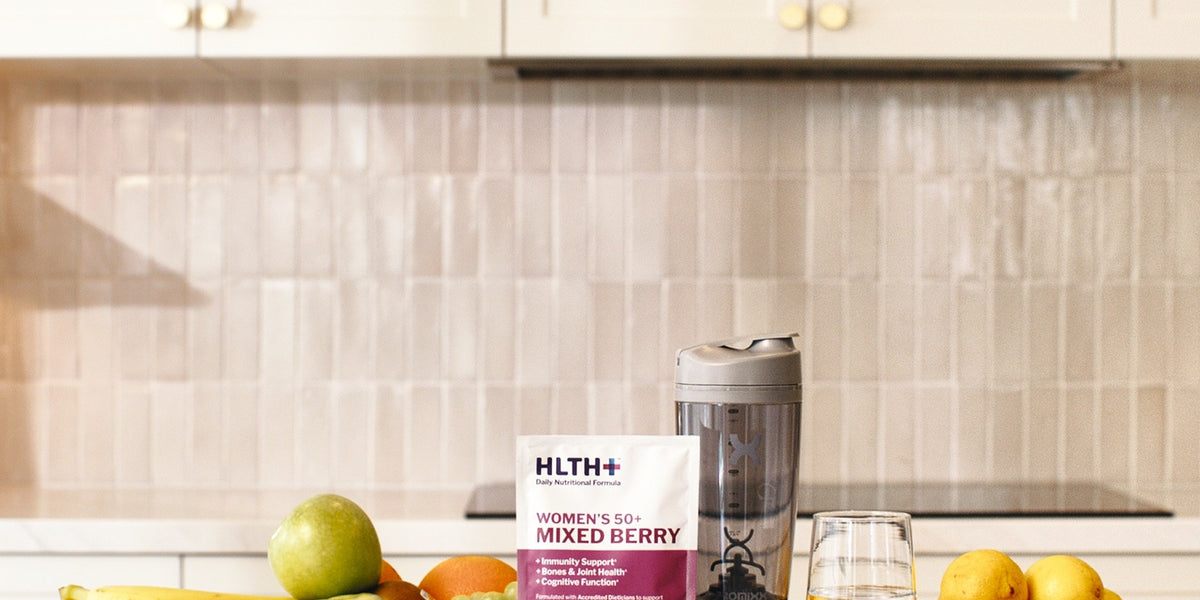
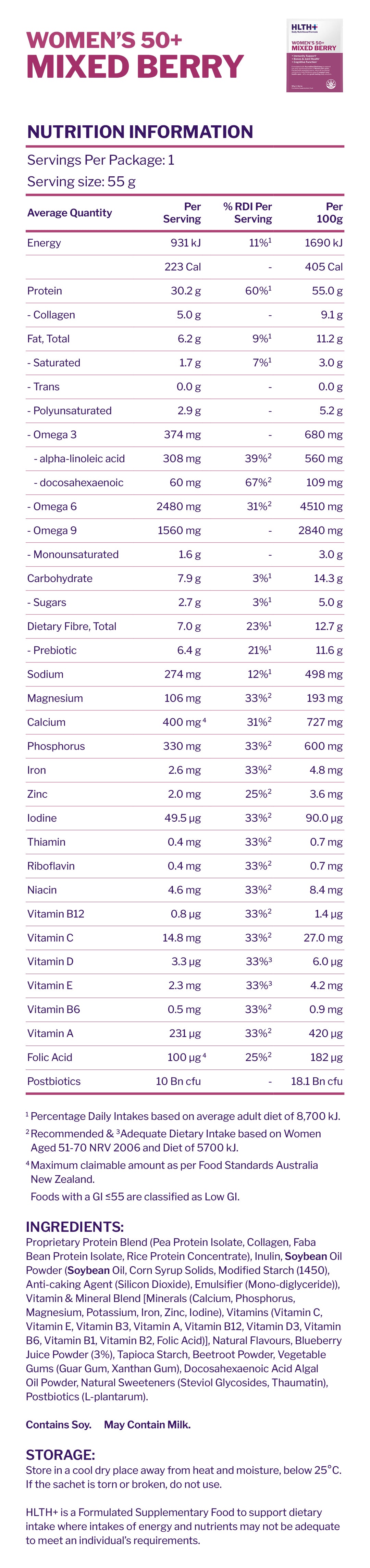
HLTH+ is a Formulated Supplementary Food, not a collagen powder. One 55g sachet (Women's) lists 5g collagen (bovine), with 30g protein per serve, 7g dietary fibre and, across protein, dietary fibre, vitamins, minerals, collagen and DHA, 30 essential daily nutrients. The ✦ Find My Formula quiz shows what your current routine is not giving you: take the 30-second quiz.
The Women's Vanilla panel lists the protein sources as pea protein isolate, collagen, faba bean protein isolate and rice protein concentrate. Over 90% of Australian adults do not meet dietary guidelines (AIHW), so a food-first approach stays the goal, and when calories drop a daily formula is nutritional insurance beside it, not a substitute for eating well. HLTH+ is formulated by Accredited Dietitians to the Nutrient Reference Values, the published government intakes developed by the National Health and Medical Research Council, the Australian Government Department of Health and Ageing and the New Zealand Ministry of Health, and the range runs Women's, Women's 50+, Men's and Men's 50+.
It sells at hlthplus.com at RRP $6.00 per serve, or $5.10 a day on a 28-serve subscription at $142.80, and through Amazon AU and Chemist Warehouse online. For a label read of a brand that sells collagen as its own product, see the Lady Shake Collagen review, and for collagen and protein in one scoop, collagen protein powder.
Which collagen peptides should you choose?
The answer depends on what the collagen is for:
- If collagen is the whole shopping list, choose a bovine or marine peptide powder, and compare grams per serve, source and the allergen line from the table above.
- If you avoid fish or beef, read the source line first; the marine pages checked state "Contains Fish".
- If you want protein, dietary fibre and a balanced multivitamin profile in one sachet, HLTH+ lists 30g protein per serve, 7g dietary fibre and 5g collagen in a 55g sachet (Women's).
Find out what your current stack is not giving you. The 30-second Find My Formula quiz shows the gaps your current products leave.
Frequently Asked Questions
Which is better, peptides or collagen?
They are the same material at different sizes: collagen peptides are collagen broken into short amino acid chains by hydrolysis. The comparison worth making is between products, on grams of collagen per serve, source, the allergen line and what else is in the serve, because peptide, hydrolysed and collagen hydrolysate name the same kind of powder.
Is collagen vegetarian or vegan?
Usually not: Choice says the collagen used in supplements is usually derived from animals, so it is not suitable for many vegetarians or vegans. The sources named on the six Australian pages checked here are bovine (cattle) and marine (fish). Check the source line on the pack; the marine products checked state "Contains Fish".
What does kDa mean on a collagen label?
A kilodalton (kDa) is a unit of molecular mass, so a smaller figure means a shorter peptide chain, and a 2024 review puts hydrolysed collagen at 3 to 6 kDa. Two of the six pages checked print a size (2kDa and less than 2kDa). It describes chain length, not a dose or an effect.
What do type I, II and III mean on a collagen label?
Types are descriptors of the source collagen; a 2024 review counts 28 collagen types and lists I, II and III among the classical fibrillar collagens. Of the Australian pages checked, one describes its marine collagen as type 1 and one its bovine collagen as rich in type 1 and 3; neither ties a type to a gram figure.
How many grams of collagen peptides are in one serve?
It varies by product. Across the six pages checked, it runs from 3g (a marine sachet) to 25g (a bovine powder's panel serve). Neither of the two meta-analyses cited here states one daily dose the trials converged on, so read a gram target as the brand's own recommendation and compare on grams per serve.
This article is general information, not medical advice. Decisions about any medication belong with your doctor. Figures quoted are each brand's published information at the retrieval date shown; check current labels before buying.
Leave a comment
This site is protected by hCaptcha and the hCaptcha Privacy Policy and Terms of Service apply.