


Casein and whey are the two major proteins in cow's milk, and the difference that matters between them is speed. In a 1997 single-meal trial, whey produced a sharp, short rise in blood amino acids while casein held a moderate plateau for longer. Plant protein is neither of those: it contains no dairy at all, and in one trial a pea, rice and canola blend matched whey for post-exercise muscle protein synthesis at a 32g dose.
If you are looking at three tubs, one labelled slow release, one fast and one plant, the labels tell you where the protein came from, not what it will do in your day. Timing, dairy tolerance and cost per gram are what decide it.
Below: what casein is, how its speed compares with whey, what the before-bed trials found, where plant protein sits on amino acids, Australian cost per gram from one brand's own pages, and who each type suits.
What is casein protein, and how is it different from whey?
Casein is the main protein in cow's milk. A 2016 review puts casein at approximately 80% of the total protein in bovine milk (29.5 g/L) and whey protein at about 20% (6.3 g/L), with casein made up mainly of calcium phosphate micelle complexes (Davoodi and colleagues, Iranian Journal of Pharmaceutical Research, 2016). The same review calls casein and whey protein "the major proteins of milk".
Both are milk proteins, so what separates them on the shelf is how each behaves after you swallow it. The Australian casein powder priced further down is sold as micellar casein. Whey protein vs whey isolate covers how whey is filtered into concentrate and isolate, and does whey protein have lactose? follows what that does to the lactose.
Which is healthier, casein or whey?
These trials do not rank either as healthier; they show that the two behave differently, and the behaviour is measurable. In the 1997 trial, healthy adults ate a single meal containing either casein or whey, each labelled with 13C-leucine, and leucine intake was identical in both meals (Boirie and colleagues, Proceedings of the National Academy of Sciences, 1997). Whey caused a dramatic but short increase in plasma amino acids, while casein produced a prolonged plateau of moderately raised blood amino acids, probably because of slow gastric emptying.
What followed from that speed differed too. Postprandial protein synthesis was stimulated by 68% after the whey meal and 31% after the casein meal, whole-body protein breakdown fell 34% after casein but not after whey, and net leucine balance over the seven hours was more positive with casein. It was one meal in healthy adults with whole-body measurements, so it describes speed, not a health ranking.
Milk delivers both together, and a later trial tested that. In a trial that studied 18 healthy participants, phenylalanine from whey and casein taken together appeared at a similar rate at 80 to 120 minutes (0.068 against 0.070% a minute); by 220 to 260 minutes whey's had slowed to 0.039% while casein's held at 0.068% (Soop and colleagues, American Journal of Physiology, Endocrinology and Metabolism, 2012). The Victorian Department of Health also notes that "protein shakes, powders and supplements are unnecessary for most Australians' health needs" (Better Health Channel, Protein), so speed is a tool for a reader who already uses a powder, not a reason to start one.
What is casein protein good for?
The clearest use in the trials below is a dose before sleep, the longest gap most people have between meals. In one trial, 16 healthy young men trained in the evening, had recovery nutrition of 20g protein and 60g carbohydrate, then drank 40g of casein or a placebo 30 minutes before sleep. Whole-body protein synthesis over the 7.5-hour night was higher with casein (311 against 246 micromoles per kilogram), net protein balance was 61 against minus 11, and mixed muscle protein synthesis was about 22% higher, a difference the authors describe as borderline (P = 0.05) (Res and colleagues, Medicine and Science in Sports and Exercise, 2012).
That trial compared casein with a placebo, not with whey, so it does not show casein beating whey. A 2017 trial in 48 older men (mean age 72) gave 40g casein, 20g casein, 20g casein plus leucine or a placebo before sleep; overnight myofibrillar protein synthesis was 0.044% an hour with 40g against 0.033% with placebo (P = 0.02) (Kouw and colleagues, The Journal of Nutrition, 2017). A review of the field notes that recent studies suggest at least 40g of protein is needed for a robust increase in overnight muscle protein synthesis (Trommelen and van Loon, Nutrients, 2016).
A long gap is not only a night-time thing. When calories drop, whether from a deliberate deficit or a reduced appetite, meals can shrink and the gaps between them can stretch.
More on what changes when you eat less →
What are the downsides of casein protein?
The main one is that it is milk. A milk allergy is "an immune reaction to proteins that are found in cow's milk", while lactose is "the main type of sugar found in milk made by mammals", and lactose intolerance is a different condition (healthdirect, Lactose intolerance, last reviewed December 2024). Casein and whey are both proteins found in cow's milk, so both sit on the allergy side of that line; whether either is safe for a diagnosed allergy is a question for a doctor or an allergy specialist.
Australian labels make this easy to check. Milk must be declared in bold in the ingredient list and again in a bolded "contains" statement (FSANZ, Allergen labelling for consumers, plain English rules from 25 February 2024). Bulk Nutrients' Micellar Casein page reads "Contains Dairy", its Whey Protein Isolate page "Contains: Milk" and its Earth Protein page "None" (retrieved 29 September 2026).
Lactose is where the panel matters. The whey isolate page states "approximately 0.3 grams per serve", while the casein page publishes no lactose figure and does not mark the powder lactose free, so a reader with lactose intolerance should ask the brand rather than assume; does whey protein have lactose? covers the whey side. This is general information, not medical advice; decisions about a diagnosed allergy or intolerance belong with your doctor.
Where does plant protein fit next to casein and whey?
Plant protein sits outside the milk comparison, and its questions are amino acids and how a blend performs. The Better Health Channel says 9 amino acids are ones your body cannot make, that animal products, dairy products included, "have large amounts of all of the essential amino acids and are known as high-quality protein", and that plant proteins "contain all of the essential amino acids, but the amounts of one or two of these amino acids may be low" (Better Health Channel, Protein, reviewed July 2024). Casein and whey are both dairy proteins, so they share the first description.
The same page's answer to that gap is variety across plant foods: a meal containing cereals and legumes, "such as baked beans on toast, provides all the essential amino acids found in a typical meat dish". In a direct test, ten resistance-trained adults had 32g of protein from whey or from a pea, brown rice and canola blend after leg exercise. Plasma essential amino acid availability over four hours was about 44% higher on whey, yet muscle protein synthesis did not differ between them: 0.085% an hour on whey against 0.080% on the blend over the first two hours, and 0.085% against 0.086% over the next two (Van der Heijden and colleagues, Medicine and Science in Sports and Exercise, 2024).
That trial did not include casein, so no measured casein against plant comparison is printed here. Plant protein vs whey and pea protein vs whey run the plant side in full, complete protein explains how completeness is scored, and amino acids explained covers the nine.
Which costs less per gram of protein: casein, whey or plant?
On one Australian manufacturer's published pages, plant was cheapest per gram of protein, casein sat in the middle and whey isolate was dearest. One brand, one flavour (chocolate), one pack size and one retrieval day keep it like for like.
| Whey protein isolate | Micellar casein | Pea, fava bean and rice blend | |
|---|---|---|---|
| Source | Cow's milk whey | Cow's milk casein | Pea, fava bean and rice |
| Digestion pattern in the trials above | Fast: short, sharp rise in plasma amino acids (Boirie 1997) | Slow: prolonged moderate plateau (Boirie 1997; Soop 2012) | One trial of a different blend (pea, rice, canola): whey's plasma essential amino acid availability was ~44% higher over 4 hours (Van der Heijden 2024) |
| Protein per 30g serve | 25.5g | 23g | 22.2g |
| Protein per 100g | 85.0g | 77g | 74.1g |
| Price, 1kg (33 serves) | $79.00 | $50.00 | $42.00 |
| Price per serve | $2.39 | $1.52 | $1.27 |
| Cost per gram of protein | 9.4 cents | 6.6 cents | 5.7 cents |
| Allergen line on the page | Contains: Milk | Contains Dairy | None |
| Sweetener on the ingredient list | Sucralose | Sucralose | Stevia and thaumatin |
Figures are Bulk Nutrients' own published nutrition panels and prices for its Whey Protein Isolate, Micellar Casein Protein and Earth Protein, chocolate flavour, single 1kg bags, retrieved 29 September 2026. All three pages list lower per-bag prices on multi-bag orders, so single 1kg bags are used for all three; brands reformulate and change prices, so check the current listing.
The arithmetic: $79.00 divided by 33 serves is $2.39 a serve, divided by 25.5g of protein is 9.4 cents a gram; $50.00 divided by 33 is $1.52, divided by 23g is 6.6 cents; $42.00 divided by 33 is $1.27, divided by 22.2g is 5.7 cents. Plant-based protein powder runs the same kind of sums across more plant products.
Which one suits which reader?
- You want a fast dose around a session. Whey, on the trial evidence: it produced the sharper, shorter rise in plasma amino acids, and best whey protein in Australia ranks the options on the label.
- You have a long gap without food, or a protein dose before sleep. Casein, the protein used in the before-bed trials above and the one that held blood amino acids up for longer.
- You want both patterns in one drink. Milk delivers them together, and the 2012 trial found similar early absorption and a more sustained casein tail.
- You avoid dairy. A plant blend; check the allergen line, because casein and whey are both proteins found in cow's milk.
- Cost per gram decides it. On the one-brand arithmetic above, plant then casein then whey isolate.
- You want the serve to do more than protein. None of the three is built for that; the next section covers it.
How HLTH+ compares
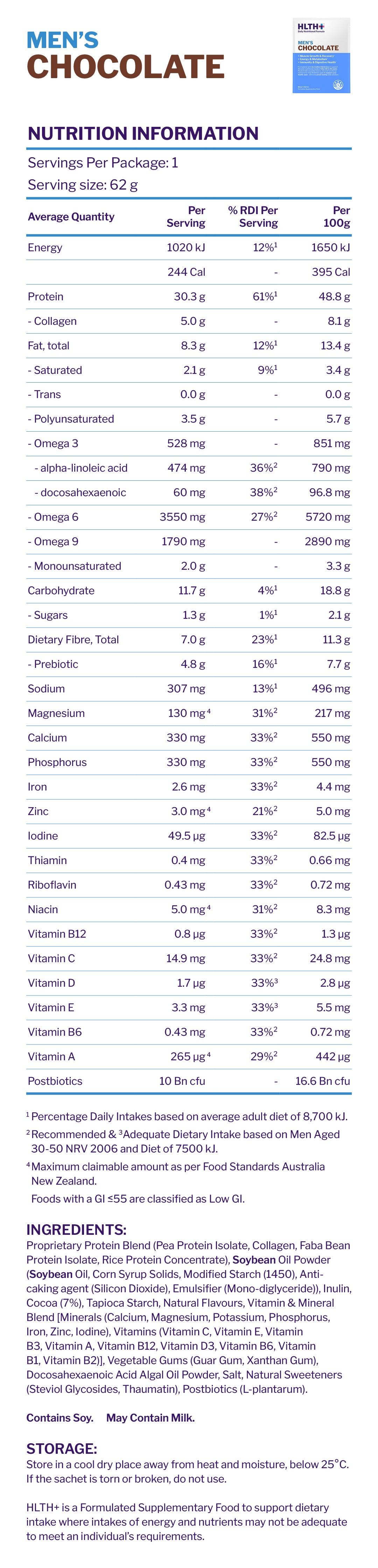
Casein, whey and plant powders are single-job products: protein, and the trials above are about how quickly it arrives. HLTH+ is a dairy-free Formulated Supplementary Food that puts 30g protein per serve, 7g dietary fibre and 30 essential daily nutrients into one 55g Women's sachet. The ✦ Find My Formula quiz shows what your current routine is not giving you.
Which should you pick? A verdict by reader type
If what you want is a slow-release milk protein for a long gap, casein is that product. If you want a fast milk protein around training, whey is that product, and if you avoid dairy, a plant blend is. If you want protein, dietary fibre and a balanced multivitamin profile in one sachet, that is HLTH+.
The starting point for most people is already thin: over 90% of Australian adults do not meet dietary guidelines on the Australian Institute of Health and Welfare's poor-diet measure. HLTH+ carries 30g protein per serve, and under Schedule 4 of the Food Standards Code, protein contributes to the maintenance of muscle mass, as part of a healthy diet involving a variety of foods. It is built to sit beside meals.
HLTH+ is dairy-free, so lactose-free, and gluten-free; allergen line: contains soy. The Women's Vanilla panel lists its protein blend as pea protein isolate, collagen, faba bean protein isolate and rice protein concentrate, so part of the 30g protein comes from collagen.
One 55g Women's sachet also carries 7g dietary fibre, 5g collagen and 60mg DHA, with no added sugar. It is published as Women's, Women's 50+, Men's and Men's 50+, each formulated by Accredited Dietitians to the Nutrient Reference Values, the intakes published in 2006 by the National Health and Medical Research Council, the Australian Government Department of Health and Ageing and the New Zealand Ministry of Health.
It is Australian made in facilities complying with Good Manufacturing Practice and sells at hlthplus.com at RRP $6.00, or $5.10 a day on a 28-serve subscription at $142.80, plus Amazon AU and Chemist Warehouse online.
See what your current stack is missing. The 30-second ✦ Find My Formula quiz is diagnostic: it shows what the tubs already in your cupboard are not giving you.
Frequently Asked Questions
Is casein a complete protein?
The Victorian Department of Health says animal products, dairy products included, have large amounts of all of the essential amino acids and are known as high-quality protein. Casein is one of the two main proteins of cow's milk, so it falls under that description. Plant proteins contain all of them too, though one or two may be low.
Can you take casein and whey together?
Milk supplies them together. In a trial that studied 18 healthy participants, labelled whey and casein taken together showed similar early absorption, but by 220 to 260 minutes whey's rate had slowed to 0.039% a minute while casein's held at 0.068%. On that result, a mixed powder gives both patterns in one drink.
Does casein protein contain lactose?
Casein is a protein; lactose is the sugar in milk. Whether a powder carries any is a label question. One Australian brand's whey isolate page states about 0.3g lactose per serve, while its casein page publishes no lactose figure and does not mark the powder lactose free, so ask the brand before assuming.
How much does casein protein cost per gram in Australia?
On Bulk Nutrients' own chocolate pages retrieved 29 September 2026, micellar casein at $50.00 for 1kg gave $1.52 a 30g serve with 23g protein, or 6.6 cents a gram. The same brand's whey isolate came to 9.4 cents and its pea, fava bean and rice blend to 5.7 cents.
Leave a comment
This site is protected by hCaptcha and the hCaptcha Privacy Policy and Terms of Service apply.