


Either side of the workout is fine. A 2013 meta-analysis of randomised trials found that once it controlled for covariates, protein timed around training showed no significant advantage for muscle size or strength, and a later 10-week trial in 21 resistance-trained men found 25 g of protein immediately before or immediately after training produced similar results on every measure.
You are probably deciding whether the half-hour rule you heard in the change room is real, and whether a shake at the wrong moment wastes the serve. The research gives a much wider answer than the rule does.
Below: what the trials found, when timing does start to matter, how much protein per serve the sports-nutrition position stands set, and where a Formulated Supplementary Food fits if you train early and eat less.
Is it better to take protein before or after a workout?
The most direct test is a 2017 trial in PeerJ. Twenty-one resistance-trained men completed it, each taking a supplement of 25 g protein and 1 g carbohydrate either immediately before or immediately after every session, across three total-body sessions a week on non-consecutive days for 10 weeks (Schoenfeld and colleagues, PeerJ, 2017).
Before and after had similar effects on every measure studied: strength, muscle size and body composition. The authors wrote that the findings "refute the contention of a narrow post-exercise anabolic window" and suggest the interval for protein intake "may be as wide as several hours or perhaps more after a training bout depending on when the pre-workout meal was consumed."
It is a small trial with one dose, so it is read alongside the larger pooled analysis below. The International Society of Sports Nutrition's position stand on protein and exercise lands in the same place: the best time to ingest protein "is likely a matter of individual tolerance, since benefits are derived from pre- or post-workout ingestion" (Jäger and colleagues, Journal of the International Society of Sports Nutrition, 2017).
For the food either side of a session, see what to eat before a workout and what to eat after a workout.
What did the pooled analysis of timing trials find?
Schoenfeld, Aragon and Krieger pooled randomised trials of protein timing in a 2013 meta-regression: 23 studies and 525 subjects for muscle size, and 20 studies and 478 subjects for strength (Journal of the International Society of Sports Nutrition, 2013). A simple pooled analysis showed a small to moderate effect of timing on muscle size and no significant effect on strength.
Then the authors controlled for covariates, and the timing effect went. In the full model there were no significant differences between treatment and control for strength or muscle size, and total protein intake was the strongest predictor of how large the effect on muscle size was.
| Analysis | Result |
|---|---|
| Strength, simple pooled analysis (20 studies, 478 subjects) | No significant effect |
| Muscle size, simple pooled analysis (23 studies, 525 subjects) | Small to moderate effect |
| Strength, full model controlling for all covariates | No significant difference |
| Muscle size, full model controlling for all covariates | No significant difference |
| Strongest predictor of the muscle size effect | Total protein intake |
Why would a timing effect appear and then vanish? Aragon and Schoenfeld point out that most chronic timing studies did not match total protein intake between the groups, so it is not possible to tell whether better results came from timing or "simply by a greater protein intake overall" (Aragon and Schoenfeld, 2013). Total protein is the lever, and how much protein to build muscle covers the number.
Is the anabolic window real?
Not as it was sold. Aragon and Schoenfeld reviewed the evidence and concluded that support for an "anabolic window of opportunity" is "far from definitive", because the idea rests largely on the assumption that you train fasted (Aragon and Schoenfeld, 2013).
If you have eaten beforehand, that meal keeps working (the meal before a workout is where it starts). In the work they review, 20 g of whey taken immediately before resistance exercise raised muscular uptake of amino acids to 4.4 times resting levels during exercise, and it did not return to baseline until three hours after. Their conclusion was that immediate post-exercise protein "seems redundant" for limiting breakdown in that situation, and that the next scheduled protein-rich meal "is likely sufficient".
Their practical rule is generous: pre-exercise and post-exercise meals should not be separated by more than about three to four hours, for a typical resistance session lasting 45 to 90 minutes. The position stands also report that muscle stays sensitised to protein for at least 24 hours after a session (Jäger and colleagues, 2017), which is a long time next to a 30 minute window. For the food side of the meal after a session, see what to eat after a workout.
When does protein timing matter more?
In a few specific situations, and the researchers say so. This table sets each one against what the review or position stand actually states.
| Your situation | What the source says | Source |
|---|---|---|
| You ate a protein-containing meal before training | Immediate post-exercise protein "seems redundant"; the next scheduled protein-rich meal "is likely sufficient" | Aragon and Schoenfeld, 2013 |
| You train after an overnight fast | Muscle protein breakdown rises during fasted exercise, so "it would make sense to provide immediate nutritional intervention", ideally protein with carbohydrate | Aragon and Schoenfeld, 2013 |
| Your last meal was more than three to four hours before you started | The classical advice to eat at least 25 g of protein as soon as possible "seems warranted" | Aragon and Schoenfeld, 2013 |
| You already eat about 1.6 g/kg a day or more | The benefits of timing around the session "seem to be lessened" | Jäger and colleagues, 2017 |
| You are an older adult | In young men 20 g of whole egg protein maximally stimulated muscle protein synthesis after exercise; in elderly subjects, 40 g of whey gave greater increases than 20 g | Aragon and Schoenfeld, 2013 |
None of this makes eating protein soon after training a mistake. The nutrient timing position stand calls the pragmatic recommendation "to feed as soon as possible after a workout", and says that when a strategy may help or be neutral and fits your schedule, it is worth using (Kerksick and colleagues, 2017).
Learn more about protein and muscle when you are eating less: nutrition support for muscle.
How much protein should you have in one serve?
The same two position stands answer the serve-size question. The protein stand gives 0.25 g of a high-quality protein per kilogram of body weight, or an absolute dose of 20 to 40 g, evenly distributed every three to four hours across the day. The nutrient timing stand gives 20 to 40 g (0.25 to 0.40 g/kg per dose) on the same schedule and says meeting total daily protein, with evenly spaced feedings, "should be viewed as a primary area of emphasis" for people who exercise.
| Body weight | 0.25 g/kg per serve | 0.40 g/kg per serve |
|---|---|---|
| 60 kg | 15 g | 24 g |
| 75 kg | 18.75 g | 30 g |
| 90 kg | 22.5 g | 36 g |
That table is arithmetic on the published g/kg range; the stands also give the absolute 20 to 40 g.
Spread matters on its own. In a seven-day crossover feeding study of eight adults, an even split of about 30 g of protein at breakfast, lunch and dinner (31.5, 29.9 and 32.7 g) produced a 24-hour muscle protein synthesis rate 25% higher than a skewed split (10.7, 16.0 and 63.4 g) on diets matched for energy and protein (Mamerow and colleagues, Journal of Nutrition, 2014).
Put together, the practical frame is a daily total, taken in serves of 20 to 40 g, spaced through the day, with one of those serves landing somewhere in the few hours around training. How high the daily total should sit is worked through in how much protein to build muscle, and what makes a protein high quality is covered in complete protein.
Is a protein shake before or after a workout any different?
Not on the evidence. The 2017 trial above used a protein supplement, but the protein position stand notes that intact proteins, "such as egg, whey, casein, beef, soy and even whole milk", can evoke an anabolic response similar to or greater than free amino acids when essential amino acid amounts are equal (Jäger and colleagues, 2017).
So a shake is one way to deliver a serve and food is another. The nutrient timing stand's closing advice is to follow whatever strategy "offers the most convenience or compliance" (Kerksick and colleagues, 2017). If you are choosing a shake, best protein shakes in Australia compares what is on the labels.
Tolerance is the one practical limit. The Better Health Channel notes that a meal high in fat, protein or dietary fibre just before exercise is likely to increase the risk of digestive discomfort, and recommends carbohydrate-led food in that last stretch (Better Health Channel, Sporting performance and food). That is a tolerance point, not a timing rule: if a shake sits badly before training, have it after, which the 2017 trial found worked similarly.
If the reason you are asking is soreness rather than muscle size, that is a separate question with its own evidence, covered in sore muscles after exercise.
What if you train early and are eating less?
A smaller appetite turns the timing question from academic into practical. When calories drop, whether alongside rapid weight loss, reduced eating and medically induced weight loss or a planned deficit, fewer full meals get finished, and a 6 am session can leave little room for a protein serve before or after.
In one placebo-controlled crossover trial of 30 adults, a GLP-1 medicine lowered total calorie intake across the day's ad libitum meals by 24% compared with placebo (Blundell and colleagues, Diabetes, Obesity and Metabolism, 2017). That is a general figure about eating in a trial, not a statement about any one person.
The per-serve figures above do not shrink with the appetite. For resistance-trained people in a calorie deficit, the protein stand notes that higher intakes of 2.3 to 3.1 g/kg a day "may be needed to maximize the retention of lean body mass" during hypocaloric periods (Jäger and colleagues, 2017).
This is general information, not medical advice, and decisions about any medication belong with your doctor. For the pre-session side of a small appetite, what to eat before a workout covers small, carbohydrate-led options.
Where does a daily formula fit around training?
Whole food reaches every number on this page, and the protein position stand says active people can meet their daily protein through whole foods. The harder part is the daily pattern: over 90% of Australian adults do not meet dietary guidelines (AIHW), and we believe in a food-first approach that the statistics say is not doing the job alone, which is what nutritional insurance means.
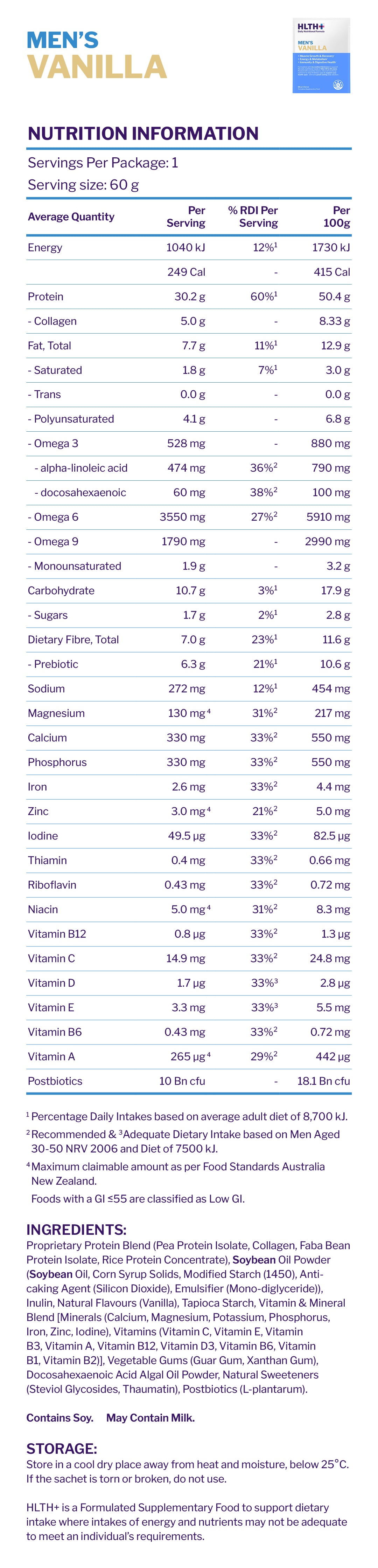
HLTH+ is a Formulated Supplementary Food. One 55g Women's sachet carries 30g protein per serve and 7g dietary fibre, at RRP $6.00.
Protein contributes to the maintenance and growth of muscle mass, as part of a healthy diet involving a variety of foods. The position stands set their 20 to 40 g range for high-quality protein, so read any protein label for its sources as well as its grams.
Because a sachet carries 7g dietary fibre, it fits the meal a few hours before a session or the hours after it, rather than the final hour, which matches the Better Health Channel's advice on fibre close to exercise. It is not designed as a meal replacement, because it is built to complement a food-first approach; it works fine as a healthy snack or to tie you over between a morning session and your next proper meal.
HLTH+ is published as Women's, Women's 50+, Men's and Men's 50+, each formulated by Accredited Dietitians to the Nutrient Reference Values, the intakes published in 2006 by the National Health and Medical Research Council, the Australian Government Department of Health and Ageing and the New Zealand Ministry of Health. The ✦ Find My Formula quiz shows what your current routine is not giving you (take the quiz).
If your meals already put 20 to 40 g of protein around your training, keep eating that way. If you train early and a full meal is not on the cards, or you want protein, dietary fibre and a balanced multivitamin profile in one sachet, that is where HLTH+ fits. It sells at hlthplus.com, on Amazon AU and through Chemist Warehouse online.
Find out what your current stack is missing. The ✦ Find My Formula quiz takes about 30 seconds and shows the gaps your existing bottles are leaving. Take the quiz.
Frequently Asked Questions
What is the best time to take protein?
There is no single best minute. A 2013 meta-analysis found no significant timing effect once covariates were controlled, and total protein intake was the strongest predictor of muscle size gains. Aim for 20 to 40 g serves every three to four hours across the day, with one serve landing in the hours around training.
Do I have to have protein within 30 minutes of a workout?
No. A 10-week trial found 25 g of protein immediately before or immediately after training gave similar results, and the authors suggest the interval may be as wide as several hours. If you trained fasted or ate more than three to four hours earlier, eating protein soon after is still sensible.
Is it okay to take protein before a workout on an empty stomach?
It is a tolerance question. The protein position stand says the best timing is likely a matter of individual tolerance, since benefits come from pre- or post-workout intake. The Better Health Channel notes meals high in protein just before exercise may raise digestive discomfort risk, so having it after instead is a reasonable swap.
How long are muscles sensitive to protein after training?
At least 24 hours, according to the International Society of Sports Nutrition position stands, though the effect likely diminishes the longer after the session you wait. The protein position stand, summarising a review, says sensitivity might be greatest in the first five to six hours, so a serve in the hours around training is a sensible habit.


Leave a comment
This site is protected by hCaptcha and the hCaptcha Privacy Policy and Terms of Service apply.