

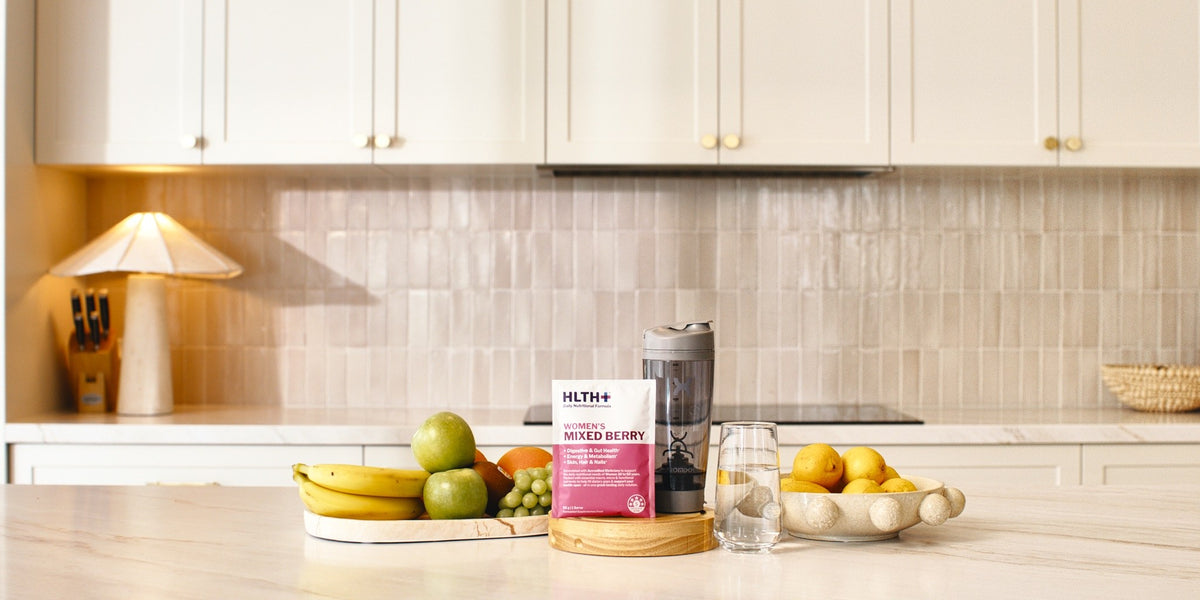
Protein ice cream gets its protein from the base you blend and freeze, never from the toppings. Regular vanilla ice cream holds 2.0g of protein per 100g; a base built on a HLTH+ sachet (30g protein per serve) or on 150g of cottage cheese (25.5g) holds 7.7g to 15.9g per 100g in the three recipes below.
A protein figure with no working is only a guess, and a batch that freezes into an icy block is a freezing problem you can fix, not a failure on your part.
Below are three recipes with the protein and sugars sums shown, then the texture fixes that work on all three.
What ice cream is high in protein?
Standard ice cream is not. The Australian Food Composition Database (AFCD, Release 3.0, Food Standards Australia New Zealand, retrieved 6 October 2026) lists 2.0g of protein per 100g for regular vanilla ice cream and 2.0g for the premium version.
Each row takes the database's per-100g value and scales it to the amount in the recipe; the HLTH+ row is the label's 30g of protein per serve. Milk and soy beverage go in at 1mL to 1g, a small undercount because the database gives both a density just above water's, and totals are added before rounding, so a total may differ by 0.1g from its rounded parts. The database has no Greek yoghurt entry, so the recipes use its natural yoghurt entry; swap your own tub's label figure in and the sum still works.
| Ingredient | Serve | Protein per serve |
|---|---|---|
| HLTH+ sachet (Women's, label figure) | 1 sachet, 55g | 30g |
| Cottage cheese | 150g | 25.5g |
| Natural yoghurt, regular fat | 100g | 5.3g |
| Peanut butter, no added sugar or salt | 20g | 4.86g |
| Soy beverage, regular fat, added calcium | 100mL | 3.8g |
| Reduced-fat milk (about 1% fat) | 100mL | 3.5g |
| Frozen banana | 150g | 2.1g |
| Frozen mango | 100g | 0.4g |
| Frozen mixed berries | 80g | 0.48g |
| Regular vanilla ice cream | 100g | 2.0g |
Fruit adds little: 150g of frozen banana is 2.1g. The same arithmetic runs through protein smoothie recipes and high-protein snacks.
How do you make protein ice cream in a blender and a freezer?
This is the no-machine method: blend a base, freeze it flat, then blend it again. It uses a Chocolate sachet, yoghurt, milk and peanut butter, and makes one serve of 275g. It contains dairy and peanuts.
Ingredients: 1 HLTH+ Chocolate sachet (55g), 100g natural yoghurt, 100mL reduced-fat milk, 20g peanut butter.
- Blend everything until completely smooth, then pour it into a shallow freezer container so it freezes in a thin layer.
- Freeze until solid all the way through; overnight is the safe choice.
- Break the block into chunks and blend again with a splash of milk until thick and creamy, scraping down as you go.
- Eat it soft, or return it to the freezer to firm up before scooping.
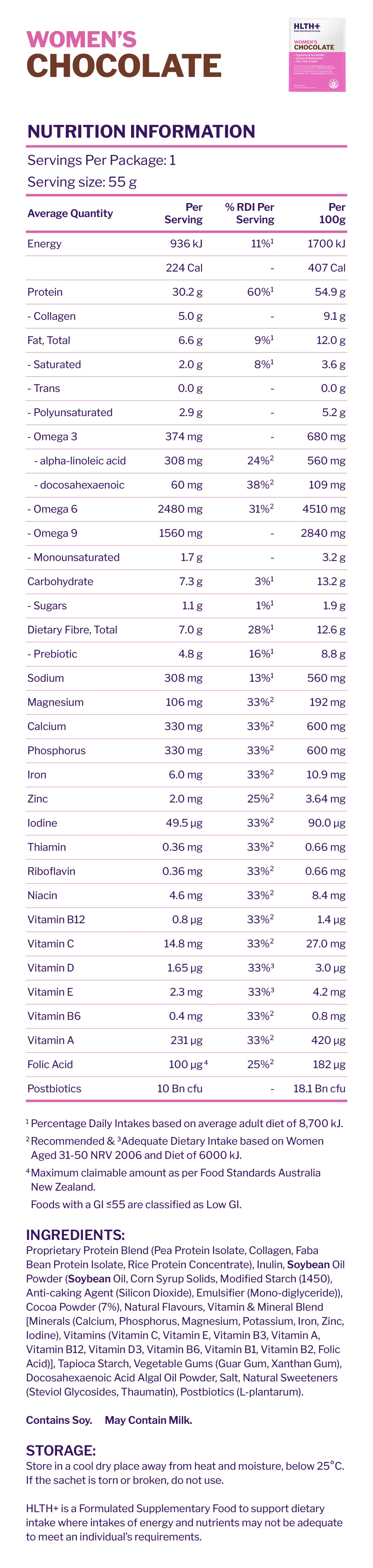
Protein per serve: 30g (sachet) + 5.3g (yoghurt) + 3.5g (milk) + 4.86g (peanut butter) = 43.7g.
Sugars per serve: 1.5g (Women's sachet) + 5.1g (yoghurt) + 5.0g (milk) + 1.04g (peanut butter) = 12.6g total.
Dairy-free version: swap the yoghurt for 100g of soy-based yoghurt (3.8g protein) and the milk for 100mL of soy beverage (3.8g). The protein sum becomes 30g + 3.8g + 3.8g + 4.86g = 42.5g, and the sugars sum 1.5g + 8.7g + 2.7g + 1.04g = 13.9g total, of which 9.9g is added sugars in the two soy entries (the database's soy yoghurt is vanilla flavoured).
The main recipe uses no sugar or syrup as an ingredient, and the sachet is sweetened without artificial sweeteners. To read the label of any other powder, protein powder without artificial sweeteners shows what to look for. A Men's sachet is also 30g of protein per serve, with 1.7g of sugars, so each sugars total here rises by 0.2g.
How do you make protein ice cream from frozen bananas?
Frozen banana blends into a thick, soft base without any churning. This version adds a Mixed Berry sachet and a splash of soy beverage, contains no dairy ingredient, and makes one serve of 385g.
Ingredients: 1 HLTH+ Mixed Berry sachet (55g), 150g frozen banana pieces, 80g frozen mixed berries, 100mL soy beverage.
- Slice ripe bananas and freeze the pieces flat on a tray until solid, so they do not freeze into one lump.
- Put the soy beverage and sachet in a food processor or high-powered blender, then add the frozen banana and berries.
- Blend in short bursts, scraping down the sides, until it looks like soft serve.
- Eat it straight away, or freeze it briefly so it holds a scoop.
Protein per serve: 30g (sachet) + 2.1g (banana) + 0.48g (mixed berries) + 3.8g (soy beverage) = 36.4g.
Sugars per serve: 1.5g (Women's sachet) + 20.55g (banana) + 7.36g (mixed berries) + 2.7g (soy beverage) = 32.1g total. The fruit supplies 27.9g of it, and 1.8g is added sugars in the soy entry.
Allergen line: HLTH+ contains soy. For a dairy-free drink rather than a frozen dessert, dairy-free protein shakes compares the options.
Eating less than you used to? Learn more about what changes nutritionally when you eat less →
How do you make protein ice cream in a Ninja CREAMi?
A Ninja CREAMi-style machine spins a solid-frozen pint into ice cream, so the work is in the base. This recipe uses no sachet and no powder: cottage cheese, yoghurt, milk and frozen mango, blended smooth, frozen in the pint container, then spun. It contains dairy and makes one batch of 450g, so check your machine's fill line before you pour.
Ingredients: 150g cottage cheese, 100g natural yoghurt, 100mL reduced-fat milk, 100g frozen mango.
- Blend everything until completely smooth; any cottage cheese curds that survive the blender survive the freezer.
- Pour into the pint container up to the machine's fill line, then freeze it level for the time your manual gives.
- Process it on the setting your manual gives for ice cream.
- If the result is powdery or crumbly, add a splash of milk and process it again as your manual directs.
Protein per batch: 25.5g (cottage cheese) + 5.3g (yoghurt) + 3.5g (milk) + 0.4g (mango) = 34.7g.
Sugars per batch: 2.7g (cottage cheese) + 5.1g (yoghurt) + 5.0g (milk) + 12.4g (mango) = 25.2g total, and the mango supplies 12.4g of it. Half a batch carries half of each figure.
No machine? Freeze the same base in a shallow tray and blend it again, as in the first recipe. Whether you need a powder at all is the subject of do I need protein powder, and the answer here is that this batch reaches 34.7g without one.
Why is homemade protein ice cream icy, and how do you fix it?
Much of a homemade ice cream base is water, which freezes into crystals, and an icy texture means those crystals are large. A 2025 review in Comprehensive Reviews in Food Science and Food Safety reports that lower total solids increase ice phase volume and ice crystal size, and that sugars, milk minerals and other dissolved solids lower the freezing point (Wu and colleagues, 2025).
A 2026 paper in the Journal of Food Science adds that temperature fluctuations accelerate recrystallisation and the growth of ice crystals, resulting in an icy texture (VanWees and colleagues, 2026). The same paper found that the source of dairy protein influenced the structure of the ice, air, fat and serum phases in high-protein frozen desserts, and casein vs whey vs plant protein covers how those proteins differ.
The fixes below are cooking craft built on those findings.
- Start with a thicker base. In the database, reduced-fat milk is 93.3g water per 100g, natural yoghurt 84.6g and cottage cheese 75.4g, so a thicker base starts with less water to freeze.
- Add fat. Regular-fat milk has 3.5g fat per 100g against 1.2g in reduced-fat, and 20g of peanut butter adds about 10.9g of fat (54.3g per 100g).
- Let sugar help. A mix with more dissolved sugar holds less ice at freezer temperature, so the sugars from the fruit count, and a base with little, such as plain cottage cheese and yoghurt alone, holds more ice.
- Blend again after freezing. Commercial freezers whip air in while they freeze, and the second blend, or the machine's spin, is the home kitchen's closest equivalent.
- Keep it cold and steady. Freeze at the back of the freezer, make small batches, and do not let it melt and refreeze, since temperature swings grow the crystals.
How do the recipes compare with regular ice cream?
Per 100g, the recipes carry 3.9 to 7.9 times the protein of regular vanilla ice cream in the database.
| Batch weight | Protein per 100g | Protein per batch | Total sugars per 100g | Total sugars per batch | |
|---|---|---|---|---|---|
| Regular vanilla ice cream (AFCD) | 100g | 2.0g | 2.0g | 10.1g | 10.1g |
| 1. Chocolate, blender and freezer (sachet) | 275g | 15.9g | 43.7g | 4.6g | 12.6g |
| 2. Frozen banana and Mixed Berry (sachet) | 385g | 9.4g | 36.4g | 8.3g | 32.1g |
| 3. Cottage cheese and mango pint (no sachet) | 450g | 7.7g | 34.7g | 5.6g | 25.2g |
The database lists 7.2g of the ice cream's 10.1g sugars as added sugars. On a shop tub, the Food Standards Code lets a protein claim stand at 5g of protein per serving and "good source" at 10g per serving (Schedule 4, section S4-3), so read the serving size as well as the claim. For a powder instead of a tub, see the best protein powder in Australia.
What changes when you eat less than you used to?
Over 90% of Australian adults do not meet dietary guidelines, on the AIHW poor-diet measure. When calories drop, whether from illness, age, a smaller appetite or the rapid weight loss, reduced eating and medically induced weight loss some people are going through, there is less food to deliver each nutrient in the first place.
Some people eating less are on prescribed GLP-1 medications. The arithmetic on this page is the same for anyone whose appetite has dropped: a small serve reaches a protein number only if its ingredients are dense.
This page is general information, not medical advice, and decisions about any medication belong with your doctor.
Where does a HLTH+ sachet fit among these recipes?
A HLTH+ sachet carries 30g of protein per serve, 7g of dietary fibre and 30 essential daily nutrients in 55g (Women's), made in Australia in facilities that comply with Good Manufacturing Practice. HLTH+ comes as Women's, Women's 50+, Men's and Men's 50+, each formulated by Accredited Dietitians to the Nutrient Reference Values published in 2006 by the National Health and Medical Research Council, the Australian Government Department of Health and Ageing and the New Zealand Ministry of Health. The ✦ Find My Formula quiz shows what your current routine is not giving you.
Which recipe suits which reader:
- You want protein from whole foods and nothing else in the pint: recipe 3, which reaches 34.7g from cottage cheese, yoghurt, milk and mango.
- You want protein, dietary fibre and a balanced multivitamin profile in one sachet: HLTH+, in recipes 1 and 2.
- You avoid dairy: recipe 2 uses none, and HLTH+ is dairy-free and gluten-free. Allergen line: contains soy.
HLTH+ is a Formulated Supplementary Food. It sells at hlthplus.com at RRP $6.00, or $5.10 a day on a 28-serve subscription, and through Amazon AU and Chemist Warehouse online. For the wider field, see the best protein shakes in Australia.
HLTH+ is not designed as a meal replacement because it complements a food-first approach; but it works fine as a healthy snack or to tie you over.
The same arithmetic earlier in the day is in protein pancakes and breakfast smoothie.
See what your current routine is missing. The 30-second ✦ Find My Formula quiz is diagnostic: it shows the gaps your existing tubs and bottles leave, so you know what you are missing before you buy anything.
Frequently Asked Questions
Can you make protein ice cream without a Ninja CREAMi?
Yes. The first two recipes need only a blender or food processor and a freezer: blend a base, freeze it flat and blend it again, or blitz frozen banana and berries straight into soft serve. Only the third recipe is written for the machine, and it also works frozen in a tray and re-blended.
Can you make protein ice cream without protein powder?
Yes: recipe 3 uses no powder. The Australian Food Composition Database lists 25.5g of protein in 150g of cottage cheese, and with natural yoghurt, milk and frozen mango the batch reaches 34.7g. Blend it completely smooth before freezing so no curds survive.
Can you make dairy-free protein ice cream?
Yes. Recipe 2 blends frozen banana, frozen mixed berries, soy beverage and a HLTH+ Mixed Berry sachet for 36.4g of protein, and recipe 1 has a dairy-free swap that reaches 42.5g. HLTH+ is dairy-free and gluten-free; allergen line: contains soy.
How much protein is in regular vanilla ice cream?
The Australian Food Composition Database lists 2.0g of protein per 100g for regular vanilla ice cream, and 2.0g for the premium version. The three recipes here hold 7.7g to 15.9g per 100g. A shop tub can carry a protein claim at 5g per serving and "good source" at 10g.
Can you put a HLTH+ sachet in ice cream?
Yes: recipes 1 and 2 use a Chocolate and a Mixed Berry sachet. Each sachet carries 30g of protein per serve, so a recipe's total is 30g plus the database figure for everything else that goes in. The sachet is dairy-free, so the dairy in recipe 1 is only the yoghurt and milk.

Leave a comment
This site is protected by hCaptcha and the hCaptcha Privacy Policy and Terms of Service apply.