
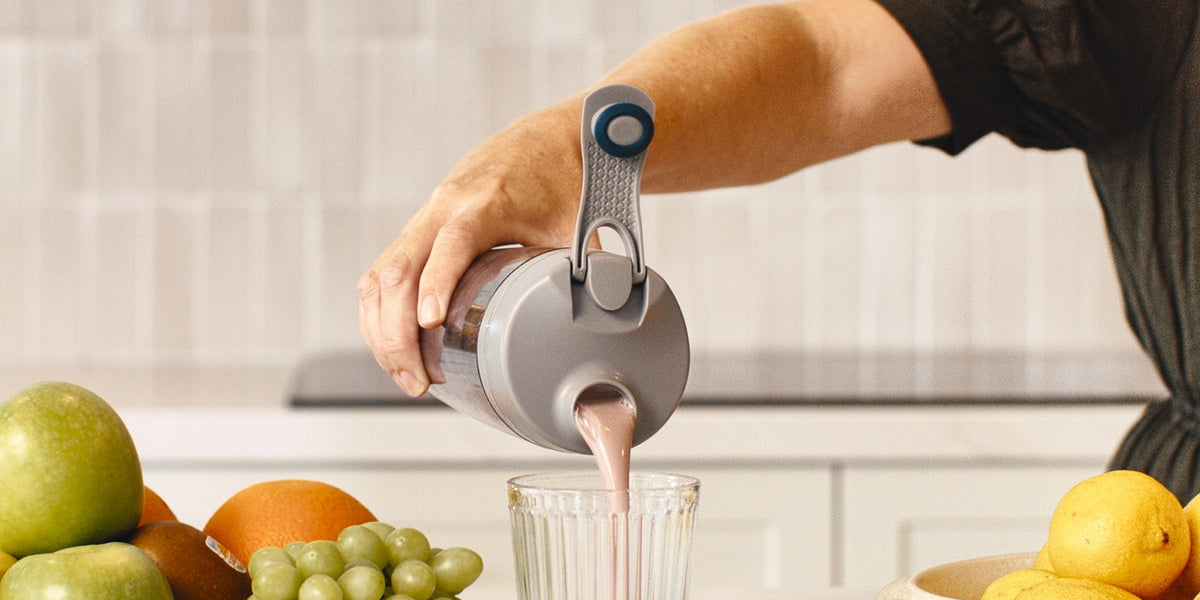
A smoothie is a breakfast when one glass carries protein, dietary fibre and a slow carbohydrate, not just fruit and ice. A HLTH+ sachet supplies the first two in one serve, at 30g of protein and 7g of dietary fibre, and rolled oats, fruit and milk add the carbohydrate. Five recipes below show the working, and the lowest reaches 32.0g of protein.
Fruit is most of the volume in a typical smoothie and almost none of the protein: a 100g banana gives 1.4g on Australian Food Composition Database figures. If you blend because mornings are short, the glass has to do the whole job of breakfast, and a recipe card rarely tells you whether it does. This page gives the test and the arithmetic, so you can check any smoothie, including your own.
Below: what a breakfast smoothie needs, how the protein reaches 30g, whether a smoothie can replace breakfast, five recipes with every sum shown, and where HLTH+ fits. If you would rather eat breakfast from a plate, high-protein breakfast ideas has 25 of them.
Is it good to have a smoothie for breakfast?
It is when the glass carries what a breakfast carries. Victoria's Better Health Channel says breakfast replenishes the stores of energy and nutrients in your body, and that people who do not have breakfast "may not meet their recommended daily intakes of fibre, vitamins and minerals" (Better Health Channel, Breakfast, retrieved 6 October 2026). Its own list of quick breakfasts includes "smoothies made from fresh fruit or vegetables, natural yoghurt and milk".
The gap is wide: over 90% of Australian adults do not meet dietary guidelines on the Australian Institute of Health and Welfare (AIHW) poor-diet measure. A glass only helps if it carries the right things, and three make it a breakfast:
- Protein: around 30g, from one dense ingredient plus add-ins (the next section shows the sums).
- Dietary fibre: from oats, seeds and fruit (fibre-rich foods lists more), or from a formula that carries it.
- A slow carbohydrate: rolled oats are the usual choice.
On that last point, the Better Health Channel says carbohydrates that break down slowly, "such as oats", release glucose gradually, and it lists fruit, milk and porridge (oats) among low glycaemic index (GI) foods, meaning a GI under 55 (Better Health Channel, Carbohydrates and the glycaemic index). Blending changes texture, which the same page names as one factor in a food's glycaemic index, so read low GI as a description of the ingredients, not a measured value for the glass.
A healthy breakfast on the go covers the food-only version for a bag.
What should be in a breakfast smoothie?
Build the glass around one ingredient that carries most of the protein, then let oats, seeds and milk fill in. For scale, Schedule 4 of the Food Standards Code lets a food call itself a good source of protein from 10g a serve; the target on this page is 30g.
One source for the 30g target is a 2014 feeding study of eight healthy adults, where an even split of 31.5g, 29.9g and 32.7g of protein across breakfast, lunch and dinner gave a 24-hour muscle protein synthesis rate 25% higher than a skewed split of 10.7g, 16.0g and 63.4g (Mamerow and colleagues, Journal of Nutrition, 2014). Eight people over a week is a signal, not a rule, and how much protein you need to build muscle covers the whole-day figure.
The International Society of Sports Nutrition's position stand gives 20 to 40g in one sitting as its general range for athletes (Jäger and colleagues, 2017).
Every figure below is from the Australian Food Composition Database (AFCD, Release 3.0, Food Standards Australia New Zealand), retrieved 6 October 2026 and scaled from per 100g. The HLTH+ row uses the brand's published Women's figures.
| Ingredient | Serve | Protein | Dietary fibre | Sugars |
|---|---|---|---|---|
| HLTH+ Women's sachet (published figures) | 1 sachet, 55g | 30g | 7g | 1.5g |
| Whey protein powder, protein above 70% | 30g scoop | 25.5g | 0.54g | 0.39g |
| Cottage cheese | 100g | 17g | 0g | 1.8g |
| Reduced-fat milk (about 1% fat) | 250mL | 8.75g | 0g | 12.5g |
| Natural yoghurt, regular fat | 150g | 7.95g | 0.15g | 7.65g |
| Rolled oats | 40g | 4.88g | 3.8g | 0.4g |
| Peanut butter, no added sugar or salt | 20g | 4.86g | 1.3g | 1.04g |
| Almond meal | 15g | 2.96g | 1.65g | 0.78g |
| Chia seeds | 10g | 2.38g | 3.32g | 0.07g |
| Banana | 100g | 1.4g | 2.2g | 13.4g |
Among whole foods, cottage cheese carries the most protein and chia and oats the most dietary fibre, while fruit barely moves the protein total. Release 3.0 has no Greek-style yoghurt, so the natural yoghurt entry is used instead. Milk is weighed at 100g per 100mL, and each sum adds the unrounded figures and rounds once at the end, which is why a total can differ by 0.1g from adding the rounded parts by hand.
Eating less than you used to? Learn more about keeping nutrition up on smaller meals →
For twelve general-purpose blends, protein smoothie recipes shows the same working. This page keeps to breakfast, so none of its recipes repeat.
Can you replace breakfast with a smoothie?
Yes, when the glass passes the test above. The Better Health Channel says "skipping breakfast is not recommended", and it lists smoothies among its quick options.
"Meal replacement" is also a defined retail category. The Food Standards Code requires a formulated meal replacement to contain, per serving, at least 12g of protein, 850 kJ and 25% of the recommended dietary intake (RDI) of each listed vitamin and mineral (Standard 2.9.3, section 2.9.3-3). A smoothie you blend at home is food, not a labelled product, so the three-part test is the measure.
HLTH+ is not designed as a meal replacement because it complements a food-first approach; but it works fine as a healthy snack or to tie you over.
If a glass is not what you want at 7am, protein pancakes and high-protein breakfast ideas cover the plate versions.
What are five breakfast smoothies that reach 30g of protein?
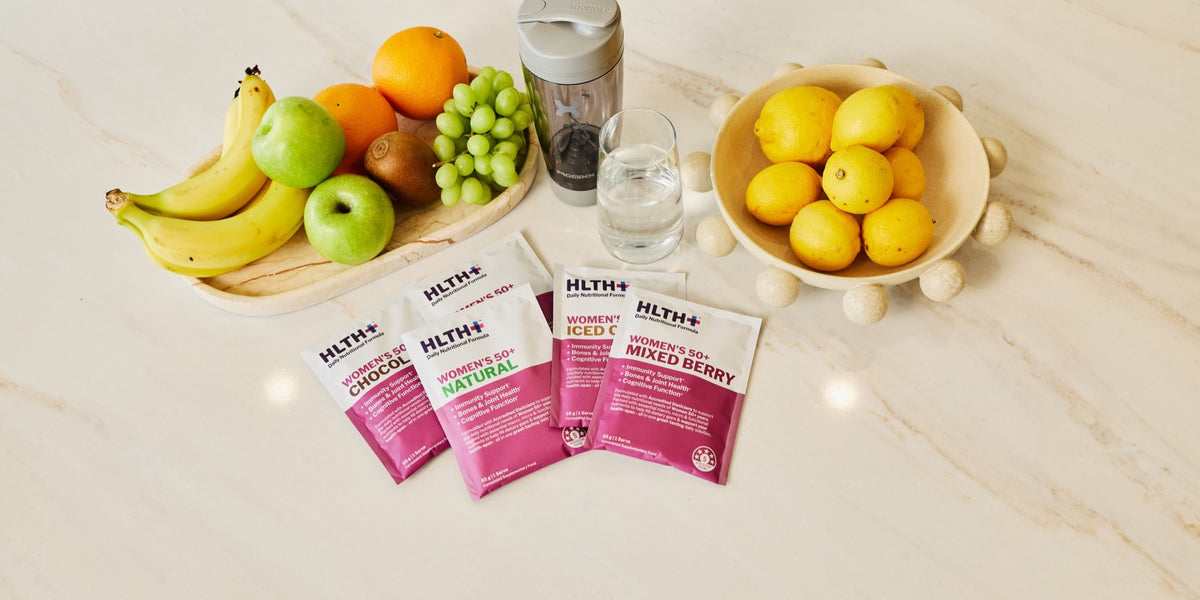
Five breakfast smoothie ideas follow: four use a HLTH+ sachet and one needs no powder. In the sachet recipes the first line of every sum is the published 30g of protein, 7g of dietary fibre and 1.5g of sugars (Women's; the Men's sachet lists 1.7g of sugars), and every other line is an Australian Food Composition Database figure scaled to the weight in the recipe.
1. Iced Coffee, frozen banana and almond
Ingredients: 1 HLTH+ Iced Coffee sachet, 150mL reduced-fat milk, 100mL cold water, 100g frozen banana, 15g almond meal, ice.
- Pour the milk and water into the blender, then add the banana and almond meal.
- Tip in the sachet and top with ice.
- Blend for about 30 seconds, until no banana pieces remain.
Protein per serve: 30g (sachet) + 5.25g (milk) + 1.4g (banana) + 2.96g (almond meal) = 39.6g.
Dietary fibre per serve: 7g (sachet) + 0g (milk) + 2.3g (banana) + 1.65g (almond meal) = 11.0g.
Sugars per serve: 1.5g (Women's sachet) + 7.5g (milk) + 13.7g (banana) + 0.78g (almond meal) = 23.5g total.
This one contains caffeine, because the Iced Coffee flavour does. For coffee-led options, protein coffee has more.
2. Mixed Berry, chia and milk
Ingredients: 1 HLTH+ Mixed Berry sachet, 200mL reduced-fat milk, 50mL cold water, 100g frozen mixed berries, 10g chia seeds, ice.
- Put the milk, water, frozen berries and chia in the blender jug.
- Add the sachet, then the ice on top.
- Blend until the berries are fully broken down.
Protein per serve: 30g (sachet) + 7g (milk) + 0.6g (berries) + 2.38g (chia) = 40.0g.
Dietary fibre per serve: 7g (sachet) + 0g (milk) + 3.3g (berries) + 3.32g (chia) = 13.6g.
Sugars per serve: 1.5g (Women's sachet) + 10g (milk) + 9.2g (berries) + 0.07g (chia) = 20.8g total.
3. Banana, oat and cottage cheese, with no powder
Ingredients: 100g cottage cheese, 40g rolled oats, 100g banana, 250mL reduced-fat milk, ice.
- Pour in the milk first, then the cottage cheese, oats and banana.
- Top with ice.
- Run the blender for about a minute; oats and cottage cheese take longer than fruit to go smooth.
Protein per serve: 17g (cottage cheese) + 4.88g (oats) + 1.4g (banana) + 8.75g (milk) = 32.0g.
Dietary fibre per serve: 0g (cottage cheese) + 3.8g (oats) + 2.2g (banana) + 0g (milk) = 6.0g.
Sugars per serve: 1.8g (cottage cheese) + 0.4g (oats) + 13.4g (banana) + 12.5g (milk) = 28.1g total.
Nothing in this one comes from a tub, and it contains dairy.
Can a breakfast smoothie be green, or made the night before?
Yes to both. The green recipe uses the Natural sachet and no dairy at all, though the sachet does contain soy (more in dairy-free protein shakes). The night-before recipe follows the method the Better Health Channel gives for overnight oats, "rolled oats soaked in milk overnight in the fridge", then finishes in the blender on the day.
4. Natural, spinach and kiwifruit
Ingredients: 1 HLTH+ Natural sachet, 250mL cold water, 50g baby spinach, 150g green kiwifruit (about two, peeled), 100g Lebanese cucumber, 50g avocado, ice.
- Put the water, spinach, kiwifruit, cucumber and avocado in the blender jug.
- Add the sachet and the ice.
- Blend until no green flecks are left.
Protein per serve: 30g (sachet) + 1.4g (spinach) + 1.8g (kiwifruit) + 0.7g (cucumber) + 0.8g (avocado) = 34.7g.
Dietary fibre per serve: 7g (sachet) + 1.25g (spinach) + 4.5g (kiwifruit) + 0.7g (cucumber) + 2.95g (avocado) = 16.4g.
Sugars per serve: 1.5g (Women's sachet) + 0g (spinach) + 13.2g (kiwifruit) + 1.8g (cucumber) + 0g (avocado) = 16.5g total.
5. Chocolate, raspberry and oat, made the night before
Ingredients: 1 HLTH+ Chocolate sachet, 40g rolled oats, 200mL reduced-fat milk, 100g frozen raspberries, ice.
- The night before, stir the oats, milk and raspberries together in a jar and refrigerate it.
- In the morning, tip the jar into the blender with the sachet and some ice.
- Blend until the oats and raspberries are smooth.
Protein per serve: 30g (sachet) + 4.88g (oats) + 7g (milk) + 1.1g (raspberries) = 43.0g.
Dietary fibre per serve: 7g (sachet) + 3.8g (oats) + 0g (milk) + 4.8g (raspberries) = 15.6g.
Sugars per serve: 1.5g (Women's sachet) + 0.4g (oats) + 10g (milk) + 6.7g (raspberries) = 18.6g total.
Sugars here are total sugars: the AFCD records no added sugars for any whole food in these five recipes, and the sachet's 1.5g is the Women's figure applied to every flavour. If you drink one before exercise, what to eat before a workout deals with timing.
Why does each glass matter more when you are eating less?
Smaller meals carry less of everything, so each ingredient in the glass has to do more. That holds for a deliberate deficit and equally for rapid weight loss, reduced eating and medically induced weight loss. In a placebo-controlled crossover trial of a GLP-1 medicine in 30 adults, participants offered as much food as they wanted ate about a quarter fewer calories across the day than on placebo (Blundell and colleagues, Diabetes, Obesity and Metabolism, 2017).
Researchers have also put a number on dietary fibre: 69 people using that class of medicine averaged 14.5g a day in a 2025 study, roughly half the 28g a day the authors used as the recommended intake (Frontiers in Nutrition, 2025). That is where dense ingredients earn their place: from the table above, 10g of chia seeds adds 3.32g of dietary fibre and 100g of cottage cheese adds 17g of protein.
Everything in this section is general information, not medical advice; decisions about any medication belong with your doctor. For the protein side in more depth, see protein when appetite drops.
How does HLTH+ fit into a breakfast smoothie?
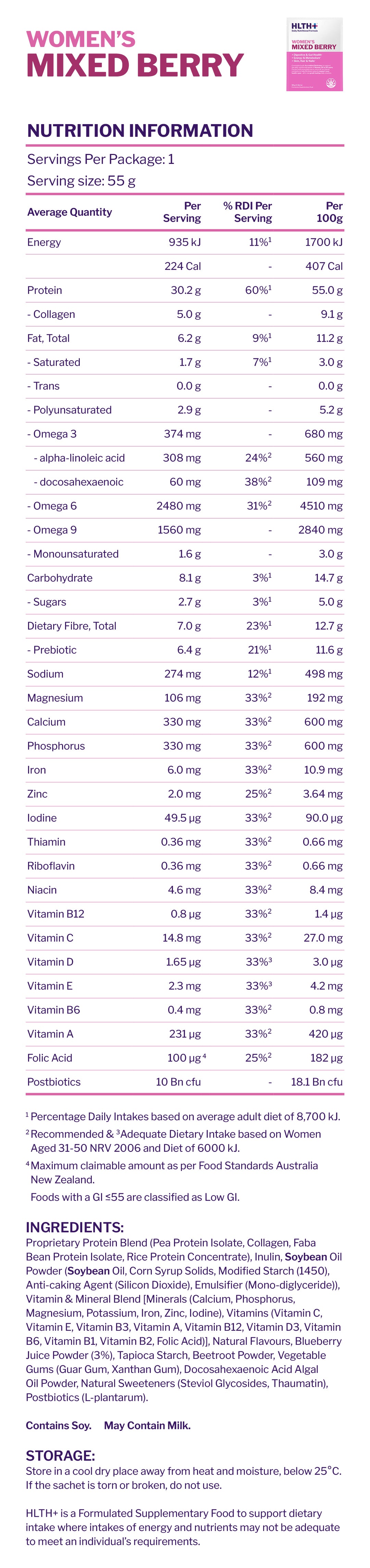
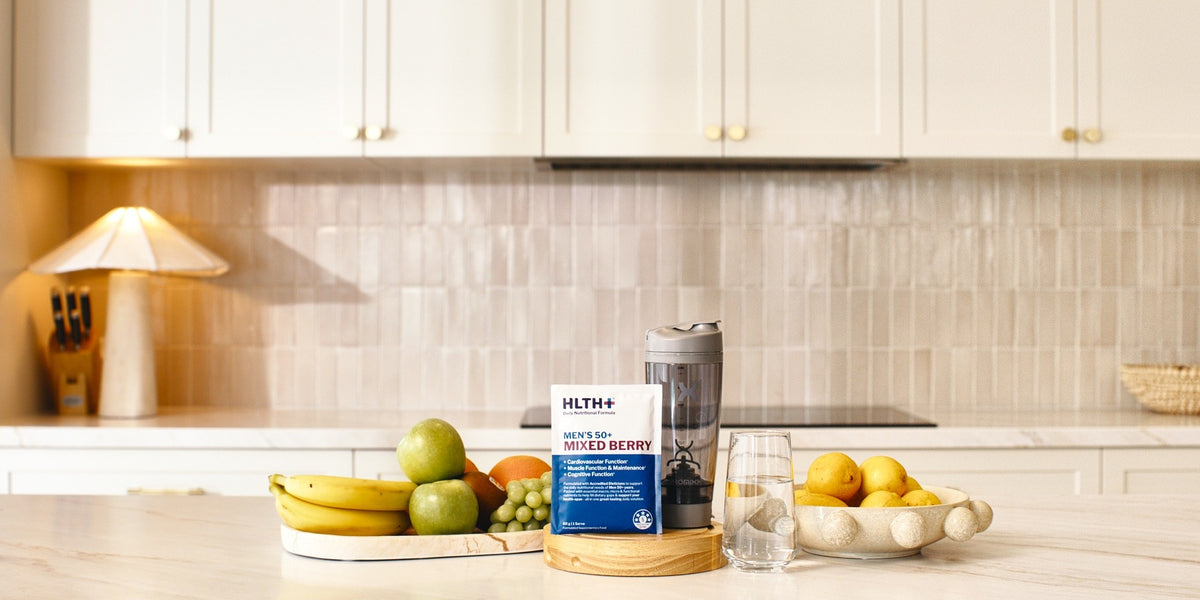
Recipes 1, 2, 4 and 5 open with a 55g HLTH+ Women's sachet, which carries 30g of protein per serve and 7g of dietary fibre within 30 essential daily nutrients across protein, dietary fibre, vitamins, minerals, collagen and DHA. Each version (Women's, Women's 50+, Men's and Men's 50+) is formulated by Accredited Dietitians to the Nutrient Reference Values that the National Health and Medical Research Council, the Australian Government Department of Health and Ageing and the New Zealand Ministry of Health published in 2006. The ✦ Find My Formula quiz shows what your current routine is not giving you.
As part of a healthy diet involving a variety of foods, protein contributes to the maintenance of muscle mass, and dietary fibre contributes to regular laxation. At 7g per serve the sachet meets the threshold the Code sets for an excellent source of dietary fibre, and it also carries a balanced multivitamin profile.
As a Formulated Supplementary Food, HLTH+ is made in Australia in facilities that comply with Good Manufacturing Practice; it is dairy-free and gluten-free, with no added sugar and no nasties, artificial colours, artificial flavours or artificial sweeteners, and it contains soy. A serve is RRP $6.00, or $5.10 a day on a 28-serve subscription, and it sells at hlthplus.com, Amazon AU and Chemist Warehouse.
Choosing between them:
- You want to build it all from food: recipe 3 reaches 32.0g of protein and 6.0g of dietary fibre with nothing from a tub.
- You want protein, dietary fibre and a balanced multivitamin profile in one sachet: HLTH+, recipes 1, 2, 4 and 5.
- You already own a whey scoop: the database entry carries 25.5g of protein and 0.54g of dietary fibre per 30g scoop, so oats, chia and fruit supply the dietary fibre, the way recipe 3's add-ins do.
Comparing a scoop with a sachet panel to panel is in protein shake for breakfast and the best protein shakes in Australia.
Find the gap in your morning. The 30-second ✦ Find My Formula quiz is diagnostic: it shows what your current breakfast and supplements are not giving you.
Frequently Asked Questions
Is a smoothie or egg better for breakfast?
They carry different things, so neither wins outright. 150g of poached egg carries 19.7g of protein and no dietary fibre in the Australian Food Composition Database. Recipe 3 here carries 32.0g of protein and 6.0g of dietary fibre. Either can anchor a breakfast, and many people alternate them.
How much protein is in a breakfast smoothie?
Most of it comes from one ingredient. On database figures a 30g scoop of whey powder supplies 25.5g and 100g of cottage cheese 17g, a HLTH+ sachet supplies 30g, and 100g of banana adds only 1.4g. Milk, oats and seeds make up the rest, and the five recipes here land between 32.0g and 43.0g.
Can you make a breakfast smoothie without milk?
Yes. Recipe 4 uses water and no dairy, and HLTH+ is dairy-free and gluten-free, though it contains soy. Using water in place of the milk in recipes 1, 2 and 5 takes 5.25g, 7g and 7g of protein out of their sums, so they land at 34.4g, 33.0g and 36.0g.
How much sugar is in a breakfast smoothie?
Most of it comes from fruit and milk. In the five recipes here the totals run from 16.5g in the green smoothie, mostly kiwifruit, to 28.1g in recipe 3, mostly banana and milk. The Australian Food Composition Database records no added sugars for any whole food used, and HLTH+ contains no added sugar.
Leave a comment
This site is protected by hCaptcha and the hCaptcha Privacy Policy and Terms of Service apply.