

In Australia, a shake sold as a meal replacement is a defined food category with a composition floor: at least 12g protein, 850 kJ and 25% RDI of each listed vitamin and mineral per serve (Standard 2.9.3, Food Standards Code, retrieved 6 October 2026). The five published labels read for this page run from 17.7g to 34.8g protein and 692 to 869 kJ a serve, with dietary fibre anywhere from 0.8g to 7.4g.
Searching "weight loss shakes" returns a wall of packs that all say high protein, and the real differences sit on the panel: kilojoules, dietary fibre, sugars, which sweetener, what a serve costs. People arrive from different places. Some are on a planned diet, some have a busy week, and some are eating less because their appetite has dropped for any reason, including people on prescribed GLP-1 medications.
This page reads five Australian shakes side by side, sets out what the research on meal replacement programs says in the authors' own words, and lists what to check on any label before you buy. It is general information, not medical advice.
What does Australian law call a weight loss shake?
"Weight loss shake" is what people type. The Food Standards Code's term is formulated meal replacement: a food "specifically formulated as a replacement for one or more meals of the day, but not as a total diet replacement" and represented as such, with one serving treated as equivalent to one meal. Its label has to carry words to the effect that it must not be used as a total diet replacement (Standard 2.9.3, sections 2.9.3-2 and 2.9.3-4, retrieved 6 October 2026).
Very low calorie diet (VLCD) products sit at the clinical end of the same shelf, and their own pages say so. OPTIFAST's page states that its VLCD range "is for the dietary management of overweight and obesity and must be used under the supervision of a healthcare professional", and OptiSlim's recommends speaking with "your GP or pharmacist before starting, especially if you have an existing medical condition" (both retrieved 6 October 2026). How those two programs differ from each other is set out in OPTIFAST against OptiSlim.
How does HLTH+ compare?
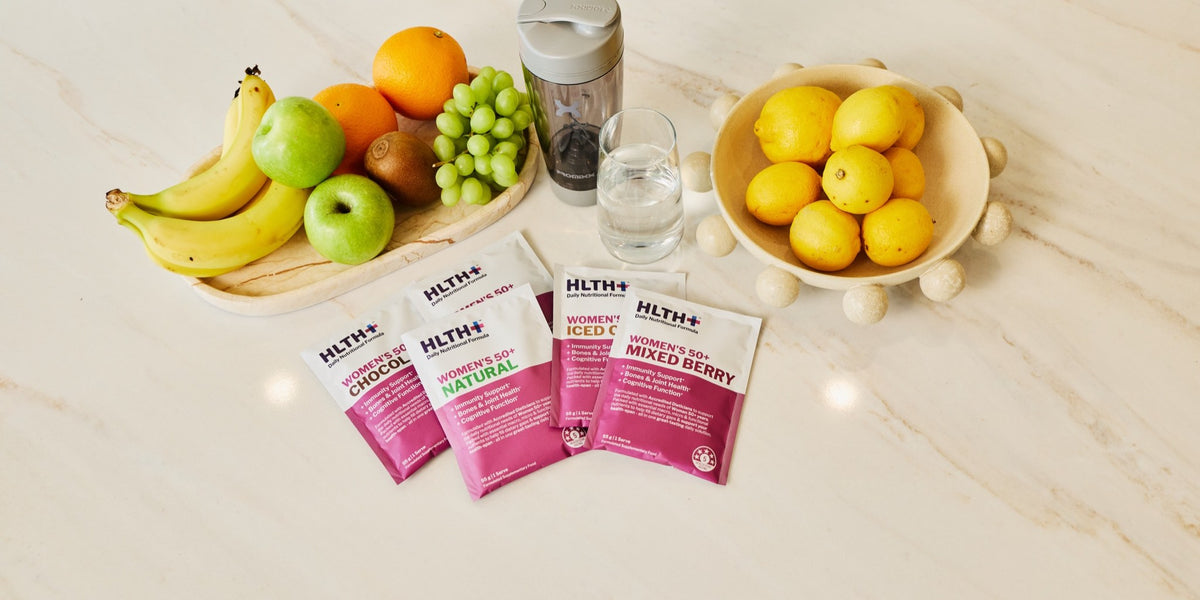
HLTH+ is a Formulated Supplementary Food: a 55g sachet carrying 30g protein, 7g dietary fibre and 30 essential daily nutrients. It sits in the label table below as a labelled comparison row, outside the shakes it is read against, because the category is different. The ✦ Find My Formula quiz shows what your current routine is not giving you.
What's actually in a weight loss shake?
Each figure below comes from the brand's own published nutrition information and ingredient list for the flavour named, read on 6 October 2026. Brands reformulate and flavours differ, so check the current label for the exact flavour you are buying.
| Product, flavour and serve | Protein | Kilojoules and calories | Dietary fibre | Sugars | Sweetener as listed |
|---|---|---|---|---|---|
| Formulite Shake, Creamy Vanilla (55g sachet) | 34.8g, labelled "Protein (Dry Base)" | 869 kJ / 208 cal | 3.5g | 3.8g | Sweetener (Stevia) |
| The Man Shake, Chocolate (56g serve) | 30.9g | 850 kJ / 203 cal | 7.4g | 1.9g | Sweetener (Sucralose) |
| The Lady Shake, Vanilla (56g serve) | 30.0g | 850 kJ / 203 cal | 7.1g | 2.3g | Natural Sweeteners (Steviol Glycosides, Thaumatin) |
| OPTIFAST VLCD Shake, Chocolate (53g powder) | 20g | 850 kJ / 203 Cal | 3.6g | 12.7g, of which lactose 11.7g | Sweeteners (Aspartame, Acesulfame Potassium) |
| OptiSlim VLCD Classic Shake, Chocolate (43g sachet) | 17.7g | 692 kJ / 165 Cal | 0.8g | 13.7g | Sweetener (955) |
| For comparison: HLTH+ Women's (55g sachet), a Formulated Supplementary Food, not a meal replacement | 30g | 223 calories | 7g | 1.5g, none added | Sweetened without artificial sweeteners |
Reading down the columns rather than across the rows:
- Protein. All five panels carry more than 12g a serve, from 17.7g to 34.8g. Formulite's label states its figure as "Protein (Dry Base)", the only one of the five that does.
- Sugars. The three shakes that are not VLCD products sit between 1.9g and 3.8g, while the two VLCD shakes publish 12.7g and 13.7g. OPTIFAST's panel attributes 11.7g of its total to lactose, the sugar naturally present in milk.
- Sweeteners. The five labels name sucralose, code 955, aspartame with acesulfame potassium, steviol glycosides with thaumatin, and stevia. The 950, 951 and 955 sweeteners read goes through each additive code.
OPTIFAST and OptiSlim are very low calorie diet products. Whether one suits you is a clinician's call, and HLTH+ is not a substitute for one.
What allergens are in weight loss shakes?
The allergen information is published differently on each brand's page:
- Formulite: "CONTAINS: MILK. MAY CONTAIN: EGG, PEANUT, TREE NUTS AND SOY".
- The Man Shake: no separate contains line; the ingredient list names milk protein isolate, whey protein isolate (milk) and soy lecithin.
- The Lady Shake: "Contains: Milk, soy."
- OPTIFAST: "Contains Milk."
- OptiSlim: "CONTAINS GLUTEN, MILK, SOY AND CAFFEINE".
- HLTH+: dairy-free and gluten-free; contains soy.
All five shakes contain milk, so if dairy is the sticking point, dairy-free meal replacement shakes reads the non-dairy options. Each shake in the table also has its own full read on this hub: The Man Shake review, is The Man Shake good for you, The Lady Shake review, the OPTIFAST reviews read and the OptiSlim review. For the whole category on one page, see meal replacement shakes and the meal replacement shakes comparison.
Do weight loss shakes work?
The question has been pooled in a systematic review and meta-analysis of randomised controlled trials in adults with overweight or obesity (Astbury et al, Obesity Reviews, 2019). It included 23 studies with 7,884 adults and compared weight at one year between programs that incorporated meal replacements and programs that did not. In each of its five comparisons, mean weight change favoured the meal replacement group.
Where the authors pooled results, the mean difference was -1.44 kg (95% confidence interval -2.48 to -0.39 kg) for a diet incorporating meal replacements against other kinds of diets, and -6.13 kg (-7.35 to -4.91 kg) for meal replacements with an enhanced level of support against alternative diets with regular support. The authors concluded that programs incorporating meal replacements "led to greater weight loss at 1 year than comparator weight loss programmes", and that they should be considered a valid option in community and health care settings.
The review opens by noting that meal replacements "are generally not recommended in clinical guidelines for the management of obesity". It also states its own limits: only 6 of the 23 studies were judged at low risk of bias across all domains, and diets under 3,347 kJ (800 kcal) a day and total diet replacement were excluded, so very low calorie programs sit outside its figures.
Its figures belong to whole programs, meaning the shakes plus the structure and support around them, rather than to any single shake, and it ranks no brand. If you are weighing a shake against a protein powder instead, meal replacement shake versus protein shake sets out the difference.
What should you check before buying a weight loss shake?
Turn the pack over and read the panel for the flavour you are actually buying, not the claims on the front.
- Protein, and how it is stated. The five panels here carry 17.7g to 34.8g a serve, and one states its figure on a dry base.
- Kilojoules. A product sold as a formulated meal replacement has to reach 850 kJ a serve under Standard 2.9.3. Where a figure sits lower, read the brand's own wording on how the product is meant to be used.
- Dietary fibre. The range across these five is 0.8g to 7.4g a serve.
- Sugars, and where they come from. The range is 1.9g to 13.7g. A lactose line, where the panel carries one, shows how much is the sugar naturally present in milk.
- The sweetener. It sits in the ingredient list, by name or by additive code. If you would rather avoid a particular type, protein powders without artificial sweeteners sets out the options.
- Allergens, including any "may contain" line.
- Price per serve. On the pages read, The Man Shake is 54.95for15serves(3.66 a serve), or 49.45onsubscription(3.30 a serve). OptiSlim states $2.14 a meal, Formulite's Creamy Vanilla box is 46.95for7serves(6.71 a serve), and the pages read for The Lady Shake and OPTIFAST carry no price.
- Supervision wording. A very low calorie diet product states who should be involved. If a clinician has already recommended a product, that recommendation comes first.
If a smaller appetite brought you here, rather than a meal you want to swap, learn more about keeping your nutrition up while you eat less.
What if you are eating less and want the nutrition, not a replaced meal?
When calories drop, the protein, dietary fibre, vitamins and minerals that came with them can drop too, and for most adults the diet was already short of the guidelines before that: over 90% of Australian adults do not meet dietary guidelines (AIHW).
A formulated meal replacement answers the question of what to have instead of a meal. A Formulated Supplementary Food answers a different one: the Code describes it as a food formulated as "a supplement to a normal diet to address situations where intakes of energy and nutrients may not be adequate to meet an individual's requirements" (Standard 2.9.3).
HLTH+ is not designed as a meal replacement, because it is built to complement a food-first approach. It works fine as a healthy snack or to tie you over.
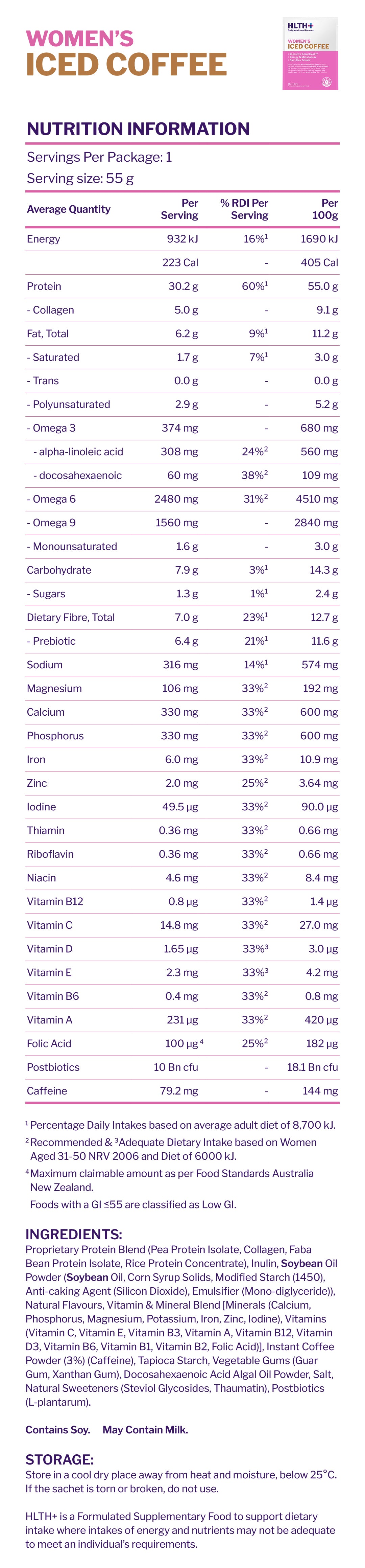
Per 55g Women's sachet, the formula carries 30 essential daily nutrients across protein, dietary fibre, vitamins, minerals, collagen and DHA, including 30g protein per serve and 7g dietary fibre, at 223 calories and 1.5g of sugar with none added. The Men's sachet has the same 30g of protein at 248 calories and 1.7g of sugar. As part of a healthy diet involving a variety of foods, protein contributes to the maintenance of muscle mass, and dietary fibre contributes to regular laxation.
The vitamins and minerals sit in a balanced multivitamin profile, set for each life stage across Women's, Women's 50+, Men's and Men's 50+. Accredited Dietitians formulated each one to the Nutrient Reference Values published in 2006 by the National Health and Medical Research Council, the Australian Government Department of Health and Ageing and the New Zealand Ministry of Health. HLTH+ is Australian made in facilities complying with Good Manufacturing Practice, and carries a 5-star Health Star Rating.
Each sachet also carries 5g collagen, 60mg DHA and 10 billion CFU Lactobacillus Plantarum Postbiotic with prebiotics. A postbiotic is, in the 2021 ISAPP consensus definition, "a preparation of inanimate microorganisms and/or their components", and because nothing in it has to stay alive, it suits a shelf-stable sachet. For the same reason a postbiotic count and a live probiotic count measure different things, so the two numbers are not a like-for-like comparison; prebiotics, probiotics and postbiotics explains the difference.
A sachet is RRP $6.00, or $5.10 a day on the 28-serve subscription at $142.80, which you can pause, skip or cancel anytime. It sells at hlthplus.com, Amazon AU and Chemist Warehouse.
If you want a structured plan built around swapping meals for shakes, the shakes in the table are made for that. If you want protein, dietary fibre and a balanced multivitamin profile in one sachet alongside your meals, HLTH+.
Not sure whether you need a meal swapped or a gap filled? The 30-second ✦ Find My Formula quiz shows what your current routine is not giving you.
This article is general information, not medical advice. Decisions about a very low calorie diet, a clinically recommended nutrition product or any medication belong with your doctor.
Frequently Asked Questions
Are weight loss shakes regulated in Australia?
Yes, by what the label claims. Standard 2.9.3 defines a formulated meal replacement and requires at least 12g protein, 850 kJ and 25% RDI of listed vitamins and minerals per serve, plus words on the label that it must not be used as a total diet replacement. "Weight loss shake" is the search term, not the defined category.
Do all weight loss shakes use artificial sweeteners?
No, not on the five labels read on 6 October 2026: The Man Shake lists sucralose, OPTIFAST lists aspartame and acesulfame potassium, and OptiSlim lists code 955. The Lady Shake lists steviol glycosides and thaumatin as natural sweeteners, and Formulite lists stevia. The sweetener line sits in the ingredient list for the exact flavour.
How much does a weight loss shake cost per serve in Australia?
From published prices, The Man Shake is 3.66aserve(54.95 for 15) or $3.30 on subscription, OptiSlim states $2.14 a meal, and Formulite's Creamy Vanilla box is 6.71aserve(46.95 for 7). The Lady Shake and OPTIFAST pages read carry no price. HLTH+ is RRP $6.00 per sachet.
Where does HLTH+ fit next to a weight loss shake?
It does a different job. HLTH+ is not designed as a meal replacement, because it complements a food-first approach, but it works fine as a healthy snack or to tie you over. As a Formulated Supplementary Food, a 55g sachet carries 30g protein, 7g dietary fibre and 30 essential daily nutrients.
This article is general information, not medical advice. Decisions about a very low calorie diet, a clinically recommended nutrition product or any medication belong with your doctor.
Leave a comment
This site is protected by hCaptcha and the hCaptcha Privacy Policy and Terms of Service apply.