


A meal replacement shake, a protein shake and a nutrition shake are three different things on an Australian label. A formulated meal replacement must carry at least 12g protein, 850 kJ and 25% RDI of each of 16 listed vitamins and minerals per serve; a protein powder is a protein serve with no such floor; a nutrition shake is a supplement to a normal diet rather than a stand-in for a meal.
You are probably looking at three tubs that all say "protein" and trying to work out which one does which job. The names get used loosely online, which is how a scoop of powder ends up treated as a meal, or a meal replacement ends up used as a top-up it was never built to be. If the question underneath is whether you need a powder at all, learn more in do I need protein powder.
Below: what the Food Standards Code requires of each category, one published panel for each, a side-by-side table, and who each one suits.
What is the difference between a meal replacement shake and a protein shake?
The difference is the job and the rulebook behind it. A meal replacement is a regulated food built to stand in for a meal, so the Code sets a floor for what it must contain. A protein shake is a protein serve, and a nutrition shake is a supplement taken beside meals.
The table puts one published panel from each category side by side, per serve as the brand prints it. The Man Shake is sold as a meal replacement (its own product page types it as a "High Protein Meal Replacement Shake"), Bulk Nutrients' Whey Protein Isolate is a plain protein powder, and HLTH+ is a Formulated Supplementary Food.
| Per serve | Meal replacement: The Man Shake (Chocolate) | Protein powder: Bulk Nutrients Whey Protein Isolate (Chocolate) | Formulated Supplementary Food, not a meal replacement: HLTH+ (Women's) |
|---|---|---|---|
| Serve size | 56g | 30g scoop | 55g sachet |
| Protein | 30.9g | 25.5g | 30g |
| Dietary fibre | 7.4g | No dietary fibre row on the panel | 7g |
| Vitamins and minerals | 10 vitamins and 7 minerals itemised, plus sodium and potassium | No vitamin or mineral rows on the panel | A balanced multivitamin profile |
| Calories | 203 (850 kJ) | About 115 (480 kJ) | 223 (Men's: 248) |
| Allergen line | Milk, and soy (as lecithin), in the ingredient list | Contains milk | Dairy-free, gluten-free. Contains soy |
| What the panel covers | Panel itemises protein, dietary fibre, vitamins, minerals and a probiotic count | Panel itemises protein, fat, carbohydrate and sodium | 30 essential daily nutrients across protein, dietary fibre, vitamins, minerals, collagen and DHA |
Figures are each brand's published nutrition information, retrieved 6 October 2026 for The Man Shake and Bulk Nutrients; HLTH+ figures are the per-serve numbers the brand publishes. Bulk Nutrients publishes kilojoules only, so its calories are 480 kJ divided by 4.184. Flavours vary and brands reformulate, so check current labels before buying.
Protein per serve does not separate the categories: 30.9g in the meal replacement, 25.5g in the powder, 30g in the sachet. What separates them is calories, dietary fibre and the vitamin and mineral rows. For each brand read alone, learn more in the Man Shake review, is the Man Shake good for you and the Bulk Nutrients review.
How does HLTH+ compare?
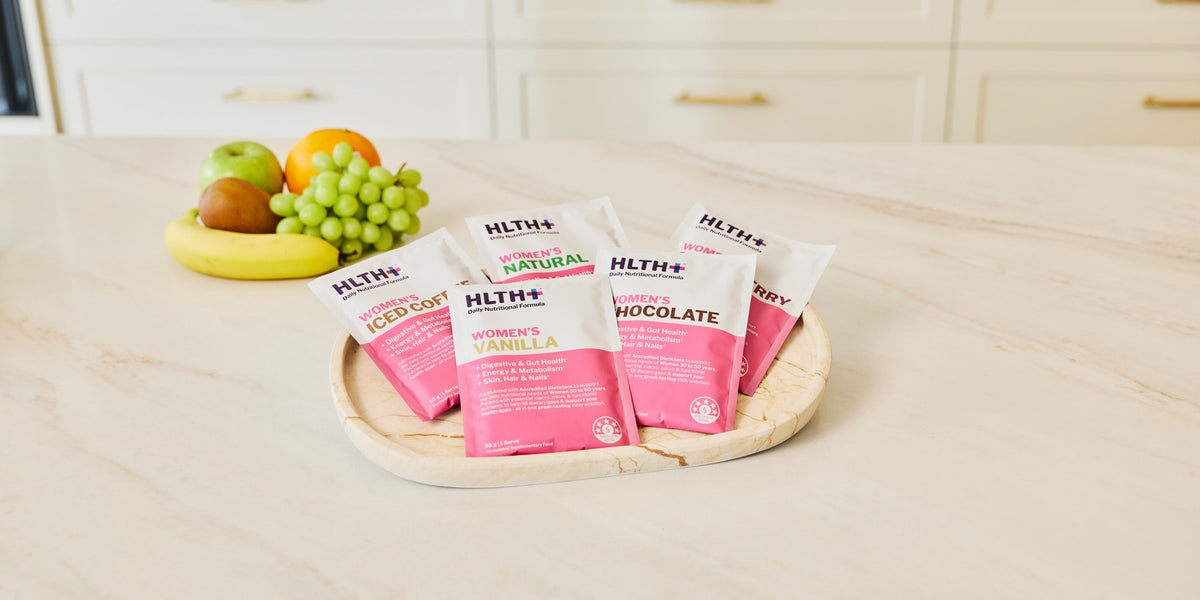
HLTH+ is the third column: a Formulated Supplementary Food with 30g protein, 7g dietary fibre and a balanced multivitamin profile in one 55g Women's sachet, built to sit beside meals. Its job is to round out what you already eat, so it is built as a serve that sits next to your meals and carries more than protein. The ✦ Find My Formula quiz takes 30 seconds and shows what your current routine is not giving you.
What must a meal replacement shake contain?
On an Australian label the product is a formulated meal replacement, which the Code describes as a food "specifically formulated as a replacement for one or more meals of the day, but not as a total diet replacement" (Standard 2.9.3, Food Standards Code, retrieved 6 October 2026). The Code treats one serving of it as "equivalent to one meal", and section 2.9.3-3 says that serving must hold no less than 12g protein, 850 kJ and 25% of the RDI for every vitamin and mineral on one Schedule 29 list.
That Schedule 29 table lists 16 nutrients: ten vitamins (A, thiamin, riboflavin, niacin, folate, B6, B12, C, D and E) and six minerals (calcium, iodine, iron, magnesium, phosphorus and zinc) (Schedule 29, Food Standards Code). The label must also carry words to the effect that the product must not be used as a total diet replacement.
On the table above, The Man Shake's panel sits on the 850 kJ line and well over the 12g protein floor, and it itemises every vitamin and mineral on that list, plus selenium. For the same floor read across five published shakes, learn more in meal replacement shakes, and for how they rank, the best meal replacement shakes in Australia.
What is a protein powder, and what does a scoop carry?
"Protein powder" is what shoppers call it; the Code has no category by that name. The nearest is the formulated supplementary sports food, "a product that is specifically formulated to assist sports people in achieving specific nutritional or performance goals", whose label must say it is not a sole source of nutrition and should be consumed in conjunction with a nutritious diet (Standard 2.9.4, Food Standards Code, retrieved 6 October 2026). A powder not sold on that basis is a general food, and neither route sets a vitamin and mineral floor like the one in Standard 2.9.3.
A scoop does one job well. Bulk Nutrients' Chocolate whey isolate publishes, per 30g scoop, 25.5g protein, 480 kJ and 0.4g sugars, with no dietary fibre row and sodium as the only mineral on the panel. For protein per serving, the International Society of Sports Nutrition position stand gives a general recommendation of 0.25g of a high-quality protein per kilogram of body weight, or an absolute dose of 20 to 40g (Jäger and colleagues, Journal of the International Society of Sports Nutrition, 2017), so the scoop's 25.5g lands inside that range.
Learn more about the isolate end of the category in the best whey protein in Australia.
What is a nutrition shake?
"Nutrition shake" is a shopper's name too, and the nearest Code category is the Formulated Supplementary Food: "a food specifically formulated as, and sold on the basis that it is, a supplement to a normal diet to address situations where intakes of energy and nutrients may not be adequate to meet an individual's requirements" (Standard 2.9.3). Its serving floor sits below a meal replacement's, at no less than 8g protein, 550 kJ and 20% of the RDI for at least one listed vitamin or mineral (section 2.9.3-5). Its label has to describe that role as a supplement to a normal diet.
Why does that category exist? Over 90% of Australian adults do not meet dietary guidelines (AIHW), and a supplement to a normal diet is aimed at the gap between what is eaten and what is needed. It also fits the days when calories drop and a reduced appetite means less food on the plate.
More on what changes in your nutrition when you eat less →
What does a nutrition shake like HLTH+ carry?
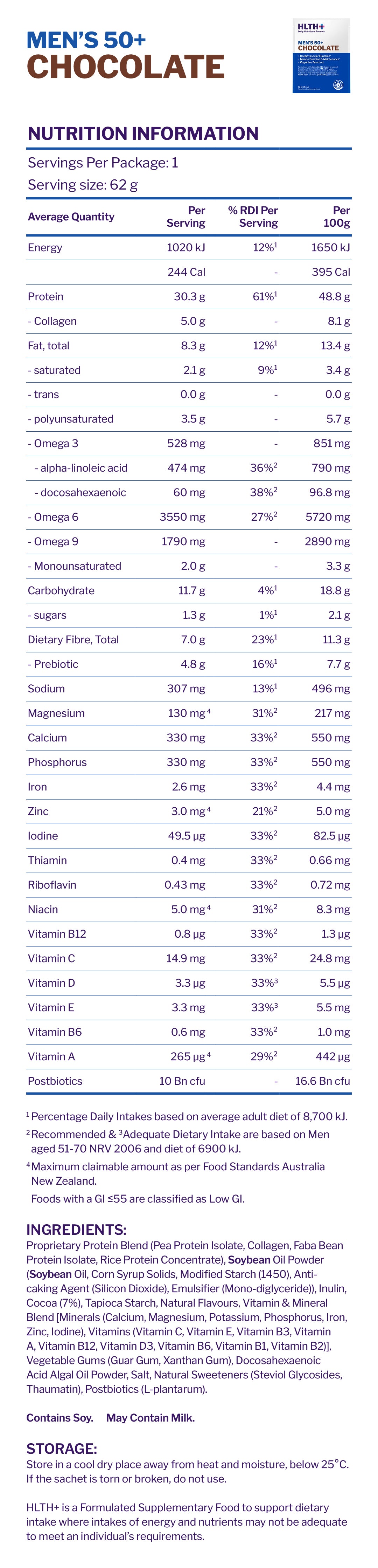
Per serve, a 55g Women's sachet lists 30 essential daily nutrients, counted across protein, dietary fibre, vitamins, minerals, collagen and DHA. Inside that total sit 30g protein per serve, 7g dietary fibre, 5g collagen, 60mg DHA and 10 billion CFU Lactobacillus Plantarum Postbiotic with prebiotics, for 223 calories and 1.5g of sugar, none of it added. A Men's sachet keeps the 30g of protein at 248 calories and 1.7g of sugar.
A postbiotic is built from microorganisms that are no longer alive: the 2021 consensus of the International Scientific Association for Probiotics and Prebiotics defines it around "inanimate microorganisms and/or their components" (Salminen and colleagues, Nature Reviews Gastroenterology & Hepatology, 2021). A postbiotic count and a live probiotic count on another shake therefore measure different things, so the two numbers are not a like-for-like pair.
The vitamins and minerals come as a balanced multivitamin profile, matched to gender and life stage across Women's, Women's 50+, Men's and Men's 50+. Accredited Dietitians formulated it to the Nutrient Reference Values, published in 2006 by the National Health and Medical Research Council, the Australian Government Department of Health and Ageing and the New Zealand Ministry of Health.
As part of a healthy diet involving a variety of foods, protein contributes to the maintenance of muscle mass, and dietary fibre contributes to regular laxation. HLTH+ is made in Australia in facilities that comply with Good Manufacturing Practice, carries a 5-star Health Star Rating, and contains no nasties, artificial colours, artificial flavours or artificial sweeteners.
A single serve is RRP $6.00, and a 28-serve subscription at $142.80 comes to $5.10 a day, with pause, skip or cancel anytime. Buy it at hlthplus.com, Amazon AU or Chemist Warehouse. For more shakes side by side, learn more in the best protein shakes in Australia.
Can a protein shake replace a meal?
Not on its own: a scoop stirred into water is a protein serve, and Bulk Nutrients' panel shows 480 kJ against the 850 kJ a formulated meal replacement has to carry, with none of the 16 listed vitamins and minerals on it. Stirred into 300mL of reduced-fat milk, the glass reaches about 1,044 kJ and 36g protein, and the milk brings 357mg calcium (figures from the Australian Food Composition Database, Release 3.0, per 100g with a millilitre taken as a gram: 188 kJ, 3.5g protein, 119mg calcium). That calcium is the milk's work; the powder itself still adds no vitamin or mineral rows.
A formulated meal replacement is the category built for that swap, and even its label has to say it must not be used as a total diet replacement. For a morning-specific build, learn more in protein shake for breakfast; for shakes sold with a weight goal on the pack, weight loss shakes in Australia reads their labels.
HLTH+ is not designed as a meal replacement, because it is built to complement a food-first approach. It works fine as a healthy snack or to tie you over until a proper meal.
Which one suits which reader?
- You want a ready-made stand-in for one meal: a formulated meal replacement, read against the 12g, 850 kJ and 16-nutrient floor, such as The Man Shake.
- You already eat full meals and want a protein serve and nothing else: a protein powder, such as a whey isolate at 25.5g per scoop.
- You want protein, dietary fibre and a balanced multivitamin profile in one sachet beside your meals: HLTH+, a Formulated Supplementary Food, RRP $6.00.
If you are not sure which gap you have, the ✦ Find My Formula quiz is built to show what your current routine is not giving you.
This article is general information, not medical advice. A formulated meal replacement or any clinically recommended nutrition product is a decision for you and your health professional, and decisions about any medication belong with your doctor.
Frequently Asked Questions
How many vitamins and minerals must a meal replacement shake contain?
Standard 2.9.3 requires a formulated meal replacement to carry at least 25% RDI of each of 16 vitamins and minerals per serve, alongside 12g protein and 850 kJ. A protein powder has no such floor: Bulk Nutrients' Chocolate whey isolate lists no vitamin or mineral rows on its panel (retrieved 6 October 2026).
Does a meal replacement shake have more protein than a protein shake?
Not necessarily. On the panels retrieved 6 October 2026, The Man Shake publishes 30.9g protein per 56g serve and Bulk Nutrients' Chocolate whey isolate publishes 25.5g per 30g scoop. The difference between the categories is calories, dietary fibre and vitamins and minerals, not the protein number.
Is a protein powder a sports food?
Sometimes. Standard 2.9.4 defines a formulated supplementary sports food as a product specifically formulated to assist sports people in achieving specific nutritional or performance goals, and a powder not sold on that basis is a general food. The label shows which route the maker has taken.
What does Formulated Supplementary Food mean on a label?
It is a prescribed name under Standard 2.9.3: a food specifically formulated as, and sold on the basis that it is, a supplement to a normal diet to address situations where intakes of energy and nutrients may not be adequate. It sits beside meals rather than standing in for one.
Can HLTH+ replace a meal?
HLTH+ is a Formulated Supplementary Food, with 30g protein and 7g dietary fibre in a 55g Women's sachet, sold as a supplement to a normal diet. It is not designed as a meal replacement, because it is built to complement a food-first approach. It works fine as a healthy snack or to tie you over until your next meal.

Leave a comment
This site is protected by hCaptcha and the hCaptcha Privacy Policy and Terms of Service apply.