

The scale reports one number, and weight lost quickly while eating much less is not all fat. In the body-composition substudies of the STEP 1 and SURMOUNT-1 trials, roughly 40% and about 25% of the weight lost was lean mass, and lean mass is a broader category than muscle. Nutrient intake moves too, and no scale reads it.
If your weight is falling and you are eating far less than you used to, the useful question is what else is going with it. Most pages either alarm or dismiss, and few say what was measured, in whom, and what the authors themselves call a limit.
This page gives the body-composition figures as the papers state them, explains what lean mass is, sets out what trials of strength training and protein intake measured, and covers what happens to nutrient intake when calories drop.
What does the medication do, and why does eating less follow?
GLP-1 medications are prescription medicines that act on the receptor for glucagon-like peptide-1, a gut hormone that slows gastric emptying and inhibits food intake (Müller et al, Molecular Metabolism, 2019). A reduced appetite is an expected effect, and in the STEP 1 trial nausea and diarrhoea were the most common adverse events (Wilding et al, New England Journal of Medicine, 2021). Questions about the medication itself belong with your prescriber.
The rest of this page is about rapid weight loss, reduced eating and medically induced weight loss alike: what happens to body composition and nutrient intake when calories drop, whatever the reason. The body-composition findings come mostly from trials of the medication, and where a lifestyle comparison exists it sits beside them. If a stalled scale is the question, why the scale stalls comes first.
This article is general information, not medical advice. Decisions about any medication belong with your doctor.
How much of the weight lost is lean mass?
Two large trials scanned a subset of their participants. In STEP 1, a 68-week comparison of a medication with placebo, a subset had dual-energy X-ray absorptiometry (DXA) scans, and the supplementary appendix figures put lean mass at roughly 40% of the weight lost in the medication group (Wilding et al, 2021, as calculated from that appendix by Mechanick et al, Obesity Reviews, 2025). Muscle loss with age is the older version of this question, and sarcopenia has its own page.
In the SURMOUNT-1 substudy, 160 of the 2,539 participants had DXA at baseline and week 72, with 36 of them in the placebo group. Of the body weight lost, approximately 75% was fat mass and 25% was lean mass for both the medication and placebo groups, and the proportions were consistent across most post hoc subgroups by sex, age and amount lost (Look et al, Diabetes, Obesity and Metabolism, 2025).
| Source | What was measured | Lean mass as a share of weight lost |
|---|---|---|
| STEP 1, DXA substudy (Wilding et al, 2021; calculated by Mechanick et al, 2025) | DXA in a subset of participants over 68 weeks; share calculated from the appendix figures | Roughly 40% |
| SURMOUNT-1, DXA substudy of 160 participants (Look et al, 2025) | DXA at baseline and week 72 | About 25%, in both the medication and placebo groups |
| Meta-analysis of 20 randomised trials, 15,782 participants (Eisa and Barood, 2026): medication trials | DXA or magnetic resonance imaging | 25% to 39% |
| Same meta-analysis: lifestyle interventions | DXA or magnetic resonance imaging | 26.2% |
| Same meta-analysis: lifestyle plus resistance training | DXA or magnetic resonance imaging | 17.5% |
Two points sit under the table. The 2026 meta-analysis found no significant difference between the medication trials and lifestyle interventions (p = 0.42 for the comparison), with moderate heterogeneity between trials (I2 = 68%) (Eisa and Barood, Diabetes, Obesity and Metabolism, 2026). An older and widely cited rule of thumb puts fat-free mass at about one-fourth of weight lost, though its reviewers note that lean tissue losses with dieting tend to be small and raise questions about study design, power and measurement reliability (Heymsfield et al, Obesity Reviews, 2014).
Both trials were funded by the manufacturers, and the SURMOUNT-1 authors state that the subgroups were limited in size and that the analysis did not evaluate physical activity or nutrient intake. Loose skin is one more thing a scale does not show, and why skin loosens after weight loss covers it.
Is lean mass the same as muscle?
No. Under the definitions used in a 2025 review, lean mass is lean soft tissue without bone, fat-free mass adds bone, and the two terms are often used interchangeably while many studies do not explain their scan methods (Mechanick et al, 2025). The same review states that muscle usually accounts for about one-half of lean mass, and that it is not possible to determine from the STEP 1 publication how much of the lean mass lost was muscle rather than liver, heart and other organs and tissues.
That review was funded by Abbott Nutrition, a nutrition company, so it is used here for definitions and appendix figures, not for its estimates. A 2026 paper in Cell Reports Medicine makes the same point about muscle, stating that lean body mass "is not just comprised of skeletal muscle but also includes the heart, liver, bones, and other tissues" (Langer et al, Cell Reports Medicine, 2026). That work was funded by public research grants in the United States and Germany, and its authors declare that one is now employed by a medication manufacturer and another holds shares in two.
Water counts as well. In a 2026 randomised trial of 46 people, drinking 1,000 mL of water before a DXA scan significantly raised the whole-body lean soft tissue estimate (Sergi et al, Clinical Nutrition ESPEN, 2026). A lower lean mass reading therefore means less of some lean tissue, and a scan alone cannot say which. What that tissue asks of the plate is covered in protein when appetite is low.
What do trials of strength training and protein show when calories are low?
Two bodies of evidence speak to it, and both measure kilograms of lean mass rather than strength. A 2026 systematic review of 34 randomised trials with 1,455 participants compared calorie restriction alone with calorie restriction plus exercise, and adding exercise left people with 0.87 kg more fat-free mass (95% CI 0.59 to 1.16) and cut the fat-free mass lost by 45.7% on average (Deller et al, Diabetes, Obesity and Metabolism, 2026). The authors found no significant difference between training modes, though the estimates leaned towards strength training, and only two of the studies reported skeletal muscle mass.
Protein has a systematic review of its own. Across 18 randomised trials and 22 comparisons, protein intakes above the recommended dietary allowance attenuated lean mass loss under calorie restriction by 0.36 kg (95% CI 0.06 to 0.67; 14 comparisons), and made no significant difference to lean mass in people who were neither restricting calories nor training (Hudson et al, Advances in Nutrition, 2020).
The Australian physical activity guidelines suggest that adults should do strength training at least 2 times a week (healthdirect, reviewed May 2025). The per-meal numbers are on how much protein to build muscle.
Does eating less lower nutrient intake as well?
Over 90% of Australian adults do not meet dietary guidelines (AIHW), so a smaller intake often starts from a shortfall, not a surplus. A joint advisory from four US professional societies, supported by National Institutes of Health grants, states that a large, rapid reduction in calorie intake can lead to insufficient intakes of essential vitamins and minerals, and it names iron, calcium, magnesium and zinc among the nutrients of concern (Mozaffarian et al, American Journal of Clinical Nutrition, 2025). It is a consensus of experts appraising the literature, not a trial.
One small study measured what people actually ate. In a cross-sectional study of 69 adults using a prescribed medication that lowers appetite, a 3-day food record put average dietary fibre intake at 14.5g a day against the 28g a day recommended, with calcium, iron, magnesium and potassium also below reference intakes (Johnson et al, Frontiers in Nutrition, 2025). The study used US reference values and was funded by its authors' employer, a supplements retailer.
None of this shows on a scale; it shows in a food record. Dietary fibre when you are eating less, vitamins and minerals when intake falls and nutrition on a smaller appetite take each in turn.
What can you check besides the scale?
Three things can be checked without relying on the scale, and each comes from the studies above:
- Training: the Australian physical activity guidelines suggest strength training at least 2 times a week, which is countable.
- Intake: the study of 69 adults used a 3-day food record, the same method that shows where protein, dietary fibre and other nutrients land in your own week.
- Scan conditions: if you have a DXA scan, the water trial shows that what you drank beforehand can move the lean soft tissue reading, and its authors recommend limiting water intake to under 500 mL within 90 minutes of a scan.
A dietitian or your doctor can read these with you.
More on muscle and nutrition when you are eating less: learn more.
Where does a Formulated Supplementary Food fit when calories drop?
This is a separate question from body composition: it is about the plate. When calories drop, protein, dietary fibre and micronutrients fall with the food that carries them. HLTH+ is built on a food-first approach, and the AIHW figure above is why it is positioned as nutritional insurance beside a varied diet, never in place of one.
What a serve of HLTH+ carries
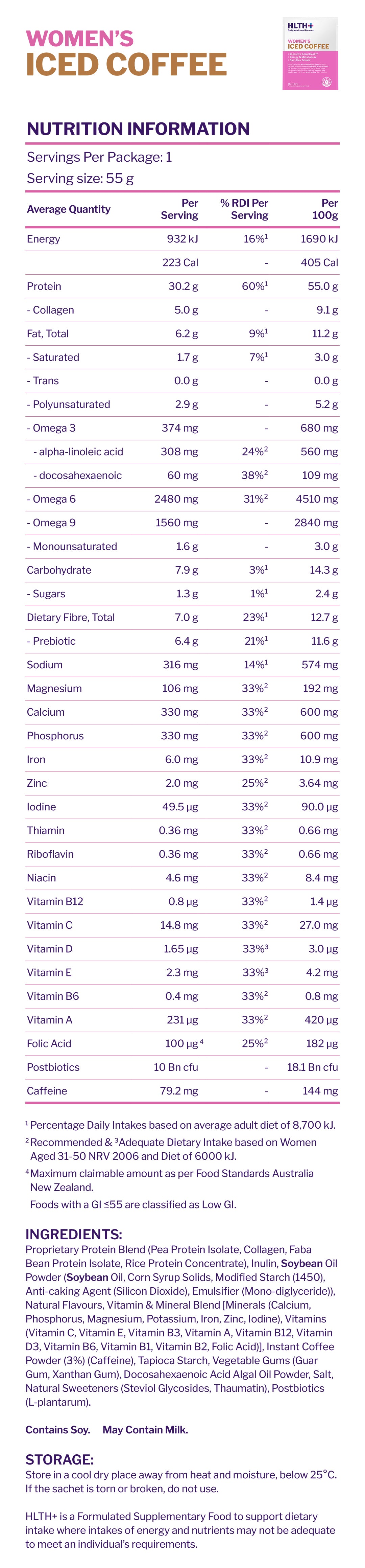
HLTH+ is Australian made and dietitian formulated, a Formulated Supplementary Food with 30g protein per serve, 7g dietary fibre and 30 essential daily nutrients in one sachet (55g in Women's), at RRP $6.00. It is formulated to the Nutrient Reference Values, published in 2006 by the National Health and Medical Research Council, the Australian Government Department of Health and Ageing and the New Zealand Ministry of Health, across Women's, Women's 50+, Men's and Men's 50+. The ✦ Find My Formula quiz shows what your current routine is not giving you: take the 30-second quiz.
Each serve has 30g protein, and protein contributes to the maintenance of muscle mass, as part of a healthy diet involving a variety of foods. On subscription the 28-serve pack works out at $5.10 a day. It is stocked at Chemist Warehouse online and on Amazon AU if that is easier than ordering direct.
Where to take it from here
If the question is your body composition, the sections above are the evidence, and your doctor or an Accredited Practising Dietitian is where to take it. If you are eating less and want protein, dietary fibre and 30 essential daily nutrients in one sachet beside your food, that is what HLTH+ is built for.
Find out what your current routine is missing. The 30-second quiz is diagnostic: it shows the gaps your current supplement stack leaves. Take the quiz.
Frequently Asked Questions
What does lean mass mean on a body composition scan?
On a dual-energy X-ray absorptiometry scan, lean mass is the soft tissue that is not fat and not bone: muscle, organ tissue and water. It is not the same as muscle. In a 2026 randomised trial, drinking 1,000 mL of water before a scan significantly raised the whole-body lean soft tissue estimate (Sergi et al).
Is lean mass loss only seen with the medication?
No. In the SURMOUNT-1 substudy, about 25% of the weight lost was lean mass in both the medication and placebo groups (Look et al, 2025). A 2026 meta-analysis of 20 randomised trials found 26.2% in lifestyle interventions, against 25% to 39% in the medication trials, with moderate heterogeneity between trials (Eisa and Barood).
How often should adults do strength training?
The Australian physical activity guidelines suggest that adults should do strength training at least 2 times a week (healthdirect, reviewed May 2025). In a 2026 systematic review of 34 randomised trials, adding exercise to calorie restriction left people with 0.87 kg more fat-free mass on average (Deller et al), measured in kilograms of lean mass rather than strength.
Which nutrients fell short in a study of 69 adults eating less on a prescribed medication?
A 3-day food record study of 69 adults found average dietary fibre intake of 14.5g a day against 28g recommended, with calcium, iron, magnesium and potassium also below reference intakes. It was cross-sectional, used US reference values and was funded by its authors' employer, a supplements retailer (Johnson et al, 2025).
Does this page replace advice from my doctor or dietitian?
No. This is general information, not medical advice. Decisions about any medication belong with your doctor, and an Accredited Practising Dietitian can review your intake. The figures here come from published trials and reviews, which describe groups of people on average and cannot say what is happening in your own body.
This article is general information, not medical advice. Decisions about any medication belong with your doctor.
Leave a comment
This site is protected by hCaptcha and the hCaptcha Privacy Policy and Terms of Service apply.