

Why am I tired all the time?
Being tired all the time usually has more than one cause, and the recognised ones are a short list: poor sleep, stress and low mood, infections, a physical condition such as anaemia or an underactive thyroid, some medicines, and a diet that falls short. Healthdirect, the government-funded health information service, adds that sometimes a cause is not found. If tiredness has lasted more than two weeks without improving, the next step is your doctor, not a supplement.
If you are reading this mid-slump, the worry is rarely the tiredness itself. It is what it might mean, and whether the answer is a nap, a blood test or a change in what you eat. Healthdirect names one sign worth noticing: a feeling of tiredness that does not get better with rest.
This page goes through the recognised causes, shows when to book the appointment, and then looks at the nutrient gaps that have Australian numbers behind them.
Healthdirect describes fatigue as feeling exhausted during or after your usual activities, or too depleted to start them. It groups the causes like this:
| Group | What healthdirect lists |
|---|---|
| Lifestyle | A busy schedule, lack of exercise, poor diet, poor sleep, too much caffeine, excessive alcohol use, other substance use |
| Stress and mood | Stress, anxiety, depression, grief |
| Infections | The flu, COVID-19, glandular fever |
| Physical conditions | Anaemia or iron deficiency, insomnia or obstructive sleep apnoea, an underactive thyroid or diabetes, cancer, heart failure and some other heart conditions, kidney disease, some autoimmune conditions |
| Medicines | Some medicines can cause fatigue |
The Better Health Channel (Victorian Department of Health) names the same families, including flu, glandular fever, chronic fatigue syndrome, thyroid disorders, heart disease and diabetes. None of this list is a diagnosis; it is the map a doctor works through.
If foggy thinking is the bigger complaint than tiredness, brain fog causes covers it separately.
Why am I tired even though I sleep enough?
Hours in bed and restful sleep are not the same thing. Healthdirect lists insomnia and obstructive sleep apnoea among the physical conditions behind fatigue, which matters if you sleep eight hours and still wake flat. The Better Health Channel passes on the Sleep Health Foundation's recommendation of 7 to 9 hours a night for adults aged 18 to 64, and says about one-third of Australians are thought to be sleep deprived.
A week of logged bedtimes and wake times answers the hours question. If the log looks fine and you still wake flat, say so to your doctor in those words, because your doctor will ask about your sleep and whether rest helps. Caffeine and alcohol sit on healthdirect's lifestyle list too, so note the late coffee and the evening drink in the same log.
Could stress, low mood or a recent infection be behind it?
Yes. Healthdirect lists stress, anxiety, depression and grief as things fatigue can be a symptom of, and the Better Health Channel says fatigue is a common symptom of mental health problems such as depression and grief. It also names workplace stress as a cause in its own right.
Infections are on the list too. Healthdirect names the flu, COVID-19 and glandular fever, and says long COVID can cause fatigue that lasts for months. If a bad virus preceded the slump by a few weeks, mention the date to your doctor.
Could a medical condition or a medicine be the reason?
Some of the causes on healthdirect's list are conditions that only a test or an examination can find: anaemia or iron deficiency, an underactive thyroid, diabetes, heart conditions, kidney disease and some autoimmune conditions. They are not rare. The Australian Bureau of Statistics' National Health Measures Survey 2022-24 found that 7.7% of adults had an abnormally low haemoglobin level, 10.5% of females against 4.8% of males, and notes that haemoglobin can be used to test for iron deficiency anaemia.
Anaemia itself has more than one cause: iron deficiency is one, and vitamin B12 deficiency is another.
Medicines can also be on the list. Healthdirect says some medicines can cause fatigue, so if the tiredness began around the time you started or changed one, raise it with the doctor who prescribes it. Do not change a prescribed medicine on your own.
This section is general information, not medical advice. Decisions about starting, changing or ending any medication belong with your doctor.
When should I worry about being tired all the time?
See your doctor if any of these apply. Healthdirect's advice is to see a doctor if you have fatigue for more than 2 weeks and it is not getting better, and sooner if it:
- is worrying you
- is getting in the way of the things you normally do
- comes with other symptoms, such as weight loss
The Better Health Channel is blunter: see your doctor for a diagnosis if you have chronic tiredness. The visit itself is practical. Your doctor asks what the tiredness feels like, how long it has lasted, how you sleep, what you eat and drink, and what medicines you take, then examines you and may recommend blood tests.
This page cannot tell you which cause applies to you, and it is not trying to. What it can do is make the appointment more useful, which is the point of the next section.
What vitamin deficiency causes tiredness?
Four nutrient gaps appear in Australian and UK health sources with tiredness among their signs: iron, vitamin B12, folate and vitamin D. Healthdirect is clear that the only reliable way of telling if you are iron deficient is an iron study blood test, and vitamin B12 deficiency and vitamin D deficiency are also diagnosed by blood test. The table sets out what each source states, and what the Australian figures say.
| Nutrient | Tiredness on the symptom list | Who the sources name | Australian measure |
|---|---|---|---|
| Iron | "Feeling fatigued (tired), listless and weak" (healthdirect); tiredness and poor concentration (ABS) | Females who have periods, pregnant and breastfeeding people, teenagers, especially females (healthdirect) | 5.6% of females and 0.9% of males had a ferritin level under the WHO cut-off (ABS 2022-24); 26.8% of females and 8.2% of males had an inadequate iron intake from food and drink (ABS 2023) |
| Vitamin B12 | Fatigue and weakness, anaemia, numbness or tingling in the hands and feet, memory problems or balance difficulties (healthdirect) | Older adults, people who follow a vegetarian or vegan diet, people with pernicious anaemia, people taking certain medicines, people who have had bariatric surgery (healthdirect) | 13.9% of females and 5.6% of males had an inadequate intake from food and drink (ABS 2023) |
| Folate | Fatigue (healthdirect); "feeling weak or tired" (NHS, on vitamin B12 or folate deficiency anaemia) | Pregnant people, people with alcohol dependence, people with malabsorption conditions such as coeliac disease, people on restrictive diets (healthdirect) | 13.8% of adult females and 5.8% of adult males had an inadequate intake from food and drink, and 18.9% of females aged 18 to 29 (ABS 2023) |
| Vitamin D | "Mild bone pain, muscle weakness, tiredness", and often no symptoms at all (healthdirect) | People who stay indoors a lot, cover their skin for work or cultural reasons, have naturally dark skin, or are pregnant or breastfeeding (healthdirect) | 20.6% of adults were vitamin D deficient, highest at 29.2% for ages 18 to 29 (ABS 2022-24) |
Read the last column with care. Ferritin and vitamin D are blood measurements, so those two figures are the closer to a diagnosis. The intake figures count food and drink only, leave out supplements, and describe an intake below the average requirement, which is not the same thing as a deficiency.
The signs overlap, so a single symptom cannot tell you which gap, if any, applies, and the numbers above are what to ask your doctor about. Symptoms, causes and testing for vitamin B12 deficiency have their own page.
Can eating less leave you short on nutrients?
It can, and the arithmetic is simple. Calories and nutrients arrive in the same food, so when a day's eating shrinks, both shrink with it. Healthdirect lists poor diet among the lifestyle causes of fatigue, and the ABS notes that inadequate iron intake may lead to iron deficiency, which can cause tiredness and poor concentration.
The starting point matters. Over 90% of Australian adults do not meet dietary guidelines (AIHW), so for most people a smaller diet is a smaller version of one that was already short.
Eating less happens for plenty of reasons: a busy month, a lost appetite, a deliberate deficit, or rapid weight loss, reduced eating and medically induced weight loss. Where the cause is a medicine, the size of the drop has been measured: in a 12-week crossover trial of 30 adults with obesity, people taking a GLP-1 medicine ate about 24% fewer calories across the day's freely chosen meals than on placebo (Blundell et al, 2017).
Which nutrients thin out first is covered in the vitamins that fall away when you eat less. If breakfast is the meal that went first, healthy breakfast on the go covers quick options.
General information, not medical advice. Decisions about any medication belong with your doctor.
Where does a Formulated Supplementary Food sit beside food?
How HLTH+ fits a smaller day of eating: nutrition support when calories drop.
HLTH+ is a Formulated Supplementary Food under the FSANZ Food Standards Code, made in Australia in facilities that comply with Good Manufacturing Practice. It exists to support dietary intake when calories and nutrients may not be adequate to meet an individual's requirements. The approach is food first, and the AIHW figure above says food alone is not getting most people there, so this is nutritional insurance underneath a food-first plan.
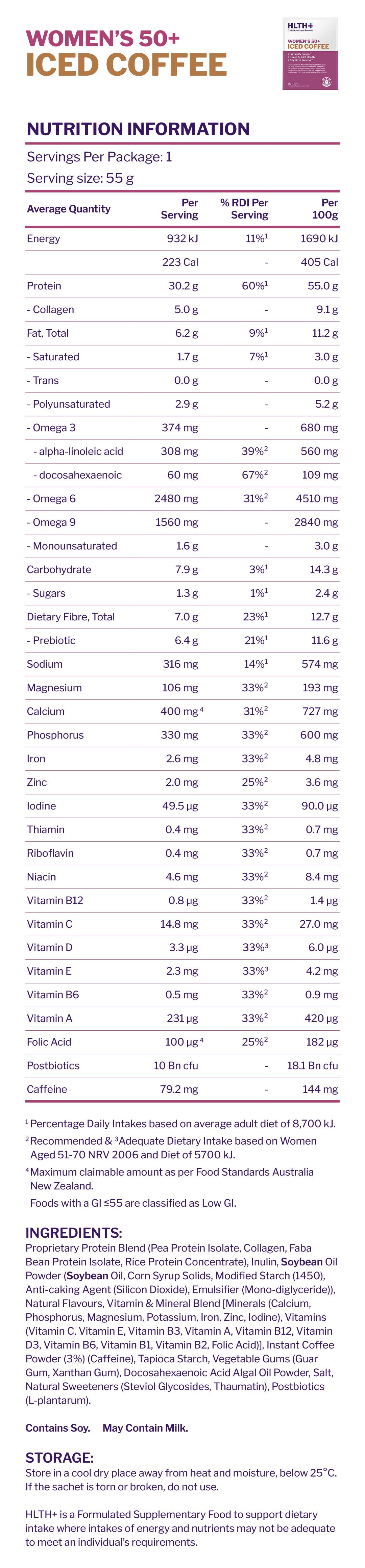
Each serve carries 30 essential daily nutrients, counted across protein, dietary fibre, vitamins, minerals, collagen and DHA. That includes 30g protein per serve and 7g dietary fibre, in a 55g sachet in the Women's formulas.
The range is dietitian formulated by gender and life stage, as Women's, Women's 50+, Men's and Men's 50+. Each one is formulated to the Nutrient Reference Values published by the National Health and Medical Research Council, the Australian Government Department of Health and Ageing and the New Zealand Ministry of Health, because needs shift at 30, at 50 and again at 70.
RRP $6.00. On subscription, 28 serves at $142.80 comes to $5.10 a day and 14 serves at $75.60 comes to $5.40 a day, with pause, skip or cancel at any time. It is sold at hlthplus.com, through the HLTH+ Amazon AU store and at Chemist Warehouse online.
If you want 30g protein per serve, 7g dietary fibre and a balanced multivitamin profile in one sachet beside a food-first plan, that is where HLTH+ sits.
The ✦ Find My Formula quiz shows what your current routine is not giving you, and it takes 30 seconds.
Learn more about whether a daily multivitamin is worth taking and how to choose a multivitamin for women.
Frequently Asked Questions
Is it normal to be tired all the time?
Fatigue is very common, but tiredness that does not improve with rest is worth checking. Healthdirect says to see your doctor if it lasts more than 2 weeks and is not getting better, and sooner if it is worrying you, getting in the way of daily activities or comes with other symptoms such as weight loss.
How do I find out why I am always tired?
Start with your doctor, who will ask about your symptoms, sleep, diet, lifestyle and medicines, and examine you. Depending on what they find, they may recommend blood tests. Healthdirect notes that an iron study is the only reliable way to tell whether you are iron deficient, and vitamin B12 and vitamin D are also confirmed by blood test.
Who is most likely to be low in iron?
Healthdirect names children, teenagers (especially females), females who have periods, and people who are pregnant or breastfeeding. In the ABS National Health Measures Survey 2022-24, 5.6% of adult females had a ferritin level under the WHO cut-off, against 0.9% of adult males. Only an iron study blood test confirms iron deficiency.
Can caffeine or alcohol make you more tired?
They can be part of the picture. Healthdirect lists too much caffeine and excessive alcohol use among the lifestyle causes of fatigue, and the Better Health Channel names alcohol or drugs as well. Noting when you have your last coffee and how much you drink each week gives your doctor something concrete to work with.
Can not eating enough make you tired?
Healthdirect lists poor diet among the lifestyle causes of fatigue, and the ABS notes that inadequate iron intake may lead to iron deficiency, which can cause tiredness. A smaller diet carries fewer nutrients along with the calories. Over 90% of Australian adults already do not meet dietary guidelines (AIHW).
This article is general information, not medical advice. Decisions about any medication belong with your doctor.

Leave a comment
This site is protected by hCaptcha and the hCaptcha Privacy Policy and Terms of Service apply.