

You cannot prevent loose skin after weight loss with certainty, because the research has not shown which of the named factors decides how much you get. A scoping review of 24 studies concluded that evidence is lacking to determine which adults are at heightened risk of developing excess skin (Baillot et al, Obesity Surgery, 2017). What you can do is act on the parts that are within your control, and know which parts are not.
If you are partway through losing weight, the worry is probably already there, and most pages that answer it promise a method without a source. Loose skin is not a measure of effort, and nothing in the research says it is.
This page sorts the factors into what you can influence and what you cannot, says what each source found, and says plainly where the evidence stops.
If skin has already loosened, what the options are and what each source states has its own page, and so does why skin loosens in the first place.
Can you prevent loose skin when you lose weight?
Not with certainty, and no source read for this page says otherwise. Excess skin follows bariatric surgery in more than 70% of adults, and the same review reports that evidence is lacking on who is at heightened risk of it (Baillot et al, 2017). Its authors call for more research on the correlates of excess skin to inform tailored interventions for those more vulnerable.
Nearly all of that research comes from people who had bariatric surgery, because a large loss and a fixed surgery date make skin easy to track over time. None of the sources read measured skin after a smaller, slower loss, so this page makes no prediction for one.
Any page that offers a guaranteed method is offering more than the studies do. What follows is narrower and easier to defend: the factors the sources name, which of them you can influence, and what each source states about them.
The table below sorts them, and the sections after it start with the advice repeated most often: pace.
Which factors affect how much loose skin you get, and which can you influence?
A 2024 histology study lists the factors presumed to influence the ability of the skin envelope to contract: the rate and amount of weight loss, age, smoking habits, sun exposure and genetic predisposition (Hany et al, Obesity Surgery, 2024). "Presumed" is the authors' word, and the list sits in the paper's introduction, not among its findings. What a stretched dermis looks like under the microscope is covered in why skin loosens after weight loss.
| Factor | Can you influence it? | What the sources state |
|---|---|---|
| Amount of weight lost | In part: set with your doctor | On the presumed list (Hany et al, 2024); the 24-study scoping review found its findings on weight loss inconclusive (Baillot et al, 2017) |
| Rate of weight loss | In part: set with your doctor | On the presumed list (Hany et al, 2024); the scoping review's abstract reports no finding on rate (Baillot et al, 2017) |
| Age | No | On the presumed list (Hany et al, 2024); scoping review findings inconclusive (Baillot et al, 2017) |
| Genetics | No | On the presumed list (Hany et al, 2024) |
| Sex | No | In the scoping review, women reported more excess skin, and more inconvenience from it, than men (Baillot et al, 2017) |
| Sun exposure | Yes | On the presumed list (Hany et al, 2024); the Better Health Channel names UV radiation from sunlight as the major factor in wrinkling skin in Australians |
| Smoking | Yes | On the presumed list (Hany et al, 2024); the Better Health Channel states that smokers will have more wrinkles |
The two "yes" answers carry a caveat. The Better Health Channel lines are about wrinkling, not loose skin after weight loss, and no source read tests sun exposure or smoking against skin retraction. They are marked "yes" because they are the items on the list a person can change, not because a trial shows that changing them spares skin.
Time since weight loss is the other variable people ask about; whether loose skin settles with time, and the options if it does not has its own page.
Does losing weight slowly prevent loose skin?
It is the advice repeated most often, and it is a presumed factor rather than a demonstrated one. The rate of weight loss is on the Hany list, the scoping review found the evidence inconclusive for correlates such as age and weight loss and its abstract reports no finding on rate, and none of the sources read gives a pace that spares skin, so this page gives no target pace (Hany et al, 2024; Baillot et al, 2017).
That holds for rapid weight loss, reduced eating and medically induced weight loss alike, including weight lost by people on GLP-1 medications: none of the sources read compares skin outcomes by pace. How fast to lose is a decision for you and your doctor, and the skin evidence is not strong enough to set it. Learn more about what fast weight loss does to muscle and nutrient intake, or about what is happening when the scale stalls.
Does strength training change how much loose skin you get?
The training sources read describe muscle, not skin. Adults should do strength training at least 2 times a week (healthdirect, reviewed May 2025), and "muscle cells respond to continuous resistance training by increasing in size (hypertrophy)" (Better Health Channel, reviewed July 2022). Neither page tests whether more muscle under loose skin changes how it looks.
The nearest research is a 2026 review of prehabilitation: exercise, nutritional support and psychological support started before bariatric surgery and carried through to body contouring surgery. It reported that this preparation may improve weight-loss durability, body composition and candidacy for body contouring, and that further research is needed to define standardised protocols and determine their effectiveness (Campbell et al, Plastic and Reconstructive Surgery Global Open, 2026). Its abstract discusses fitness, body composition and surgical candidacy; it reports no skin outcome.
Protein is the nutrient with a muscle statement behind it. Protein contributes to the maintenance of muscle mass and to the growth of muscle mass, as part of a healthy diet involving a variety of foods. That sentence is about muscle; no source read tests protein intake against loose skin, so none is claimed here.
The muscle side goes further in how much protein to build muscle and in sarcopenia, the loss of muscle with age.
Eating less than you used to? Learn more about keeping nutrition up on a smaller plate.
Do sun protection and not smoking make a difference to skin?
For wrinkling, the Better Health Channel says yes; for loose skin after weight loss, none of the sources read tests it. The Better Health Channel states that "UV radiation from sunlight is the major factor in wrinkling skin in Australians", that "smokers will have more wrinkles", and that "if you limit sun exposure and avoid smoking, you can reduce the amount of wrinkles you develop" (Better Health Channel, Wrinkles, produced with Sinclair Dermatology, reviewed October 2023). Sun exposure and smoking also appear on the presumed-factor list above (Hany et al, 2024).
Cancer Council Australia's Slip, Slop, Slap, Seek, Slide steps are the practical version (Cancer Council Australia):
- Slip on a shirt.
- Slop on sunscreen.
- Slap on a hat.
- Seek shade.
- Slide on wraparound sunglasses.
If you smoke, your GP can talk through your options. Whether either step changes skin retraction after weight loss is not tested in the sources read.
Can a cream, food or supplement change how much loose skin forms?
None of the sources read for this page tested a cream, oil, food or supplement for this purpose. We searched PubMed on 6 October 2026 for trials of creams, topical products and oral supplements on excess skin or skin laxity after weight loss, and found no trial that tested one. A product marketed for this has no trial behind it that we could find.
For skin that has already formed, the authors of a 2018 systematic review state that these skin deformities after massive weight loss cannot be resolved by modifications in lifestyle, diet and exercise (Toma et al, Obesity Surgery, 2018). Dietary collagen has its own page: collagen for skin.
Negative physical impacts of excess skin were reported in 67% of the studies in the scoping review, psychosocial impacts in 75% and daily-life impacts in 83% (Baillot et al, 2017). Skin that chafes, gets rashes or gets in the way of moving is worth a GP appointment, whatever the cause.
This article is general information, not medical advice. Decisions about any medication belong with your doctor.
When you are eating less, what happens to your nutrition?
This part is about the plate, not the skin. When calories drop, whether through a planned deficit, a smaller appetite, or rapid weight loss, reduced eating and medically induced weight loss, the protein, dietary fibre, vitamins and minerals the missing food carried drop with it. Over 90% of Australian adults do not meet dietary guidelines (AIHW), so most people start eating less from a diet that already falls short.
We believe in a food-first approach, and a smaller plate built around protein-rich whole foods comes first. The statistics say food first is not closing the gap on its own, and that gap is what nutritional insurance is for.
How HLTH+ compares
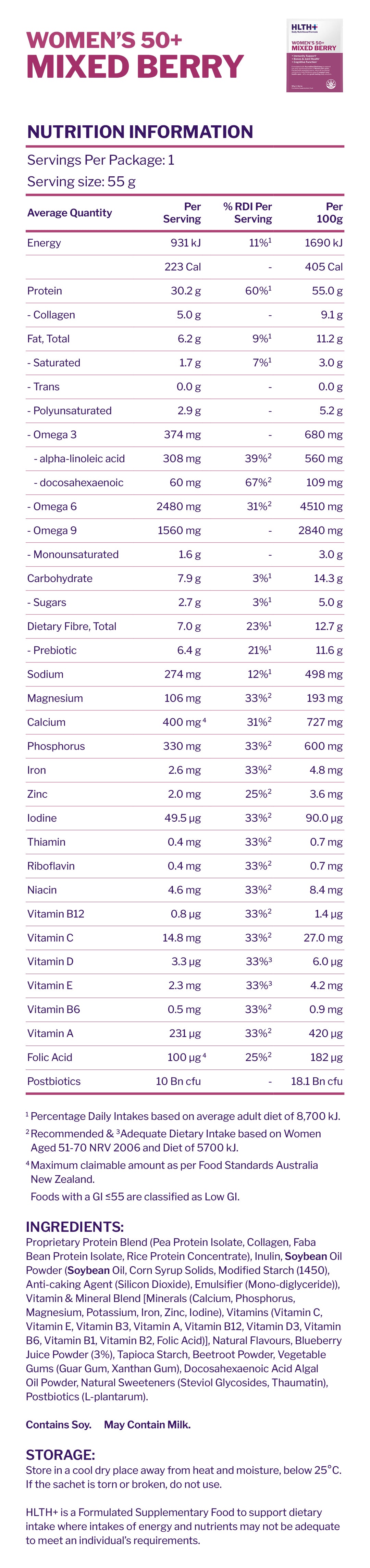
HLTH+ is a Formulated Supplementary Food made to sit beside meals: each sachet (55g in Women's) holds 30g protein per serve, 7g dietary fibre and 30 essential daily nutrients, at RRP $6.00. The Women's, Women's 50+, Men's and Men's 50+ formulas are each built to the Nutrient Reference Values set out in 2006 by the National Health and Medical Research Council, the Australian Government Department of Health and Ageing and the New Zealand Ministry of Health. The ✦ Find My Formula quiz shows what your current routine is not giving you: take the 30-second quiz.
HLTH+ is Australian made, in facilities that comply with Good Manufacturing Practice. A 28-serve subscription comes to $5.10 a day, and for anyone who would rather buy through a retailer it is on Amazon AU and Chemist Warehouse online.
Who it suits
If what you want answered is the skin, start with the evidence above and your GP. If you are eating less and want 30g protein, 7g dietary fibre and 30 essential daily nutrients from one sachet alongside your meals, HLTH+ is made for that job.
Not sure what your current routine covers? The 30-second quiz is diagnostic: it shows what your supplement stack leaves out, so you can see the gaps instead of guessing at them. Take the quiz.
Frequently Asked Questions
Does protein intake change how much loose skin you get?
No source read tested it. Protein contributes to the maintenance of muscle mass and to the growth of muscle mass, as part of a healthy diet involving a variety of foods; that statement is about muscle. A PubMed search on 6 October 2026 found no trial of protein, diet or nutrition against excess skin after weight loss.
How common is loose skin after weight loss?
After bariatric surgery, excess skin affects more than 70% of adults, according to a scoping review of 24 studies (Baillot et al, 2017). That figure comes from adults who had surgery for severe obesity. None of the studies read for this page measured skin after a smaller loss, so there is no comparable figure for one.
When should you see a GP about loose skin?
When excess skin chafes, gets rashes or limits movement, or when it is affecting how you feel day to day. A scoping review of 24 studies found negative physical impacts reported in 67% of studies and psychosocial impacts in 75% (Baillot et al, 2017). Your GP can explain what is realistic and talk through referral options.
Who is most likely to get loose skin after weight loss?
Women reported more excess skin and greater inconvenience from it than men in a scoping review of 24 studies after bariatric surgery. Pre-surgery BMI, time since surgery and type of surgery were not significantly associated with how troubled people were by it, and findings on age and weight loss were inconclusive (Baillot et al, 2017).
This article is general information, not medical advice. Decisions about any medication belong with your doctor.
Leave a comment
This site is protected by hCaptcha and the hCaptcha Privacy Policy and Terms of Service apply.