
Protein powder is a food. It adds protein, and some calories, to the day, and no label can make it act on body fat by itself. What the research does measure is narrower: how a higher-protein diet behaves when calories are already lower.
If you are standing in the aisle comparing tubs, or scrolling past a dozen pages that each name a winner, the real question is what any of it adds up to. Most pages skip the numbers behind the claims and go straight to a ranking.
This page sets out what the trials measured, what a powder cannot do, how to read a label, and how four types of powder compare on their own published panels.
Is protein powder good for you when trying to lose weight?
It depends on the diet around it, and the research on it is careful. A 2015 review in the American Journal of Clinical Nutrition found that short, tightly controlled feeding studies showed greater weight loss, fat mass loss and preservation of lean mass on higher-protein, calorie-restricted diets than on lower-protein ones, while longer studies produced limited and conflicting findings (Leidy et al, American Journal of Clinical Nutrition, 2015). The authors point to dietary compliance as the main reason for the mixed results: improvements showed up in people who stuck to the prescribed higher-protein diet.
Notice what is being compared. These are diets, built from food and measured under supervision, not a tub of powder against no tub. The abstract does not name a powder, a brand or a product type, and nothing in this page claims that any of them were tested.
Over 90% of Australian adults do not meet dietary guidelines (AIHW). Eating less often begins from that shortfall, and whether anyone needs a powder at all has a page of its own: do I need protein powder.
Can protein powder help you lose weight?
A powder does not act on fat. It supplies protein and calories, and the research above is about the protein, in a diet, over weeks. The Better Health Channel, a Victorian Department of Health service, states that any protein you eat on top of what your body needs is either excreted or stored as weight gain (Better Health Channel, Protein).
So what do the hormone and metabolism lines on some labels and ads rest on? The 2015 review describes a modest satiety effect, greater perceived fullness and elevated satiety hormones after higher-protein meals, and states that the acute feeding trials do not support an effect on energy intake at the next eating occasion (Leidy et al, 2015). That is the measured size of the effect, and a label that says more than that needs its own source.
There is a second body of evidence on what is kept while calories are low. In a 2020 meta-analysis of 18 randomised trials, intakes of protein above the recommended dietary allowance were linked with 0.36 kg less lean mass lost during energy restriction (14 comparisons, 95% CI 0.06 to 0.67), while people who were not restricting or training saw no significant difference (Hudson et al, Advances in Nutrition, 2020).
That result is a weighed amount of lean tissue, not a measure of strength or of fat. For what exercise adds while eating less, what the scale hides about muscle goes through the body-composition studies one by one.
What does a protein powder label actually show?
A label is a short list of facts, and four of them do most of the work. The numbers below are each brand's own published panel.
- Protein per serve, and the serve itself. A 30g scoop and a 56g serve are different amounts of powder, so compare grams of protein per serve and then check the serve size beside it.
- Calories or kilojoules. The three brand panels in the table below run from 428 kJ to 850 kJ a serve, which is the part of the label that adds to a day's total.
- Sugars and sweeteners. The panel shows sugars; the ingredient list shows which sweeteners were used. Nuzest's Smooth Vanilla lists "Natural sweetener (Thaumatin)" and The Man Shake's Chocolate lists "Sweetener (Sucralose)".
- Dietary fibre and allergens. Some panels carry no dietary fibre row at all, and the allergen line sits separately from the ingredient list.
Two further checks are worth thirty seconds: is the protein from one source or a blend, and does the panel list amino acids? The Better Health Channel describes animal and dairy proteins, soy and quinoa as rich in every essential amino acid, and other plant proteins as containing all of them, though one or two may be low (Better Health Channel, Protein). A complete protein is one that carries every one of the nine essential amino acids, so check any label for it.
For the wider picture on food and a reduced appetite: learn more.
What protein powder contains 30 grams of protein per serve?
Four label types sit under the heading "protein powder", and the Food Standards Code defines two of them, the formulated meal replacement and the Formulated Supplementary Food (Standard 2.9.3, Food Standards Code). Here is one published panel from each type, per serve.
| Type | Label read | Serve | Protein | Dietary fibre | Sugars | Energy as published |
|---|---|---|---|---|---|---|
| Whey protein isolate | Bulk Nutrients WPI, Chocolate flavour | 30g scoop | 25.5g | Not listed on the panel | 0.4g | 480 kJ |
| Plant protein, single source (pea protein isolate) | Nuzest Clean Lean Protein, Smooth Vanilla flavour | 25g serve | 20g | 0.3g | 0.2g | 102 Cal (428 kJ) |
| Sold as a meal replacement | The Man Shake, Chocolate | 56g | 30.9g | 7.4g | 1.9g | 850 kJ (203 cal) |
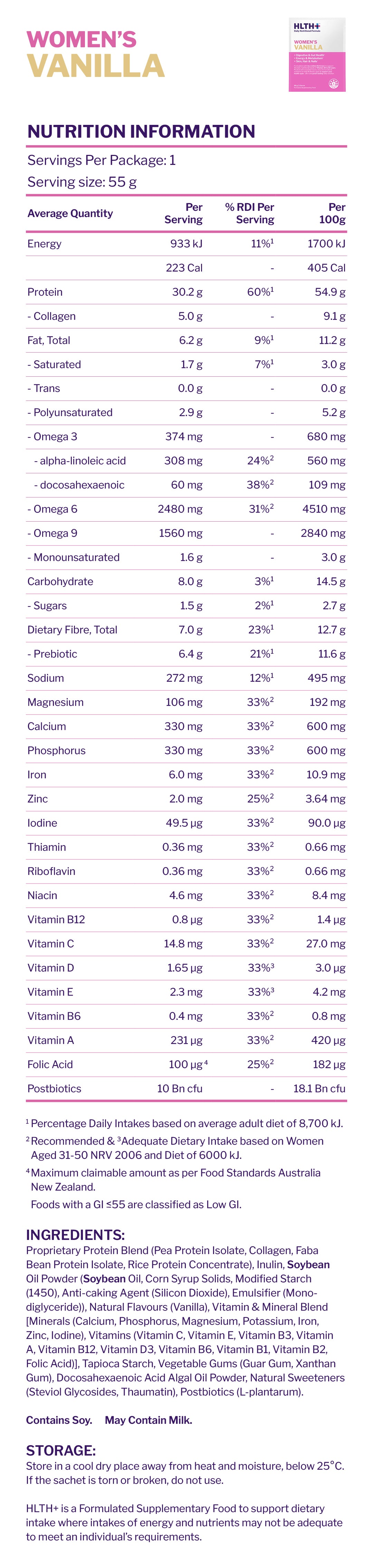
| Formulated Supplementary Food for topping up a diet, not a meal replacement | HLTH+, Women's | 55g sachet | 30g | 7g | 1.5g | 223 calories |
Every figure above is a brand's own published panel, read on 13 October 2026; labels change, so check the current one before buying. Serves differ in size, which is why the table reads across a row and not down a column.
Whey isolate is a concentrated protein source with a short panel. The Man Shake page sells its product as a meal replacement, and it lists 30.9g protein and 7.4g dietary fibre per 56g serve. HLTH+ is a Formulated Supplementary Food that contains soy.
The heading's question has a plain answer in the table: the two multi-ingredient products do, and a single-source isolate reaches 20g to 25.5g in a 25g to 30g scoop. Pea isolate and whey isolate are built differently, so their amino acid make-up differs; the Better Health Channel passage above is the generic guide, and this page does not rank them. For the range of tubs on Australian shelves, best protein powder Australia and best protein powder for women read many more labels.
How does HLTH+ compare?
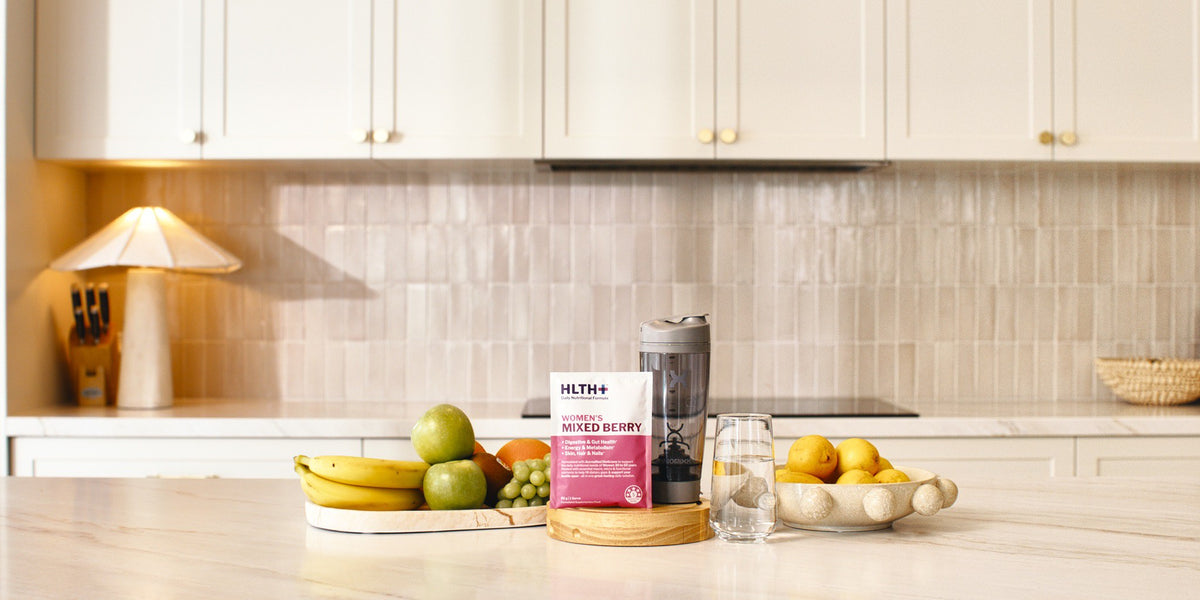
HLTH+ sits beside the powders in the table as a Formulated Supplementary Food, and it is Australian made and dietitian formulated. The Women's sachet weighs 55g and is priced at RRP $6.00, with dietary fibre (7g), 30g protein and 30 essential daily nutrients inside. The ✦ Find My Formula quiz shows what your current routine is not giving you. Start with the quiz.
How do people use a powder when eating less?
Every use of a powder comes down to a gap in the day. With less food on the plate, what it carried goes missing too: protein, dietary fibre and micronutrients, and a serve covers part of that gap; the honest use is a serve where a meal was skipped. Weight loss shakes compares shakes sold for that purpose, and meal replacement shake vs protein shake separates the two categories by their panels.
For breakfast the same logic applies on a smaller scale, and protein shake for breakfast works through it. How much protein per sitting is worth aiming for is a separate matter, and the page on how much protein to build muscle has those numbers.
Where does HLTH+ fit in a day of eating less?
What a serve of HLTH+ carries
A serve of HLTH+ brings 30g protein, 7g of dietary fibre and a balanced multivitamin profile, and the flavour is sweetened without artificial sweeteners. HLTH+ is formulated to the Nutrient Reference Values of 2006, developed by the National Health and Medical Research Council, the Australian Government Department of Health and Ageing and the New Zealand Ministry of Health. Every life stage has a formula of its own: Women's, Women's 50+, Men's and Men's 50+.
Daily cost: $142.80 across 28 serves is $5.10 a day; $75.60 across 14 is $5.40 a day. You can also find it through Chemist Warehouse online or the HLTH+ store on Amazon AU.
The meal replacement question
As for meals, it is not designed as a meal replacement because it complements a food-first approach; but it works fine as a healthy snack or to tie you over.
Where to take it from here
If you want a concentrated protein with a short panel, a whey isolate is that; if you want a single-source plant powder, pea isolate is that; if you want a balanced multivitamin profile, dietary fibre and protein together in a single sachet beside your food, HLTH+ is that.
See what your supplement stack is not covering. The quiz takes 30 seconds and maps the gaps. Take the quiz.
When is it worth talking to a professional?
This article is general information, not medical advice. Decisions about any medication belong with your doctor.
Dietitians can read a food record, a goal and a label together, which no page can do. An Accredited Practising Dietitian is the person to ask if your intake has dropped sharply, if you are managing a medical condition, or if you are unsure what a powder would add to your week. If the reason you are eating less is a prescribed medication of the GLP-1 class, your prescriber is the one to ask about it.
Frequently Asked Questions
How many grams of protein does one serve of powder carry?
It varies with the serve size. In the four panels read for this page it ranged from 20g in a 25g scoop of pea protein isolate to 30.9g in a 56g serve of a meal replacement shake, with a whey isolate at 25.5g per 30g and HLTH+ at 30g per 55g sachet.
Does protein powder have calories?
Yes. It is a food, and the panel lists its energy. The products read for this page published 480 kJ for a 30g scoop of whey isolate, 428 kJ (102 Cal) for a 25g scoop of pea protein isolate and 850 kJ (203 cal) for a 56g meal replacement serve; HLTH+ lists 223 calories in a Women's sachet.
Do the studies on higher-protein diets test protein powders?
The abstracts of the two reviews cited here describe protein intakes and calorie-restricted diets, not a named powder or product type. The 2015 review covers diets and feeding trials; the 2020 meta-analysis covers protein intakes above the recommended dietary allowance. That is why this page reports them as results for protein, not for any tub.
Does it matter whether a powder is whey or plant?
Both supply protein, but their amino acid amounts differ. The Better Health Channel describes animal and dairy proteins as rich in every essential amino acid and other plant proteins as sometimes low in one or two. This page does not rank them for any goal; the label and a dietitian are the guide.
Should I talk to a professional before adding a powder?
If you take prescribed medication, have a medical condition, or have cut your intake sharply, a dietitian or your doctor is the right first conversation. They can read your intake and your label together. What a powder adds depends on the rest of your diet.
This article is general information, not medical advice. Decisions about any medication belong with your doctor.
Leave a comment
This site is protected by hCaptcha and the hCaptcha Privacy Policy and Terms of Service apply.