

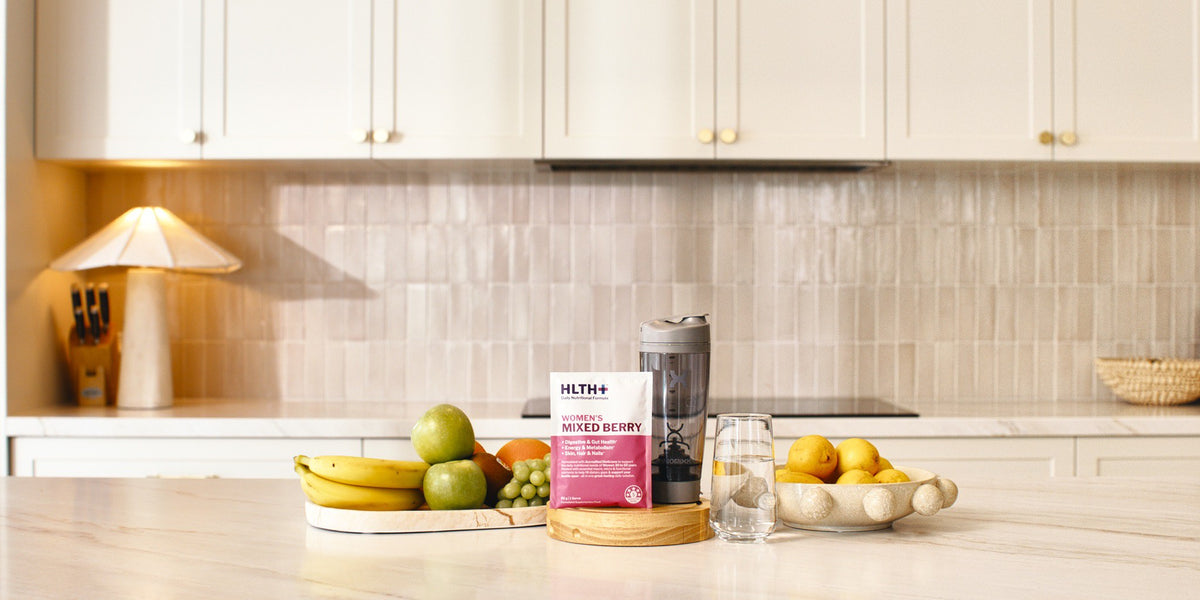
Protein pudding is a chilled dessert whose protein comes from its base, and in every recipe here that base is a HLTH+ sachet (30g protein per serve). Set with cornflour it reaches 37.0g in a 265g serve; stirred with chia seeds it reaches 43.5g in a 325g serve.
A protein figure with no working is a guess, and a pudding that comes out runny or gritty is a ratio problem rather than a failure on your part. Below are the two base recipes, their flavours and swaps, the texture fixes, and the sums behind every number.
What are protein puddings made of?
A protein pudding is a milk or yoghurt base, thickened with starch, chia or gelatine, with protein added from a powder, from dairy or from both. Release 3.0 of the Australian Food Composition Database (AFCD, from Food Standards Australia New Zealand, read on 13 October 2026) lists 3.6g of protein per 100g for a homemade chocolate pudding and 3.5g for regular vanilla custard, so the protein has to come from somewhere other than the dessert itself.
Each recipe starts from the label figures for one Women's sachet (30g protein, 7g dietary fibre, 1.5g sugars, 55g) and adds every other ingredient at its database value, scaled to the amount used. Liquids are weighed as if 1mL were 1g, which undercounts slightly, since the database gives milk a specific gravity of 1.04 and soy beverage 1.03. Each sum is added in full and rounded once at the end, so a printed total can differ from its parts by 0.1g.
| Food (database entry) | Protein per 100g | Dietary fibre per 100g | Total sugars per 100g |
|---|---|---|---|
| Chia seeds, dried | 23.8g | 33.2g | 0.7g |
| Natural yoghurt, regular fat | 5.3g | 0.1g | 5.1g |
| Reduced-fat milk (about 1% fat) | 3.5g | 0g | 5.0g |
| Soy beverage, regular fat, added calcium | 3.8g | 0.6g | 2.7g (1.8g added) |
| Mixed berries, frozen | 0.6g | 3.3g | 9.2g |
| Cornflour, from maize starch | 0.4g | 0g | 0g |
| Homemade chocolate pudding | 3.6g | 1.1g | 23.4g (21.1g added) |
| Regular vanilla custard | 3.5g | 1.3g | 13.8g (8.4g added) |
Drinks and bars lean on the same numbers, and protein smoothie recipes and high-protein snacks show the sums for those.
How do you make a chocolate protein pudding that sets?
This is the stovetop version: cornflour thickens the milk, and the sachet goes in once the pan is off the heat. It makes one serve of 265g and contains dairy.
Ingredients: 1 HLTH+ Chocolate sachet (55g), 200mL reduced-fat milk, 10g cornflour.
- Whisk the cornflour into the cold milk in a small saucepan until no dry lumps remain.
- Heat gently, stirring the whole time, until it thickens, then take it off the heat and let it cool until warm rather than hot.
- Whisk in the sachet until smooth, pour into a glass or ramekin, cover, and chill for at least 2 hours.
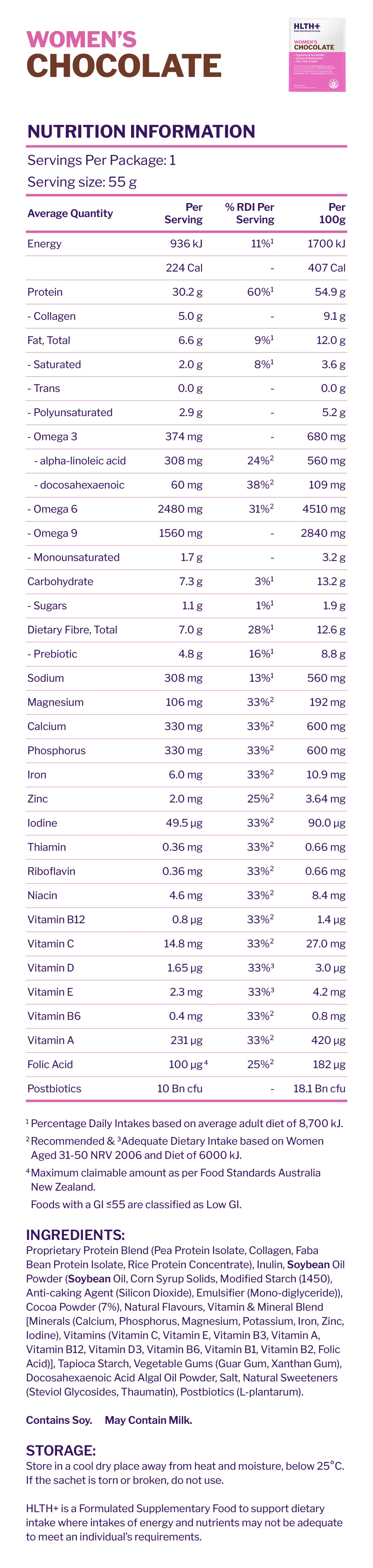
Protein in the bowl: sachet 30g, milk 7.0g, cornflour 0.04g, giving 37.0g.
Dietary fibre in the bowl: sachet 7g, milk 0g, cornflour 0g, giving 7.0g.
Sugars in the bowl: sachet 1.5g, milk 10.0g, cornflour 0g, giving 11.5g total. The database records no added sugars in the milk or the cornflour, and the sachet has no added sugar.
Dairy-free version: use 200mL of soy beverage in place of the milk. Protein then totals 30g + 7.6g + 0.04g = 37.6g, dietary fibre 7g + 1.2g = 8.2g, and sugars 1.5g + 5.4g = 6.9g, with 3.6g of that recorded as added sugars in the soy entry. Soy is in the sachet's blend too, so this swap keeps soy in the bowl.
If you avoid gluten, read the cornflour packet. The database lists one cornflour made from maize starch, which is the entry used here, and another made from maize and wheat starch.
Iced Coffee set pudding
Use the same quantities with a HLTH+ Iced Coffee sachet in place of the Chocolate one. The Iced Coffee flavour contains caffeine. Method, chill time and sums are unchanged: 2 hours in the fridge, 37.0g of protein, 7.0g of dietary fibre and 11.5g of total sugars in 265g.
Cooking for an appetite that has shrunk? More on the nutrition side of eating less →
How do you make protein chia pudding with a sachet?
The chia version needs no stove. You shake the sachet into milk, let the seeds swell, and chill; the 33.2g of dietary fibre per 100g in the chia row is the same figure used in fibre-rich foods. This Vanilla recipe makes one serve of 325g and contains dairy.
Ingredients: 1 HLTH+ Vanilla sachet (55g), 250mL reduced-fat milk, 20g chia seeds.
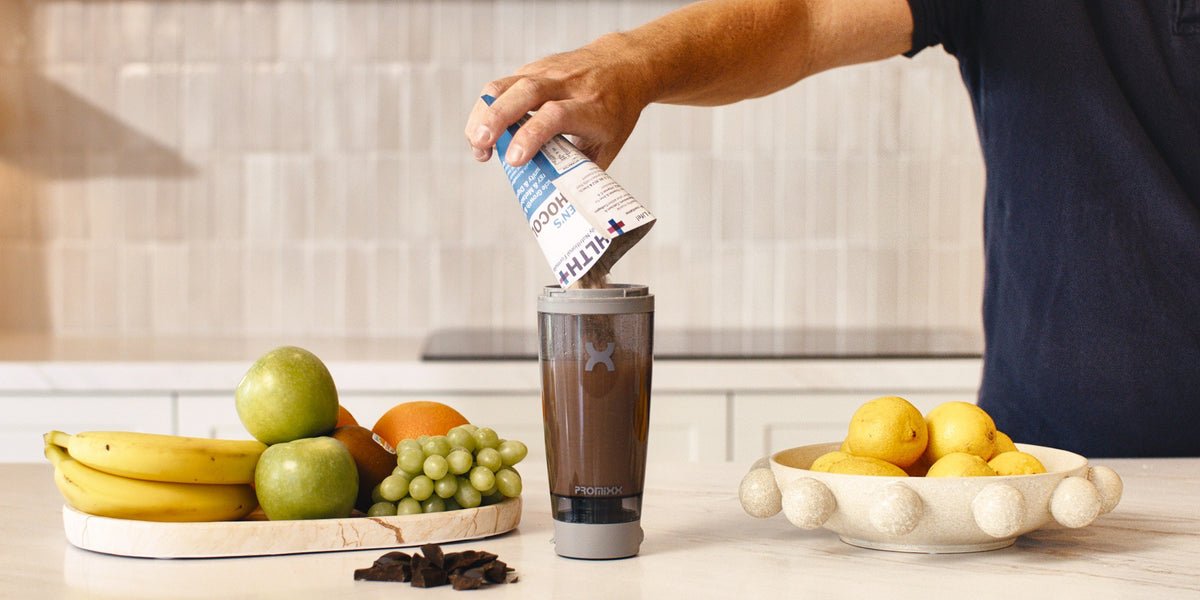
- Shake or whisk the sachet and milk until completely smooth.
- Stir in the chia, leave it for 10 minutes, then stir again so the seeds do not set in clumps.
- Cover and chill for at least 4 hours; overnight is easier to plan around.
Protein in the jar: sachet 30g, chia 4.76g, milk 8.75g, giving 43.5g.
Dietary fibre in the jar: sachet 7g, chia 6.64g, milk 0g, giving 13.6g.
Sugars in the jar: sachet 1.5g, chia 0.14g, milk 12.5g, giving 14.1g total, with no added sugars recorded for the chia or the milk.
Dairy-free version: use 250mL of soy beverage. Protein then totals 30g + 4.76g + 9.5g = 44.3g, dietary fibre 7g + 6.64g + 1.5g = 15.1g, and sugars 1.5g + 0.14g + 6.75g = 8.4g, with 4.5g of that recorded as added sugars in the soy entry.
Mixed Berry chia pudding
Make the Vanilla recipe with a HLTH+ Mixed Berry sachet, then spoon 80g of frozen mixed berries, thawed, over the top once it has set. It makes 405g, takes the same 4 hours or overnight in the fridge, and still contains dairy through the milk.
Protein in the jar: sachet 30g, chia 4.76g, milk 8.75g, berries 0.48g, giving 44.0g.
Dietary fibre in the jar: sachet 7g, chia 6.64g, milk 0g, berries 2.64g, giving 16.3g.
Sugars in the jar: sachet 1.5g, chia 0.14g, milk 12.5g, berries 7.36g, giving 21.5g total. The database records none of it as added.
How do you make protein pudding with yoghurt and protein powder?
Yoghurt makes the chia pudding thicker and spoonable, and it adds dairy beyond the milk. Mix a HLTH+ Vanilla sachet with 150mL of reduced-fat milk, stir in 100g of natural yoghurt and 20g of chia, rest it for 10 minutes, stir, and chill for at least 4 hours. It makes 325g and contains dairy.
Protein in the jar: sachet 30g, chia 4.76g, milk 5.25g, yoghurt 5.3g, giving 45.3g.
Dietary fibre in the jar: sachet 7g, chia 6.64g, milk 0g, yoghurt 0.1g, giving 13.7g.
Sugars in the jar: sachet 1.5g, chia 0.14g, milk 7.5g, yoghurt 5.1g, giving 14.2g total, none of it recorded as added. The database has no Greek-style yoghurt entry, so the natural yoghurt entry stands in; use your own tub's label figure and the sum still works.
For a pudding-style breakfast in a glass, breakfast smoothie blends the same sachet with oats, fruit and chia.
Why does a sachet thicken a pudding, and how do you fix a grainy or runny one?
Inside the sachet, the 7g dietary fibre and 5g collagen soak up liquid while the mixture stands, so a sachet pudding firms up in the fridge. Chia does the same job on a larger scale: a 2026 paper in Gels describes chia seed mucilage as a plant hydrocolloid, and the mucilage it extracted showed high water holding capacity (Sanpedro-Diaz and colleagues, Gels, 2026).
That is cooking craft, and it gives you levers to pull when a batch misbehaves.
- Runny after chilling: give it longer, or add chia. Each extra 5g of chia adds 1.19g of protein and 1.66g of dietary fibre to the serve.
- Gritty or speckled: the sachet was not fully dissolved before the chia went in. Blend or shake the sachet and milk first, and stir the seeds in afterwards.
- Lumpy set pudding: the cornflour met hot milk. Start it in cold milk, whisk it before the pan warms, and whisk the sachet in off the heat.
- Too thick: whisk in a splash of milk. Each 50mL adds 1.75g of protein and 2.5g of sugars.
- A skin on top: press cling wrap onto the surface before chilling.
How do the puddings compare with a regular chocolate pudding?
Per 100g, the four puddings below carry 3.0 to 3.9 times the protein of the database's homemade chocolate pudding. That pudding lists 23.4g of total sugars per 100g, with 21.1g of it added sugars.
| Weight per serve | Protein per 100g | Protein per serve | Total sugars per 100g | Total sugars per serve | |
|---|---|---|---|---|---|
| Homemade chocolate pudding (AFCD) | 100g | 3.6g | 3.6g | 23.4g | 23.4g |
| Chocolate or Iced Coffee set pudding | 265g | 14.0g | 37.0g | 4.3g | 11.5g |
| Vanilla chia pudding | 325g | 13.4g | 43.5g | 4.4g | 14.1g |
| Mixed Berry chia pudding | 405g | 10.9g | 44.0g | 5.3g | 21.5g |
| Vanilla chia and yoghurt pudding | 325g | 13.9g | 45.3g | 4.4g | 14.2g |
Compare per 100g for density and per serve for what you actually eat, because these bowls weigh 265g to 405g against a 100g reference portion. For frozen versions of the same idea, see protein ice cream, and for a griddle one, protein pancakes.
Is a shop-bought protein pudding as good as a homemade one?
Neither wins by default, because the answer sits on the label. The Food Standards Code lets a food carry a protein claim once a serving holds 5g, and a "good source" claim once it holds 10g (Schedule 4, section S4-3), so a claim on a tub shows it clears the threshold, not how far past it the serve goes.
Check these on any protein pudding, shop-bought or homemade:
- Protein per serve and per 100g, and the serve weight, since serve weight changes the per-serve figure.
- Total sugars and added sugars, which are separate lines in the database and on a good label.
- The sweetener list, if you avoid artificial sweeteners.
- The dietary fibre row, if dietary fibre matters to you.
- The allergen line: milk, soy, nuts and gluten show up in different places.
What changes nutritionally when portions shrink?
Over 90% of Australian adults do not meet dietary guidelines, the AIHW reports on its poor-diet measure. Eat less because of illness, age or a smaller appetite and there is less food to carry each nutrient.
This article is general information, not medical advice; decisions about any medication belong with your doctor. Even so, a small dessert can still reach a protein number when its base is dense, where a thin one cannot.
Where does HLTH+ sit among these recipes?
Each 55g Women's sachet holds 30 essential daily nutrients, including the 30g protein and 7g dietary fibre in each serve that drive the sums above. There are life-stage formulas for Women's, Women's 50+, Men's and Men's 50+, every one of them formulated to the Nutrient Reference Values (2006), developed by the National Health and Medical Research Council, the Australian Government Department of Health and Ageing and the New Zealand Ministry of Health. To see your own gaps, the ✦ Find My Formula quiz shows what your current routine is not giving you.
Pick the route that suits how you cook:
- You want a pudding from pantry staples alone: chia, milk and yoghurt reach 15.3g of protein on database figures, no sachet needed.
- You want protein and dietary fibre in the same sachet as a balanced multivitamin profile: HLTH+, in any of the four recipes above.
- You avoid dairy: the soy versions use none, and HLTH+ is labelled dairy-free and gluten-free, though soy is in the blend.
Classed as a Formulated Supplementary Food, HLTH+ is Australian made, manufactured in facilities that comply with Good Manufacturing Practices (GMP). Buy it direct from hlthplus.com at RRP $6.00, or on subscription, where $142.80 across 28 serves is $5.10 a day. Amazon AU and Chemist Warehouse stock it too.
It is not designed as a meal replacement because it complements a food-first approach; but it works fine as a healthy snack or to tie you over.
Your stack, checked. The ✦ Find My Formula quiz is a diagnostic: it shows which nutrients your existing tubs and bottles leave out, ahead of any purchase. Start the quiz.
Frequently Asked Questions
Can you make protein pudding without protein powder?
Yes. Chia pudding made with 20g of chia seeds and 250mL of reduced-fat milk reaches 13.5g of protein on Australian Food Composition Database figures, and swapping 100mL of the milk for 100g of natural yoghurt takes it to 15.3g. The sachet is what carries a pudding past 30g.
Can you make dairy-free protein pudding?
Yes. Use soy beverage in place of the milk: the set pudding then reaches 37.6g of protein and the chia pudding 44.3g. The sachet is labelled dairy-free and gluten-free, and soy is in the blend. Leave out the yoghurt version, because yoghurt is dairy.
How much protein is in a regular chocolate pudding?
The Australian Food Composition Database lists 3.6g of protein per 100g for homemade chocolate pudding, with 23.4g of total sugars, 21.1g of them added. The four puddings in the comparison table hold 10.9g to 14.0g of protein per 100g, because the sachet alone carries 30g in a serve.
Can you use a Men's sachet or a different flavour?
Yes. A Men's sachet also gives 30g of protein in each serve, at 60g to 62g, and its sugars are 1.7g against 1.5g, so each sugars total rises by 0.2g. The sums use the formula's sugars figure for every flavour, and the heavier sachet shifts the per-100g figures slightly.
Which of these puddings need no cooking?
The chia puddings need none: shake the sachet into milk, stir in the chia, and chill. Only the set chocolate pudding uses the stove, to cook the cornflour in the milk before the sachet goes in. Every recipe needs chilling, 2 hours for the set pudding and at least 4 for chia.
Leave a comment
This site is protected by hCaptcha and the hCaptcha Privacy Policy and Terms of Service apply.