


The International Society of Sports Nutrition calls creatine monohydrate the most effective ergogenic supplement currently available to athletes, yet a 2021 review describes the evidence in women as understudied. For women, the findings are encouraging on strength and training performance, mixed on bone, and thin on pregnancy, and the papers below say so themselves.
If you lift, run or play a team sport and keep seeing creatine marketed as something for men, it is hard to tell what was measured in women from what was assumed. The supplement is also surrounded by myths about kidneys, hair and water retention.
This page sets out what three open-access papers found, who was studied, and where each paper says its own evidence runs out.
What are the benefits of creatine for women?
Creatine is a compound your body makes (about 1 g a day) and that you eat (about 1 g a day), mostly from meat and fish, according to the Australian Institute of Sport. A 2021 review in Nutrients reports that women have 70 to 80% lower endogenous creatine stores than men and eat less dietary creatine, which is the reasoning behind studying it in women (Smith-Ryan et al, Nutrients, 2021). The same review notes that resting muscle creatine runs about 10% higher in women than in men, which could mean a smaller response.
The review concludes that creatine appears effective for strength and exercise performance in premenopausal women. The review adds that most swimming studies found no benefit for a single sprint, and a second paper notes that not all data show better performance in women (Antonio et al, 2021). The table sets out the trials the review describes.
| Who was studied | What the trial gave | What it reported | Limit |
|---|---|---|---|
| Untrained women, 10 weeks of resistance training | 20 g a day for 4 days, then 5 g a day | 1-repetition-maximum gains in leg press, leg extension and squat 20% to 25% greater than placebo; fat-free mass up 2.6 kg against 1.6 kg | One trial in sedentary women |
| Collegiate women soccer players (14 women) | 15 g a day for 5 days, then 5 g a day for 12 weeks | Bench press up 18% against 9% on placebo; squat up 24% against 12% | Small sample; both groups gained similar body weight |
| Women's national team soccer players | 4 x 5 g a day for 6 days | Better repeated-sprint performance and some agility tasks | Short protocol; sample size not given in the review |
| Postmenopausal women, supplement alone | About 20 g a day for 7 days | Fat-free mass up 0.52 kg and strength gains | One week; the review calls the effects minor |
| Postmenopausal women, supplement alone | 1 g a day for 52 weeks, then 3 g a day for 52 more | No effect on fat-free mass, bone density or muscle function | Low doses |
Both papers carry disclosures. The publishing fee for the Nutrients review was paid by Alzchem, a creatine manufacturer, and two authors advise the company. The 2021 question-and-answer paper lists several authors with similar ties to creatine companies.
Does creatine work for women over 40 and after menopause?
Here the evidence is more specific. Most postmenopausal trials paired creatine with resistance training, and the Nutrients review states that the vast majority of that research supports daily doses of 5 g or more for muscle, strength and everyday tasks such as the 30-second chair stand. A meta-analysis of 357 older adults, cited in the International Society of Sports Nutrition position stand, found greater gains in muscle mass, strength and function with creatine during resistance training (Kreider et al, 2017).
Creatine without training is a weaker proposition. The 2021 question-and-answer paper concludes that creatine alone is unlikely to produce substantial strength gains in older adults, and that short-study gains in lean mass may be body water. For the training side, see how much protein builds muscle and sarcopenia.
Bone is mixed. One 52-week trial reported a slower rate of hip bone mineral density loss, several others found no bone effect, and the review's own summary sentences point in different directions.
Age is the other limit: the postmenopausal trials enrolled women after menopause, so they do not speak directly to women in their early 40s. Papers suggest hormone shifts could make creatine matter more in perimenopause, but that is reasoning from physiology, not a trial result; see perimenopause symptoms and menopause supplements for the wider picture.
Does creatine make you gain weight or retain water?
The International Society of Sports Nutrition position stand says the only consistently reported side effect of creatine is weight gain. Early loading studies reported short-term fluid retention of about 0.5 to 1.0 litres, generally in proportion to the weight gained (Kreider et al, 2017).
The Australian Institute of Sport page describes that gain as body water that stays while muscle creatine stays raised and drifts back over 4 to 6 weeks after stopping, a maximum of about 1 or 2 kg. The 2021 question-and-answer paper found evidence of rises in body water over the short term but several longer studies where total body water did not change. It also states that randomised trials of one week to two years show no increase in fat mass, and the Nutrients review adds that rapid weight gain is more common in men than in women.
Two details apply to women in particular. The Nutrients review says weight may also rise if creatine is taken with the commonly advised 1.0 g per kg of carbohydrate, and that extra calories from that practice may not be warranted for women who burn fewer calories than men.
Is creatine safe to consume?
The position stand concludes there is no compelling scientific evidence that short or long-term creatine monohydrate use, up to 30 g a day for 5 years, harms otherwise healthy people. Preparation of that paper was funded by the Council for Responsible Nutrition, a supplement-industry body, so weigh the source accordingly. The Nutrients review cites a systematic review that found no adverse effects on the gastrointestinal, kidney, liver or heart systems in women.
Kidneys come up most. The 2021 paper traces the worry to a 1998 case report of a man who already had kidney disease, and concludes that at recommended doses creatine does not cause kidney damage in healthy people.
It also explains that creatine raises creatinine, the blood marker doctors use to read kidney function, so a blood test can look different without kidney harm. Tell whoever orders your blood tests that you take it.
Gut upset is described by the Australian Institute of Sport as mild, temporary and mostly anecdotal. Its suggestions are skipping the loading phase, taking creatine with meals, and not taking it alongside high-fibre foods or supplements known to cause gut disturbance.
Pregnancy is where the evidence stops. The Nutrients review says no human studies had tested creatine supplementation in pregnancy, and the position stand describes only animal data and an interest in the question.
None of the three papers addresses breastfeeding. If you are pregnant, breastfeeding, taking medicines or have a kidney condition, talk to your doctor before you start.
Can creatine be beneficial for brain health?
The brain holds a small amount of creatine, and the Australian Institute of Sport says supplementation can raise it, though by less than in muscle. Its summary table lists better cognitive processing, particularly when brain energy is under strain from stressors such as sleep deprivation.
The Nutrients review reports that creatine has improved cognitive performance and reduced mental fatigue in healthy adults during stressful mental tasks, and suggests women may respond more because they have lower brain creatine. The mood trials it cites enrolled women with major depression who were already taking antidepressants, so they say little about everyday mood. Any change to mental health care belongs with your doctor.
What doses did the studies use?
These are the protocols the papers describe, not advice:
- Loading: about 0.3 g per kg of body weight a day for 5 to 7 days (about 20 g), then 3 to 5 g a day.
- Daily only: 3 to 5 g a day with no loading phase, which reaches similar muscle creatine over about 3 to 4 weeks.
- Postmenopausal trials: 5 g a day, or 0.1 g per kg a day, with resistance training for 12 to 52 weeks.
- Form: creatine monohydrate is the most extensively studied form, and the Australian Institute of Sport sees no scientific reason to use another.
The Nutrients review concludes women can use the same dosing strategy as men and that loading raised total muscle creatine by 19%, similar to men. Whether to take creatine at all, and how much, is a call for you and a sports dietitian or doctor.
Muscle and nutrition on a smaller appetite: learn more.
What can a sachet add to a training week on a smaller plate?
This is a separate question from creatine: it is about the plate. Training asks for protein, and rapid weight loss, reduced eating and medically induced weight loss can shrink what you eat.
Over 90% of Australian adults do not meet dietary guidelines (AIHW). Many people begin from a shortfall before they cut anything.
A 2020 meta-analysis pooled 18 randomised trials. Intakes higher than the RDA went with 0.36 kg less lean mass lost during energy restriction (14 comparisons, 95% CI 0.06 to 0.67). They also went with 0.77 kg more lean mass gained alongside resistance training (only 3 comparisons, 95% CI 0.23 to 1.31) (Hudson et al, Advances in Nutrition).
Timing is covered by protein before or after a workout, and the post-session plate covers the meal itself; for powders compared label by label, see best protein powder for women, and a single brand's panel is read in the Tropeaka review.
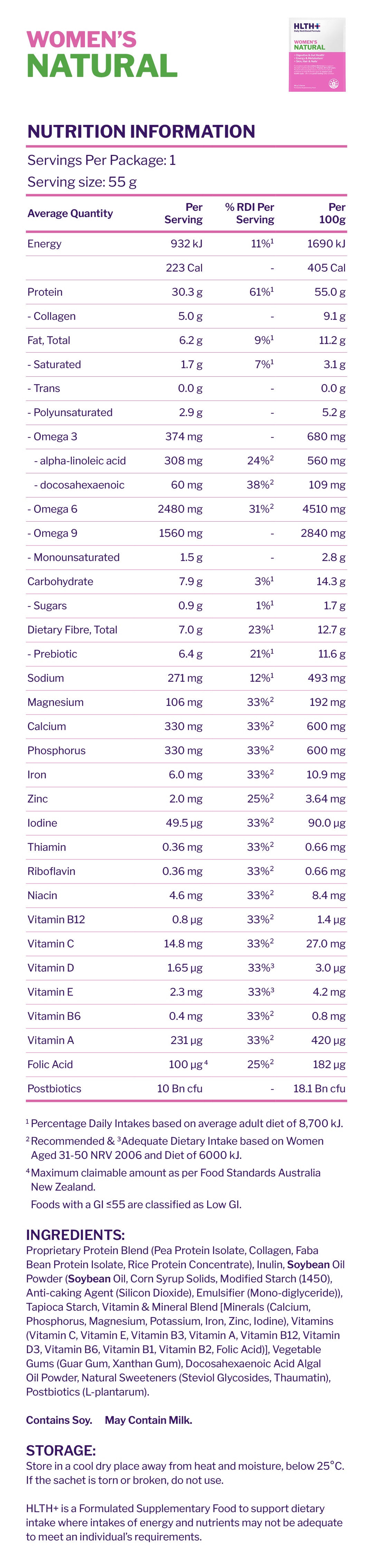
What a sachet of HLTH+ carries
HLTH+ is an Australian made, dietitian formulated Formulated Supplementary Food. A Women's sachet weighs 55g, sells at RRP $6.00 and lists 7g dietary fibre inside a total of 30 essential daily nutrients. As part of a healthy diet involving a variety of foods, every serve's 30g protein contributes to the maintenance of muscle mass.
We believe in a food-first approach, but the statistics say it is not working on its own, so HLTH+ is nutritional insurance. It is not designed as a meal replacement because it complements a food-first approach; but it works fine as a healthy snack or to tie you over.
Women's, Women's 50+, Men's and Men's 50+ track the Nutrient Reference Values (published 2006; developed by the National Health and Medical Research Council, the Australian Government Department of Health and Ageing, and the New Zealand Ministry of Health). Subscribed, $142.80 across 28 serves is $5.10 a day. Stockists include Amazon AU and Chemist Warehouse online.
Finding your gaps
If your question is creatine, the sections above hold the evidence, and a sports dietitian is the right next conversation. If you train on a smaller plate, HLTH+ was formulated to put protein, dietary fibre and a balanced multivitamin profile in one sachet.
Find the gaps in your routine. The ✦ Find My Formula quiz shows what your current routine is not giving you. About 30 seconds is all it takes. Take the quiz.
Frequently Asked Questions
Do the studies use a loading phase for women?
Some do and some do not. In the Nutrients review, loading raised total muscle creatine by 19%, similar to men, while a daily 5 g dose was equally effective but took about 3 to 4 weeks. The authors conclude women can follow the same strategy as men.
Does creatine damage the kidneys?
The 2021 question-and-answer paper concludes that at recommended doses creatine does not cause kidney damage in healthy people, after more than 20 years of research. Supplements can raise blood creatinine, a kidney marker, so mention it before blood tests. Anyone with a kidney condition should ask their doctor first.
Is creatine only effective for men?
No, but women have been studied less. The Nutrients review concludes creatine appears effective for strength and exercise performance in premenopausal women, and the 2021 question-and-answer paper notes that not all studies show improved performance in women. Most postmenopausal trials paired creatine with resistance training.
Can you take creatine while pregnant?
The evidence is lacking. The Nutrients review says no human studies had tested creatine supplementation in pregnancy, and the position stand describes only animal data and research interest. None of the three papers addresses breastfeeding; talk to your doctor before taking it while pregnant or breastfeeding.
Does creatine work without exercise?
Less well. The 2021 question-and-answer paper concludes that creatine alone is unlikely to produce substantial strength gains in older adults. The Australian Institute of Sport says creatine combined with resistance exercise consistently improves strength outcomes, and postmenopausal trials found larger gains with training.
This article is general information, not medical advice. Decisions about any medication belong with your doctor.

Leave a comment
This site is protected by hCaptcha and the hCaptcha Privacy Policy and Terms of Service apply.