


Do collagen supplements help skin?
The pooled randomised trials report favourable results for oral hydrolysed collagen on two instrument-measured outcomes, skin hydration and skin elasticity, over roughly 2 to 12 weeks and mostly in women. The same reviews list small trials, mixed products and, in one review's words, industry funding as limits. The hair evidence is thinner again.
If you are weighing a collagen powder, you have probably met a pack that says skin, another that says hair, and a page that cites a study without saying what it tested. This page reads the trial reviews as their authors wrote them, limits included, then sets out what an Australian label is allowed to say about collagen.
A 2023 systematic review and meta-analysis pooled 26 randomised controlled trials with 1,721 participants and reported that hydrolysed collagen supplementation significantly improved skin hydration and elasticity compared with placebo, with trial durations of 2 to 12 weeks (Pu and colleagues, Nutrients, 2023). An earlier 2021 meta-analysis of 19 randomised, double-blind, controlled trials (1,125 participants aged 20 to 70, 95% of them women) reported favourable results against placebo on hydration, elasticity and wrinkles, and its authors framed the conclusion around 90 days (de Miranda and colleagues, International Journal of Dermatology, 2021). Only the abstract of that second paper is open to read.
A 2025 meta-analysis of ten randomised trials (646 participants) put numbers on it: a standardised mean difference of 1.25 for hydration (95% confidence interval 0.77 to 1.74) and 0.61 for elasticity (0.21 to 1.02), at doses of 1 to 10g a day (Danessa and colleagues, Indian Journal of Dermatology, Venereology and Leprology, 2025). A standardised mean difference is a way of putting results from different instruments on one scale, so a larger number is a larger gap between collagen and placebo groups.
What did the skin trials actually measure?
The pooled hydration and elasticity results are readings from probes, not mirrors. Hydration was commonly measured with a corneometer, which passes a high-frequency current through the skin surface to estimate the water in its top layer, and elasticity with cutometry, which applies suction to a small patch of skin and measures how far it deforms (Pu and colleagues).
Who was tested matters as much as what was measured: the 2021 meta-analysis was 95% women, and the 2025 authors state that their findings are more applicable to females. A 2026 narrative review says most studies assess skin outcomes after 8 to 12 weeks of supplementation (Biełach-Bazyluk and colleagues, Nutrients, 2026). Which product carries which dose is label territory, covered in best collagen supplements in Australia.
In 2021, a dermatologist told Choice there was still insufficient evidence that skin would be visibly improved, while emerging studies showed measurable change that "may or may not be clinically noticeable".
How strong is the skin evidence, and what limits do the authors state?
The authors name real limits, and they are consistent across reviews. The table sets out what each review pooled, what it reported and what its authors say holds the result back.
| Review | What it pooled | What it reported | Limits its authors state |
|---|---|---|---|
| de Miranda et al, 2021 | 19 randomised, double-blind, controlled trials; 1,125 participants, 95% women | Favourable results against placebo on hydration, elasticity and wrinkles | None in the abstract; the full text is not open access, so it was not read |
| Dewi et al, 2023 | 14 randomised trials; 967 participants; 4 to 12 weeks | Favourable results on skin moisture and elasticity against placebo | Heterogeneity from different products, doses, durations, populations and measurement tools; some trials combined collagen with other active ingredients |
| Pu et al, 2023 | 26 randomised trials; 1,721 participants; 2 to 12 weeks | Significant gains in hydration and elasticity against placebo | Differing interventions, some trials under 40 people, lifestyle habits not analysed, risk of bias flagged in individual trials |
| Danessa et al, 2025 | 10 randomised trials; 646 participants | Hydration SMD 1.25; elasticity SMD 0.61 | Most trials could not control for weather, findings more applicable to females, moderate heterogeneity (I-squared 55.5 to 56.5%), risk of bias generally unclear, publication bias not assessable |
Sources: Dewi et al, Cureus, 2023, plus the three papers linked above. SMD means standardised mean difference; what fish, bovine and porcine sources mean on a label is in collagen peptides.
Funding is the limit people skip. The 2026 narrative review names short study durations, heterogeneous designs, multi-ingredient formulations (see collagen protein powder for how blends are labelled) and industry funding as the reasons confidence in the size and consistency of the effects is reduced, and calls for "high-quality, long-term, independently funded trials" (Biełach-Bazyluk and colleagues).
The review also notes that in one trial, self-rated improvements were larger than the instrument readings. Pu and colleagues report a hospital research grant and no conflicts of interest.
Do collagen supplements help hair?
The evidence is thinner. The 2026 review notes that hair and nails are made mainly of keratin rather than collagen, so any link from swallowing collagen to hair is indirect. It proposes that amino acids derived from collagen may serve as building blocks for keratin, and says the signalling pathways proposed for hair are mainly demonstrated in preclinical models.
The same review's table lists four clinical studies on hair:
- A comparison of two multi-ingredient supplements in women with telogen effluvium, with no placebo group.
- A placebo-controlled trial of low-molecular-weight collagen peptides in adults with damaged hair.
- A 12-week trial in 83 people with hair loss, where a supplement of hydrolysed fish collagen, amino acids, iron and selenium was added to usual care, so the effect of collagen alone cannot be isolated.
- A 24-week placebo-controlled trial of 1,000mg a day in 114 women aged 20 to 50 with thigh cellulite and self-reported hair thinning, where hair diameter rose significantly at week 24 and hair was a secondary outcome (Hwang and colleagues, Journal of Medicinal Food, 2026).
Three of that last trial's five authors list company affiliations, and the authors declare no competing interests. The review's own summary is that well-controlled clinical studies remain limited, in small and varied populations.
Hair shedding is a separate question from thinning: telogen effluvium typically appears two to three months after a trigger, and crash dieting and low protein intake are recognised triggers (StatPearls). Our page on why hair sheds after rapid weight loss, reduced eating and medically induced weight loss covers it.
Is it worth taking collagen supplements for skin?
The reviews cannot answer that for you, but they define what the trials tested: doses of 1 to 10g a day, skin measured after about 8 to 12 weeks, and outcomes recorded as hydration and elasticity, mostly in women. The 2026 review says the evidence is limited by short study durations, so the findings say little about years of use.
The reviews above pooled trials in skin ageing; none of the abstracts read for this page describes people after weight loss, and what the evidence says about loose skin after weight loss has its own page, as do the reasons skin loosens and the tightening options.
On downsides, Choice says the amounts taken at recommended doses are unlikely to cause harm (last updated 6 July 2021). The label lines that matter are the source and the allergen statement.
Anyone on prescribed medication, or with a food allergy or a medical condition, is best to ask a doctor or pharmacist before adding a collagen product; this page is general information, not medical advice. The label-by-label comparisons are in best collagen supplements in Australia and collagen powder.
What can an Australian collagen label legally say?
Schedule 4 of the Food Standards Code is the list of pre-approved food-health relationships, and no row in it names collagen as the food or property of food. Collagen appears in the compilation in force from 30 April 2026 only three times, each inside a vitamin C row about normal collagen formation (Schedule 4).
That leaves collagen with content statements. Under Standard 1.2.7, a nutrition content claim about a property of food outside the Schedule 4 claims table may say only that the food contains it, how much it contains, or both, and grams of collagen per serve is that kind of statement (the collagen peptides explainer reads six product pages against it). For a general level health claim, a business needs either a Schedule 4 row or a relationship it has notified to Food Standards Australia New Zealand (FSANZ), certifying that a systematic review established it (Standard 1.2.7, sections 1.2.7-13, 1.2.7-18 and 1.2.7-19).
Businesses do use the notification route. On 6 October 2026 FSANZ's public register held 1,350 entries, and 330 of them named collagen as the food or property of food, notified between April 2018 and September 2026; by our keyword count of the health-effect column, 185 mention skin, 20 mention hair and 28 mention nails. FSANZ states that publication "does not indicate acceptance, approval or validation of the notified food-health relationship" (FSANZ register).
So a skin or hair sentence on a collagen product may rest on one of those notifications, which FSANZ publishes without assessing, and it says nothing about how strong the trial evidence is. A 2022 review that compared collagen companies' claims and social media posts with the literature found that dermatologic claims in the media surpass any evidence currently supported by the literature (Rustad and colleagues, Journal of Cosmetic Dermatology, 2022). Supplements registered as therapeutic goods follow TGA rules instead, which are outside this page.
If your appetite or your portions have shrunk, learn more about what changes when you eat less.
What does a Formulated Supplementary Food add when you are eating less?
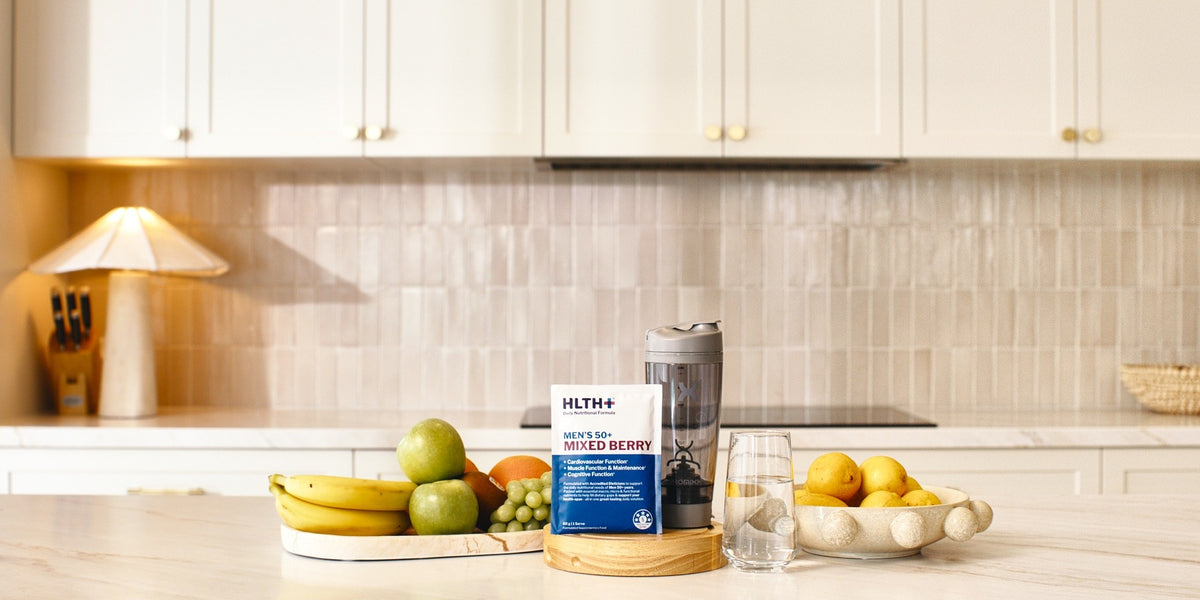
HLTH+ is a Formulated Supplementary Food, so collagen is one line on a longer panel. A 55g Women's sachet lists 30g protein per serve, with 5g collagen (bovine) inside that figure, plus 7g dietary fibre and 30 essential daily nutrients counted across protein, dietary fibre, vitamins, minerals, collagen and DHA. The ✦ Find My Formula quiz shows what your current routine is not giving you: take the 30-second quiz.
Over 90% of Australian adults do not meet dietary guidelines (AIHW), so a food-first approach stays the goal, and when calories drop with a reduced appetite, a daily formula is nutritional insurance beside food. HLTH+ is formulated by Accredited Dietitians to the Nutrient Reference Values, the published government intakes developed by the National Health and Medical Research Council, the Australian Government Department of Health and Ageing and the New Zealand Ministry of Health, across Women's, Women's 50+, Men's and Men's 50+.
It sells at hlthplus.com at RRP $6.00 per serve, or $5.10 a day on a 28-serve subscription at $142.80, and through Amazon AU and Chemist Warehouse online.
Which route fits what you want
- If you want to try collagen on its own, read the label checks in collagen peptides and, for blends, collagen protein powder: grams per serve, source and the allergen line.
- If you want protein, dietary fibre and a balanced multivitamin profile in one sachet, HLTH+ lists 30g protein per serve, including 5g collagen, and 7g dietary fibre in a 55g sachet (Women's).
Find out what your current stack is not giving you. The 30-second Find My Formula quiz shows the gaps your current products leave.
Frequently Asked Questions
Is marine collagen safe if you have a fish allergy?
A 2026 review advises people with a history of fish allergy to use marine collagen peptide supplements with caution, because hydrolysis lowers but does not remove allergen risk, and cases of severe reactions, including anaphylaxis, have been reported. Check the source and allergen lines on any label, and ask your doctor or pharmacist if you are unsure.
Which collagen is better for skin, marine or bovine?
The reviews name no winner. In one meta-analysis, 14 of 26 trials used fish collagen and one used bovine; elasticity results did not differ significantly by source, while hydration results varied by source and duration. A 2026 review says benefits track peptide size and hydroxyproline content more than collagen source.
What are the first signs collagen is working?
None of the reviews read for this page lists early signs or a week-by-week timeline. The trials measured hydration and elasticity with instruments, mostly after 8 to 12 weeks, and one review notes that in one trial self-rated improvements were larger than instrument readings. Any sign-by-week list on a pack is the brand's own.
What does collagen do in the skin?
In the body, collagen is a key structural protein of the skin, which a 2026 review links to its mechanical strength, elasticity and hydration. What a swallowed supplement does is a separate question. The effects that review describes on skin cells called fibroblasts come from cell culture models, and the human trials measure outcomes, not mechanisms.
What dose did the skin trials use?
A 2025 meta-analysis of ten randomised trials reported doses of 1 to 10g a day, most commonly 4g, with a median of 3.5g. A separate meta-analysis found its 26 trials ran 2 to 12 weeks. That is the range tested, not a recommended intake, and brands set their own serve sizes.
This article is general information, not medical advice. Decisions about any medication belong with your doctor. Research figures are as published in the papers cited; the FSANZ register figures were retrieved on 6 October 2026.

Leave a comment
This site is protected by hCaptcha and the hCaptcha Privacy Policy and Terms of Service apply.