

The Health Star Rating is a voluntary front-of-pack score from ½ to 5 stars that the manufacturer calculates for a packaged food or drink, and it is built to compare similar products, not different kinds of food (Health Star Rating system, About, retrieved 6 October 2026). Five stars is the top of the scale, and it is not a measure of vitamins and minerals or a guide to how much of the product to eat.
You are standing at a shelf, or scrolling a product page, with a star badge in one hand and a nutrition panel in the other, and the two do not obviously agree. That is expected: the stars and the panel answer different questions, and the stars come from a published formula.
This page sets out that formula as the official Implementation Guide states it, what five stars does and does not cover on a shake label, the criticisms on record, and where the system stands in October 2026.
What is the Health Star Rating system?
The Health Star Rating (HSR) system rates the nutritional profile of packaged food and gives each product a rating from ½ to 5 stars, shown on the front of the pack and calculated by the manufacturer (healthstarrating.gov.au, About). It was introduced in Australia and New Zealand in 2014, as a joint initiative of the Australian, state and territory governments and the New Zealand Government (healthstarrating.gov.au, Governance), and Food Ministers make all decisions about it. Companies do not pay to use it, and manufacturers and retailers can adopt and remove it at any stage (healthstarrating.gov.au, For shoppers).
Because use is voluntary, many packs carry no rating: after the final uptake date of 14 November 2025, it was displayed on 39% of intended products in Australia and 36% in New Zealand, against a target of 70% (healthstarrating.gov.au, Uptake reports and targets). For the shakes themselves, see best protein shakes in Australia.
How is the Health Star Rating calculated?
The calculator first considers four components associated with increasing the risk factors for chronic diseases, then balances them against positive components (healthstarrating.gov.au, For shoppers). Every rating is calculated on a consistent measure of 100 g or 100 mL (How ratings are calculated), so the serve size printed on a pack does not change the stars. The algorithm and calculator are public, though a label alone may not carry every input, such as fruit, vegetable, nut and legume content (healthstarrating.gov.au, FAQs).
- Counted against the product (baseline points): energy in kilojoules, saturated fat, total sugars and sodium.
- Counted for the product (modifying points): the percentage of fruit, vegetables, nuts and legumes, and in some categories protein and dietary fibre.
- Category 1 (non-dairy beverages, jellies and water-based ice confections): baseline points for energy and total sugars only, plus fruit, vegetable, nut and legume points, with no protein or dietary fibre points.
The final score is the baseline points minus the modifying points, and a lower score earns more stars (Health Star Rating System Implementation Guide, Version 9.1, Appendix 1).
How HLTH+ compares
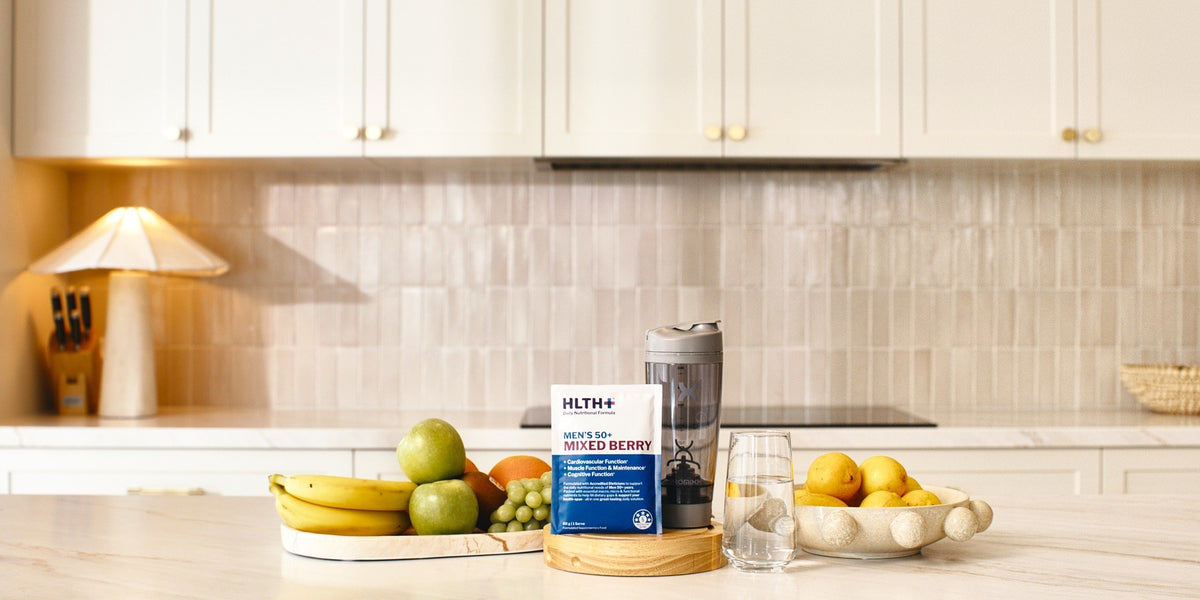
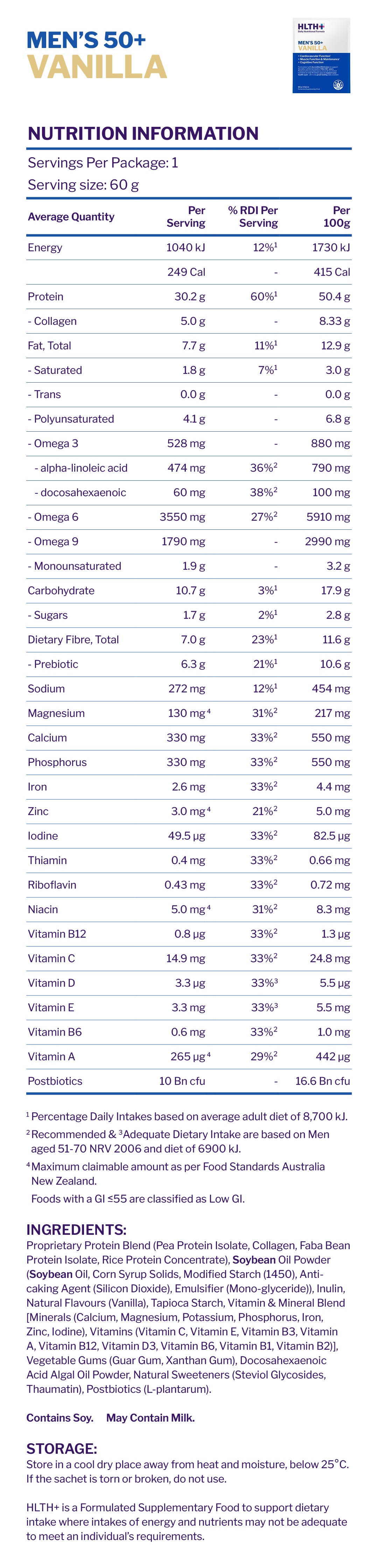
HLTH+ is a daily nutritional formula, a Formulated Supplementary Food, and its site lists a 5-star Health Star Rating. The rating reflects the components above; the 30 essential daily nutrients in one 55g sachet are a different count, made across protein, dietary fibre, vitamins, minerals, collagen and DHA, which is why the panel is still where you read them. The 30-second ✦ Find My Formula quiz shows what your current routine is not giving you.
How do the points turn into stars?
Per 100 g or 100 mL, three steps on the points scales for Categories 1D, 2 and 2D look like this; the Guide's full tables continue past 10 points.
| Component | Counted as | 1 point above | 5 points above | 10 points above |
|---|---|---|---|---|
| Energy | Baseline | 335 kJ | 1,675 kJ | 3,350 kJ |
| Saturated fat | Baseline | 1.0 g | 5.0 g | 10.0 g |
| Total sugars | Baseline | 5.0 g | 20.7 g | 40.3 g |
| Sodium | Baseline | 90 mg | 450 mg | 900 mg |
| Protein | Modifying | 1.6 g | 8.0 g | 20.0 g |
| Dietary fibre | Modifying | 0.9 g | 4.7 g | 9.7 g |
Source: Implementation Guide, Version 9.1, Tables 1 and 6, retrieved 6 October 2026. Protein points are available when baseline points are under 13, or, at 13 or more, only when fruit, vegetable, nut and legume points reach 5 or more. Dietary fibre points apply in Categories 2, 2D, 3 and 3D, and not in Categories 1 and 1D.
The final score is then read against the product's category. The Guide (section 4.3) puts milk, and dairy beverages and dairy alternative beverages that meet its calcium and ingredient criteria, in Category 1D, listing protein shakes among its examples if the calcium requirements are met; Category 2 is "all other foods that do not fit within any other category" and does not include beverages. Drinks that miss the Category 1D criteria, dairy-based ones included, fall in Category 1, where Table 7 lists water at 5 stars, unsweetened flavoured water at 4.5, and a score of 0 or lower at 4.
| Stars | Category 1D final score | Category 2 final score |
|---|---|---|
| 5 | -2 or lower | -11 or lower |
| 4.5 | -1 | -10 to -7 |
| 4 | 0 | -6 to -2 |
| 3.5 | 1 | -1 to 2 |
| 3 | 2 | 3 to 6 |
| 2.5 | 3 | 7 to 11 |
| 2 | 4 | 12 to 15 |
| 1.5 | 5 | 16 to 20 |
| 1 | 6 | 21 to 24 |
| 0.5 | 7 or higher | 25 or higher |
Source: Implementation Guide, Version 9.1, Table 7, retrieved 6 October 2026.
Sweeteners, colours and flavours are not among the components the Guide lists, so the stars cannot show them. The ingredient list does, and sweeteners 950, 951 and 955 explains how to read that bracket.
What does 5 stars mean on a shake label?
Five stars means the product reached the top band of the formula for its category, worked out per 100 g or 100 mL and meant for comparison with similar products. The official shopper guidance is specific about the limits: a high star rating "guides you towards a healthier product, but does not necessarily mean that the product" (healthstarrating.gov.au, For shoppers):
- provides a balanced diet
- should replace items from other food groups
- should be eaten in large amounts
The same page explains why a product high in total sugars can still score well: "A product may be higher in total sugars but lower in saturated fat or energy", or it may be high in protein, dietary fibre or fruit, vegetable, nut and legume content, which raises the rating. A shake's stars therefore tell you where it sits among similar shakes, and the system's own example applies: you can compare a yoghurt to another yoghurt, but not to a bag of chips (healthstarrating.gov.au, About).
On shakes specifically, the Guide excludes Formulated Supplementary Sports Foods, and drinks that are not milk-like but are fortified with protein, such as protein water, from Category 1D (Implementation Guide, section 4.3).
How does the "as prepared" rule work for a powder?
A powder's rating is calculated as sold by default. It may be calculated as prepared only if the product must be rehydrated, diluted or mixed with water and the label clearly gives those directions (Implementation Guide, section 4.2). Drinking chocolate and other powdered drinks whose preparation specifies the addition of milk are among the Guide's examples of products not permitted to use as prepared, so their rating is calculated as sold.
The directions on the pack therefore decide which basis a powder's stars rest on, so read them before you compare a powder's stars with a ready-to-drink bottle's.
A product's regulatory category matters too. The Guide says the rating may be displayed on formulated meal replacements and Formulated Supplementary Foods (Standard 2.9.3, Divisions 2 and 3), and must not be displayed on infant formula products, food for infants, Formulated Supplementary Foods for young children, Formulated Supplementary Sports Foods or food for special medical purposes. For how the meal replacement category is defined, see meal replacement shakes.
What does the Health Star Rating not measure?
The system "does not consider other health effects of ingredients, products, processing methods or nutrients like vitamins and minerals", and it can be used "along with other information on the food package, such as the ingredients list and the Nutrition Information Panel" (healthstarrating.gov.au, How ratings are calculated). It also "does not replace dietary advice from a qualified dietitian, nutritionist or resources like the Australian Dietary Guidelines" (same page).
- Vitamins and minerals: read the nutrition information panel.
- Sweeteners, colours and flavours: read the ingredient list.
- How much to eat: the Guide says the system is not designed to give quantities for a healthy diet.
- Whether a multivitamin adds anything to your day: a separate question, covered in do multivitamins work.
Over 90% of Australian adults do not meet dietary guidelines (AIHW, Poor diet in adults), so a star count on one pack is a small piece of a larger picture. When calories drop, a smaller plate carries fewer nutrients, so the panel matters more than the badge.
More on what changes when you eat less: Nutrition when your appetite is lower →
What are the criticisms of the Health Star Rating?
CHOICE reported on 21 August 2019 that consumer groups and public health experts called the system's Five Year Review "a missed opportunity". Its food policy expert said the recommendations "give manufacturers a green light to keep packing food with added sugar and salt, while cashing in on undeserved high Health Star Ratings", and that "a 70% target over a five year period is not high enough" (CHOICE, Health Star Rating review doesn't go far enough).
In the same article CHOICE said it had been calling for added sugars to be included in the nutrition information panel; the Guide's baseline points are for total sugars.
A peer-reviewed study of 21,197 products found uptake of 37% overall in 2023, with 24% of products rated 3 stars or lower displaying the label against 53% of products rated 3.5 or higher (Keaney and colleagues, European Journal of Clinical Nutrition, October 2024). The authors concluded that, in a voluntary system, most manufacturers will display the label only where it has marketing value.
The system's own independent Five Year Review, run between 2017 and 2019, found that it "has been performing well" and made recommendations to improve it (healthstarrating.gov.au, System reviews).
Is the Health Star Rating mandatory in Australia?
No. The Food Standards Australia New Zealand (FSANZ) proposal page states: "The HSR system is currently voluntary" (FSANZ, Proposal P1067, page last updated 11 June 2026).
Food Ministers agreed to consider mandating the system if the 70% uptake target for 14 November 2025 was missed, and on 13 February 2026 they asked FSANZ to prepare a proposal on mandating it in the Food Standards Code (healthstarrating.gov.au, Proposal on mandating).
FSANZ took submissions on Proposal P1067 from 7 May to 5 July 2026, and its work is expected to take 12 to 18 months, with two opportunities for public comment if it prepares a draft variation. The system remains voluntary while that runs, and a transition period would be put in place should FSANZ recommend, and Ministers agree, to mandate it. Today the stars on a pack are the manufacturer's own calculation, so read the panel as well; the wider shake category, label by label shows how.
How do you read 5 stars on a shake label?
- Compare like with like. Set a shake only against products in its own category.
- Read the stars as per 100 g or 100 mL. They are not per serve.
- Check the directions. A powder whose label directs mixing with water may be rated as prepared; one whose directions add milk is rated as sold.
- Read the nutrition information panel. Protein, dietary fibre, vitamins and minerals per serve sit there.
- Read the ingredient list. Sweeteners, colours and flavours sit there too.
Which shake label is right for you?
- If you want a quick like-for-like check between two shakes on a shelf: the Health Star Rating, read within its category and alongside the panel, does that job.
- If you want one widely sold shake's label read line by line: is The Man Shake good for you.
- If you want protein, dietary fibre and a balanced multivitamin profile in one sachet: HLTH+, with 30g protein per serve and 7g dietary fibre in a 55g sachet, sold at hlthplus.com, Amazon AU and Chemist Warehouse.
HLTH+ comes as Women's, Women's 50+, Men's and Men's 50+, each formulated by Accredited Dietitians to the Nutrient Reference Values, the intakes published in 2006 by the National Health and Medical Research Council, the Australian Government Department of Health and Ageing and the New Zealand Ministry of Health.
Not sure what your routine is missing? The 30-second ✦ Find My Formula quiz is built to show what your current stack is not giving you. Take the quiz.
Frequently Asked Questions
Can you compare the Health Star Rating of a shake with a cereal?
No. The official guidance is to compare similar products from similar areas of the supermarket: breakfast cereals with other breakfast cereals, and a yoghurt with another yoghurt, not with a bag of chips. The stars are a tool for comparing products of the same kind, so set a shake's stars against other shakes.
Who calculates the Health Star Rating on a pack?
The manufacturer does, using the public calculator, and manufacturers and retailers are responsible for calculating and displaying it correctly. Food Ministers make the decisions about the system, and a Health Star Rating Unit in the Department of Health, Disability and Ageing runs it. Questions about a rating go to the HSR Unit.
Does the Health Star Rating separate added sugars from natural sugars?
The Guide's baseline points are for total sugars per 100 g or 100 mL, with no separate points for added sugars. CHOICE said in 2019 it had been calling for added sugars to be included in the nutrition information panel. For the kind of sugar a product contains, read the ingredient list as well as the stars.
This article is general information, not medical advice. Decisions about any medication, or about a change to how you eat, belong with your doctor or dietitian. Sources as retrieved on 6 October 2026.
Leave a comment
This site is protected by hCaptcha and the hCaptcha Privacy Policy and Terms of Service apply.