


Loose skin after weight loss has four groups of options: time, strength training, non-surgical devices and surgery. Surgery is the one that removes excess skin, radiofrequency devices have a systematic review reporting measurable improvement in laxity, and for time and training the research is thinner.
The weight has come off and the skin has not followed, and many pages on the subject list treatments with confident claims and no source attached. The useful question is what was measured, in whom, and how well.
This page goes through each option in order of invasiveness, with what the source actually states and how the authors describe the strength of the evidence. Why skin loosens in the first place has its own page: why skin loosens after weight loss.
Does loose skin go away on its own, and how long does it take?
Partly. In a Swedish study of 200 people assessed before gastric bypass and again 18 months later, 149 completed the follow-up, and every measure of sagging had fallen except on the thighs (Biörserud et al, Surgery for Obesity and Related Diseases, 2016). A second Swedish study measured less excess skin in adults on the arms, breasts and abdomen after weight loss, but more on the inner thighs (Elander et al, Surgery for Obesity and Related Diseases, 2019).
Time does not repair everything. Skin removed at surgery an average of 20.5 months after weight loss surgery, in 10 people, still showed a poorly organised collagen structure and elastin degradation (Light et al, Plastic and Reconstructive Surgery, 2010). None of the studies read gives a date by which skin settles, so there is no evidence-based timeline to quote.
Excess skin follows bariatric surgery in more than 70% of adults, and which factors decide how much stays is less settled than it sounds (Baillot et al, Obesity Surgery, 2017).
The factors thought to affect how much skin stays
| Factor | What the sources state |
|---|---|
| Time since weight loss | Skin still showed damaged collagen and elastin about 20.5 months after surgery (Light et al, 2010); time since surgery was not significantly associated with how troubled people were by excess skin (Baillot et al, 2017) |
| Amount of weight lost | Listed as a presumed influence (Hany et al, 2024); findings were inconclusive for weight loss in a 24-study scoping review (Baillot et al, 2017) |
| Rate of weight loss | Listed as a presumed influence (Hany et al, 2024); the scoping review's abstract reports no finding on it |
| Age | Listed as a presumed influence (Hany et al, 2024); findings were inconclusive in the scoping review (Baillot et al, 2017) |
| Sex | Women reported more excess skin and greater inconvenience from it than men (Baillot et al, 2017) |
| Smoking, sun exposure and genetics | Listed as presumed influences (Hany et al, 2024) |
The presumed-influence list comes from a 2024 histology study in Obesity Surgery (Hany et al). Almost every study above followed people after bariatric surgery, where the losses are large and the timeline is clean. We found no primary study measuring skin after a smaller loss, so nothing here says what to expect from a modest one.
Weight loss shows up in other tissue too: hair shedding after rapid weight loss, reduced eating and medically induced weight loss has its own page, why hair sheds after weight loss.
What is the best treatment for loose skin after weight loss?
The sources do not name one best option for everyone: surgery is the option described as removing excess skin, and the research on time and training is thinner. Non-surgical devices have systematic reviews behind them, but reviews that report on skin laxity in general rather than on people after major weight loss. The table lists each option with what its source states.
| Option | What the source states | How the evidence is framed |
|---|---|---|
| Time and stable weight | Sagging measures fell after 18 months except on the thighs (Biörserud et al, 2016); damaged collagen and elastin persisted at about 20.5 months (Light et al, 2010) | Cohort and tissue studies in people after bariatric surgery; no timeline given |
| Strength training | Adults should do strength training at least 2 times a week (healthdirect); muscle cells respond to continuous resistance training by increasing in size (Better Health Channel) | Guidance on muscle; none of the sources read measures skin |
| Creams, oils and wraps | Not tested in any of the reviews read for this page | No evidence found in these sources |
| Radiofrequency devices | Measurable improvement in skin laxity of the face and body, with most complications minor and transient (Rohrich et al, 2022) | Systematic review of 23 articles, nine of them on body areas |
| Micro-focused ultrasound | Improvement in sagging of the mid and lower face, with no considerable side effects reported (Khan and Khalid, 2021) | Review of 10 articles; results reported for the face |
| Devices used with liposuction | Evidence limited by significant heterogeneity; no firm conclusion that any single device is superior (Faustino et al, 2026) | 19 studies, serious risk of bias in about half |
| Helium plasma radiofrequency | No evidence supports skin tightening beyond that achieved with liposuction; serious adverse events reported (Swanson, 2025) | Systematic review of 25 publications |
| Surgery | Body contouring aims to remove and tighten excess skin (Australian Society of Plastic Surgeons); quality-of-life measures improved in the pooled analysis (Toma et al, 2018) | Systematic review and meta-analysis of 13 studies |
What food can and cannot do for skin is covered in the nutrition side of loose skin.
Can you tighten loose skin without surgery?
Radiofrequency has the strongest review behind it. A 2022 systematic review of the MEDLINE literature found 207 articles on radiofrequency for cosmetic purposes and kept 23; three evaluated monopolar devices and six bipolar devices on body areas. It concluded that there is clinical evidence these devices "produce measurable improvement in skin laxity of the face and body with an acceptable complication profile", with most reported complications minor and transient and major complication rates higher with monopolar than bipolar devices (Rohrich et al, Plastic and Reconstructive Surgery, 2022).
Micro-focused ultrasound has a smaller review: 10 articles, reporting improvement in sagging of the mid and lower face and no considerable side effects (Khan and Khalid, Cureus, 2021). The abstract reports face outcomes, not the abdomen or arms.
Two limits apply to both. Neither abstract says the people treated had lost weight, so neither describes loose skin after major weight loss specifically. Measurable improvement is not removal: a 2026 international consensus of 10 clinicians on non-surgical care after medication-driven weight loss says non-surgical rejuvenation "in certain patients, cannot replace the need for surgical intervention", and it is expert opinion, not trial data (Nikolis et al, Journal of Cosmetic Dermatology, 2026).
Devices sold as add-ons to liposuction have weaker support. A 2026 systematic review of 19 studies found "significant heterogeneity" and a serious risk of bias in about half, precluding "firm conclusions regarding the superiority of any single device" (Faustino et al, Aesthetic Plastic Surgery, 2026). A 2025 systematic review of 25 publications on helium plasma radiofrequency found the studies typically reported surgeons' subjective evaluations of photographs and surveys, and most were funded by the manufacturer.
It states: "No evidence supports a claim of skin tightening beyond that which may be achieved using traditional or ultrasonic liposuction"; it also lists full-thickness burns and, in four case reports, helium-induced pneumothorax (Swanson, Annals of Plastic Surgery, 2025).
Does strength training tighten loose skin?
None of the sources read measures skin. What they measure is muscle, and the guidance is consistent: adults should do strength training at least 2 times a week (healthdirect, reviewed May 2025), which matches the national guideline of muscle-strengthening activities on at least 2 days a week as summarised by the NSW Government. Better Health Channel notes that "muscle cells respond to continuous resistance training by increasing in size (hypertrophy)" and that a beginner needs to train two or three times per week (Better Health Channel, reviewed July 2022).
The authors of the systematic review quoted at the top state, in its introduction, that skin deformities after massive weight loss "cannot be resolved by modifications in lifestyle, diet and exercise" (Toma et al, Obesity Surgery, 2018). Training changes the muscle under the skin, and the studies read do not test it as a way to tighten the skin itself.
Protein contributes to the maintenance and growth of muscle mass, as part of a healthy diet involving a variety of foods. That statement is about muscle mass, not skin. How much protein to build muscle sets out the per-meal numbers, and sarcopenia covers muscle with age.
More on what changes when you eat less: learn more about what happens when intake drops.
When is surgery an option, and who decides?
Surgery is the option that removes excess skin, and it is a decision between you, your GP and a Specialist Plastic Surgeon. The Australian Society of Plastic Surgeons lists tummy tuck (abdominoplasty), liposuction, body lift, thigh lift and arm lift as body contouring procedures, with the aim to "remove and tighten excess skin, usually after massive or significant weight loss" (Australian Society of Plastic Surgeons). It says each procedure is highly individualised, lists heavy bleeding, prominent scarring, infection and blood clots among the possible complications, and advises seeking the opinion of a Specialist Plastic Surgeon first.
The reasons people ask are functional as well as cosmetic. In a scoping review of 24 studies after bariatric surgery, negative physical, psychosocial and daily-life impacts of excess skin were reported in 67, 75 and 83% of studies (Baillot et al, 2017). A systematic review and meta-analysis found statistically significant improvements in physical functioning, psychological wellbeing and social functioning after body contouring surgery (Toma et al, 2018).
Timing follows weight. The UK criteria from the British Association of Plastic, Reconstructive and Aesthetic Surgeons, as reported in that review, include weight stability of 12 months, and the Australian Society of Plastic Surgeons advises reaching your optimal weight first. Why the scale stalls explains what a plateau is.
In Australia, the Medical Board's cosmetic surgery guidelines, in force from 1 July 2023, require a referral from a general practitioner or other specialist medical practitioner, at least two pre-operative consultations, and a cooling-off period of at least seven days after two consultations and informed consent before surgery can be booked or a deposit paid. They name abdominoplasty and liposuction as examples of cosmetic surgery, and they do not apply to reconstructive surgery (Medical Board of Australia).
This article is general information, not medical advice. Decisions about any medication belong with your doctor.
Where a Formulated Supplementary Food fits when you are eating less
This is a separate question from the skin: it is about the plate. When calories drop, whether from a deliberate deficit or from rapid weight loss, reduced eating and medically induced weight loss, protein, dietary fibre and micronutrients fall with the food that carries them. Over 90% of Australian adults do not meet dietary guidelines (AIHW), so a smaller plate starts from a shortfall.
We believe in food first; the statistics say food first is not doing it alone, which is what nutritional insurance means.
How HLTH+ compares
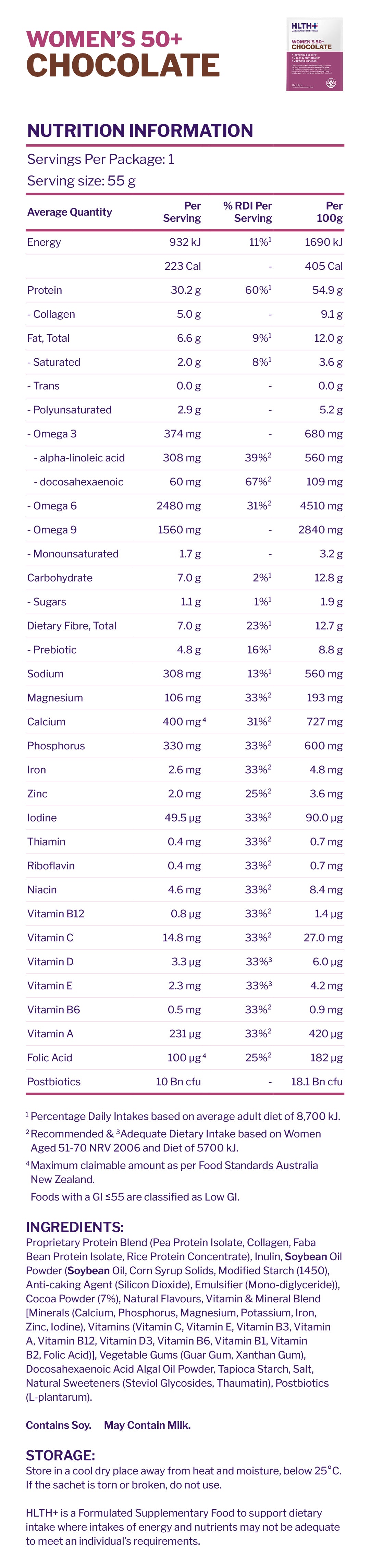
HLTH+ is a Formulated Supplementary Food: one sachet (55g in Women's) carries 30g protein per serve, 7g dietary fibre and 30 essential daily nutrients, at RRP $6.00. It is formulated to the Nutrient Reference Values, published in 2006 by the National Health and Medical Research Council, the Australian Government Department of Health and Ageing and the New Zealand Ministry of Health, across Women's, Women's 50+, Men's and Men's 50+. The ✦ Find My Formula quiz shows what your current routine is not giving you: take the 30-second quiz.
It is Australian made, in facilities complying with Good Manufacturing Practice. On subscription, the 28-serve pack works out at $5.10 a day. It is stocked at Chemist Warehouse online and on Amazon AU if that is easier than ordering direct.
Which one suits which reader
If the question is the skin itself, the sections above are the evidence and your GP is the place to start. If you are eating less and want protein, dietary fibre and 30 essential daily nutrients in one sachet beside your food, that is what HLTH+ is built for.
Find out what your current routine is missing. The 30-second quiz is diagnostic: it shows the gaps your current supplement stack leaves. Take the quiz.
Frequently Asked Questions
Can a cream, oil or wrap tighten loose skin after weight loss?
None of the reviews read for this page tested a cream, oil or wrap on excess skin after major weight loss. The authors of a systematic review state that these skin deformities cannot be resolved by modifications in lifestyle, diet and exercise (Toma et al, 2018), and surgery is the option that removes excess skin.
Which areas of loose skin are least likely to settle on their own?
In a Swedish study of 149 people 18 months after gastric bypass, every measure of sagging fell except on the thighs (Biörserud et al, 2016). A second study measured less excess skin in adults on the arms, breasts and abdomen but more on the inner thighs (Elander et al, 2019). Both followed people after bariatric surgery.
How long should weight stay stable before body contouring surgery?
The sources read give no single Australian figure. A systematic review reports UK criteria that include weight stability of 12 months (Toma et al, 2018), and the Australian Society of Plastic Surgeons advises reaching your optimal weight first. Timing is set with your GP and a Specialist Plastic Surgeon.
What does the Medical Board of Australia require before cosmetic surgery?
From 1 July 2023, the guidelines require a referral from a general practitioner or other specialist medical practitioner, at least two pre-operative consultations, and a cooling-off period of at least seven days after two consultations and informed consent, before surgery can be booked or a deposit paid. Abdominoplasty and liposuction are cosmetic surgery; reconstructive surgery is excluded.
Does age change how much loose skin stays?
Age is named as a presumed influence on the skin's ability to contract (Hany et al, 2024), but a scoping review of 24 studies found the findings inconclusive for correlates such as age and weight loss (Baillot et al, 2017). Neither source gives an age at which skin stops retracting.
This article is general information, not medical advice. Decisions about any medication belong with your doctor.

Leave a comment
This site is protected by hCaptcha and the hCaptcha Privacy Policy and Terms of Service apply.