


What causes a weight loss plateau?
A plateau is what happens when the body's energy use catches up with a smaller body. As weight comes off, resting energy expenditure falls, some of what was lost is lean mass that used to burn calories at rest, and the intake and activity side of the equation is harder to measure precisely than it feels. None of that means effort has stopped working; it means the numbers behind the deficit have moved.
If the scale has sat still for a few weeks and nothing else about your day has obviously changed, that experience is the adaptation the research below describes, not a sign of doing something wrong. What is unusual is how rarely the mechanism gets explained rather than just named.
Here is what is actually happening under a plateau, and where nutrition fits while it runs its course.
This is general information, not medical advice. Decisions about any medication belong with your doctor.
Why does the body slow down as weight comes off?
Resting energy expenditure adjusts as the body changes
Energy expenditure is not fixed once weight loss starts, it moves with the body. A National Institute of Diabetes and Digestive and Kidney Diseases workshop in 2019 was convened to explore the adaptations in appetite, energy expenditure and thermogenesis that occur in the weight-reduced state and that may oppose keeping weight off (Aronne, Hall, Jakicic, Leibel, Lowe, Rosenbaum and Klein, Obesity, 2021).
How far expenditure can fall is measurable. A study that followed contestants from a televised rapid-weight-loss competition for six years found resting metabolic rate had dropped by 610 kcal a day by the end of the 30-week program, and years later, even after substantial weight regain, it still sat 704 kcal a day below the original baseline, about 499 kcal a day lower than body size and composition alone predicted (Fothergill, Guo, Howard and colleagues, Obesity, 2016).
That was an unusually fast, closely studied loss, and the exact numbers will not match a slower, more typical one. What the study shows is the direction and persistence of the effect: metabolism does not simply fall in proportion to lost weight, it can fall further again, and that gap can hold for years.
Lean mass loss lowers the number further
Some of any weight lost is muscle, not fat, and muscle is more metabolically active at rest than fat tissue is. Victoria's Better Health Channel puts it plainly: when dieting reduces muscle mass, "your body will burn even fewer calories than before because the relative amount of muscle in your body has decreased and your metabolic rate is slower" (Better Health Channel, Victorian Department of Health).
The same page is blunt about speed, "when you lose weight too quickly, you lose fat and muscle", and puts a reasonable rate at about half a kilogram to 1kg a week, which is one reason two people who lose the same total weight can end up with two different resting metabolisms. What actually slows muscle loss works through the mechanism and the numbers in full.
You may be estimating differently than you are eating
Estimating how much food and activity actually happen in a day is a well-documented blind spot, not a character flaw. In a classic clinical study of people who reported eating very little and still not losing weight, careful laboratory measurement found their actual intake ran an average of 47% higher than what they had reported, and their physical activity was overestimated by 51%, while their energy expenditure sat within 5% of what their body composition predicted (Lichtman, Pisarska, Berman and colleagues, New England Journal of Medicine, 1992).
The finding was not that anyone was lying. Fourteen days of laboratory measurement found the gap, which makes it a reason to trust a few days of actual measurement over a felt sense of "I'm barely eating anything," not a verdict on anyone's honesty.
Water and glycogen move the scale on their own
Day to day, the number on the scale reflects more than fat. Carbohydrate is stored in muscle as glycogen together with bound water, at least 3g of water for every gram of glycogen in a muscle-biopsy study (Fernández-Elías, Ortega, Nelson and Mora-Rodriguez, European Journal of Applied Physiology, 2015), so a higher-carbohydrate day or a change in training can shift the scale before any fat has actually changed. A stalled reading over a few mornings is not the same thing as a stalled trend over a few weeks.
| What's changing | What's actually happening | What responds to it |
|---|---|---|
| Resting energy expenditure | Falls as body size drops, and can fall further than weight and composition alone predict | Reassessing intake periodically, not assuming the original plan still fits |
| Lean mass | A share of any loss is muscle, which burns more at rest than fat does | Protein at each meal and resistance training, not deeper restriction |
| Reported intake and activity | Estimating both is a known blind spot in careful laboratory measurement, not a discipline problem | A few days of actual measurement rather than a felt sense |
| Water and glycogen | Carbohydrate intake and training shift how much water muscle holds day to day | Reading the trend over two to three weeks, not one morning |
Does a prescribed weight-loss medication change the mechanism?
The mechanism is the same whatever produced the gap in the first place, whether that is a deliberate diet, an illness, or a reduced appetite from a prescribed medication such as a GLP-1 medicine: rapid weight loss, reduced eating and medically induced weight loss all change body composition in similar ways. In the STEP 1 trial's body-composition sub-study, roughly 40% of the weight lost was lean mass (Wilding and colleagues, New England Journal of Medicine, 2021). As intake settles into a smaller, steadier pattern, the deficit that was driving loss narrows on its own, which is a mechanism question, not something to change on your own.
The wider pattern of what changes as intake drops sits in GLP-1 side effects, indexed by symptom and what causes each one, mechanism by mechanism. If what has gone quiet is the mental chatter about food rather than the scale, that experience is covered separately in food noise.
General information, not medical advice. Decisions about any medication belong with your doctor.
What is worth a call to your doctor
A plateau on its own is not the thing to worry about; weight change you did not set out to cause is. The NHS defines unintentional weight loss as losing weight without changing your diet or exercise routine, and says to see a GP if it keeps happening, and as soon as possible if it comes with other symptoms (NHS, Unintentional weight loss). Never change a prescribed medication or its dose on the strength of an article.
Feeding your way through: what a smaller day of food still needs
The food-side levers with genuine evidence behind them, ranked by trial quality, are set out in natural appetite suppressants. The two below matter most while a plateau runs its course, because a deficit draws on exactly what they supply.
Protein, to hold onto the muscle you have
Protein contributes to the maintenance and growth of muscle mass, as part of a healthy diet involving a variety of foods, and holding onto muscle is directly relevant here: less muscle lost means a smaller fall in resting energy expenditure. How much protein to build muscle and protein when appetite is smaller work through the per-meal targets in full; the short version is that spreading protein across the day, rather than loading it at dinner, is the practical lever.
Dietary fibre, on a base that was already short
The fibre question is less about the plateau itself and more about the gap underneath it: over 90% of Australian adults do not meet dietary guidelines even at a normal appetite (AIHW), and a smaller day of food narrows the same nutrients further. Dietary fibre comes from legumes, wholegrains and vegetables with the skin on, and a smaller day of food carries less of each; the mechanics of that specific gap are worked through in dietary fibre on a reduced appetite.
More on what changes nutritionally as intake settles: learn more.
Where a Formulated Supplementary Food fits
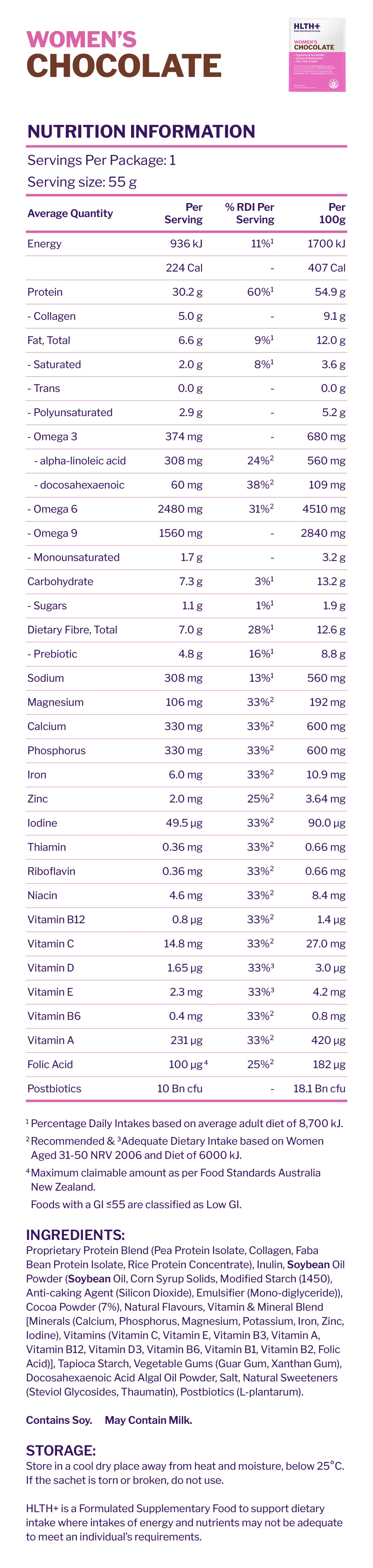
This section is about nutrition, separate from the mechanisms above it. When someone is eating less than usual, for any reason, protein, dietary fibre and the wider nutrient set still have to fit inside fewer meals, and that is what a Formulated Supplementary Food is built for.
HLTH+ is an Australian-owned and made Formulated Supplementary Food under the FSANZ Food Standards Code, made in facilities complying with Good Manufacturing Practice. Each sachet carries 30g protein, 7g dietary fibre and 30 essential daily nutrients in total, dietitian-formulated by life stage (Women's, Women's 50+, Men's and Men's 50+) against the Nutrient Reference Values published by the National Health and Medical Research Council, the Australian Government Department of Health and Ageing and the New Zealand Ministry of Health.
RRP $6.00, or $5.10 a day on the 28-serve subscription at $142.80 and $5.40 a day on the 14-serve at $75.60. Pause, skip or cancel at any time. Sold at hlthplus.com, and online through Amazon AU and Chemist Warehouse.
Find out what your current stack is missing. The ✦ Find My Formula quiz takes about 30 seconds and shows the gaps your existing bottles are leaving. Take the quiz.
Frequently Asked Questions
What causes a weight loss plateau?
Mainly the body's own arithmetic changing. Resting energy expenditure falls as body size and lean mass drop, so the same intake creates a smaller deficit than before. Add day-to-day water shifts from carbohydrate and the normal difficulty of estimating exactly what you eat, and the scale can sit still for weeks while fat is still being lost.
Why has my weight loss stalled even though I haven't changed anything?
You may not have changed anything, but your body has. A smaller body needs less energy to run, and some of the weight already lost was lean mass, which burns more at rest than fat does. The deficit that worked at a higher weight can shrink toward zero without any change on your end.
Does a plateau mean my metabolism is broken?
No. What researchers call metabolic adaptation is a normal response to losing weight, not damage. In one closely studied group, resting metabolism stayed measurably below what body size predicted years later, which shows the effect is real and can persist, not that something has gone wrong.
Can a prescribed weight-loss medication cause a plateau?
Yes, in the same way as any period of eating less. As intake settles at a new, lower level, the deficit that was driving weight loss narrows on its own, which is a mechanism question, not something to adjust on your own. Decisions about any medication belong with your doctor.
This article is general information, not medical advice. Decisions about any medication belong with your doctor.

Leave a comment
This site is protected by hCaptcha and the hCaptcha Privacy Policy and Terms of Service apply.