

Sustagen is a nutritional supplement drink, sold on nutrition: extra protein, vitamins and minerals added to a small volume for someone whose eating has fallen short. Up & Go is a liquid breakfast, sold on convenience: a ready-to-drink carton built for a rushed morning, not a nutrition gap.
Sustagen Everyday, the product in the range closest in purpose to a breakfast drink, publishes 3g of protein and 8.3g of sugars in a 15g serve before any milk is added (retrieved 22 September 2026). Sanitarium's own published panel for Up & Go could not be retrieved on the day this page was written, and that gap is stated plainly here rather than filled with a guess.
The reader typing this search is standing in a supermarket aisle with one tin and one carton, trying to work out whether they are the same kind of product wearing different branding. They are not, and mixing the two categories up is how a shopper ends up with the wrong tool for the job they actually have.
This page reads Sustagen's own published panel, explains what a liquid breakfast is built to do even where its own figures could not be retrieved, and sets out the dimensions that actually decide which one, if either, fits your morning.
Which Sustagen, and what is Up & Go?
Sustagen is not one product. Six are published on the brand's own site: Hospital Formula, Hospital Formula Plus Fibre, OPTIMUM, Sport, Everyday and a Ready to Drink version (range read 22 September 2026). Hospital Formula is clinical nutrition, described on the brand's own page as "a formulated meal replacement" that "cannot be used as a total diet replacement"; the full read of that tin is in is Sustagen good for you.
Sustagen Everyday is a different job: a 15g powder stirred into 175mL of reduced fat milk, described by the brand as "an everyday nutrition top-up into your diet for extra sustenance", carrying "14 Vitamins & Minerals" and "Low in fat" made up with reduced fat milk (retrieved 22 September 2026). A light addition to an existing diet, not a meal on its own, is the closer match to a breakfast carton, so Everyday is the product used here.
Up & Go is Sanitarium's ready-to-drink range, sold as a liquid breakfast: a single carton meant to be drunk in place of sitting down to eat, not stirred into anything. That format difference is the first thing separating the two, before a single nutrient is compared.
What does the Sustagen Everyday label publish?
These are the brand's own published figures for the Vanilla flavour, read off Sustagen's nutrition information panel (retrieved 22 September 2026). The pack holds 36 servings, and the brand's directions put a serving at three teaspoons, about 15g.
| Per the brand's own panel | Per 15g serving (powder only) | Per serving + 175mL reduced fat milk |
|---|---|---|
| Energy | 232 kJ / 55 kcal | 578 kJ / 138 kcal |
| Protein | 3g | 9.5g |
| Fat, total | 0.1g (saturated 0.05g) | 2.4g (saturated 1.5g) |
| Carbohydrate | 10.7g | 20g |
| of which sugars | 8.3g | 17.6g |
| Dietary fibre | No fibre row on this panel | No fibre row on this panel |
| Sodium | 30mg | 97mg |
| Calcium | 90mg | 300mg (38% of the panel's daily intake reference) |
| Vitamins and minerals | 13 rows on the panel: vitamin A, thiamin, riboflavin, niacin, folate, vitamin B12, vitamin C, vitamin E, iron, phosphorus, zinc and potassium alongside calcium | Same 13 rows, scaled with the milk |
Figures are Sustagen's own published nutrition information, retrieved 22 September 2026; brands reformulate, so check the current label before buying. The brand's own claim is "14 Vitamins & Minerals"; the panel itself carries 13 rows, and that difference is the brand's wording, not this page's count.
Two things stand out. Most of that 9.5g of protein and 300mg of calcium comes from the 175mL of milk you supply rather than the powder itself: only 3g of protein and 90mg of calcium are in the tin. And no version of the panel, powder alone or made up with milk, carries a dietary fibre row.
Under Schedule 4 of the Australia New Zealand Food Standards Code, a food needs at least 5g of protein per serving to carry any protein content claim and at least 10g to be called a good source, judged on the food as it is consumed. Made up with milk as directed, Sustagen Everyday clears the first line at 9.5g and sits under the second, which fits its own framing as a top-up rather than a protein product.
Why isn't there an Up & Go column on that table?
Because this page could not verify one. Sanitarium's own product pages returned a server error on every attempt made while writing this article, across four page addresses, and a direct connection to the domain failed independently of the page content.
No archived copy was available either. Every attempt and its result was logged, because a number that cannot be checked does not get printed as if it could.
No protein, sugar, dietary fibre, sodium or energy figure for Up & Go appears anywhere on this page, in the table, the body or the FAQ below. If you have a carton in front of you, it carries its own nutrition information panel, and that panel is the number to trust, not one repeated from memory or a different flavour.
A nutritional supplement drink vs a liquid breakfast: what the category difference actually means
Category and purpose come first, because the two products are not built to answer the same question. A nutritional supplement drink like Sustagen Everyday is designed to sit alongside what you already eat, adding nutrients on top of a normal diet rather than standing in for a meal. A liquid breakfast is designed to be the meal: something you drink in the time it would otherwise take to skip eating altogether.
That distinction matters, because over 90% of Australian adults do not meet dietary guidelines on the AIHW poor-diet measure, and a breakfast choice is one place that gap opens. A top-up answers that gap only if the rest of the day's eating is already reasonably solid; a stand-in breakfast answers it only if what it delivers, checked against its own current label, clears a sensible bar for protein, dietary fibre and sugar. Treating the two as interchangeable answers neither question.
Learn more about what a healthy breakfast on the go actually needs to carry, which sets out the protein and dietary fibre thresholds a portable breakfast should clear before you trust it with the job.
Protein, sugar and what's missing on the Sustagen side
Four rows decide most of what a shopper actually wants to know, and only Sustagen's side of them can be printed here with a source.
Protein. Sustagen Everyday's powder carries 3g, rising to 9.5g with the directed 175mL of reduced fat milk: two-thirds of the final figure comes from your fridge, not the tin. How much protein an adult needs depends on body weight and activity, not on either product's label.
Sugar. 8.3g from the powder, 17.6g once the milk is in, so the milk supplies 9.3g of the made-up figure; the tin's own Vanilla ingredient list opens with non fat milk solids (58%), then sugar (retrieved 22 September 2026). Sustagen's directions offer no water-only version of Everyday, so the sugar figure is inseparable from the serving instructions.
Dietary fibre. Absent from every version of the Sustagen Everyday panel. Under the same Schedule 4, a food needs at least 4g of dietary fibre per serving to be called a good source and at least 7g for an excellent source; Everyday publishes no fibre row at all.
What Up & Go might or might not carry on these same four rows is not stated here, because it could not be verified on the day. That silence is deliberate rather than an oversight: a liquid breakfast's protein and sugar figures genuinely matter for the same reasons above, so the rule here is to check the current carton rather than to repeat a number from memory.
What changes when your morning appetite has dropped
A third reader lands on this search: someone whose appetite has fallen away, through rapid weight loss, reduced eating and medically induced weight loss, including people on GLP-1 medications by their doctor's decision, and who is looking at either tin or carton to fill a gap that has nothing to do with a rushed commute.
That gap has a measurable shape, and it is not calories. A 2025 study of GLP-1 medication users measured average dietary fibre intake at 14.5g a day against the 28g recommended (Frontiers in Nutrition); Sustagen Everyday's own panel carries no dietary fibre row at all, and no Up & Go figure could be checked. When calories drop, a dietary fibre shortfall of that size is the gap this reader is actually trying to fill.
This section is general information, not medical advice, and decisions about any medication belong with your doctor. Nothing here replaces advice from a doctor or an Accredited Practising Dietitian.
Where a Formulated Supplementary Food fits, when neither product does
Learn more about what changes in your nutrition when overall intake drops.
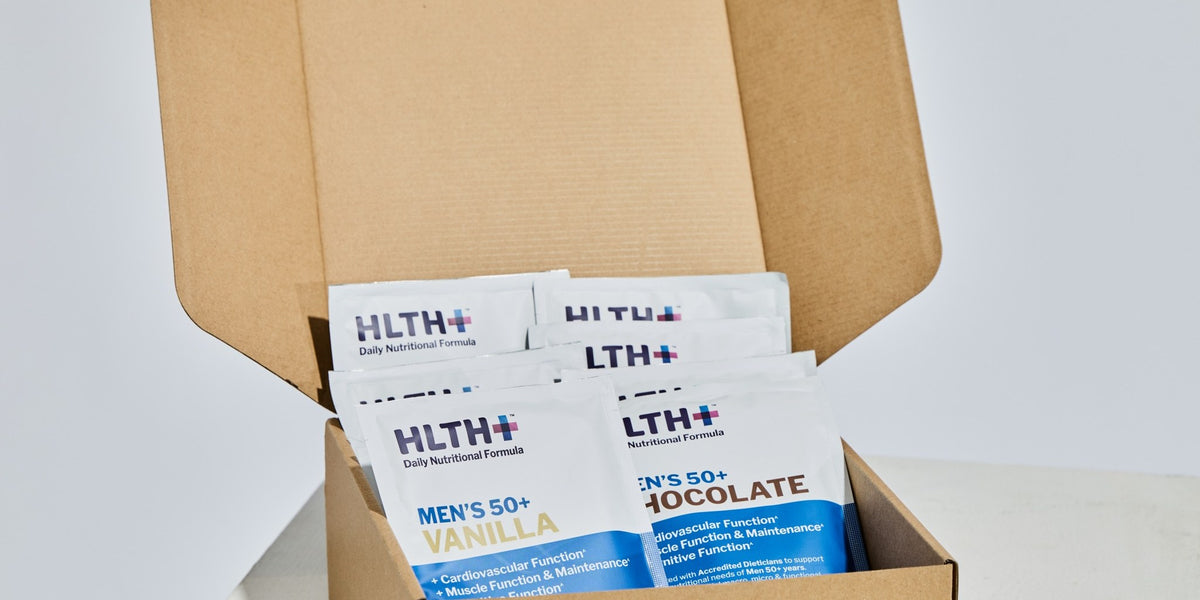
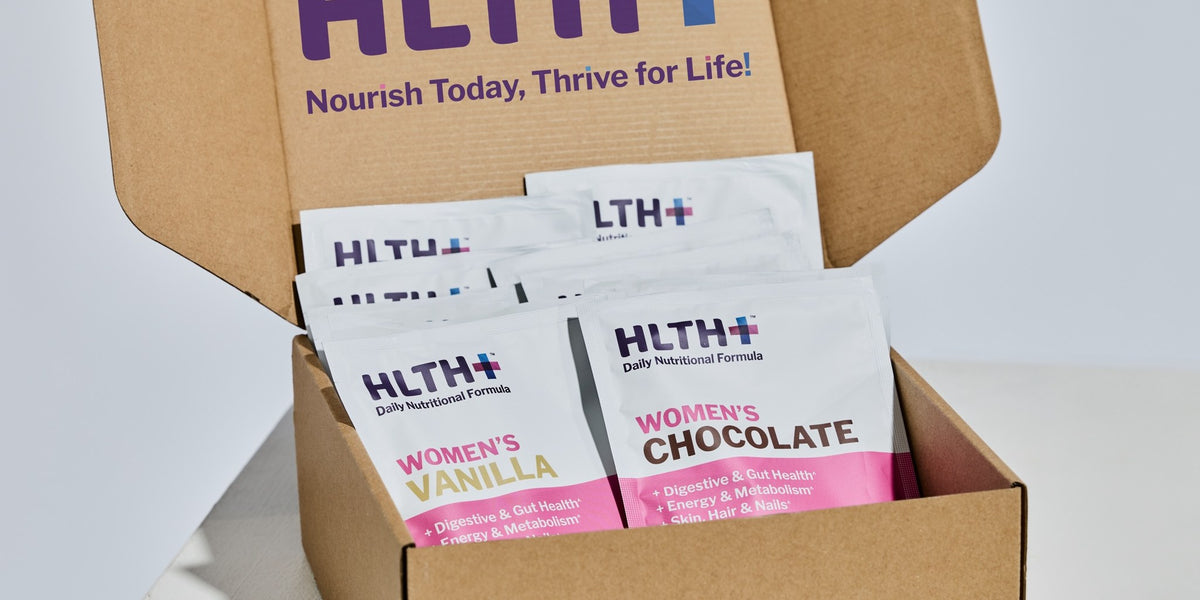
HLTH+ is not designed as a meal replacement, because it is built to complement a food-first approach; it works fine as a healthy snack or to tie you over. It sits in a different category from both a nutrition top-up and a liquid breakfast: a Formulated Supplementary Food that goes beside food.
One 55g Women's sachet carries 30g protein per serve, 7g dietary fibre, 5g collagen, 60mg DHA and 10 billion CFU Lactobacillus Plantarum Postbiotic alongside prebiotics, at 1.5g of sugar with none added and 223 calories. The Men's sachet holds the same 30g of protein at 1.7g of sugar and 248 calories, and every sachet carries a balanced multivitamin profile. Protein contributes to the maintenance of muscle mass, and dietary fibre contributes to regular laxation, as part of a healthy diet involving a variety of foods.
Counted across protein, dietary fibre, vitamins, minerals, collagen and DHA, one serve carries 30 essential daily nutrients, dosed by sex and life stage across Women's, Women's 50+, Men's and Men's 50+, formulated by Accredited Dietitians to the Nutrient Reference Values published in 2006 by the National Health and Medical Research Council, the Australian Government Department of Health and Ageing and the New Zealand Ministry of Health. Sustagen's own panel carries the standard footnote, "percentage daily intakes are based on the average adult diet of 8700 kJ"; that figure is a labelling reference value set above what the Nutrient Reference Values actually recommend for most adults, so a formula built to it over-delivers calories to the individual.
It is Australian-owned and Australian-made in facilities complying with Good Manufacturing Practice, dairy-free and gluten-free, carries a 5-star Health Star Rating, and holds hundreds of reviews across the range. It sells at hlthplus.com at RRP $6.00, or $5.10 a day on a 28-serve subscription at $142.80, with free shipping on orders over $100 and no lock-in, and through Amazon AU and Chemist Warehouse online.
Allergen line: contains soy. If Sustagen was recommended by a doctor or dietitian, keep taking it and raise any change with them, not a website.
Sustagen alternatives covers the routes people take when the everyday tin is what they want to replace, and Sustagen vs Ensure covers the clinical comparison for a reader with a Hospital Formula tin on the bench. High-protein breakfast options sets out a genuinely protein-forward morning from whole foods.
See what your current stack is not giving you. The 30-second ✦ Find My Formula quiz is built to show the gaps your existing tin or carton leaves, rather than to sell you another one.

Frequently Asked Questions
Is Sustagen the same as Up & Go?
No: Sustagen Everyday is a nutritional supplement drink, a 15g powder stirred into 175mL of reduced fat milk and described by the brand as "an everyday nutrition top-up" (retrieved 22 September 2026). Up & Go is a liquid breakfast, a ready-to-drink carton meant to stand in for the meal itself. They are different categories with different jobs.
Which has more protein, Sustagen or Up & Go?
Sustagen Everyday publishes 3g of protein per 15g serve of powder, rising to 9.5g once the directed 175mL of reduced fat milk is added, most of it from the milk (retrieved 22 September 2026). Sanitarium's own Up & Go panel could not be retrieved when this page was written, so no figure is printed here; check the current carton.
Is Up & Go a meal replacement?
That is not established here, because Sanitarium's own published material could not be retrieved on the day. What is established is that Sustagen Everyday is not one: the brand's own wording describes it as a top-up, not a meal replacement, and only the separate Hospital Formula range carries that description.
Can I drink Sustagen or Up & Go every day if I'm well?
Nothing stops you, but read the current label against what you actually need. Sustagen Everyday's powder carries 3g of protein and no dietary fibre row before milk is added (retrieved 22 September 2026), so most of its nutritional value depends on the milk you supply. Check any liquid breakfast's own panel the same way before making it a daily habit.
What is a good alternative if neither Sustagen nor a liquid breakfast is what I actually need?
A Formulated Supplementary Food such as HLTH+ sits in a different category again: not a meal replacement, but built to complement a food-first approach, with 30g protein and 7g dietary fibre in a 55g sachet. Sustagen alternatives covers the other routes in more detail.

Leave a comment
This site is protected by hCaptcha and the hCaptcha Privacy Policy and Terms of Service apply.