

What Does The Lady Shake's Own Label Actually Say?
The Lady Shake's own label carries no side-effect warning of any kind; what it carries is an ingredient list, and that list is where a genuine digestive reaction would come from. Search "Lady Shake side effects" and much of what comes back is forum chatter and testimonial threads, none of it checkable. The label is, so start there.
If you are part-way through your first pack and something feels off, the worry is usually whether the shake itself is the problem or whether it is a normal adjustment. This page reads the published label and FAQ for what could actually cause a reaction, with the general facts on each ingredient cited to a primary health source.
Per 56g serve, The Lady Shake's published panels range from 28.4g to 30.2g protein, 3.2g to 8.9g dietary fibre and 1.9g to 7.1g sugars depending on flavour (Chocolate: 30.2g protein, 6.4g fibre, 2.2g sugars; their nutrition page, read in full 2 September 2026 and re-checked 22 September 2026). The protein is milk-derived, milk protein isolate and whey protein isolate, sweetened with steviol glycosides and thaumatin, and every flavour carries 168 million CFU of added probiotics per serve. Milk and soy (as soy lecithin, an emulsifier) are both declared in the ingredient list.
Collagen Peptides appear in the core range's protein blend, though no gram figure is published for them. A separate product, The Lady Shake Collagen, is sold alongside the core range with its own label; read the label facts on that one here. No DHA or other omega-3 figure appears on any of the published panels.
If you want the fuller side-by-side against HLTH+, protein, fibre, sugar and the rest, our full Lady Shake review carries the whole table. This page has a narrower job: reading the label for what could actually cause a reaction.
What Category Is The Lady Shake, and Why Does That Change What Counts as a "Side Effect"?
The Lady Shake is marketed and sold as a meal replacement, not a snack or a top-up. That matters for reading its label, because a formulated meal replacement is defined in the Food Standards Code (Standard 2.9.3) as "a food for sale that is specifically formulated as a replacement for one or more meals of the day, but not as a total diet replacement." The same Standard sets a composition floor for the category: at least 12g protein and 850 kJ per serve, plus a minimum share of the listed vitamins and minerals.
That design is also why the effects worth checking are digestive-adjustment ones, not warning-label ones: a product built to replace a meal in one serve carries a meal's worth of fibre, protein and micronutrients in that serve. None of that is a defect in the product; it is the category doing what it says on the label.
Can the Fibre in The Lady Shake Cause Bloating?
Short answer: not the fibre itself, the jump. Dietary fibre is one of the genuinely useful things on this label, up to 8.9g in some flavours, but the gut has to adjust to a fibre increase and it does not do that instantly.
The Better Health Channel is direct about it: "a sudden switch from a low-fibre diet to a high-fibre diet may lead to some abdominal pain and increased flatulence (wind)." Their advice is equally direct: "stick to the recommended intake and slowly introduce fibre into the diet", rather than jumping straight to a full daily serve.
That matters more if your gut is already working differently than usual. A GLP-1 medicine slows gastric emptying and gut motility as part of how it works (Müller et al., Molecular Metabolism, 2019), so a sudden fibre increase on top of that is a timing question, not a flaw in the ingredient. The baseline is often low to begin with: in one study, people on GLP-1 medications averaged 14.5g of fibre a day against the 28g the study used as the recommendation (Frontiers in Nutrition, 2025), so a serve carrying up to 8.9g is a large step relative to that.
The sweeteners on the label are steviol glycosides and thaumatin, listed as natural sweeteners; no sugar alcohol (sorbitol, xylitol, erythritol) appears in the ingredient list. So the ingredients to read against on this label are the fibre, the probiotics and the milk protein.
Wider context for the jump: over 90% of Australian adults do not meet dietary guidelines (AIHW), which is the baseline a sudden fibre increase usually lands on.
Could the Probiotics Cause Bloating Too?
Possibly, and separately from the fibre. Healthdirect says plainly that people taking probiotics can have side effects "such as bloating, upset stomach or lots of gas," because "your gut microbiome changes when you take probiotics," and that "these side effects are most common in your first week of taking probiotics."
The Lady Shake carries 168 million CFU of added probiotics per serve, so if the first few days feel different, that matches what healthdirect describes for the first week on any probiotic rather than a hidden problem with the product. Healthdirect's own advice if it does not settle is to speak to a doctor, who can adjust the dose.
Is The Lady Shake a Problem If You're Lactose Intolerant?
Possibly, and the label tells you plainly. The Lady Shake's protein comes from milk protein isolate and whey protein isolate, milk is declared in its ingredient list, and each flavour panel publishes a lactose figure: from 0.2g (Choc Honeycomb) to 1.5g (Cookies & Cream) per serve across the ten flavours read 22 September 2026, with Fruit Muesli listing 2.4g on an earlier read (13 August 2026).
Healthdirect lists the symptoms of lactose intolerance as wind, bloating, abdominal pain and cramps, nausea and diarrhoea, adding that "the symptoms usually happen soon after you eat or drink products containing lactose" and that symptoms "will depend on how much of the milk or dairy product you eat." So the lactose row on the flavour you are buying is the one to read, not the protein row. How much lactose whey protein carries in general is covered in our piece on whether whey protein contains lactose.
Soy is the second allergen declared, present as soy lecithin, an emulsifier, worth flagging separately for anyone avoiding soy specifically rather than dairy.
How to Reduce the Chance of a Reaction When You Start
None of this is specific to The Lady Shake; it is what the primary sources above say about adding a new source of fibre or probiotics to your diet in one hit. Three things lower the odds of an uncomfortable first week:
- Build up to the full 56g serve rather than starting at it. The Better Health Channel's advice for any fibre increase is to introduce it slowly and stick to the recommended intake.
- Drink water alongside it, not instead of your normal fluids. The same source notes that fibre not accompanied by enough fluid may cause abdominal discomfort or constipation.
- Give the probiotic a week. Healthdirect says bloating and gas are most common in the first week; if they are still bothering you after that, its advice is to speak to a doctor rather than push through.
What Does The Lady Shake's Own FAQ Say About Side Effects?
Not much, and that is itself worth knowing. Their published FAQ page (read 22 September 2026) carries no dedicated side-effects section, no list of possible reactions and no bloating or digestion callout of its own.
The closest line reads: "we recommend checking with a medical professional if you are taking any medication or have any health issues to ensure our product is right for you." That is a general caution rather than a list of known effects, so it does not tell you anything the label itself does not already cover.
More on keeping your nutrition steady while your digestion is more sensitive than usual → nutrition support if you're eating less than you used to.
Who Should Check With a Doctor Before Starting The Lady Shake?
The same people who should check before starting any meal-replacement product:
- anyone on prescribed medication (The Lady Shake's own FAQ line above says the same)
- anyone with an existing digestive condition
- anyone pregnant or breastfeeding
- anyone whose appetite or digestion has already changed for medical reasons.
That last group is worth naming directly, because it overlaps with who is searching this question. If a GLP-1 medicine has already slowed your gut down, layering a new fibre and protein source on top is exactly the kind of change worth mentioning to whoever prescribes it, not because The Lady Shake is unusual, but because any dietary change is worth flagging in that situation.
If you are weighing it against other meal-replacement shakes rather than against a daily-nutrition product, our explainer on what meal replacement shakes actually are covers the category, and The Man Shake review reads the version marketed to men on its own label, which publishes a comparable panel per 56g serve (30.9g protein, 7.4g dietary fibre, their product page, 22 September 2026).
Where HLTH+ Fits, If Dairy Is What You're Checking For
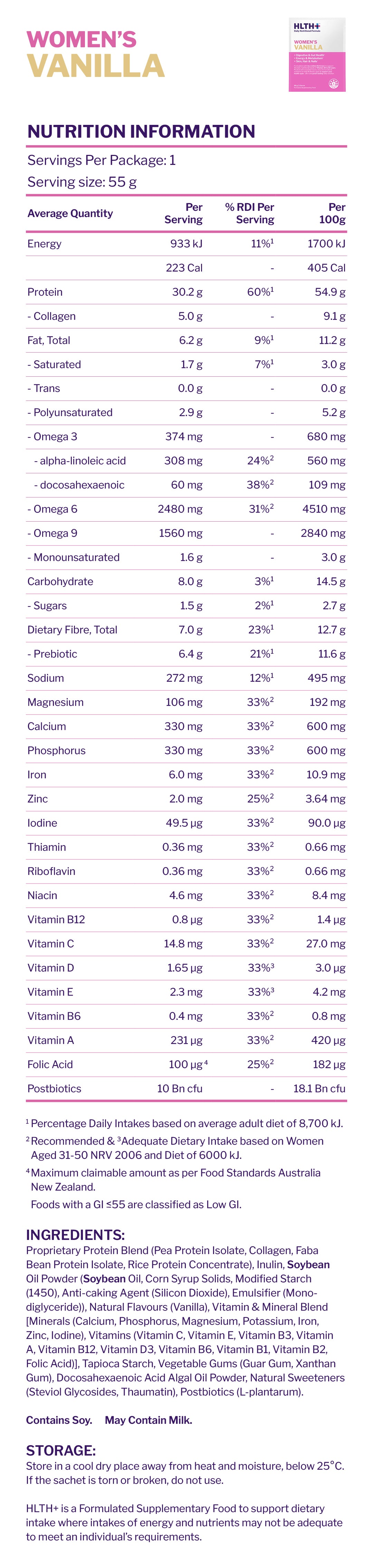
If the milk line on the label is the one you are reading for, HLTH+ sits on a different axis: a 55g sachet is dairy-free and gluten-free, with 30g protein and 7g dietary fibre in the same serve, formulated to the Nutrient Reference Values published by the National Health and Medical Research Council, the Australian Government Department of Health and Ageing and the New Zealand Ministry of Health. It is a Formulated Supplementary Food eaten beside meals, so it answers a different question from the one this page set out to read.
Frequently Asked Questions
Does The Lady Shake cause bloating?
Its label lists no side effects, only ingredients. Dietary fibre, up to 8.9g depending on flavour, can cause abdominal pain or wind if you increase your intake suddenly, according to the Better Health Channel, which recommends introducing fibre gradually. That is a fibre-adjustment effect common to any high-fibre food, not something specific to this product.
Is The Lady Shake dairy-free?
No. Its protein is milk protein isolate and whey protein isolate, milk and soy are declared in its ingredient list, and each flavour panel publishes a lactose figure, from 0.2g to 2.4g per serve depending on flavour. Anyone avoiding dairy or lactose should read that row on the flavour they are buying.
What does The Lady Shake's own FAQ say about side effects?
Their published FAQ carries no dedicated side-effects section. The closest line reads: "we recommend checking with a medical professional if you are taking any medication or have any health issues to ensure our product is right for you." It is a general caution, not a list of known reactions.
Is it safe to have The Lady Shake alongside prescribed medication?
The Lady Shake's own guidance is to check with a medical professional first if you are taking any medication or have a health issue. That is sound general advice for any new shake or supplement, and it is worth raising specifically if your appetite or digestion has already changed for medical reasons.
What's the difference between The Lady Shake and The Lady Shake Collagen?
The Lady Shake is the core meal-replacement range; Collagen Peptides appear in its ingredient list without a published gram figure. The Lady Shake Collagen is a separate, dedicated product with its own label and its own published panel, so the two should not be confused when you're comparing figures.
This page is general information, not medical advice. Decisions about any medication belong with your doctor.
Not sure what your current stack is missing? The 30-second ✦ Find My Formula quiz shows what it isn't giving you.
Leave a comment
This site is protected by hCaptcha and the hCaptcha Privacy Policy and Terms of Service apply.